معرفی
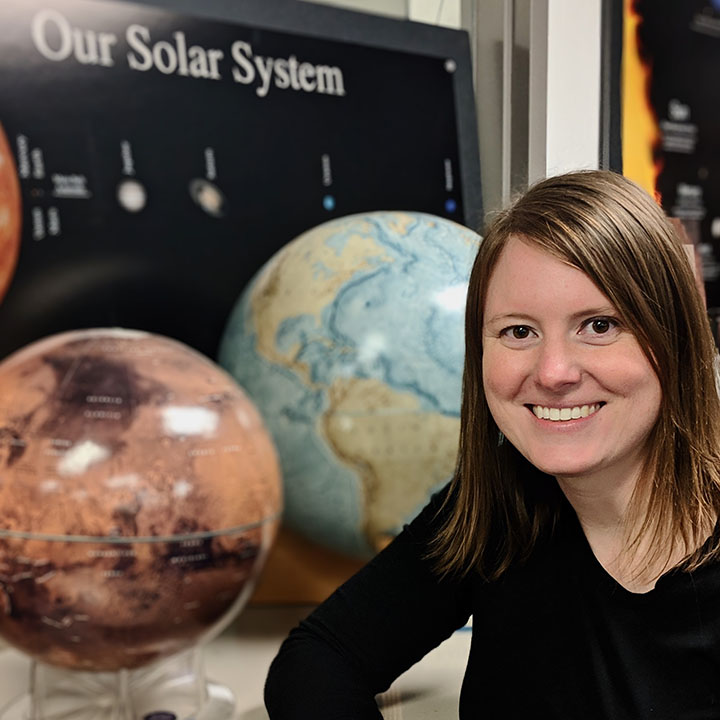
James Wray is a Professor at the Georgia Institute of Technology in the School of Earth and Atmospheric Sciences, where he leads the Astrogeology & Remote Sensing (ARES) research group. His work focuses on planetary surface processes across our solar system, with special emphasis on Mars and icy moons. He holds a Ph.D. in Astronomy from Cornell University (2010) and an A.B. in Astrophysical Sciences from Princeton University (2006).
Education:
- Ph.D. in Astronomy, Cornell University, 2010
- M.S. in Astronomy, Cornell University, 2009
- A.B. in Astrophysical Sciences, Princeton University, 2006
Dr. Wray's research investigates climate history, aqueous environments, and surface processes on planetary bodies using spacecraft remote sensing. His group studies Martian hydrology, icy moon oceans (e.g., Europa), spectral analysis of surface compositions, and planetary analog environments. Key methodologies include hyperspectral imaging, geomorphological mapping, and terrestrial field studies.
His recent publications reveal trends in Martian geology including volcanic resurfacing, subsurface sediment mobilization, and climate-modulated surface features. Research frequently combines orbital data analysis with terrestrial analog studies to constrain planetary aqueous processes and cryosphere evolution.
Scientific Awards:
- Georgia Tech Early Career Research Award, 2018
- Georgia Tech Sigma Xi Young Faculty Award, 2015
- Shelley Award for Graduate Research in Astronomy, Cornell University, 2010
- Fannie and John Hertz Foundation Fellowship, 2006
- NSF Graduate Research Fellowship, 2006
Dr. Wray actively advises graduate students and postdoctoral researchers through the ARES group ("cosmic Wrays"). His team collaborates extensively with NASA missions including Mars Reconnaissance Orbiter and Curiosity rover science teams. Current research involves developing instrumentation for future planetary missions and interstellar object characterization.