معرفی
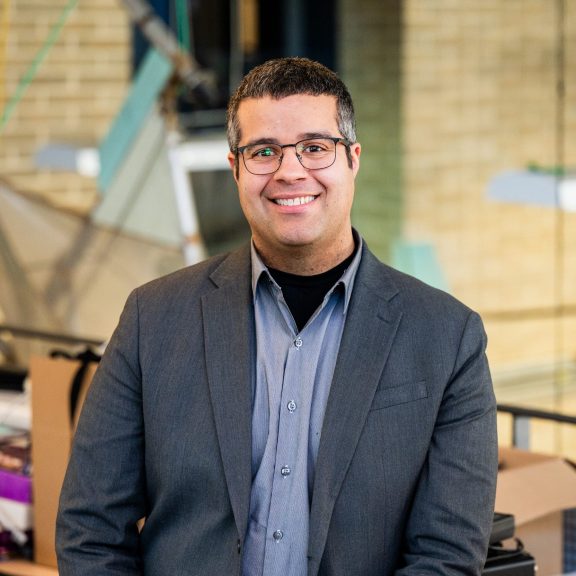
Jackson Kulik is an Assistant Professor in the Mechanical and Aerospace Engineering Department at Utah State University's College of Engineering. He leads the Dynamics, Control, and Estimation (DyCE) Lab and is part of the Autonomy, Robotics, Control, and Optimization (ARCO) Group, focusing on cislunar astrodynamics, rendezvous operations, and space situational awareness.
Education:
- PhD in Applied Mathematics, Cornell University, 2024. Dissertation: "Linear and Multilinear Methods for Guidance, Navigation, and Control of Satellite Formation Flight".
- BS in Mathematics, Texas Tech University, 2020.
Dr. Kulik's research centers on advanced guidance, navigation, and control systems for space applications, leveraging higher-order tensor methods for partial derivatives and statistical moments. His work spans astrodynamics, state estimation, and trajectory optimization with emphasis on cislunar navigation, spacecraft proximity operations, and orbital uncertainty modeling.
Recent publications (2024-2025) reveal a strong focus on linear covariance analysis fidelity, non-Gaussian uncertainty propagation, and reachable set theory for spacecraft dynamics. These works integrate tensor mathematics with practical space mission challenges, particularly in satellite formation flight and space domain awareness.
Scientific Awards:
- DOD NDSEG Fellowship (2021)
Dr. Kulik mentors five graduate students including PhD candidates Alex Nelson (RPO/Cislunar GN&C), Braden Hastings (Situational Awareness), and Allan Lyon (stochastic navigation), plus Master's student Zack Fraser (GN&C engineering). His research is supported by Department of Defense funding, building on his NDSEG Fellowship background.
The DyCE Lab operates within USU's ARCO Group, developing novel mathematical frameworks for space system dynamics and control. Current projects address cislunar navigation challenges, spacecraft rendezvous algorithms, and space object tracking using tensor-based statistical methods.