معرفی
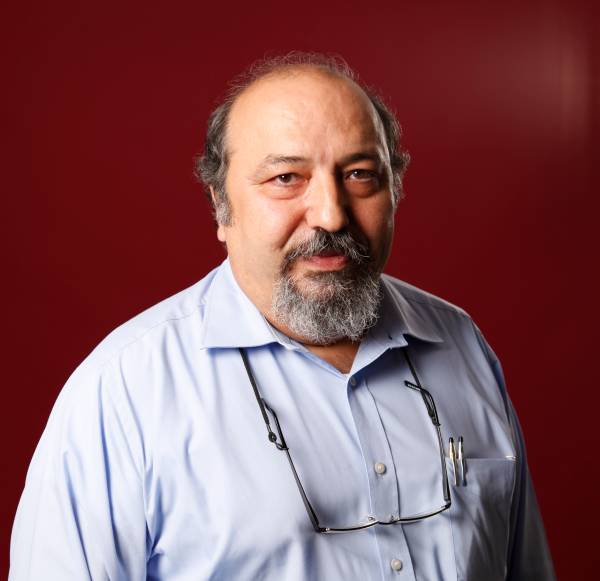
Professor Izzet Kale serves as the Head of the Department of Engineering at the University of Westminster and Director of the Applied DSP and VLSI Research Group, which he founded in the late 1980s. His leadership spans academic administration, cutting-edge research, and extensive industry collaboration with European, US, and Japanese corporations.
Professor Kale's research portfolio is exceptionally diverse, spanning digital and analogue signal processing, mixed-signal silicon circuit design (both synchronous and asynchronous), sensor networks, GNSS receivers, biomedical signal processing, satellite on-board processing, and communication systems. His current research focuses on low-power DSP algorithms and devices applicable across communications, GNSS, sensors, and biomedical industries, with particular emphasis on Internet of Things applications. He leads innovative work in sensor networks for ground monitoring, UAV-based environmental sensing, and wearable health devices, while collaborating with the European Space Agency on efficient low-power reconfigurable channeliser algorithms for next-generation satellite systems.
His publication record demonstrates remarkable consistency and impact across multiple domains, with research trending toward increasingly integrated solutions that bridge hardware design, signal processing algorithms, and real-world applications in healthcare, environmental monitoring, and satellite communications. Recent work shows particular strength in biomedical signal processing (especially ECG analysis), secure low-power circuit design, and advanced GNSS interference mitigation techniques.
Professor Kale has served extensively in professional capacities including IEEE UK&I Section Committee membership for multiple years and currently serves as Chapter Chair for the CAS and I&M Chapters. He has contributed significantly as Associate Editor, Reviewer, and Special Session Organizer for IEEE and RIN journals, while maintaining a 100% track record in successful delivery of industry-sponsored research contracts.
His academic mentorship has been substantial with 31 PhD students successfully graduated and 7 currently under supervision. His research has been supported by diverse funding sources including Sabancı University Nanotechnology Research Center, Defence and Security Accelerator, European Commission, British Council, and European Space Agency, reflecting the broad applicability and impact of his work across multiple sectors.
The Applied DSP and VLSI Research Group under his leadership has established itself as a center of excellence for next-generation product-oriented applied research, consistently translating theoretical advances into practical implementations through strong industry partnerships and interdisciplinary collaboration.