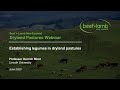
معرفی
Dr. Hossein Alizadeh is a Senior Research Officer in the Department of Agricultural Sciences at Lincoln University, New Zealand. With expertise in plant pathology and soil microbiology, he focuses on sustainable agricultural solutions through plant-microbe interactions. His research spans agricultural biotechnology, microbial ecology, and biological control with practical applications for modern farming challenges.
Dr. Alizadeh earned his PhD from the University of Canterbury, Christchurch, New Zealand. His educational foundation supports his innovative work in sustainable agriculture and plant-microbe interactions.
His primary research focuses on two critical areas: enhancing plant nitrogen uptake to reduce fertilizer waste (initially funded by MBIE and now supported by industry partners), and developing methods to increase plant drought tolerance. As a biotechnologist, he investigates how microbes and plants interact 'in planta' to create commercial products for sustainable land-based production. His work addresses urgent agricultural challenges including climate change impacts, consumer resistance to agrichemicals, and waterway pollution concerns.
Analysis of his recent publications reveals a strong emphasis on Trichoderma applications for biological pest control, drought resilience in crops, and fungal volatile organic compounds for plant protection. His research demonstrates interdisciplinary approaches combining microbiology, plant physiology, and sustainable agricultural practices to develop practical farming solutions.
- Methods and compositions comprising Trichoderma Hamatum (Patent, 2025)
Dr. Alizadeh has supervised postgraduate research including the completed project 'Interactions between Escherichia coli and the New Zealand native plants Leptospermum scoparium and Kunzea robusta.' His research has received funding from the Ministry for Business, Innovation and Employment and industry partners focused on sustainable agricultural innovations. Notably, his team demonstrated that native plants including northern rātā and swamp mānuka reduced Escherichia coli numbers in soil by 90% compared with ryegrass.
His laboratory research centers on plant-microbe interactions, particularly involving Trichoderma species applications in agriculture. Dr. Alizadeh collaborates extensively with researchers from ESR, the University of Canterbury, Ngaa Muka Development Trust, and Matahuru Marae in Waikato, demonstrating strong community and academic partnerships.