معرفی
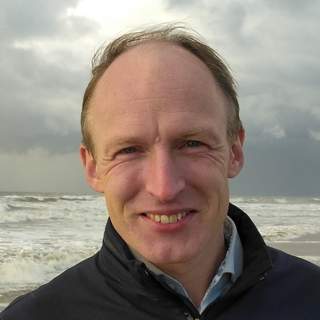
Hil G.E. Meijer is an Associate Professor in the Department of Applied Mathematics at the University of Twente, Faculty of Electrical Engineering, Mathematics and Computer Science. He is also affiliated with the TechMed Centre, reflecting his interdisciplinary work in mathematics, artificial intelligence, and medical technology. He currently serves ad interim as Programme Director for Applied Mathematics and has chaired its Programme Committee from 2017 to 2023.
- PhD in Codimension 2 Bifurcations of Iterated Maps, Utrecht University (2006)
- Senior University Teaching Qualification (SUTQ), 2022
- Basic University Teaching Qualification (UTQ), 2011
His research lies at the intersection of mathematical modelling, nonlinear dynamics, and clinical neuroscience. He focuses on dynamical systems theory applied to neural networks, epilepsy, brain stimulation, and ion dynamics under metabolic stress. His work contributes to UN Sustainable Development Goals in Health and Well-being and Education. He teaches courses in Differential Equations, Nonlinear Dynamics, and Mathematical Neuroscience, including the national Mastermath course.
The recent publications show a strong trend toward biophysical modelling of neural systems, integration of AI with dynamical systems, and clinical translation in epilepsy and anesthesia. His work combines theoretical mathematics with data-driven and simulation-based approaches to understand brain function and dysfunction.
- First Prize DSWeb 2019 Contest – For contributions to dynamical systems software
- Onderwijsprijs 2017 BMT – Teaching excellence in Biomedical Technology
- Parel Honorary Award 2021 – Recognizing impactful interdisciplinary research in brain health
Hil Meijer actively supervises BSc and MSc students, leads research projects in computational neuroscience, and collaborates with clinical teams. He has organized national workshops (NDNS+) and contributed to the development of tools like MatCont for bifurcation analysis. He is involved in strengthening project-based mathematical modelling in undergraduate education. His leadership in curriculum development and research supervision underscores his central role in both academic and clinical innovation.