معرفی
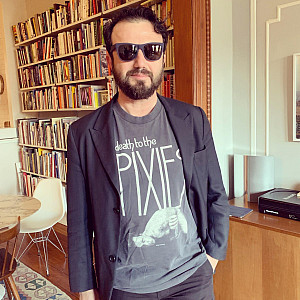
Hakan Topal is a Professor of New Media and Art+Design at Purchase College, State University of New York, where he teaches in the School of Film and Media Studies within the New Media department. Originally from Ankara, Turkey, he has been living and working in Brooklyn, NY since 2000, maintaining a dual career as both an academic and practicing artist.
Topal earned his educational credentials from prestigious institutions: a B.S. in Engineering and an M.S. in Gender and Women's Studies from Middle East Technical University in Turkey, followed by a Ph.D. in Sociology from the New School for Social Research. His academic foundation in both technical and social sciences informs his interdisciplinary approach to art and research.
His research spans the intersection of art, technology, and social inquiry, with particular focus on geopolitical and ecological contexts. Topal's documentary-based conceptual practice combines artistic and social research, archaeology, and diverse media including text, photography, video, performance, architectural interventions, and installations to reveal interconnected layers of social reality. Southwest Asia—particularly Anatolia and Mesopotamia—has been central to his work due to its unique archaeological, historical, geopolitical, and ecological significance.
His recent publications in Hyperallergic demonstrate his critical engagement with contemporary art institutions and cultural heritage, reflecting broader themes in his artistic practice that examine borders, migration, ecological destruction, and state power. These works form part of a consistent trajectory examining how cultural institutions operate within complex geopolitical frameworks.
Topal has received significant recognition for his contributions:
- Doris and Carl Kempner Distinguished Professor (2023-25)
- TAPROOT Fellows (2025-26)
As an active educator and artist, Topal has presented his work at leading international venues including the Istanbul Biennials, TBA21 in Vienna, Kunst-Werke in Berlin, ZKM Center for Art and Media in Karlsruhe, MoMA PS1, and the Turkish Pavilion at the Venice Biennial. His work frequently emerges from community engagement in high-alert zones along borders and areas of ecological significance, using artistic practice as a form of critical inquiry and social engagement.
His notable projects include Still Life (2012-16) documenting the Roboski massacre, Soil.Water.Ash. (2014, 2022) addressing coal power plant workers' resistance, and The Golden Cage (2022) exploring migration through the lens of an endangered bird species, demonstrating his consistent focus on the relationship between state power, borders, and marginalized communities.