معرفی
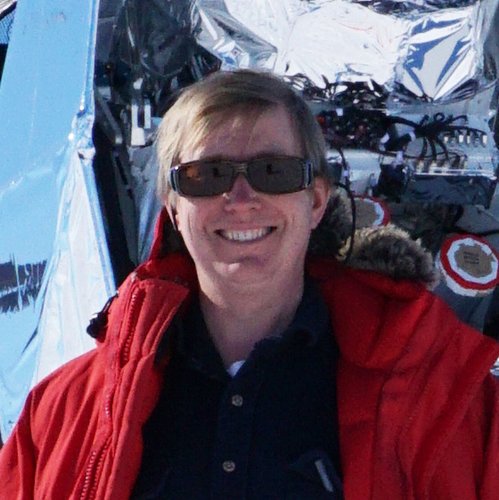
Gregory S Tucker is Professor of Physics at Brown University, where he joined the faculty in 1997. A graduate of MIT with a PhD from Princeton University, he previously completed postdoctoral work at the University of British Columbia and served as a physicist at the Harvard-Smithsonian Center for Astrophysics. He leads the Observational Cosmology and Astrophysics group at Brown, which develops specialized instrumentation for cutting-edge research in cosmology and astrophysics.
Dr. Tucker's educational background includes a BS from Massachusetts Institute of Technology (1985), MA from Princeton University (1987), and PhD from Princeton University (1991). His academic journey has positioned him at the forefront of observational cosmology research.
Professor Tucker's research spans multiple frontiers in cosmology and astrophysics. His work focuses on measuring the universe at very large scales through cosmic microwave background (CMB) observations and studying the earliest galaxies. He has made significant contributions to projects like the Wilkinson Microwave Anisotropy Probe (WMAP), the Balloon-borne Large Aperture Submillimeter Telescope (BLAST), and its polarimetry extension BLASTPol. More recently, his group has developed techniques using 21 cm emission of neutral hydrogen to study dark energy and has expanded into exoplanet research with projects like the Exoplanet Climate Infrared Telescope (EXCITE). His research group specializes in developing novel instrumentation for balloon-borne, ground-based, and space-based observations.
The analysis of Professor Tucker's recent publications reveals a consistent focus on precision cosmological measurements, particularly in CMB polarization and interferometric techniques. His work spans theoretical modeling, instrument development, and data analysis, with strong emphasis on overcoming systematic errors in observations. The publications demonstrate expertise in both theoretical cosmology and practical instrumentation design, particularly for balloon-borne experiments.
- National Academy of Sciences National Research Council Senior Fellowship (2002)
- Gruber Prize in Cosmology (2012)
- Breakthrough Prize in Fundamental Physics (2018)
- Giuseppe and Vanna Cocconi Prize (2019)
Professor Tucker has secured significant funding from NASA and NSF for his research, serving as Principal Investigator for projects including the EXoplanet Climate Infrared TElescope (EXCITE) and simulations of systematic effects in interferometry for CMB studies. His group trains students in multiple aspects of experimental cosmology, from simulation development to instrument construction and data analysis. Current projects include the development of the Millimeter-wave Bolometric Interferometer (MBI), the QU Bolometric Interferometer for Cosmology (QUBIC), and the E and B Experiment (EBEX).
The Observational Cosmology and Astrophysics group operates multiple experimental platforms, including balloon-borne telescopes like BLAST and BLASTPol that have conducted Antarctic flights, and is developing new instrumentation like EXCITE for exoplanet atmospheric studies. The group maintains strong collaborations with international partners on major cosmological projects.