
معرفی
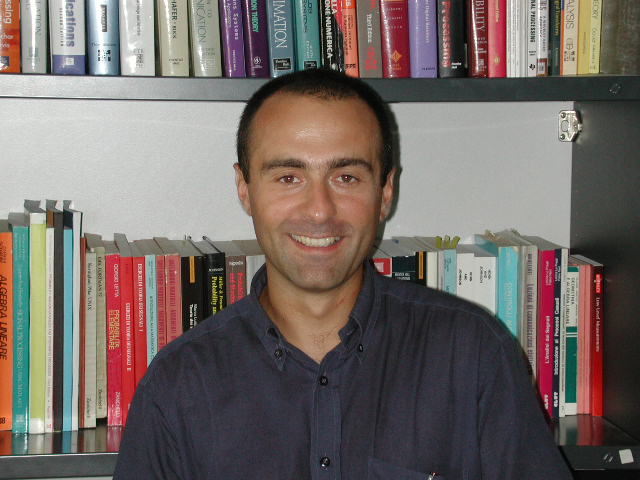
Giulio Colavolpe is a Full Professor of Telecommunications at the Department of Engineering and Architecture, University of Parma, Italy, where he coordinates the SPADiC (Signal Processing for Advanced Digital Communications) research group. He received his Laurea (cum laude) in Telecommunications Engineering from the University of Pisa in 1994 and his PhD in Information Technologies from the University of Parma in 1998. His academic career includes positions as Researcher (1999-2002), Associate Professor (2002-2016), and Full Professor (2016-present) at the University of Parma, with a visiting period at Institut Eurecom in France (2000).
Professor Colavolpe's research focuses on digital communications systems, adaptive signal processing, iterative detection techniques for memory channels, channel coding, and information theory. His work has significant applications in satellite communications, optical systems, and wireless networks. He has coordinated numerous research projects funded by the European Space Agency, the Italian Ministry of Education, Universities and Research, and international telecommunications companies. His recent publications demonstrate expertise in OTFS modulation, phase noise channels, time-frequency packing, and non-terrestrial networks.
His publication record includes two authoritative books (Wireless Communications: Algorithmic Techniques and Detection Algorithms for Wireless Communications), over 80 journal articles, more than 120 conference papers, and 21 industrial patents. His work on phase noise channels, time-frequency packing, and satellite communications has been particularly influential, with several papers evaluated as 'Excellent' in the Italian VQR assessment.
- Best paper award at SoftCOM'05
- Best paper award for Optical Networks and Systems at ICC 2008
- Best paper award at ASMS&SPSC 2010
- Included in World's Top 2% Scientists by Stanford University
Professor Colavolpe has served as an Editor for IEEE Transactions on Wireless Communications, IEEE Wireless Communications Letters, and IEEE Transactions on Communications. He has supervised 12 PhD students and over 100 Master's theses, and currently supervises one PhD student. His SPADiC research group maintains collaborations with leading institutions including USC, University of Michigan, CNIT, and Politecnico di Torino.


