معرفی
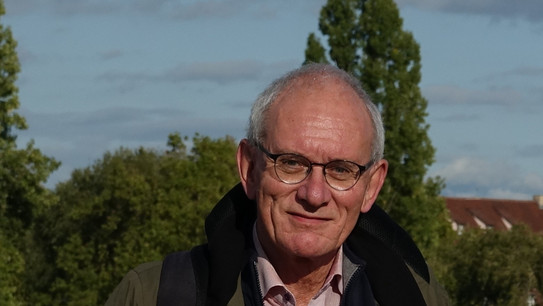
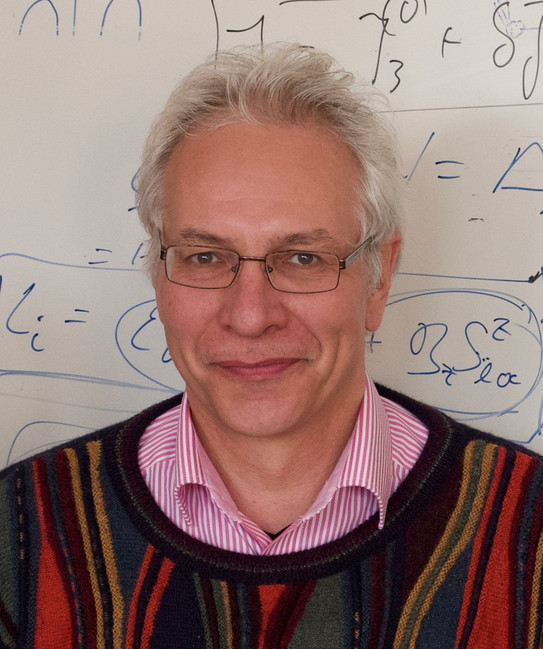
Prof. Dr. Frithjof Anders is a faculty member in the Department of Physics at the Technical University of Dortmund, where he leads a research group in Condensed Matter Theory. His work focuses on theoretical investigations of correlated electron systems, particularly the interplay of spin and charge degrees of freedom in quantum materials under equilibrium and nonequilibrium conditions.
- University: Technical University of Dortmund
- School: Faculty of Physics
- Department: Department of Physics
- Email: frithjof.anders@tu-dortmund.de
- Office: Room P1-O2-309, Otto-Hahn-Str. 4, 44227 Dortmund
His research spans several advanced topics in theoretical condensed matter physics, including the Kondo effect in heavy fermions and quantum dots, modeling of local moments in multi-impurity systems, and theoretical simulations of laser-driven spin dynamics in quantum dot ensembles. A significant focus lies on understanding decoherence mechanisms due to spin noise and on predicting inelastic signatures in scanning tunneling spectroscopy of molecules. His group also investigates current-voltage characteristics in quantum point contacts and localized states in graphene defects.
These theoretical studies are computationally intensive and conducted in collaboration with the Collaborative Research Center TRR 160, utilizing high-performance computing resources at Forschungszentrum Jülich. The research contributes to the fundamental understanding of quantum coherence, electron correlations, and non-equilibrium phenomena in nanoscale systems.
While specific publications and awards are not listed in the provided text, his active research profile and leadership in a major DFG-funded collaborative center indicate a strong ongoing research program. He supervises research activities within his group, though no individual students are named. There is no indication of part-time status, retirement, or emeritus position.
The group is part of the broader Condensed Matter Theory (CMT) research focus at TU Dortmund, which includes multiple principal investigators working on complementary theoretical and experimental themes.