معرفی
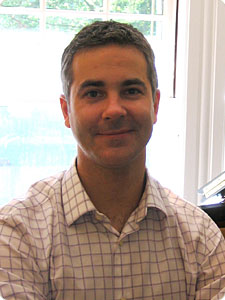
Edward E. Fenlon is a Professor of Chemistry at Franklin & Marshall College (F&M), where he has held the rank since 2016. Previously, he served as Associate Professor (2009–2016) and Assistant Professor (2003–2009). He earned his B.S. in Chemistry from St. Lawrence University (1990) and his Ph.D. in Organic Chemistry from the University of Illinois (1995), followed by postdoctoral research at Northern Kentucky University. Fenlon leads a research group focused on organic synthesis, vibrational spectroscopy, and molecular topology, with notable contributions to molecular knot design and vibrational reporters for biomolecules.
Education:
- B.S., Chemistry, St. Lawrence University (1990)
- Ph.D., Organic Chemistry, University of Illinois (1995)
Research Interests: Fenlon’s work spans organic synthesis, molecular topology, and biophysical chemistry. His lab develops vibrational probes (e.g., azides, nitriles) to study biomolecular dynamics via 2D IR spectroscopy, designs air-stable organic radicals for dynamic nuclear polarization (DNP), and explores synthetic strategies for molecular knots. He also contributes to the history of organic chemistry, including studies on the National Organic Symposium’s evolution.
Key Achievements:
- Recipient of NIH grants totaling $1.5 million for vibrational reporter research
- Over 40 peer-reviewed publications (h-index 17)
- Named to the St. Lawrence University Athletic Hall of Fame (2012)
- Executive Officer for the 2025 National Organic Symposium
Grants & Advising: Fenlon has mentored 68 undergraduate researchers, many of whom pursue careers in medicine, chemistry, and academia. His lab collaborates with institutions like the University of Maryland and MIT. Current projects include NIH-funded studies on vibrational coupling in biomolecules and NSF-supported NMR instrumentation.
Labs/Teams: His group operates within F&M’s Hackman Physical Sciences Center, utilizing advanced spectroscopic and synthetic facilities. Collaborations include work on GM3 synthase with medical researchers and knot synthesis with computational chemists.