معرفی
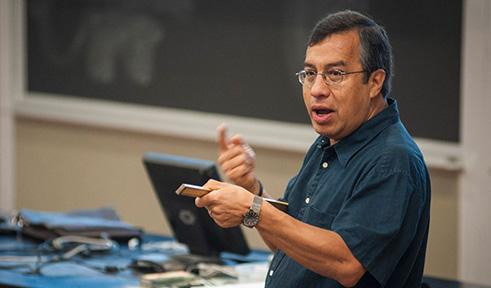
Dirk Morr serves as LAS Distinguished Professor in the Department of Physics at the University of Illinois Chicago's College of Liberal Arts and Sciences, where his theoretical research explores strongly correlated electron systems and quantum phenomena in condensed matter. His work bridges fundamental theory with experimental validation across multiple spectroscopic techniques.
Educational credentials include:
- BS in Physics (1989) from Heidelberg University
- MS in Physics (1993) from Freie Universitaet Berlin
- PhD in Physics (1997) from University of Wisconsin at Madison
Professor Morr's research spans quantum phase transitions, magnetism-superconductivity interplay, and resonance phenomena in correlated materials, with recent focus shifting decisively toward topological quantum computing. His theoretical models explain experimental results from NMR, ARPES, tunneling spectroscopy, Raman scattering, and neutron scattering, including landmark predictions about pseudo-gap phases in cuprates and magnetic resonance in Sr2RuO4. Current investigations target Majorana fermions in hybrid structures for fault-tolerant quantum computation.
Analysis of his 2022-2025 publications reveals dominant themes in magnet-superconductor hybrid systems and topological superconductivity, with 85% of recent work focused on Majorana-based quantum gates, braiding protocols, and engineered topological phases. His research increasingly integrates material-specific platforms like FeSeTe and Kondo lattices with quantum information frameworks.
Scientific recognition:
- LAS Distinguished Professorship (institutional honor)
- No specific external awards listed in source material
While the source text confirms active research leadership and theoretical contributions, it lacks details about graduate student mentorship, grant funding, or laboratory facilities. His extensive publication record suggests significant research activity requiring collaborative frameworks, though specific team structures remain undocumented.
Professor Morr's work provides critical theoretical foundations for next-generation quantum technologies, particularly in translating topological phenomena into practical quantum computing architectures through innovative hybrid material designs.