معرفی
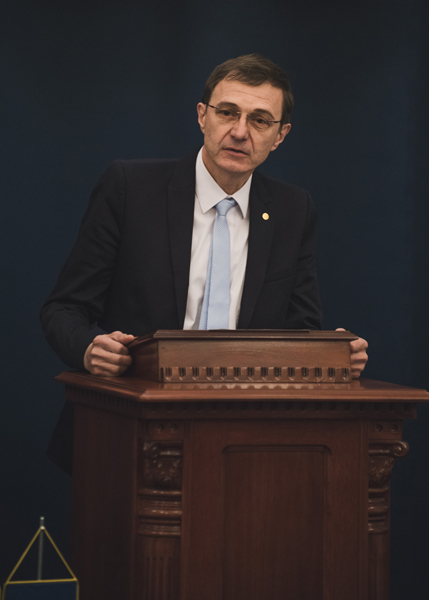
Corin Braga is a distinguished Romanian academic currently serving as Vicepresident of Babes-Bolyai University in Cluj-Napoca, Romania, a position he has held since 2020. Previously, he was Dean of the Faculty of Letters at the same university from 2008 to 2020. He is a University Professor in comparative literature since 2007 and has held numerous significant academic positions throughout his career.
His scholarly work centers on imagination studies, fictional worlds, and comparative literature. Braga has made substantial contributions to archetypology and utopian/anti-utopian studies, with publications spanning literary theory, criticism, and creative fiction in both French and Romanian. His research demonstrates a consistent focus on the theoretical frameworks of literary imagination and the structural analysis of fictional worlds across different cultural contexts.
The analysis of Braga's publications reveals a strong trajectory in the development of archetypological theory, with increasing sophistication in his approach to utopian and anti-utopian literature. His work bridges Romanian literary criticism with international theoretical frameworks, particularly in postmodern archetypology and the morphology of utopian genres. The interdisciplinary nature of his research connects literary studies with psychology, philosophy, and cultural studies.
Major Awards and Recognitions:
- Chevalier de l'Ordre des Palmes Academiques, France (2009)
- "Professor of the Year" Award of Babes-Bolyai University (2010)
- Correspondent Member of Academia Nacional de Ciencias, Buenos Aires (2012)
- Prize "I. Negoițescu" of the Apostrof cultural review for his complete works (2017)
Braga has founded and directed significant academic initiatives including the Center for Imagination Studies and the ECHINOX Journal. He also serves as Vicepresident of international organizations such as CRI2i (Centre de Recherches Internationales sur l'Imaginaire) and ALGCR (Association of General and Comparative Literature of Romania). His academic leadership extends beyond institutional boundaries to shape international scholarly conversations in comparative literature.