معرفی
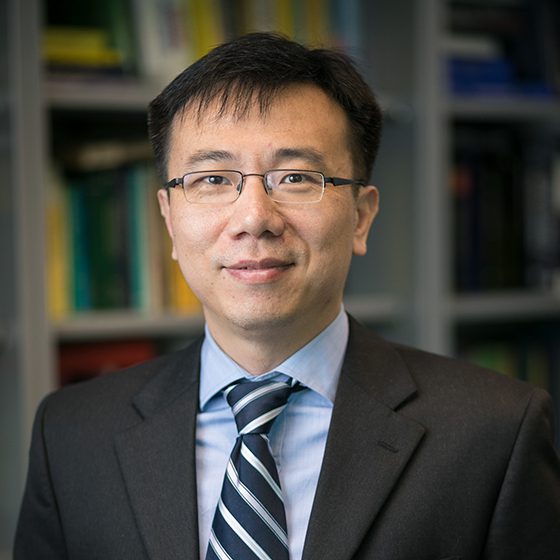
Choon Yik Tang is an Associate Professor in the School of Electrical and Computer Engineering at the University of Oklahoma, where he has been a faculty member since 2006. His academic career includes positions as Assistant Professor (2006-2013) before promotion to Associate Professor, along with previous research experience at Honeywell Laboratories and the University of Michigan.
- Ph.D. in Electrical Engineering: Systems, University of Michigan, Ann Arbor, MI, 2003
- M.S. in Mechanical Engineering, Oklahoma State University, Stillwater, OK, 1997
- B.S. in Mechanical Engineering, Oklahoma State University, Stillwater, OK, 1996
Dr. Tang's research focuses on the intersection of control theory, wireless communications, and networking. His work spans distributed computation and optimization, networked dynamical systems, control and operation of energy systems, and resource allocation in wireless networks. He has made significant contributions to wind farm control systems and residential building energy management.
Analysis of Dr. Tang's recent publications reveals a strong focus on residential HVAC control systems and building energy management, with increasing attention to model predictive control techniques and thermal dynamics modeling. His earlier work concentrated more on wind farm control systems and distributed optimization algorithms for networked systems.
- Control-Theoretic Approaches to Communication-Efficient, Distributed Convex Optimization over Wireless Networks (NSF CMMI-0900806)
- Control and Operation of Large-Scale Wind Farms in the Power System (NSF ECCS-0926038)
- Computationally Efficient Linear Transforms for Next-Generation Remote Sensing Systems (NSF ECCS-0925873)
- II-New: TurboRAN: Testbed for Ultra-Dense Multi-Band Control and Data Plane Split Radio Access Networks of the Future (NSF CNS-1730650)
Dr. Tang has advised numerous graduate students through completion of their degrees, including nine doctoral and master's students. His research has been supported by multiple National Science Foundation grants focusing on control theory applications in wireless networks and energy systems. His teaching portfolio includes courses on control systems, signals and systems, and electrical circuits.
Dr. Tang maintains an active research laboratory focused on control systems engineering with applications in energy systems and wireless networks. His team has developed innovative approaches for wind farm power control and residential building energy management.