معرفی
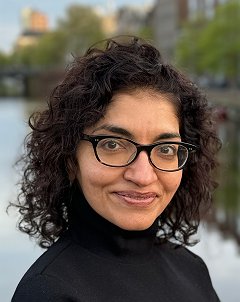
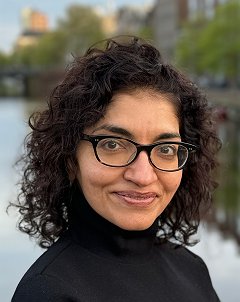
Amal Ahmed is a Professor in the Department of Computer Science at Northeastern University's College of Computer and Information Science. She is an active researcher and academic leader in programming languages, with significant contributions to type systems, compiler verification, and language interoperability. Her work bridges theoretical foundations with practical systems applications, particularly in the areas of gradual typing and secure compilation.
Dr. Ahmed's research focuses on correct and secure compilation, linking types for multi-language software, typed compilation of dependent types, semantics and logical relations, gradual typing, and safe language interoperability. Her work explores how to formally verify compilers and ensure type safety across language boundaries, with applications to modern systems like WebAssembly. She has developed novel semantic approaches to application binary interfaces and language interoperability that provide strong security guarantees.
Her recent publications show a consistent focus on formal methods for language design, with increasing attention to probabilistic programming and separation logic. She has made significant contributions to understanding how gradual typing systems can maintain parametricity and how borrowing concepts from Rust can be formally modeled. Her work on RichWasm demonstrates practical applications of her theoretical research to web technologies.
Dr. Ahmed actively serves the programming languages community through leadership roles in major conferences. She has chaired program committees, organized workshops, and mentored students through the Programming Languages Mentoring Workshop (PLMW). Her involvement spans POPL, ICFP, PLDI, SPLASH, and related conferences, where she regularly presents research and participates in steering committees.
As an educator and mentor, she has presented numerous talks on managing research, working with advisors, and navigating academic careers, particularly through the PLMW series. She has chaired doctoral symposia and served on review committees, demonstrating her commitment to developing the next generation of programming languages researchers.