معرفی
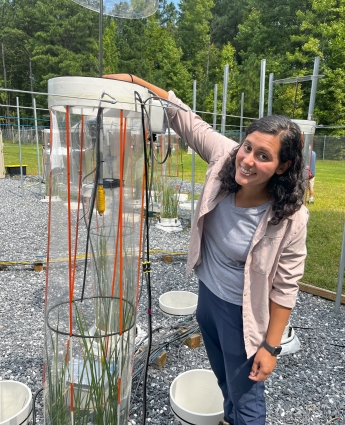
Alia Al-Haj is a Research Fellow at the Smithsonian Institution specializing in biogeochemistry and global change ecology. Her current research focuses on the Greenhouse gas Emissions NeXus (GENX) project, which investigates climate change impacts on coastal wetland biogeochemistry through both long-term stressors (sea level rise, warming) and short-term episodic events (hurricanes, heat waves, nutrient loading).
Her primary research interests encompass climate change, biogeochemistry, wetland ecology, carbon and nitrogen cycling, greenhouse gas emissions, and aquatic ecosystem dynamics. She examines how coastal ecosystems respond to anthropogenic and climatic stressors, with particular emphasis on methane and nitrous oxide fluxes in vegetated habitats like seagrass meadows and salt marshes. Her work bridges field measurements with experimental simulations to quantify biogeochemical feedbacks in vulnerable coastal zones.
Analysis of her 15 most recent publications reveals consistent focus on greenhouse gas dynamics across coastal ecosystems, especially wetlands and seagrass habitats. Key methodological themes include high-temporal resolution measurement systems, multi-omics approaches to microbial processes, and experimental simulations of climate stressors. Recurring scientific themes involve carbon-nitrogen interactions, blue carbon assessment complications, and the role of human activities like oyster aquaculture in modifying biogeochemical cycles.
Dr. Al-Haj operates within the Global Change Ecology and Technology in Ecology research labs at the Smithsonian. Her GENX project represents a major ongoing initiative examining greenhouse gas emissions under combined climate change scenarios, utilizing replicated field experiments and advanced measurement technologies to capture ecosystem responses to both chronic and acute environmental changes.