معرفی
Alexandra Ion serves as the Sara Kiesler Assistant Professor in the Human-Computer Interaction Institute (HCII) at Carnegie Mellon University's School of Computer Science. She directs the Interactive Structures Lab, pioneering research at the intersection of HCI, digital fabrication, metamaterials, and computational design to create accessible tools for novice users.
Education
- PhD from Hasso Plattner Institute, Germany
- Postdoctoral research at ETH Zurich, Switzerland
Research Focus
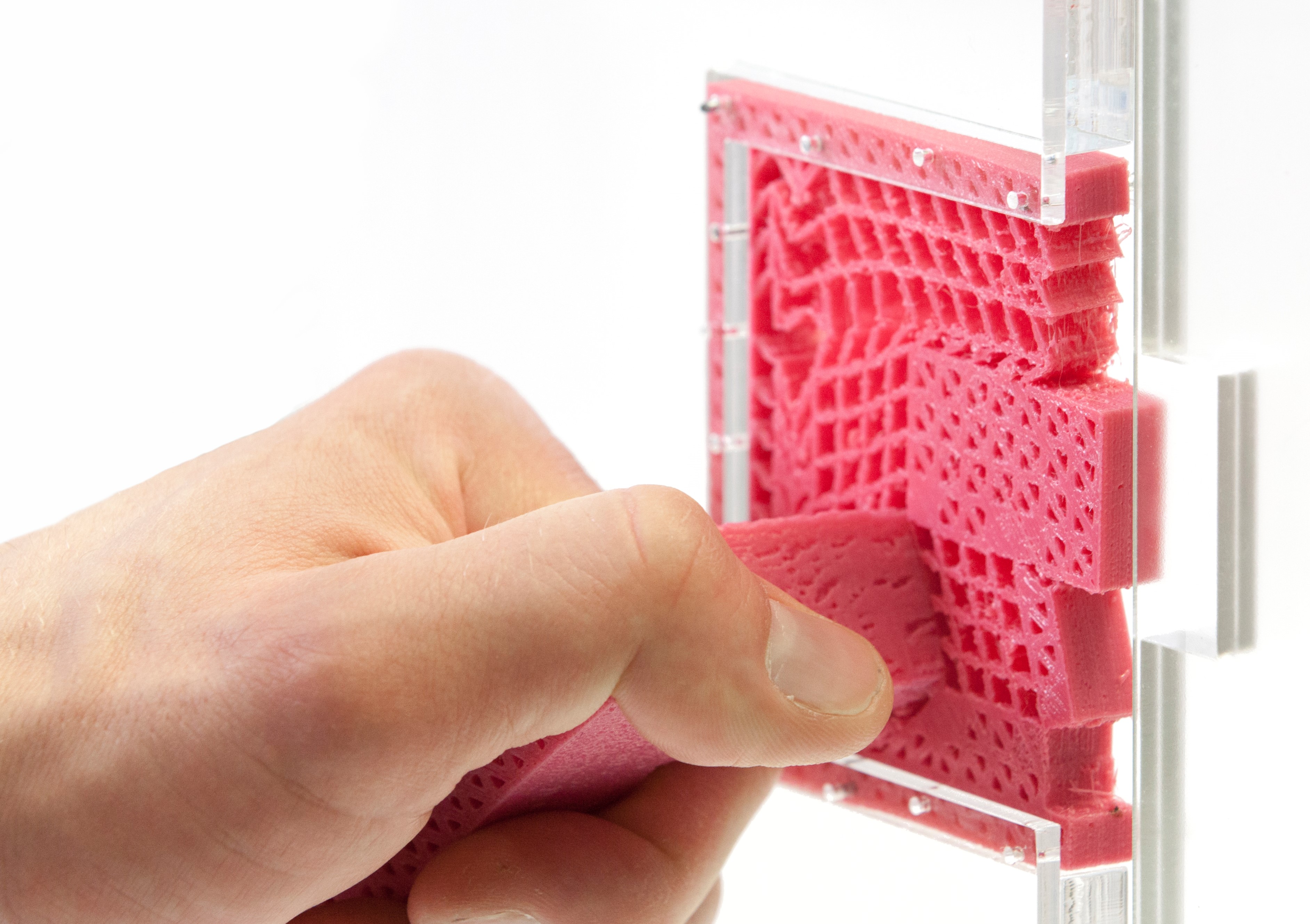
Her work centers on developing interactive design tools for digital fabrication of complex structures, emphasizing material discovery through broadened participation. She investigates how embedding functionality within geometry enables structures to react to simple inputs with complex behaviors—supporting applications in programmable matter, accessibility, and adaptive interfaces. Key themes include making advanced fabrication technologies accessible while advancing high-tech materials through user-centered innovation.
Publication Evolution
Her scholarly output reveals a trajectory from foundational metamaterial mechanisms (2016) toward integrated physical AI systems (2025). Early work established computational frameworks for mechanical metamaterials, while recent publications demonstrate applied implementations in rehabilitation robotics and unobtrusive adaptive environments. This progression reflects consistent focus on human-centered physical computing, with increasing emphasis on real-world impact in assistive technology and intelligent everyday objects.
Scientific Recognition
- NSF CAREER Award for Material-Changing Interfaces
- Best paper award at ACM PACM (ISS’23)
- UIST 2023 Best Demo Award (Jury's choice)
- Sara Kiesler Junior Development Chair (2023-2024)
- Rising Stars in EECS 2019 honoree
- Multiple Cannes Lions awards for interactive media
Mentorship and Funding
She actively advises graduate students including Yuyu Lin, Violet Han, Jesse Gonzalez, and Yujia Liu, guiding research in physical AI and rehabilitation technology. Her work receives substantial support through the NSF CAREER Award and institutional funding, enabling development of full-stack research prototypes that bridge software systems and physical interfaces. She emphasizes inclusive participation in material innovation through her lab’s design philosophy.
Interactive Structures Lab
The lab develops computational methods and innovative materials that seamlessly blend computation, fabrication, and robotics. Current projects include unobtrusive physical AI systems for everyday environments, personalized rehabilitation orthoses, and human-scale robotic surfaces. Her team’s work has been exhibited at Ars Electronica Center (Linz) and through international traveling exhibitions, demonstrating real-world viability of metamaterial applications.