معرفی
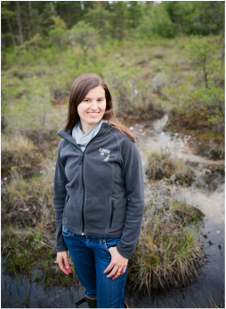
Alexa Warwick is an Assistant Professor in the Department of Fisheries and Wildlife within Michigan State University's College of Agriculture & Natural Resources. She serves as the Wildlife Participatory Engagement and Collaboration Specialist, working jointly with the Michigan Department of Natural Resources (MDNR) and MSU Extension (MSUE) to develop engagement programs for stakeholders and the public. Her position is funded through the Partnership for Ecosystem Research and Management (PERM), a cooperative venture between MDNR and MSU.
Her educational background includes:
- Ph.D. in Biological Sciences from Florida State University (2016)
- B.S. in Biology from University of Northern Iowa
- B.A. in Dual Languages: Portuguese/Spanish from University of Northern Iowa
Dr. Warwick's research focuses on wildlife ecology and conservation with emphasis on human dimensions of wildlife management. Her work spans science education, program development and evaluation, and conservation biology. She actively investigates salamander populations through SPARCnet collaboration while developing educational modules and expanding citizen science opportunities. Her outreach efforts aim to increase community engagement capacity of state wildlife agency professionals and build conservation capacity among Michigan youth and adults.
Notable achievements include being honored as a 2025 Global Scholar in Extension by CANR. She has also secured significant funding, including a $2.75 million grant to investigate movement of amphibian pathogens in wildlife trade networks.
- 2025 Global Scholars in Extension
Dr. Warwick's research portfolio demonstrates strong integration of science and public engagement, with particular attention to wildlife disease, amphibian conservation, and community-based monitoring. She previously served as a postdoc in evolution education at the BEACON Center at MSU, where she helped develop the ConnectedBio high school curriculum and organized public engagement workshops to train scientists in public communication.
Her laboratory and field work centers around the SPARCnet collaborative network for salamander research, which combines ecological monitoring with educational outreach to engage diverse audiences in conservation science.