معرفی
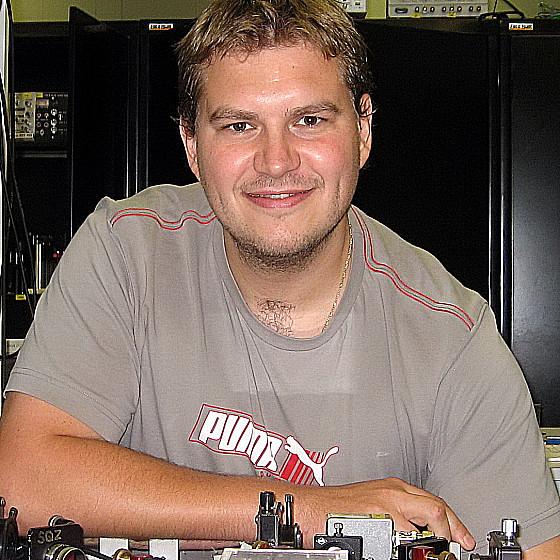
Albert Schliesser is a Professor at the Niels Bohr Institute, University of Copenhagen, where he leads research in Quantum Optics and Photonics within the Faculty of Science. His work focuses on quantum optomechanical systems, particularly membrane-based devices operating at the quantum limit. He maintains an active research program with over 76 publications, primarily in high-impact journals including Nature, Physical Review Letters, and Optica.
Professor Schliesser's research centers on quantum optomechanics, with specific expertise in cavity optomechanical systems, quantum measurement techniques, and quantum information processing using mechanical resonators. His group develops advanced optomechanical platforms including membrane-in-the-middle systems, soft-clamped membranes, and optomechanical crystals. Recent work demonstrates breakthroughs in quantum squeezing, ground-state cooling, and quantum memory for light, pushing the boundaries of quantum control in macroscopic mechanical systems. His research bridges fundamental quantum physics with potential applications in quantum sensing and quantum information technologies.
His publication record shows consistent output in top journals, with recent work (2023-2025) focusing on quantum squeezing techniques, topological phononics, quantum memory implementation, and advanced optomechanical transducers. The research demonstrates strong international collaboration, with publications featuring co-authors from multiple countries and institutions. His work has generated significant attention, with several papers picked up by major news outlets and widely shared on academic social networks.
Professor Schliesser leads the SLab research group (https://slab.nbi.dk), which specializes in experimental quantum optomechanics. The group operates advanced cryogenic and optical setups for studying mechanical systems at the quantum limit, with particular emphasis on membrane-based platforms that operate from room temperature to milliKelvin environments. Current research directions include quantum-enhanced sensing, quantum state engineering of mechanical oscillators, and developing optomechanical interfaces for quantum networks.