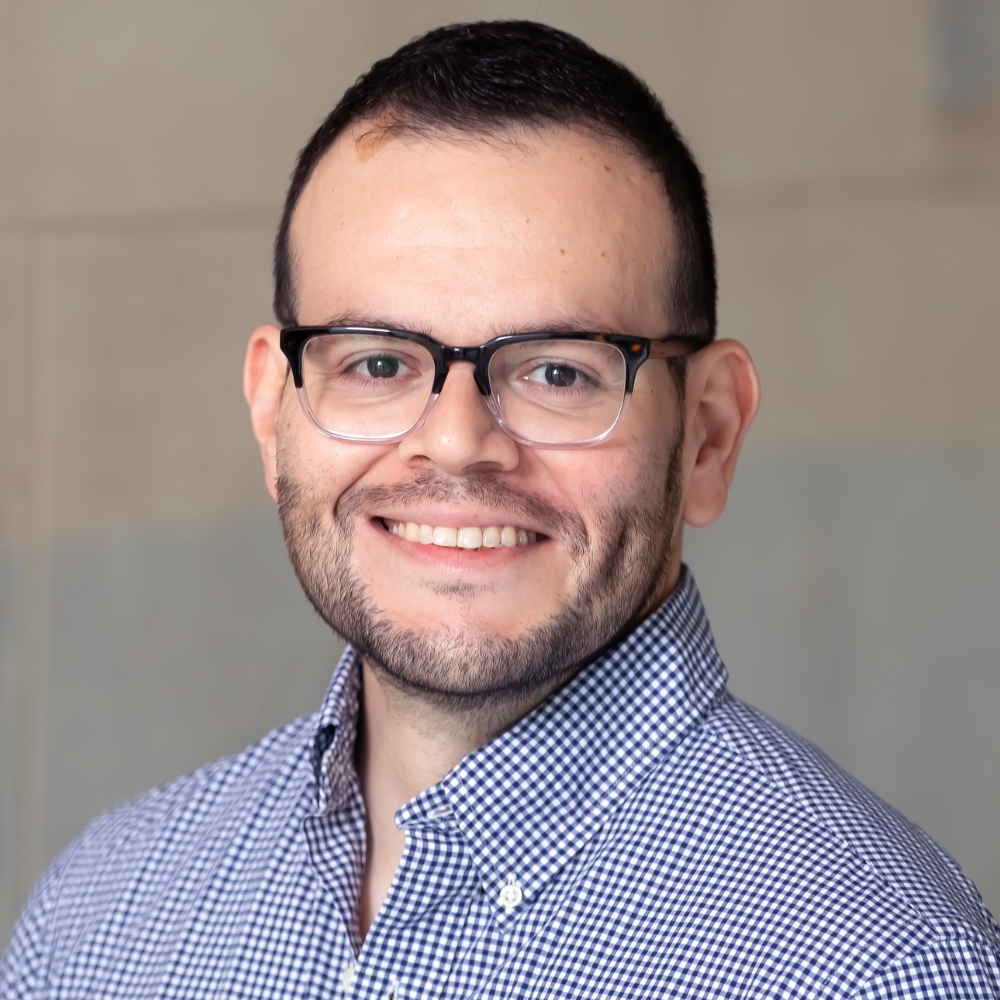
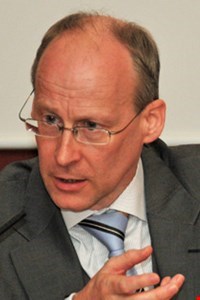
Richard J. Aldrich is a Professor of International Security at the University of Warwick. His research focuses on intelligence, cybersecurity, and digital politics, with notable contributions to understanding historical and modern security challenges. He has led major projects including the AHRC-funded study on the CIA and U.S. foreign policy, and co-edits journals like Intelligence and National Security . Aldrich advises governments on records management and declassification, notably assisting the German Bundestag inquiry into the NSA 'Snowden' affair. He holds a Distinguished Scholar award from the International Studies Association and has published extensively, including the acclaimed GCHQ: Centenary Edition . Teaching modules include 'Vigilant State: The Politics of Intelligence' and 'Cybersecurity: War, Spies, Crime, and Protest on the Internet.'
Abhinav Goyal is a Professor of Finance and Director of Global Engagement at Birmingham Business School, University of Birmingham. He is affiliated with the Department of Finance and plays a leadership role in shaping the school's international strategy. His research is widely published in premier finance journals, and he serves on editorial boards including as Associate Editor for British Accounting Review . Education: PhD in Banking and Finance, University College Dublin, Ireland (2013) MA in Financial Risk Management, Simon Fraser University, Canada (2007) BE (Hons) in Computer Science, India (2006) His research focuses on corporate finance , particularly IPOs, corporate governance, privatization, and dividend policy, with a strong emphasis on institutional and emerging market contexts. His work explores how legal, political, cultural, and media factors influence corporate financial decisions, especially in initial public offerings and payout policies. Using empirical methods, he investigates global patterns in financial markets, often drawing on cross-country datasets to assess the impact of governance reforms, ownership structures, and socio-political events. The recent articles reflect a consistent focus on IPO pricing dynamics, influenced by democracy, media, terrorism, board reforms, and legal frameworks. His research integrates insights from political economy, behavioral finance, and institutional theory, demonstrating a multidisciplinary approach to understanding financial markets. A recurring theme is the role of transparency, governance, and external shocks in shaping corporate financial behavior. Scientific Awards and Editorial Roles: Associate Editor, British Accounting Review Area Editor (Frontier Markets), Research in International Business and Finance Dr. Goyal has advised doctoral and postdoctoral researchers in finance, though specific names are not listed. He has secured research funding through collaborative projects reflected in his co-authored publications with international scholars. His past academic appointments include positions at University College Cork and the University of Liverpool, along with visiting roles at Monash University, Xi’an Jiaotong-Liverpool University, and Manipal University, indicating a strong global academic network. He teaches advanced courses such as Contemporary Topics in Banking and Finance (MBA) and Private Equity and Venture Finance (MSc), contributing significantly to graduate education. He leads no named research lab or center in the provided text, but his editorial roles and global engagement position suggest active participation in research communities and international academic collaborations.
Dr Tim Aistrope is a Senior Lecturer in International Relations and Director of Graduate Studies (Taught) at the University of Kent's School of Politics and International Relations. Based in Canterbury, his research focuses on the intersection of political culture, security studies, and international relations theory. Key themes include the role of imagination, conspiracy theories in foreign policy, and the embodiment of political narratives. His notable work includes the book Conspiracy Theory and American Foreign Policy (2016), analyzing post-9/11 secrecy and power dynamics. He teaches courses on IR theory and security, supervising PhD students exploring topics like securitization and translation. Active in professional associations, he contributes to journals like International Studies Quarterly and International Affairs . His recent publications address pandemic governance, apocalyptic narratives, and cybersecurity. Research interests span IR theory, US/Australian foreign policy, international ethics, and cyber security. His work often bridges cultural studies and security, examining how narratives shape policy and public perception. He has advised on counter-radicalization strategies and explored the role of social media in counterterrorism. His academic contributions highlight interdisciplinary approaches to understanding global politics through lenses of culture, ethics, and critical theory.
Linda Mulcahy is Professor of Socio-Legal Studies and Director of the Centre for Socio-Legal Studies at the University of Oxford. She specializes in dispute resolution and the experiences of lay users in legal systems, with research spanning healthcare complaints, court design, and digital justice. Her interdisciplinary work bridges law, sociology, and architecture. Mulcahy's research examines the socio-legal dynamics of disputes in contexts ranging from medical negligence to neighborhood conflicts. She explores how institutional designs and digital transformations affect access to justice and procedural fairness. Her current projects include oral histories of law centers and rape crisis movements, plus studies on explaining legal rights to the public. Mulcahy's extensive publications focus on legal architecture's impact on due process, visual representations of justice, and digital court reforms. Her work demonstrates consistent attention to how marginalized groups experience legal institutions. Awards and Recognition: Fellow of the Academy of Social Sciences She directs doctoral training programs and leads the Frontiers of Socio-Legal Studies blog/podcast for early career scholars. Mulcahy consults for governmental bodies including the Access to Justice Foundation and Law Centres Network.
Dr. Luca Trenta is an Associate Professor of International Relations at Swansea University's Department of Political and Cultural Studies. His research focuses on state-sponsored assassinations, US foreign policy, and covert operations, with a notable book The President’s Kill List: Assassination in US Foreign Policy since 1945 (2024). He holds grants from the British Academy and hosts the Out of the Shadows podcast. Trenta’s work bridges academia and public engagement, including media contributions to The Guardian , The New Yorker , and BBC programs. He advises PhD students on topics like Cold War interventions and international drug control. His research emphasizes historical analysis of covert actions and their legal/ethical implications, often appearing at major festivals like Hay-on-Wye and international conferences.
Dr Paul Lashmar is a Reader in Journalism at the Department of Journalism , City, University of London , within the College of Arts and Social Sciences . He previously served as Head of Department (2019–2021) and has extensive experience as a national journalist, having worked for The Observer , The Independent , World in Action , BBC, and Channel 4. His academic and professional background is detailed through the following areas: Education: PhD, Brunel University London, 2015 PDAP (PGSHE Equivalent), Brunel University London, 2011 His research interests center on investigative journalism, media and intelligence agencies, propaganda, slavery and colonial history, and policing. His current research includes the legacy of British landed gentry in colonial slavery, Cold War covert propaganda via the Foreign Office’s Information Research Department (1947–1977), and police-media relations. His recent publications reflect a strong trend in historical and political journalism, with a focus on uncovering hidden power structures, intelligence operations, and colonial injustices. His work spans books, peer-reviewed articles, and public commentary in outlets like The Conversation , The Guardian , and The Observer . Key themes include media ethics, source protection in the digital age, and the role of journalism in democratic accountability. Scientific awards and honors are not explicitly mentioned in the provided text. In terms of advising and grants : Successfully secured a City internal HEIF grant (£4,825) for the Journalism Archive Project, a collaboration with London Metropolitan Archives. Adviser to the AHRC-funded project ‘Writers in Intelligence’ (£415,000). Supervised PhD students including Natricia Duncan, Lin Pan, and Dr Sawsun Tah. He has played a significant role in public engagement, organizing a conference on organ trafficking with the Metropolitan Police and speaking at high-profile events such as the US Embassy’s MP CSCC Training Day. He also led media training within his department and contributed to numerous television documentaries and radio programs on intelligence and crime. He is a founder of the Bureau of Investigative Journalism and has advised The Centre for Investigative Journalism, underscoring his leadership in advancing investigative journalism standards.
Professor Michael Goodman is a Professor of Intelligence and International Affairs at King's College London, serving as Director of the King’s Centre for the Study of Intelligence. He previously headed the Department of War Studies and currently holds visiting roles at the Norwegian Intelligence School and Sciences Po. His research focuses on intelligence history, Cold War dynamics, and nuclear weapons, with a prolific publication record including books like The Official History of the Joint Intelligence Committee and Spinning Intelligence . Goodman has been the Official Historian of the Joint Intelligence Committee and is a British Army reservist on government secondment until 2026. His academic contributions span intelligence theory, security policy, and international affairs. Awards include the 2025 Fellowship of the Academy of Social Sciences. Goodman supervises PhD students in intelligence history, contemporary issues, and nuclear weapons studies. He leads interdisciplinary initiatives at the King’s Cybersecurity Centre and Conflict Records Unit, emphasizing historical and strategic insights into modern security challenges.
Dr. Sergio Ascencio is a Lecturer in the Department of Government at the University of Essex. He holds a PhD from the University of Rochester (2018). His academic career includes roles as Assistant Professor at the University of New Mexico (2019–2021) and Postdoctoral Associate at NYU Abu Dhabi (2018–2019). His research focuses on comparative politics, electoral systems, and political behavior, with a regional emphasis on Mexico and South Asia. Key themes include primary elections, vote buying, political dynasties, and party strategies. His work employs experimental methods and institutional analysis to explore questions of governance and democratic accountability. Recent publications (2021–2024) examine nomination rules, primary adoption, and voter dynamics across multiple countries. His 2019 study on partisan poll watchers and electoral manipulation highlights expertise in electoral integrity. Earlier work (2015, 2009) addresses issue salience modeling and delegation mechanisms in Mexican state legislatures. Contact: Email at sergio.ascencio@essex.ac.uk or via Zoom during academic support hours (Tuesdays 2–4 PM).
David Anderson is a Professor in African History at the University of Warwick's Faculty of Arts. His academic career spans over four decades, including roles as Professor in African Politics at the University of Oxford (2006-12) and Senior Lecturer in History at SOAS, University of London (1991-2002). His research focuses on colonial history, counter-insurgency, decolonization, and environmental politics. Anderson holds a Ph.D. in History from the University of Cambridge (1978-82) and a B.A. in History from the University of Sussex (1975-78). His notable works include Histories of the Hanged (2005), examining British counter-insurgency in Kenya, and Eroding the Commons (2002), analyzing colonial environmental policies. He has been honored with the 2025 Award for Research Communications, Fellow of the British Academy (2022–), and the Guggenheim Distinguished Scholar (2021–23). Anderson has supervised over 20 doctoral students, many of whom now hold academic positions globally. His research extends to public engagement, including documentaries on colonial history and Mau Mau rebellion. He is affiliated with the Global History & Culture Centre at Warwick and collaborates internationally on projects like the Stellenbosch-Warwick Partnership. Key themes in his work include colonial violence, environmental change, and postcolonial governance, reflected in his lectures and publications on topics such as Kenya’s detention camps, climate-driven conflicts, and the 'Migrated Archive' controversy.
Dr Malcolm Craig is a Senior Lecturer in American History at Liverpool John Moores University, School of Humanities and Social Sciences. He holds a PhD from the University of Edinburgh and has previously served as a Postdoctoral Research Fellow and Adjunct Lecturer at the University of Edinburgh. His academic career is centered on Cold War history, nuclear culture, intelligence, and U.S. foreign policy. Education: PhD, University of Edinburgh (2010–2014) Masters by Research, Victoria University of Wellington BA (Hons) History and Sociology, Glasgow Caledonian University His research interests include nuclear proliferation, Cold War intelligence, the cultural history of the nuclear age, and the intersection of historical trauma with tabletop roleplaying games (TTRPGs). He is particularly known for his work on the 'Islamic Bomb', UK-US nuclear diplomacy, and the role of games in representing Cold War anxieties. His current research explores how TTRPGs serve as cultural artifacts reflecting societal fears of nuclear war. His publications span top journals such as Diplomatic History , Intelligence and National Security , and Journal of American Studies . His recent articles and book reviews reveal a consistent focus on nuclear strategy, espionage, and non-proliferation, with an increasing emphasis on cultural and representational aspects of the Cold War. He has also authored a monograph on America, Britain, and Pakistan’s nuclear program. Scientific Awards and Recognition: Fellow of the Higher Education Academy Best Course Award for 'The Nuclear Cold War' (Edinburgh University Students’ Association) Dalziel Prize for British History (University of Edinburgh) Professor James F. McMillan Scholarship Craig has secured multiple research grants from institutions such as the Scowcroft Institute, British Association for American Studies, and the Ford Foundation. He actively supervises postgraduate students on topics ranging from U.S. imperialism to intelligence history. He is also an accomplished TTRPG designer, creator of a|state , Cold City , and Hot War , and frequently collaborates with game studios like Handiwork Games. His public engagement includes media appearances on BBC, TRT, Sky News, and Al Jazeera, discussing nuclear politics and U.S.-UK relations.
Mary Young is Associate Professor of Transnational Organised Crime at the University of the West of England, specializing in financial secrecy systems and environmental crime. Her research examines illicit financial flows through offshore jurisdictions and emerging green crimes. Key research areas: Money laundering through tax havens Organized crime in environmental markets Historical development of financial crime laws Corporate structures enabling illicit flows Recent publications analyze organized crime exploitation of net-zero transitions and critique international anti-money laundering frameworks. Her archival research has reshaped understanding of financial crime legislation development. Dr. Young consults for law enforcement agencies and international organizations including HMICFRS and UNODC.
Dr. Lilly Pijnenburg Muller is a Lecturer in Security Studies at King's College London's Department of War Studies, within the School of Security Studies. She joined King's in 2024 after a Fulbright fellowship at Cornell University (2022–2023). Her research focuses on critical security studies, science and technology studies (STS), and cybersecurity, examining sociotechnical practices of threat construction, AI in security, and emerging technologies' impact on governance. Her current monograph project explores cybersecurity as a sociotechnical practice in global politics, analyzing how threat intelligence organizations shape security discourses. She co-leads interdisciplinary research funded by the Cornell-KCL Global Strategic Collaboration Awards (2023–2024) and has secured grants from the Norwegian Ministry of Defence, NATO, and the ESRC. Key research areas include: critical approaches to cybersecurity, political economy of threat intelligence, AI ethics in security, and datafication in governance. She is affiliated with King's Cyber Security Research Group and the Centre for Digital Culture. Education: PhD in Social Science (2019–2022) via London Interdisciplinary Social Science Doctoral Training Partnership (LISS DTP) Recent Grants: Global Strategic Collaboration Award (2023–2024), Fulbright Scholarship (2022–2023) Events Organized: Hosted discussions on AI-enabled influence operations (2024), cyber resilience strategies (2024), and private sector cyber deterrence (2020).
Nicholas Lord is Professor of Criminology at the University of Manchester's School of Social Sciences. He serves as Director of the Centre for Digital Trust and Society and Director of CrimRxiv. His research examines international corruption/fraud regulation, organization of serious financial crimes, and implementation of criminological analysis in fraud enforcement. Research interests span corporate bribery, food fraud, illicit finance, and comparative regulatory systems. His work connects criminological theory with practical enforcement challenges in financial crime. Recent publications explore AI-enabled fraud control, shell company misuse, sports corruption, and fisheries crime. Research consistently addresses how digitalization and globalization transform criminal enterprise and regulatory responses. Awards include the Criminology Book Prize (2015), RISCS Cyber Risk Prize (2022), and Young Career Award (2014). Current funded projects examine online shell company markets (SSHRC 2024-2027), fisheries crime in Norway (2021-2025), and FinTech crime prevention. He leads multiple research networks including the European Working Group on Organisational Crime and co-founded the European Food Crime Research Group.
Professor Philip Davies serves as Professor of Intelligence Studies and Director of the Brunel Centre for Intelligence and Security Studies (BCISS) at Brunel University London's Department of Politics and History within the College of Business, Arts and Social Sciences. A political sociologist specializing in intelligence institution-building, he co-founded BCISS and developed the MA in Intelligence and Security Studies program. His academic journey includes a PhD in Sociology from the University of Reading (1997), MA in Social and Political Thought from York University Canada (1987), and BA (Hons) in Sociology from Trent University Canada (1984). PhD Sociology, University of Reading (1997) MA Social and Political Thought, York University Canada (1987) BA (Hons) Sociology, Trent University Canada (1984) Postgraduate Certificate in Teaching and Learning in Higher Education, Brunel (2006) Davies' research focuses on the organization and governance of intelligence agencies, national intelligence cultures, intelligence professionalization, and doctrine development. His work bridges practical intelligence operations with academic theory, examining how intelligence institutions interact with government machinery, international allies, and defense structures. A pioneer in comparative intelligence studies beyond the Anglosphere, he developed the theory of 'intelligence culture' and has conducted extensive research on UK, US, Indian, and Malaysian intelligence systems. His current work centers on defense and military intelligence concepts, doctrine evolution, and cyber-security policy. Analysis of his 15 most recent publications reveals a dominant trend in comparative intelligence studies with strong emphasis on British and US intelligence systems, expanding to include Malaysia and India. His work consistently examines intelligence politicization, accountability mechanisms, and the practical implementation of intelligence doctrine. The publications demonstrate increasing focus on military intelligence integration (evident in ISTAR/ISR debates) and historical case studies of intelligence failures/successes. Davies has made significant impact through practical applications of his research: Provided foundational input for UK Joint Intelligence Doctrine (JDP 2-00) and JDP 04 Understanding Advised on 2016 Investigatory Powers Act as Home Office consultative panel member Led EU INTCEN's Basic Intelligence Assessment course (2013-2019) Contributed to UK military Joint Intelligence Doctrine development (2010-2012) Delivered impact case studies for REF 2014 and REF 2021 through BCISS As an educator, Davies convenes postgraduate modules on Intelligence Concepts and Counterintelligence, while directing BCISS as a University Interdepartmental Research Centre. His media presence includes regular commentary on intelligence matters for outlets like LBC, particularly regarding the ISC Russia Report and Edward Snowden disclosures. He serves on editorial boards for Intelligence and National Security and International Journal of Intelligence and CounterIntelligence, and chairs the UK Political Studies Association/BISA Security and Intelligence Studies Group.
Professor Rochelle C Dreyfuss of the University of Cambridge, Faculty of Law, is a leading scholar in intellectual property law with a focus on international dimensions of patenting, trade secrets, and access to medicines. Her work bridges legal theory with practical implications for global innovation policy. Key research areas: TRIPS Agreement implementation Genetic material patenting Transnational IP dispute resolution Business method patent economics Trade secrecy and national security Global health policy impacts Her recent publications examine: Post-Brexit IP frameworks (2018) Experimental use defense in biotech (2017) Specialized patent adjudication (2017) Max Planck IP principles (2013) DNA patenting ethics (2013) Contact: Squire Law Library , Cambridge CB3 9DZ