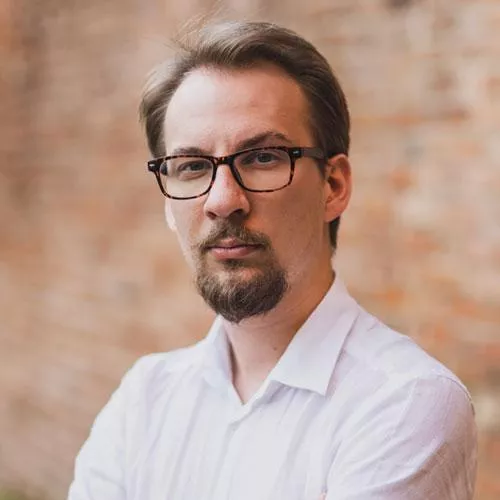
Joanna Mąkowska is an Assistant Professor at the American Studies Center, University of Warsaw. She specializes in 20th and 21st century American and Canadian literature, with a focus on poetry, ecocriticism, and feminist theory. Her roles include Academic Writing Coordinator (BA/MA), Head of Admissions Committee, and Writing Lab Coordinator. She has held prestigious fellowships including the Fulbright Junior Research Award (SUNY Buffalo) and Kosciuszko Foundation Postdoctoral Fellowship (Duquesne University). Her research explores intersections of documentary writing, protest literature, and posthumanist thought. Major works include analyses of James Baldwin, Jericho Brown, and Adrienne Rich, with recent focus on ecocritical frameworks in American poetry. She has contributed to journals like Arizona Quarterly and Modernism/modernity , and co-authored chapters in The Routledge Companion to Ecopoetics . Notable achievements include the NCN SONATA Grant (2024-2027) for her project on protest assemblages in poetry, and multiple residential fellowships at Cambridge and Yale. Her teaching spans courses like 'American Protest Literature' and 'Literary Reportage.' Labs/Teams: Leads ASC Writing Lab, fostering interdisciplinary academic writing. Grants: 5 competitive awards since 2015, including national and international fellowships.
Piotr Korduba is a Professor at Adam Mickiewicz University in Poznań, serving as Director of the Institute of Art History since 2016 and Head of the Department of the History of Modern Art. His academic leadership includes prior service as Deputy Director of the Institute (2009-2012) and extensive involvement in national cultural institutions. Education: Art History studies at Adam Mickiewicz University (1995-2000) PhD (2004) with dissertation 'The Patrician House of Gdańsk in the Modern Period' Habilitation (2014) based on 'Folk Art for Sale. Society for the Promotion of Folk Industry, Cepelia, Institute of Industrial Design' Professor Korduba's research centers on the history of residential architecture and design, with deep expertise in residential culture, artistic crafts, and German-Polish art-historical relations. His work examines how architectural spaces reflect societal structures across historical periods, particularly focusing on Polish urban environments and cross-border cultural exchanges. He investigates the social dimensions of living spaces from the early modern era to the People's Republic of Poland, emphasizing how design choices manifest cultural identity and political contexts. His publication trajectory (2005-2020) reveals consistent specialization in Polish architectural history, with increasing focus on German-Polish relations and post-war reconstruction. Key thematic clusters include residential architecture in Poznań and Gdańsk, interwar design consultancy, folk art commercialization, and the cultural significance of private spaces. Recent works demonstrate interdisciplinary approaches bridging architecture, social history, and migration studies. Scientific Awards: Józef Łukaszewicz Award, Poznań Rector’s Award of Adam Mickiewicz University National Cooperative Council Award, Warsaw Professor Korduba actively contributes to academic governance and research funding. His project leadership includes the binational 'In the Shadow of Berlin and Warsaw' architectural study (with Universität Hamburg) and the 'Ernst Stewner' photography project (with Herder-Institut Marburg). He has secured prestigious fellowships from Herzog-August Bibliothek, Foundation for Polish Science, DAAD, Lanckoroński Foundation, and Goethe-Institut. Editorial roles include Editor-in-Chief of 'Artium Quaestiones' and service on multiple scientific councils. As Director of the Institute of Art History, he oversees research teams focused on modern art history, architectural heritage, and museum studies. His leadership extends to cultural policy through memberships in the Lehndorff-Gesellschaft Steinort (palace reconstruction in Masuria) and collaborations with Poznań City Hall, Zamek Culture Centre, and national institutions like the Fryderyk Chopin Institute.
Prof. Antoni Taraszkiewicz is a faculty member at the Faculty of Architecture , Gdańsk University of Technology, serving as Head of the Department of Residential and Public Architecture . He works alongside his daughter Karolina Taraszkiewicz in both academic and professional realms, co-founding the FORT Taraszkiewicz Architects studio. Research Focus : Integrating historical architectural elements with modern sustainable design, urban revitalization of brownfields, facade composition patterns, and architectural education pedagogy. Publications : His work emphasizes the New European Bauhaus initiative, medieval tenement archetypes, multifunctional building systems, and the psychological balance in residential environments. Academic Leadership : He contributes to curriculum development, blending traditional design principles with digital tools and community-centric approaches.
Anna Górka is an Associate Professor at the Department of Environmental Design within the Faculty of Architecture at Gdańsk University of Technology. Her work focuses on rural landscapes, cultural heritage preservation, and sustainable development strategies in Polish rural areas. Research Interests: - Rural landscape planning and conservation - Traditional agricultural and architectural heritage - Climate change mitigation through community engagement - Spatial policy and socio-ecological systems - Cultural memory in rural environments - Sustainable tourism and modernization challenges Publications trends show a focus on: - Threats to rural landscapes from modernization and urban sprawl - Case studies of Kashubia region's architectural and environmental preservation - Roles of education and summer schools in fostering community resilience Her work bridges academic research with practical spatial management tools for rural communes, emphasizing the role of collective memory and cultural values in shaping resilient rural environments.
Wrocław University of Science and TechnologyPoland
Magdalena Baborska-Narożny serves as an Associate Professor in the Department of Architecture and Visual Arts at the Faculty of Architecture, Wrocław University of Science and Technology. Her work bridges architectural design, building physics, and social science to address critical challenges in residential performance and sustainability. Her research focuses on: Building performance evaluation through in-situ measurements Thermal comfort and ventilation in low-energy and historical housing Social dimensions of balcony use and heritage conservation Energy efficiency transitions in Polish residential contexts Occupant behavior impacts on building performance Analysis of her 2021-2025 publications reveals consistent emphasis on real-world building performance gaps, particularly examining ventilation strategies, overheating risks, and heritage adaptation challenges. Her methodology combines field measurements in Polish housing with occupant surveys and computational modeling, often comparing international approaches to heritage conservation and energy transitions. Key contributions include quantifying bedroom ventilation effectiveness, analyzing balcony integration in historical tenements, and evaluating solid fuel heating transitions. No scientific awards were documented in the provided sources. Information regarding academic advising relationships and research grant acquisitions was not present in the available materials. No specific laboratory affiliations or research team structures were identified in the source documentation.
Dr. Katarzyna Kajdanek is an Associate Professor at the Department of Urban and Rural Sociology, University of Wrocław. She holds leadership roles including Deputy Chairperson of the Council for Sociological Sciences, Head of the Sociology College in the Doctoral School, and Erasmus+ Programme Coordinator. She is a board member of ESA’s Urban Sociology Network (RN37) and active in the Polish Sociological Association (PTS). Her research focuses on urban-rural dynamics, civic engagement, and socio-spatial transformations. Her academic career includes scholarships for outstanding researchers (2017-2020) and leadership in funded projects like 'Reviving rural areas?' (2018-2021) and 'Return from suburbs to cities' (2019-2020). She publishes in top journals such as *City&Society* and *Applied Geography*, addressing topics like pandemic-induced urban migration, mountainous region development, and urban identity commercialization. She also edited *City and Power* (2017) and serves on the editorial board of *Sociological Studies*. Key Projects: OPUS Grant on rural revival (2018-2021), MINIATURA3 suburban migration study (2019-2020) Professional Roles: Doctoral College Head, Erasmus+ Coordinator, ESA Network Leadership Her work bridges urban sociology with policy research, analyzing how spatial changes affect social structures and vice versa. Current interests include post-pandemic urban-rural linkages and participatory urban planning strategies.
SWPS University of Social Sciences and HumanitiesPoland
Dr. Kamil Janowicz is a psychologist at SWPS University’s Institute of Psychology, affiliated with the Personality Development Research Center. His work focuses on identity development in young people, the role of future thinking in human functioning, parental identity, and the impact of (auto)narrative activity on psychological well-being. He is the principal investigator of the National Science Centre-funded project "Maternal Gatekeeping and Parental Identity – Tool Adaptation and Pilot Studies" and co-researcher on "The Role of Narrative Processing of Experiences in Identity Development and Mental Health in Emerging Adulthood." Education: Ph.D. in Psychology His research integrates narrative psychology and developmental theory, emphasizing how personal narratives shape parenting roles, mental health, and societal adaptation. He also explores perfectionism, singlehood, and cross-cultural identity dynamics. Notable awards include scholarships from the Minister of Science and Higher Education (2016/2017) and the Adam Mickiewicz University Foundation (2021/2022). Dr. Janowicz teaches "Thinking about the Future – Theory, Research, Practical Application" at SWPS University and contributes to public discourse through his popular science blog Father_ing , addressing modern fatherhood and child-rearing.
Dr. hab. Piotr Magier is an Assistant Professor at the Department of General Pedagogy , Institute of Pedagogy , within the Faculty of Social Sciences at the John Paul II Catholic University of Lublin . He serves as Vice-Dean and focuses on pedagogical theory and practice, with a strong emphasis on family-school dynamics, child development, and socioeducational challenges. Research areas include early childhood education , special education , play pedagogy , and value systems in education . Supervised theses address topics such as dyslexia , ADHD , family dysfunctionality , and media education . Contact: piotr.magier@kul.pl | Phone: +48 81 445 35 55 His recent supervised theses highlight empirical studies on educational environments , teacher burnout , and contemporary pedagogical methods (e.g., Montessori, bibliotherapy, art therapy). Key trends reflect interdisciplinary engagement with psychology , social work , and health education in shaping developmental outcomes for children in diverse contexts.
Wrocław University of Science and TechnologyPoland
Anna Bać is a faculty member at the Faculty of Architecture of Wrocław University of Science and Technology, affiliated with the Department of Architecture and Visual Arts . Her research focuses on Sustainable Architecture , Energy-Efficient Building Design , and Renewable Energy Integration . Key sub-fields include NZEB standards , Low-Carbon Construction , and Architectural Pedagogy . She has published extensively on solar heating systems, thermal storage, and sustainability in educational and urban contexts. Recent publications highlight trends in Climate-adaptive design Photovoltaic integration Passive energy systems Multi-criteria sustainability analysis
Dr Michał Żemła is an Associate Professor at the Jagiellonian University in Kraków within the Faculty of Management and Social Communication , affiliated with the Institute of Entrepreneurship . His research focuses on tourism management, destination development, overtourism dynamics, and the impact of sharing economy platforms. He supervises the student tourism society HORIZON and teaches courses including Tourism Policy, Competition in Tourism, and Management in Tourism and Sport. Research Interests: Destination Management & Marketing Overtourism Sources/Consequences Ski Resorts Development Sharing Economy in Tourism Experience Economy & Product Innovation Tourism Policy Analysis Recent publications analyze overtourism mitigation strategies, video game-induced tourism, and stakeholder perceptions of tourism impacts. His work bridges academic research with practical policy recommendations for sustainable destination management.
Dr. Alina Barczyk is an Assistant Professor at the Department of History of Architecture, Faculty of Philosophy and History, University of Łódź, Poland. Her research focuses on 18th-century European architecture, particularly Polish magnate residences, Saxon cultural influence, and Central European heritage. University of Łódź Faculty of Philosophy and History Department of History of Architecture Her scholarly work integrates archival research with in situ analysis to explore architectural patronage, ideological symbolism, and urban development in historical contexts. Key areas include: Warsaw's architectural evolution during the Saxon period Polish magnate family residences and their political significance Comparative studies between Dresden and Polish architectural forms 18th-century ceremonial spaces and decorative programs
Dr. Eng. Ewa Mackoś-Iwaszko serves as an Assistant Professor in the Department of Environmental Protection and Landscape at the Institute of Mathematics, Informatics and Landscape Architecture, Faculty of Natural and Technical Sciences, John Paul II Catholic University of Lublin. Her academic position places her at the intersection of environmental science, landscape architecture, and urban ecology, where she contributes significantly to research and educational initiatives. Her educational background includes a degree in environmental protection and landscape architecture from the John Paul II Catholic University of Lublin, a PhD in agricultural sciences specializing in horticulture, and postgraduate studies in computer graphics, desktop publishing, and publishing graphics. This diverse academic foundation supports her interdisciplinary approach to urban landscape research. Dr. Mackoś-Iwaszko's research interests focus on the impact of herbivorous arthropods on urban trees in terms of their ornamental value, landscape conservation, the role of vegetation in urban greenery systems, and the perception of urban landscapes. Her work bridges ecological science with practical landscape architecture applications, particularly examining how urban environments affect plant-animal relationships and how these relationships influence landscape aesthetics and functionality. Analysis of her recent publications reveals a consistent focus on urban dendroflora, plant-insect interactions in city environments, and the cultural dimensions of landscape. Her research demonstrates how urbanization affects biodiversity, particularly in housing estates and street tree populations, while also exploring therapeutic applications of horticulture and the historical-cultural significance of plants in regional contexts. Bronze Medal for Long Service (2021) Medal of the National Education Commission (2019) Multiple Rector's Awards from the Catholic University of Lublin (2024, 2023, 2022, 2020) Dr. Mackoś-Iwaszko actively contributes to academic service through membership on the Disciplinary Committee for Students and Doctoral Students and the Digital Humanities Program Council. She has organized numerous educational events including the Lublin Science Festival, Digital Humanities Days, and various art and photography competitions. Her work demonstrates strong commitment to both scholarly research and public science communication, particularly regarding urban ecology and landscape architecture.
Professor Ewa Trzaskowska is affiliated with the John Paul II Catholic University of Lublin (KUL) as a faculty member in the Department of Landscape Shaping and Design within the Faculty of Natural and Technical Sciences . Her work focuses on urban landscape architecture, biodiversity preservation, and sustainable development of green spaces. Education: Not explicitly detailed in provided texts Research: Urban greenery optimization, invasive species impact on biodiversity, climate-resilient design, cemetery ecology Publications: 15+ peer-reviewed articles (2010-2021) exploring landscape homogenization, green infrastructure benefits, and ecological design principles Her research demonstrates consistent focus on urban ecology and sustainable landscape planning , with particular emphasis on synantropic vegetation , pedestrian route aesthetics , and rainwater management in residential areas. She pioneered innovative approaches through projects like "Bee in the City" and "Pocket Gardens" , addressing both ecological and social dimensions of urban spaces. Scientific Recognition: KEN Medal (2018) Silver Medal for Long-Term Service (2015) KUL Rector's Team Awards As Dean and scientific publication editor-in-chief , she has significantly shaped academic discourse in landscape architecture through editorial leadership in Krajobrazy Lublina series. Her practical work includes collaborations with Lublin Housing Cooperative and participation in national expert teams addressing urban climate challenges.
Cardinal Stefan Wyszyński University in WarsawPoland
Paula Androić Gračanin is a researcher at the Doctoral School of Cardinal Stefan Wyszynski University in Warsaw, Poland (UKSW). Her work focuses on the archaeology of insular landscapes in the northeastern Adriatic, particularly the Island of Rab (Croatia), spanning the Iron Age, Roman period, and Late Antiquity. She specializes in landscape evolution, settlement organization, and interdisciplinary methods like geophysical surveys and GIS. Specializes in Adriatic island archaeology Expert in Late Antique and Roman rural settlements Uses geophysics and geoarchaeology Her research emphasizes material culture, including pottery production and iron working, while exploring communication routes and intra-regional interactions. Current projects involve diachronic analysis of settlement patterns and environmental impacts on Roman agrarian systems. Her recent publications (2024–2020) examine fortified settlements, cultural exchange, and geoarchaeological methodologies. Topics include Late Iron Age hillforts, Roman coastal infrastructure, and GIS applications in tracking settlement transformations.
Dr inż. arch. Joanna Kabrońska is an Assistant Professor at the Department of Technical Fundamentals of Architectural Design at Gdańsk University of Technology's Faculty of Architecture. She specializes in contemporary architecture, architectural heritage of Poland's ethnic minorities, collective memory, and the integration of new technologies into spatial design. Her work emphasizes the interplay between architecture, memory, and societal values, often focusing on adaptive reuse of historic structures and the role of architecture in shaping cultural identity. Education and Awards: Holds a PhD in Architecture (1994) and a DAAD post-doctoral scholarship (2002). Notable awards include the IV International Biennale of Architecture Prize (1991) and Gdańsk University's Rektor's Award for Scientific Excellence (1995). Research Interests: Explores memoryscapes, postmemory in art, and the architectural expression of collective memory. Key areas include adaptive architecture, energy-efficient building technologies, and the ethical dimensions of design. Teaching: Teaches courses on building physics, acoustics, and modern construction technologies. Serves as e-Learning Coordinator for the Faculty of Architecture since 2020, overseeing digital education initiatives. Publications: Authored over 25 peer-reviewed articles and monographs, including 'Architecture as a Form of Memory' (2008) and contributions to conferences on Holocaust memory and urban revitalization. Recent work focuses on sustainable design and the cultural significance of adaptive architectural projects. Professional Roles: Member of the European Association for Holocaust Studies (EAHS Audit Committee) and a licensed architect with expertise in heritage preservation. Coordinates interdisciplinary projects linking art, architecture, and memory studies.



.jpg)