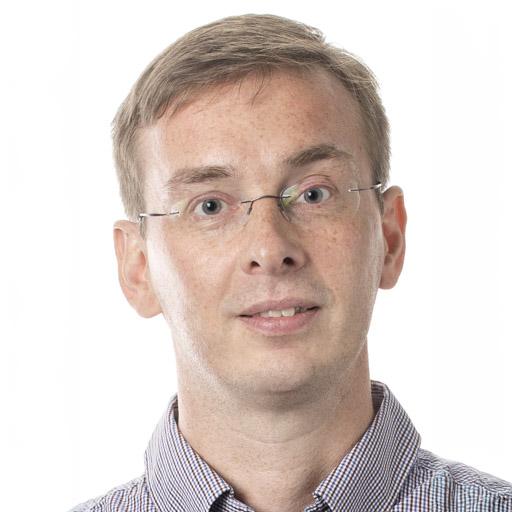
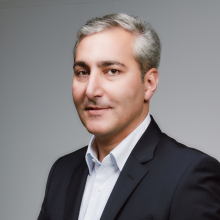
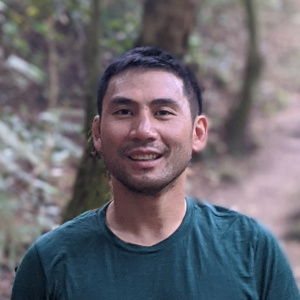
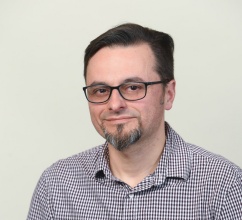
Yizhou Zhang is an Assistant Professor in the Department of Computer Science at the University of Waterloo. He holds a PhD and MS from Cornell University (2019 and 2016) and a BS from Shanghai Jiao Tong University (2012). His research focuses on programming languages, including design, implementation, and theory, with emphasis on formal methods, compiler optimization, and probabilistic programming. Education: PhD, Cornell University, 2019 MS, Cornell University, 2016 BS, Shanghai Jiao Tong University, 2012 Research interests span programming language theory, compiler construction, and formal verification. His work explores topics like certified compilers, effect handlers, and probabilistic program analysis. Recent publications emphasize formal models for memoization, nested family polymorphism, and bidirectional control flow. His publications reflect contributions to probabilistic programming semantics, compiler optimization techniques, and type systems. No scientific awards are explicitly listed. Advising and grant details are not provided in the text. Zhang’s research often intersects with formal methods and practical compiler implementation challenges.
Dr. Amal Zouaq is a Full Professor in the Department of Computer Engineering and Software Engineering at Polytechnique Montréal. She holds the FRQS (Dual) Chair in AI and Digital Health, serves as Director of the LAMA-WeST research laboratory, and is an Associate Member of MILA. Her work bridges artificial intelligence with applications in digital health, cultural heritage, and educational technologies, positioning her at the forefront of interdisciplinary AI research in Canada. Her research focuses on Artificial Intelligence , particularly Natural Language Processing and the Semantic Web . Specific interests include knowledge representation, ontology learning, SPARQL query generation, bias mitigation in language models, and clinical text processing. Her work spans multiple domains including healthcare, cultural heritage, and educational technology, with emphasis on developing practical AI solutions that address real-world challenges in knowledge management and information extraction. Analysis of her recent publications reveals a strong trajectory in advancing NLP techniques for knowledge-intensive applications. Her work increasingly focuses on domain-specific applications in healthcare and cultural heritage, with growing emphasis on ethical AI considerations like bias mitigation. The research demonstrates progression from foundational semantic web technologies toward more sophisticated neural approaches while maintaining strong theoretical grounding in knowledge representation. Scientific Recognition: Holder of the FRQS (Dual) Chair in AI and Digital Health Dr. Zouaq has supervised 23 graduate students to completion, including 1 PhD and 22 Master's theses, with research spanning ontology learning, knowledge representation, and NLP applications. Her supervision record demonstrates consistent mentorship in cutting-edge AI research with practical applications across multiple domains. She actively serves on program committees for major conferences in knowledge engineering, data mining, and semantic web technologies. She directs the LAMA-WeST (Web, Semantics and Text) laboratory , which specializes in natural language processing and artificial intelligence research. The lab focuses on knowledge representation, semantic technologies, and their applications in healthcare, cultural heritage, and educational contexts. As a member of IVADO and MILA, she collaborates with leading AI researchers across Montreal's vibrant AI ecosystem.
Dr. Matt Amy is an Assistant Professor in the School of Computing Science at Simon Fraser University (SFU), holding the Canada Research Chair in Quantum Computing. His research focuses on quantum compilers, programming languages, and formal verification of quantum programs. He also explores quantum circuit optimization and models of quantum computation. Education: PhD in Computer Science (University of Waterloo, 2019), M.Math in Quantum Information (2013), and B.Math in Computer Science (2011), all from the University of Waterloo. Research Interests: Quantum compilers and languages, circuit optimization, formal verification, and quantum computation models. His work bridges theoretical foundations with practical implementations, emphasizing efficient quantum software development. Recent research trends include advancing quantum compilation techniques, exploring NP-hard optimization problems in quantum circuits, and developing formal methods for quantum program analysis. His work on symbolic synthesis and equational theories for quantum circuits demonstrates a focus on foundational algorithmic challenges. Scientific Awards: Canada Research Chair (2025–present) Advising and Grants: While no current advisees are listed, his research is supported by grants focused on quantum computing and formal methods. He collaborates with industry through SFU’s School of Computing Science. Labs and Teams: Involved with the Tangent Lab, a research group exploring quantum algorithms and software systems at SFU.
Marsha Chechik is a Professor in the Department of Computer Science at the Faculty of Arts and Science, University of Toronto. She previously served as Department Chair from 2019-2022 and as Acting Dean in the Faculty of Information from July-December 2022. Her academic career spans numerous research contributions and leadership roles within the software engineering community. Professor Chechik's primary research interests focus on software engineering with emphasis on formal methods to enhance software quality. Her work encompasses scalable automated verification techniques including model-checking and theorem-proving, formal specification languages, verification of protocols, non-classical logics, and reasoning under inconsistency. She has made significant contributions to model management, software product lines, safety and security assurance, and automotive safety systems. Her research bridges theoretical foundations with practical applications, particularly in managing uncertainty in software models and developing techniques for automotive safety verification. Her recent publications demonstrate a strong focus on model management and transformations, software product lines and variability analysis, safety and security assurance cases, and semantic analysis of software evolution. The integration of formal methods with practical software engineering challenges, especially in safety-critical domains like automotive systems, represents a consistent theme throughout her work. Professor Chechik has been recognized with multiple prestigious awards including a Best Paper Award at RE'12, a SIGSOFT Distinguished Paper Award at ICSE'12, a Best Student Paper Award at CASCON'07, and a Distinguished Paper Award at ICSE'07, highlighting the impact and quality of her research contributions. She actively supervises graduate students and has successfully guided numerous Ph.D. candidates to completion. Her group has produced graduates who predominantly pursue research careers in both academic institutions and industrial research labs. She currently leads several funded projects including the Automotive Safety project (in collaboration with General Motors) and the Software Evolution project, focusing on practical applications of her research interests. Professor Chechik leads the Software Engineering Lab at the University of Toronto, where innovative projects like Matchmakers (a serious game for software engineering) are developed. Her collaborative network extends across institutions, with notable partnerships including Julia Rubin at the University of British Columbia, demonstrating her commitment to interdisciplinary research and academic collaboration.
Mostafa Milani is an Assistant Professor in the Department of Computer Science at Western University. His research focuses on data management, databases, and their applications in data cleaning, privacy, provenance, and fairness. Before joining Western, he held postdoctoral positions at the University of British Columbia and McMaster University, and earned his Ph.D. from Carleton University under Dr. Leopoldo Bertossi. Education: Ph.D. in Computer Science from Carleton University (supervised by Leopoldo Bertossi), Postdoctoral Fellowships at University of British Columbia and McMaster University. Research Interests: Data Quality, Privacy, Provenance, Fairness, Entity Matching, Query Optimization, and Database Systems. His work emphasizes ethical data practices and integrates machine learning for improved database interactions. He has contributed to projects like Building Trust in Data (privacy/fairness integration) and Unified Data Exploration (provenance and query recommendations). Courses taught include Databases I/II, Applied Logic, and Web Systems. Current advisees include 7 MSc and 1 PhD student. Former students have graduated across MSc and undergraduate programs. His research is supported by grants and collaborations, and he actively participates in program committees for top conferences like SIGMOD and VLDB.
Yevgen Biletskiy is a Professor in the Department of Electrical and Computer Engineering at the University of New Brunswick (UNB), Fredericton. His academic roles include serving as Co-Director of the RuleML Initiative and Program Co-Chair of RuleML-2007. He holds a Ph.D. and is a licensed Professional Engineer (P.Eng.) in New Brunswick. His teaching spans graduate and undergraduate courses in software engineering, digital systems, and power electronics, including EE 6263 (Knowledge Representation for Software Engineering) and EE 6213 (Advanced Digital Systems). Research Interests: His work focuses on Knowledge-Based Systems , Artificial Intelligence , Semantic Web , Information Extraction , FPGA-based Design , and Renewable Energy . He has supervised over 40 graduate and undergraduate students, including 3 active PhD candidates, 1 completed PhD, 9 Masters, and 30+ research-based Bachelors. Publications: Over 100 peer-reviewed articles, including recent contributions on smart grid optimization, fault diagnosis in power electronics, and ontology-driven systems. Notable works include frameworks for semantic interoperability, rule-based learning systems, and FPGA applications. Professional Activities: Served as a reviewer for NSERC grants, IEEE journals (e.g., TKDE, TE), and conferences (CDC, WTAS). He has chaired tracks at international conferences and contributed to industry partnerships through consulting roles with firms like Netsphare Solutions and Vox Interactif. Labs/Teams: Active in UNB’s research initiatives involving power systems, semantic web technologies, and e-learning systems. His lab collaborates on projects like SEMESIS (semantic search systems) and advanced manufacturing post-processing techniques.
Dr. Chanchal K. Roy is a Professor of Software Engineering/Computer Science at the University of Saskatchewan (USask), Canada, and Director of the NSERC CREATE SOAR program. He leads the Software Research Lab (SRLab) and is renowned for his work on code clone detection (NiCad tool) and software maintenance. His research spans software evolution, big data analytics, and quantum computing applications in software engineering. Dr. Roy holds a Ph.D. from Queen’s University, an M.Sc. from RWTH Aachen University, and a B.Sc. from Khulna University. Research interests include software clone detection, maintenance, and evolution, with emphasis on semantic analysis and cross-language clones. He has published over 240 papers (h-index 52) and attracted $6M+ in funding, including NSERC grants and CFI-JELF support. Awards include the GSA Advising Excellence Award, Outstanding Young Computer Science Researcher Award, and multiple Most Influential Paper awards. Key contributions include developing NiCad, advancing Stack Overflow search techniques, and leading collaborative projects in software analytics. His work has been featured in ACM Tech News, TechRepublic, and Stack Overflow blogs. Dr. Roy actively engages in keynotes at conferences like WCRE, IWSC, and BIM.
Yann-Gaël Guéhéneuc is a Professor at Concordia University's Department of Computer Science and Software Engineering. He leads the Ptidej Team, focusing on software engineering methodologies, IoT systems, and game engine architecture analysis. His research emphasizes static/dynamic analyses, service-oriented architectures, and machine learning design patterns. Current Affiliations: Concordia University (Full-time Professor) Ptidiej Team Lead Research Interests: Specializes in IoT system testing, microservices architecture, game engine design patterns, and anti-pattern detection in multi-language systems. His work bridges theoretical software engineering principles with practical industrial applications, particularly in legacy system modernization and machine learning system design. Recent Trends in Publications: Focuses on IoT testing methodologies, machine learning architecture patterns, and service-oriented system transformations. His 2025 works advance IoT system taxonomy and game engine analysis techniques. Advising: Supervises MASc and PhD programs in Software Engineering and Computer Science Labs/Teams: Ptidej Team develops software tools for system analysis (e.g., Magnet, SyDRA)
Dr. Fatih Nayebi is a Faculty Lecturer in Information Systems at McGill University while also serving as Vice President of Data & AI at the ALDO Group. He bridges academic research with enterprise innovation, focusing on data science, machine learning, and AI systems. Academic Background: Ph.D. in Computer Engineering from École de technologie supérieure M.Sc. in Software Engineering from Boğaziçi University B.Sc. in Computer Engineering from Boğaziçi University Dr. Nayebi's research interests include: Information Systems Data Science Machine Learning Engineering & MLOps Deep Learning Agentic AI Human-Computer Interaction AI in Retail His recent publications focus on AI for retail, mathematical foundations of AI, information integrity in democratic systems, and best practices for technical documentation. Dr. Nayebi also teaches graduate courses at McGill University including: Enterprise Data Science Machine Learning in Production Introduction to AI and Deep Learning Applications and Architectures of Deep Learning Designing and Developing Agentic AI Systems As an active speaker and thought leader, Dr. Nayebi has participated in events such as: World Summit AI Americas RETHINK Retail NRF Nexus 2025 Supply Chain Research Forum JOPT2025 - Annual Conference of Optimization Days He is also the founder of Gradient Divergence, an advisory studio focused on advanced AI solutions for retail and consumer brands.
Ondřej Lhoták is a Professor and Director of Undergraduate Studies at the Cheriton School of Computer Science, University of Waterloo. He holds a Ph.D. and M.Sc. from McGill University, and a B.Math from the University of Waterloo. His research focuses on: Programming language design and implementation Compiler optimization techniques Static and dynamic program analysis Object-oriented language semantics Scala programming ecosystem development As Director of Undergraduate Studies, he oversees academic programs and curriculum development for computer science students. His office is located in the Davis Centre (DC 2520) on the Waterloo campus.
Dominic Anctil is a Full Professor in the Department of Didactics at the Faculty of Education, Université de Montréal. His academic career focuses on French language education with specialization in lexical didactics, vocabulary acquisition, and writing instruction. He contributes significantly to teacher training programs and educational resources for French language instruction across multiple educational levels. His educational background includes: PhD in Education (Didactics option), Université de Montréal (2005-2011) MA in Education (Didactics option), Université de Montréal (2002-2005) Minor in Linguistics, Université de Montréal (2002-2003) Bachelor of Music, Université de Montréal (1998-2002) Dr. Anctil's research primarily investigates lexical didactics, examining how vocabulary is taught and learned in French language education. His work bridges lexicology, semantics, and language teaching methodologies with particular attention to writing instruction, grammar teaching at the primary level, and vocabulary comprehension in reading. He explores teacher approaches to lexical errors and develops effective strategies for lexical instruction across educational settings. His publication record reveals consistent focus on practical applications of lexical theory in classrooms. Much of his work addresses teaching vocabulary through children's literature, dictionary use, and targeted instructional sequences. His recent publications demonstrate continued innovation in vocabulary instruction methods and error analysis in language learning. Dr. Anctil actively supervises graduate students with recent thesis completions in 2024 focusing on vocabulary consolidation, lexical teaching resources for primary education, and vocabulary instruction practices. He serves as external examiner for graduate theses at other institutions including Université Laval and UQAM, reflecting his recognition as an expert in French language education. He is a member of OLST (Observatoire de linguistique Sens-Texte) and has contributed to educational resources including the "Ouvrir le dictionnaire" website for college students. His work extends beyond academia through collaborations with school boards and teachers, particularly in projects focused on vocabulary teaching in early childhood education and primary schools.
Patrick Lam is an Associate Professor in the Department of Electrical and Computer Engineering at the University of Waterloo, with a cross-appointment to the Cheriton School of Computer Science. His research focuses on applications of programming languages and static analysis to software engineering challenges, emphasizing verifiable software specifications and program understanding. Dr. Lam has held significant grants from NSERC and is recognized for his impactful work, including the First Decade High Impact Paper award for his Soot framework. Education: Doctorate in Computer Science, Massachusetts Institute of Technology, 2007 Master's in Computer Science, McGill University, 2000 Bachelor's in Joint Honours Mathematics and Computer Science, McGill University, 1999 Research Interests: His primary areas include static program analysis, verifiable software specifications, and compiler design, with a focus on linking high-level software designs to low-level implementations. He explores techniques like lightweight specifications and domain-specific languages to enhance software reliability and efficiency. Recent work also addresses empirical studies of programming practices and security through modularization. Publications: Dr. Lam's recent publications span advancements in static analysis tools (e.g., WasmWalker for WebAssembly), formal verification of code generated by AI tools like GitHub Copilot, and empirical studies on C++ immutability usage. His work bridges theoretical programming language research with practical software engineering applications, emphasizing tools for developer productivity and code reliability. Awards and Recognition: First Decade High Impact Paper recognition for "Soot – A Java Optimization Framework" (2010) Teaching and Grants: He has taught courses such as CS 447, ECE 453, and ECE 459 on software testing and performance programming. Active in grant-funded research, he secured NSERC Engage Grant (2013) and an ongoing NSERC Discovery Grant (2013–2018). Lam has also advised graduate students and contributed to the Software Engineering Program at Waterloo as its Director (2016–2019). Labs and Teams: His research group explores topics in program analysis and software engineering, with collaborations on projects like abstract debugging tools (GobPie) and static analysis frameworks (Soot). He maintains an open-source repository on GitHub, contributing to educational materials and research tools.
Dr. Vijay Ganesh is a Professor of Computer Science at Georgia Institute of Technology, where he also serves as Associate Director of the IDEaS Institute and is affiliated with Tech AI. Previously, he held roles as Associate Professor (2018–2023) and Assistant Professor (2012–2018) at the University of Waterloo, and Research Scientist at MIT (2007–2012). He earned his PhD from Stanford University in 2007. His research focuses on SAT/SMT solvers and their applications in AI, software engineering, security, mathematics, and physics. Notable contributions include developing solvers like MapleSAT, Z3str4, and AlphaZ3, and exploring machine learning-augmented reasoning. He has led projects in logic for AI, proof complexity, and security of blockchain technologies. His awards include ACM Impact Paper (2019), ACM Test of Time (2016), and DATE’s Ten-Year Most Influential Paper (2008). He has advised startups like Quantstamp, a blockchain security firm, and co-directed the Waterloo AI Institute (2021–2023). His teaching includes courses on discrete mathematics, software engineering, and AI. Education: PhD in Computer Science, Stanford University (2007); Master’s in Electrical Engineering, Stanford (2000) Research Interests: SAT/SMT solvers, formal methods, automated testing, AI security, combinatorial mathematics Affiliations: Georgia Tech’s School of Computer Science, IDEaS Institute
Christian Blouin is a Professor and Associate Dean, Academic in the Faculty of Computer Science at Dalhousie University. His interdisciplinary research bridges computer science and molecular biology, with a strong focus on bioinformatics and computational biophysics. Education: Ph.D. in Computer Science, Dalhousie University (2001) B.Sc. in Computer Science, Université Laval (1997) His research interests lie at the intersection of algorithms, phylogenetics, protein evolution, and molecular modeling. He develops computational methods to analyze protein structure evolution, multiple sequence alignments, and phylogenetic tree reconstruction. His work integrates high-performance computing and statistical mechanics to model biophysical properties of proteins, particularly in conformational dynamics and electrostatic interactions. The most recent publications reveal a consistent trend in developing algorithmic solutions for biological problems—especially in text mining for biological events, phylogenetic distance computation, and 3D mapping of evolutionary data. His work emphasizes automation, accuracy, and scalability in bioinformatics pipelines. Scientific Awards and Honors: TULA Fellow Dr. Blouin has secured significant research funding from NSERC, the TULA Foundation, and the CFI. His research group has contributed to tools like GenGIS for geospatial genomics and libcov for bioinformatics programming. He has advised students such as Haibin Liu and Vlado Keselj, who have co-authored key publications in text mining and phylogenetics. His lab integrates algorithm development with biological validation, aiming to bridge computational innovation with real-world biological insights.
Sam Scott is an Associate Professor in the Department of Computing and Software at McMaster University's Faculty of Engineering. He teaches undergraduate computer science and software engineering courses but does not supervise graduate students. His contact information includes phone number 905-525-9140 x22500 and email samscott@mcmaster.ca. Dr. Scott's research spans multiple interdisciplinary domains with primary interests in Natural Language Processing, Machine Learning, Cognitive Science, Philosophy of Language, and Computer Science Education. His scholarly work demonstrates a consistent trajectory from theoretical foundations in cognitive science and philosophy toward practical educational applications. He has made notable contributions to culturally responsive teaching approaches, particularly in incorporating Indigenous Ways of Knowing into computer science curriculum development. Analysis of Dr. Scott's publication history reveals an evolution from foundational work in natural language processing and philosophical inquiry toward innovative educational approaches. His recent publications show increasing focus on inclusive pedagogy, flexible assessment methods, and culturally relevant computing education. The interdisciplinary nature of his work bridges theoretical computer science with practical classroom applications. According to available information, Dr. Scott does not supervise graduate students. The VIVO database indicates no grants are currently listed for him, though the system note suggests this may represent only a small sample of his total professional activities. His teaching portfolio is extensive, covering core computer science and software engineering courses through 2025.