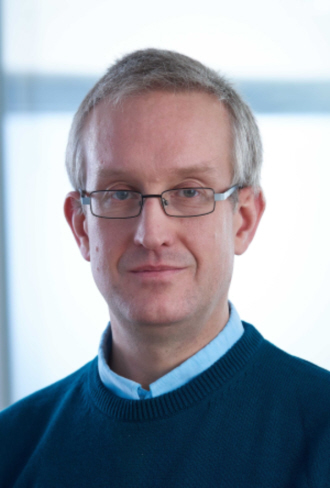
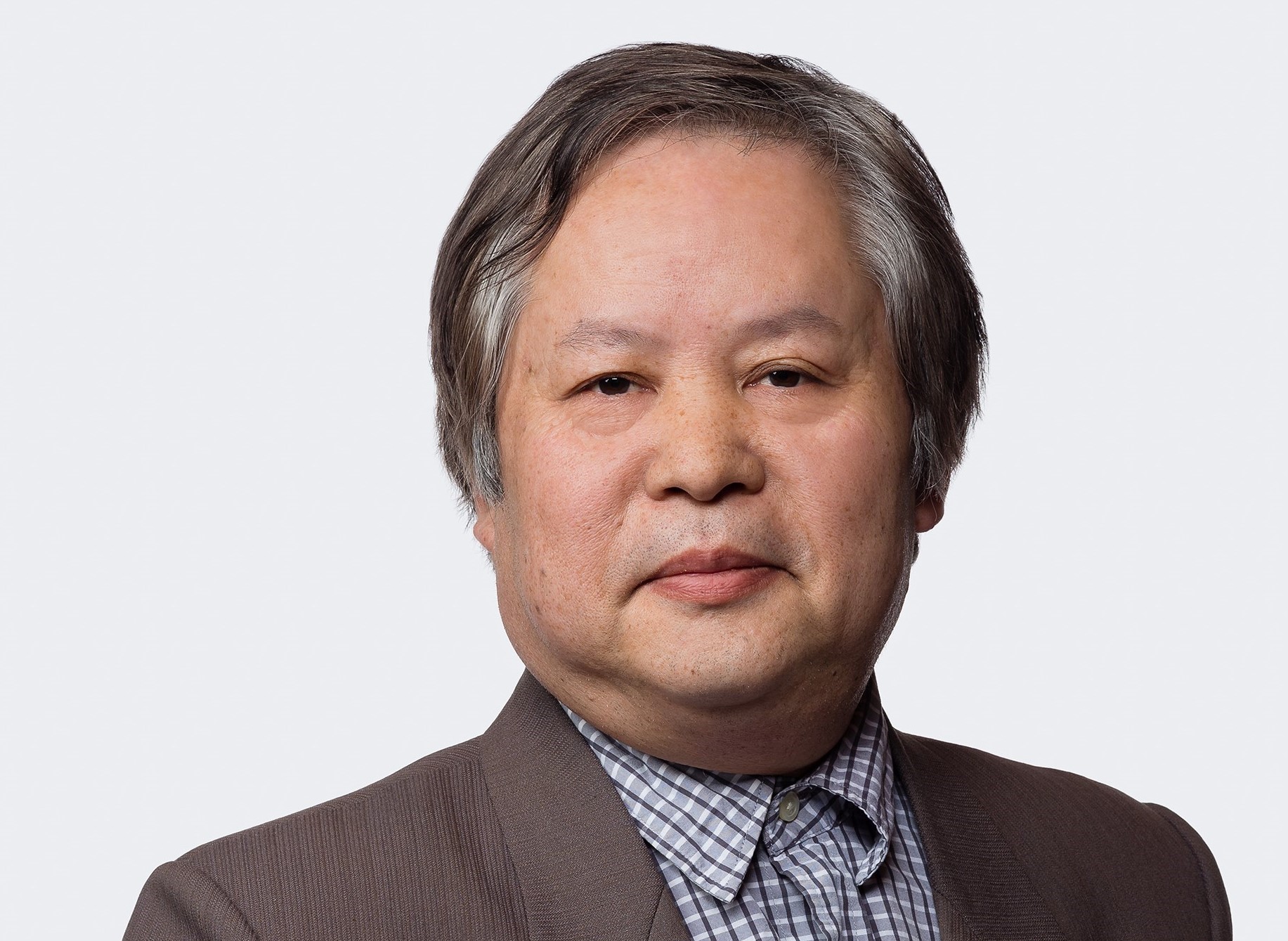
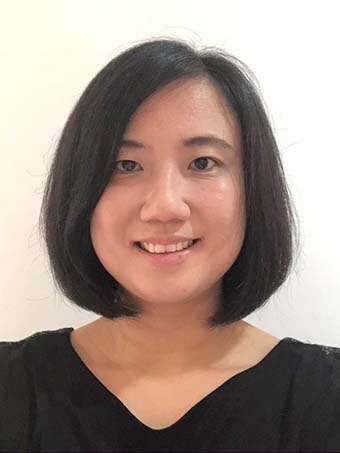
Christian Pascal Hirsch is an Associate Professor for Data Science and Statistics at the Department of Mathematics, Aarhus University. His research focuses on random networks inspired by biology and health sciences, utilizing techniques from topological data analysis and stochastic geometry. He is affiliated with the Stochastics group, AU DIGIT Centre, and AU Quantum Campus. Research Interests: Topological data analysis, large deviations theory, spatial random networks, and stochastic geometry. His work includes studies on percolation theory, Gibbs measures, and applications to neural networks and geometric functionals. Publications span journals such as the Journal of Applied and Computational Topology, Journal of Statistical Physics, and Stochastic Processes and Their Applications, covering topics from network topology to Poisson approximation.
Jes Frellsen is an Associate Professor at the Department of Applied Mathematics and Computer Science (DTU) since 2016. Previously, he held academic positions at the IT University of Copenhagen (2016-2019), postdoctoral roles at University of Cambridge (2013-2016) and University of Copenhagen (2011-2013). Education: PhD in Bioinformatics (2011), University of Copenhagen MSc in Bioinformatics (2007), University of Copenhagen BSc in Mathematics and Computer Science (2005), University of Copenhagen EAP Exchange at University of California, Santa Cruz (2004-2005) Research Focus Jes Frellsen specializes in statistical machine learning , particularly generative AI and deep generative models with applications in bioinformatics . His work integrates Bayesian inference , directional statistics , and Markov chain Monte Carlo methods to address challenges in macromolecular structure prediction and missing data imputation . Recent efforts explore uncertainty quantification in image segmentation and generative modeling for materials science. Advising & Collaborations He actively supervises PhD students and postdoctoral researchers in projects spanning news recommendation systems , medical imaging , and 3D structure generation . Collaborations include work with Zoubin Ghahramani (Cambridge) and Thomas Hamelryck (Copenhagen), with contributions to protein structure prediction and statistical methods in structural bioinformatics .
Professor Oliver Johnson is a faculty member at the School of Mathematics, University of Bristol, UK, where he serves as Head of School and holds the Professor of Information Theory position. His research bridges information theory, probability, and statistics, focusing on entropy convergence, group testing, and fundamental limits in data analysis. Current PhD students: Kieran Morris, Conor Crilly Ex-PhD students: Matt Aldridge, Leonardo Baldassini, Dan Cowley, Vaia Kalokidou, Tom Kealy, Jennifer Chakravarty, Zichen Gui, Chrys Paschou Ex-postdoc: Erwan Hillion His work includes ORCiD profile and collaborations across information theory, cybersecurity, and ecological modeling.
Jason Hartline is a Professor of Computer Science at the McCormick School of Engineering, Northwestern University, with a courtesy appointment in Managerial Economics & Decision Sciences. His research bridges computer science and economics, focusing on mechanism design, auction theory, and approximation algorithms. Ph.D. in Computer Science from the University of Washington (2003) Postdoctoral Fellow at Carnegie Mellon University (2003-2004) Researcher at Microsoft Research (2004-2007) His work develops methodologies to analyze and design economic systems using computational theory, particularly in auction mechanisms and non-truthful settings. Key contributions include the textbook Mechanism Design and Approximation and frameworks for Bayesian and prior-independent mechanism design. Recent publications (2018-2023) span topics like non-truthful mechanism learning, multi-dimensional agent modeling, and computational law. Collaborations include researchers from Harvard, Microsoft, and institutions across economics and theoretical computer science. Grants include multiple NSF awards (CCF, ECCS, HDR TRIPODS) for projects in data economics, machine learning integration, and peer grading systems. Former advisees hold academic positions at Stanford, Yale, and Penn State.
David Mount is a Professor in the Department of Computer Science at the University of Maryland, with an additional appointment at the University of Maryland Institute for Advanced Computer Studies (UMIACS). His primary research focus is Computational Geometry, particularly in designing, analyzing, and implementing data structures and algorithms for geometric problems. Applications of his work span image processing , pattern recognition , information retrieval , and computer graphics . He is a Fellow of the ACM and has received the ACM Recognition of Service Award twice. A member of the Algorithms and Theory Group, Mount has authored over 200 publications, many of which are available on Google Scholar, DBLP, and ArXiV. Research Focus Computational Geometry Algorithm Design and Analysis Geometric Data Structures Nearest Neighbor and Range Searching Clustering Algorithms Recent Publications Mount's recent publications (2023-2025) emphasize non-Euclidean geometry (e.g., Hilbert metric), dynamic geometric structures , and approximation algorithms for polytopes, Voronoi diagrams, and Delaunay triangulations. Collaborative works with students and researchers address challenges in kinetic data compression , label tracking , and geometric software development (e.g., Ipelets for polygonal geometry). Professional Activities Editorial Board Member, TheoretiCS (2021-present) Senior Associate Editor, ACM Trans. on Spatial Algorithms and Systems (2013-2020) Program Committee Member, FOCS , ESA , SODA , and other major conferences Awards ACM Fellow ACM Recognition of Service Award (twice)
Dr. Chong Liu is an Assistant Professor of Computer Science at the State University of New York at Albany (SUNY Albany) in the College of Nanotechnology, Science, and Engineering. He received his PhD in Computer Science from UC Santa Barbara in 2023 and completed a postdoctoral fellowship at the University of Chicago's Data Science Institute (2023-2024). His research focuses on Machine Learning and AI for Science, particularly Bayesian optimization, bandit algorithms, generative models, and AI applications in drug discovery. He has received the SUNY IITG/OER Impact Grant and serves as Associate Editor for IEEE-TNNLS, Area Chair for ICML/AISTATS, and editorial board reviewer for JMLR. PhD: UC Santa Barbara (2023), advised by Yu-Xiang Wang Postdoc: University of Chicago Data Science Institute (2023) Research Interests : Broad: Machine Learning, Optimization, AI for Science Specific: Bayesian optimization, Bandit algorithms, Active learning, Experimental design, Generative models, AI for drug discovery Applications: Binding affinity prediction, Drug screening, Policy optimization Recent Article Trends : His 2024-2025 publications focus on extending Bayesian optimization theory under practical constraints, quantum-accelerated bandit methods, and multi-objective optimization for drug discovery. Earlier works include private learning frameworks and human-in-the-loop systems. Scientific Awards : 2025: SUNY IITG/OER Impact Grant Professional Activities : Organized NeurIPS workshops on AI for Drug Discovery (2023, 2025), co-organizing INFORMS sessions, and serving on program committees for ICML, NeurIPS, ICLR, and AAAI. He has given invited talks at institutions including University of Chicago, UC Santa Barbara, and Genentech. Teaching : Teaching courses like Numerical Methods (CSI 401) and Machine Learning (CSI 436/536) with syllabi spanning 2024-2025 semesters.
Douglas Nychka is a Professor in the Department of Applied Mathematics and Statistics at Colorado School of Mines since 2018. He holds an emeritus position at the National Center for Atmospheric Research (NCAR), where he previously directed the Institute for Mathematics Applied to Geosciences (IMAGe) from 2004 to 2017. Nychka earned his PhD in Statistics from the University of Wisconsin-Madison and a BA in Mathematics (with Physics emphasis) from Duke University. His research focuses on spatial statistics, nonparametric regression, and computational methods for large datasets, particularly applied to environmental and geophysical problems. He has developed influential R packages like fields and LatticeKrig , which are widely used for spatial data analysis. Nychka received prestigious awards including the Jerry Sacks Award for Multidisciplinary Research (2004) and recognition as a Fellow of both the American Statistical Association and the Institute of Mathematical Statistics. His work bridges statistical theory, computational innovation, and real-world applications in climate science and renewable energy. His academic career includes 14 years as a faculty member at North Carolina State University and roles at the National Institute of Statistical Sciences. Nychka's research emphasizes spatial statistics for climate data, statistical downscaling, and uncertainty quantification, with contributions to solar radiation modeling and extreme event analysis. He actively engages in interdisciplinary projects, collaborating with experts in climatology, environmental science, and data science. Professional service includes roles on committees for the National Research Council and leadership in statistical societies. His teaching focuses on modernizing curricula to integrate data science with applied statistics. Nychka’s work is characterized by a commitment to open-source software and reproducible research, exemplified by his R package contributions.
Dr. Yangjun Chen is a Full Professor in the Department of Applied Computer Science at the University of Winnipeg, Canada. He holds a Ph.D. from the University of Kaiserslautern, Germany (1995). His research focuses on database systems, graph algorithms, computational complexity, and theoretical computer science. Key areas include Federated Databases, Deductive Databases, DNA Databases, and the P vs NP problem. Education: Ph.D. in Computer Science, University of Kaiserslautern, Germany (1995). Research interests span graph query processing, algorithm design, big data optimization, and NP-completeness. Recent work includes polynomial-time solutions for 2-MAXSAT and advancements in string matching algorithms for DNA databases. Publications highlight contributions to graph indexing, efficient reachability queries, and algorithmic efficiency in databases. His work often bridges theoretical foundations with practical database applications. Awards: Excellent Merit Award (2022-2023, 2021-2022) - University of Winnipeg Best Article, ACTA Scientific Computer Sciences (2022) Multiple Best Paper Awards at conferences like DBKDA 2016 and CyberC Summit Teaching includes Advanced Databases, Distributed Database Systems, and Algorithms courses at both undergraduate and graduate levels. Active in supervising research in database systems and theoretical computer science. Laboratory and team focus on database innovation, including projects on graph databases and efficient query processing techniques.
NG Hui Khoon is an Associate Professor at the National University of Singapore , affiliated with Yale-NUS College and the Centre for Quantum Technologies . She holds a PhD in Physics from the California Institute of Technology (Caltech), USA (2009). Research Interests: Her work focuses on theoretical aspects of quantum information and computation, particularly quantum error correction and fault tolerance , quantum noise modeling , and quantum tomography . She investigates how resource constraints limit quantum computing and develops adaptive methods for quantum state estimation using neural networks. Publication Trends: Her recent articles (2021–2013) emphasize quantum error correction frameworks, tomography techniques, and statistical methods for quantum systems. Key themes include fault tolerance under amplitude-damping noise, randomized benchmarking for time-correlated dephasing, and Bayesian approaches for prior-data conflict checking. Scientific Awards: Early Career Teaching Award (2019, Inaugural recipient) CQT Fellowship (2019 – current) Advising & Grants: No explicit advising or grant details are provided. She collaborates with institutions like the Centre for Quantum Technologies and Yale-NUS College. Labs & Teams: She is associated with the Centre for Quantum Technologies, a leading research center in quantum information science.
Linan Chen is an Associate Professor in the Department of Mathematics and Statistics at McGill University since 2014, following a postdoctoral position at the same institution (2011–2014). He holds a Ph.D. from MIT (2011, supervised by Daniel Stroock) and a B.Sc. from Tsinghua University (2006). His research focuses on probability theory and its intersections with analysis and geometry, including partial differential equations, functional analysis, Gaussian measures, and random geometry. He is affiliated with the Probability Lab of the Centre de Recherches Mathématiques (CRM) and the CNRS-Unite Mixte Internationale (CNRS-UMI) since 2014. Chen teaches advanced probability courses such as Honours Probability (Math 356) and Advanced Probability Theory I/II (Math 587/589), alongside special topics courses like Topics in Geometry and Topology (Math 599). He has advised students including Leila Sloman, Reinhold Willcox, Ulysse Blau, and Olivier Nadeau-Chamard through independent study programs. His research explores cutting-edge topics in probability, including Gaussian free fields, degenerate diffusion equations, and asymptotic properties of geometric stochastic structures. Recent work addresses high-dimensional phenomena, stochastic processes in geometry, and applications in mathematical physics. Chen’s contributions span theoretical advancements and methodological innovations, with publications in journals such as the Journal of Theoretical Probability, Annales Henri Poincaré, and SIAM Journal on Mathematical Analysis.
Chun Wang is a Professor in the Department of Measurement & Statistics at the University of Washington's College of Education. His research focuses on advancing quantitative methods in educational and psychological measurement, with expertise in item response theory (IRT), computerized adaptive testing (CAT), and cognitive diagnostic modeling. He holds affiliate faculty status at the Center for Statistics and the Social Sciences. Education: B.S. in Psychology, Peking University (China) M.S. and Ph.D. in Quantitative Psychology, University of Illinois at Urbana-Champaign Research Interests: Development and validation of multidimensional/mixture IRT models Computerized adaptive testing optimization Cognitive diagnostic modeling for classroom applications Health measurement and bias detection in assessments Recent Trends in Articles: His work bridges statistical innovation with practical applications, emphasizing fairness and efficiency in assessments. Notable areas include: - Healthcare : Predictive models for discharge disposition and functional outcomes - Education Technology : Adaptive learning systems and diagnostic feedback mechanisms - Methodology : Bias detection (DIF), Bayesian estimation techniques, and computational efficiency Scientific Awards : Includes the Anne Anastasi Award (2020), McKnight Presidential Fellowship (2017), and multiple best reviewer recognitions from leading psychometrics journals. Advising & Grants: Supervised students including Xiao J., Zhu R., and Lu J.* in high-impact projects. Co-led a $10M NIH grant (AmplifyGAIN Center) to advance Gen AI in STEM education. Published extensively in Psychometrika , Journal of Educational and Behavioral Statistics , and other top outlets. Labs/Teams: Directs the Pmetrics Lab ( https://sites.uw.edu/pmetrics/ ), collaborating on cutting-edge measurement tools for education and healthcare.
Elliot Hui, Ph.D., is an Associate Professor in the Department of Biomedical Engineering at the University of California, Irvine (UCI), within the Samueli School of Engineering. His research focuses on biological microtechnology, including spatial cell biology, microscale tissue engineering, global health diagnostics, and microfluidic computing. He leads the Hui Lab, which develops tools for automating biochemical reactions, controlling cellular organization, and understanding tissue development dynamics. Key achievements include pioneering microfluidic logic systems for autonomous laboratory automation and creating novel cell culture platforms to study intercellular communication in tissues. His work bridges engineering and biology, addressing challenges in diagnostics and regenerative medicine. Notable contributions include the development of a programmable finite state machine for microfluidic control and a SLAS Fellowship awarded to his student Erik. Research Interests: Microfluidic devices, cell-cell interaction modeling, tissue engineering, and lab-on-a-chip systems. Labs/Teams: Hui Lab at UCI, specializing in microscale biological systems and automation. Publications span topics such as microfluidic computing architectures, tissue dissociation devices, and Bayesian experimental design. His work emphasizes applications in global health diagnostics and mechanistic studies of cellular processes.
Naratip Santitissadeekorn is a Senior Lecturer in Data Assimilation at the School of Mathematics and Physics, University of Surrey, where he is affiliated with the Mathematics at the Interface Group. His work bridges mathematics, data science, and real-world applications in urban planning, crime analysis, and geophysical fluid dynamics. Dr. Santitissadeekorn received his PhD from Clarkson University in 2008, with a dissertation titled "Transport Analysis and Motion Estimation of Dynamical Systems of Time-Series data." His doctoral research was supervised by Professor Erik Bollt. Following his PhD, he completed two significant postdoctoral positions: from 2008-2011 at the University of New South Wales, Sydney, Australia, working with Professor Gary Froyland on numerical techniques for finite-time Lagrangian coherent set identification, with applications to delimiting the polar vortex and Agulhas rings; and from 2011-2014 at the University of North Carolina-Chapel Hill, working with Professor Chris Jones on data assimilation projects. Dr. Santitissadeekorn's research focuses on inverse problems and data assimilation in geophysical fluid dynamics, the applications of Lagrangian Coherent Structures (LCS), and computational ergodic theory. His work combines theoretical mathematics with practical applications, particularly in urban growth modeling and crime analysis. He has developed innovative methods for identifying coherent structures in fluid flows, estimating transition probabilities from spatiotemporal data, and creating data-driven frameworks for urban expansion scenarios. His research demonstrates how mathematical techniques can be applied to solve real-world problems in environmental science, urban planning, and public safety. An analysis of Dr. Santitissadeekorn's recent publications (2020-2023) reveals a strong focus on urban expansion modeling and network analysis. His work on urban growth has evolved from basic cellular automata models to sophisticated frameworks that manage uncertainty through parameter clustering and growth mode identification. His research on Hawkes processes has advanced ensemble-based filtering techniques for analyzing count data in large networks. These publications demonstrate a consistent pattern of applying mathematical rigor to complex spatiotemporal phenomena, with increasing emphasis on data-driven approaches and practical applications. Dr. Santitissadeekorn has made significant contributions to data assimilation methods, particularly through the development of the extended Poisson-Kalman filter (ExPKF) for urban crime modeling. His teaching includes courses in Algebra and Bayesian Statistics, reflecting his expertise in both theoretical and applied mathematics. While specific awards are not mentioned in the available information, his extensive publication record in high-impact journals demonstrates recognition within his field. Dr. Santitissadeekorn's research has practical implications for urban planning and law enforcement. His work on urban expansion models helps planners understand different growth trajectories, while his crime modeling research contributes to improved police patrolling strategies. His interdisciplinary approach, combining mathematics, computer science, and domain-specific knowledge, positions him at the forefront of applying data science to societal challenges.
Peter K. Friz is an Einstein Professor in Mathematics at TU-Berlin, affiliated with the Institute of Mathematics, and associated with the Weierstrass Institute for Applied Analysis and Stochastics. His research focuses on stochastic analysis, rough path theory, and mathematical finance, with particular emphasis on volatility modeling and applications to quantitative finance. He has held prestigious grants, including ERC Starting and Consolidator Grants, and coordinates the DFG research unit 'Rough paths, stochastic partial differential equations, and related topics.' Friz's work bridges theoretical stochastic analysis and practical financial applications, emphasizing rough path theory and its implications for differential equations and stochastic processes. His collaborations include organizing international conferences and courses on rough paths, with invited lectures at institutions like Cambridge, Paris, and Bonn. Supported by DFG, the European Research Council, and the Einstein Foundation, his research explores geometric aspects of pathwise analysis and stochastic volatility dynamics. He has advised numerous PhD students and maintains active roles in academic administration, including coordinating Berlin Mathematical School programs and teaching advanced topics in stochastic calculus. His contributions to rough path theory and stochastic finance are recognized through his academic leadership and influential publications, including co-authoring the seminal book Multidimensional Stochastic Processes as Rough Paths .
Prof. Dan Olteanu is a full professor at the Department of Informatics, University of Zurich, leading the Data Systems and Theory (DaST) group. He holds visiting professorships at the University of Oxford and is an emeritus fellow of St Cross College. His academic journey includes a PhD from Ludwig Maximilian University (2005), postdoctoral roles at Saarland University and Cornell University, and prior faculty positions at Oxford (2007–2020). He has also worked in industry with companies like LogicBlox and RelationalAI, focusing on database systems and AI. Education: Bachelor’s in Computer Science, Politehnica University of Bucharest (2000) PhD in Computer Science, Ludwig Maximilian University (2005) Professional Roles: Full Professor, University of Zurich (since 2020) Visiting Professor, University of Oxford Emeritus Fellow, St Cross College Editorial Roles: ACM TODS, VLDBJ, SIGMOD Conference Chair: ICDT Council (since 2022) His research focuses on data systems theory, including query optimization, probabilistic databases, factorized databases, and in-database machine learning. He co-authored the seminal book Probabilistic Databases (2011) and has pioneered algorithms for efficient machine learning over relational data and incremental maintenance of analytical workloads. His work emphasizes scalable, theoretically grounded solutions for real-world data challenges. Awards: ICDT 2019 Best Paper Award ACM SIGMOD 2018 Distinguished PC Member Award ERC Consolidator Grant (2016) Oxford Outstanding Teaching Award (2009) Grants & Funding: Supported by Google, Microsoft Azure, Amazon AWS, EPSRC, and the European Commission. His research bridges academia and industry, with contributions to commercial systems like LogicBlox and RelationalAI. Labs & Teams: Heads the DaST group at Zurich, focusing on data systems theory and applications. Collaborates widely in the database and AI communities.