Arun Ram is a Professor and Chair of Pure Mathematics at the School of Mathematics and Statistics . His work bridges representation theory, algebraic combinatorics, and mathematical physics, with a focus on Hecke algebras, Macdonald polynomials, and symmetry in algebraic structures. Education: PhD, University of California - San Diego Bachelors Degree, Massachusetts Institute of Technology His research explores the interplay of representation theory with combinatorial models and geometric configurations, including applications to network analysis and number systems. Key contributions include advancements in understanding Macdonald polynomial expansions, Clebsch-Gordan coefficients, and Monk rules. His projects, such as Tantalizer Algebras and Macdonald Polynomials: Combinatorics and Representations , highlight collaborations and grants in algebraic research. While no explicit scientific awards are listed, his 66+ scholarly works and 2007-2016 research contracts demonstrate sustained academic impact.
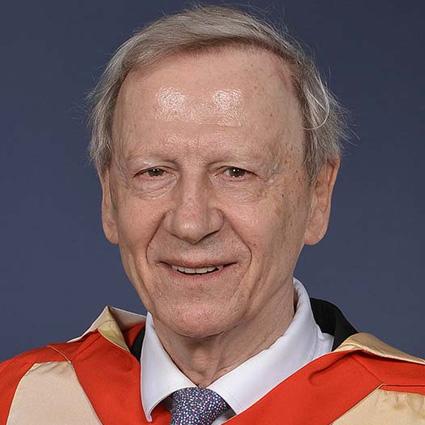
Anthony Giddens is a distinguished Professor of Sociology and Life Fellow of King's College, Cambridge. He served as Director of the London School of Economics (LSE) from 1999 to 2003 and is a Member of the House of Lords. In 2016, he was awarded an honorary doctorate by Goldsmiths, University of London. His academic career includes teaching at the University of Leicester and Cambridge, alongside his role as a global advisor to political leaders. Education: Began at the University of Hull, later completing studies at the London School of Economics (LSE). Research focuses on structuration theory, modernity, postmodernity, and political theory. His influential works include Capitalism and Modern Social Theory (1971), The Constitution of Society (1984), and The Third Way (1998). His theories on modernity and the 'third way' have shaped social democracy globally. Key awards include Fellowship in the American Academy of Science and Chinese Academy of Social Sciences. His work spans over 40 books, translated into 40+ languages. Advisory roles include influencing political strategies across Asia, Latin America, Australia, the U.S., and Europe. He advocates cosmopolitan values, emphasizing global interdependence in his 2016 honorary doctorate speech.
Rory Horner is a Senior Lecturer in Globalisation and Political Economy at the Global Development Institute (GDI), University of Manchester. He joined GDI in 2013 after completing his PhD in Geography at Clark University. His roles include Research Director (2020–2023) and leadership in academic programs such as the MSc International Development. He has held external roles including Co-Convenor of Network O (Global Value Chains) under SASE (2019–2023) and Co-chair of the Development Studies Association Annual Conference (2018). Horner’s education includes a B.A. in Economics and Geography (Trinity College Dublin), M.A. and PhD in Geography (Clark University). His research focuses on three core themes: the political economy of pharmaceuticals in global development, global value chains (GVCs) and South-South trade dynamics, and the conceptual shift to global development paradigms. His work spans fieldwork in Africa, India, and beyond, emphasizing implications for public health, industrial policy, and equitable globalisation. His publications address topics like India’s role as a generic medicine supplier, pharmaceutical value chains in sub-Saharan Africa, and the evolving geographies of global production networks. He has secured funding from UK ESRC, British Academy, and US NSF, and his media engagements include contributions to BBC News, El País, and NPR. Awards: Area Prize for new research in geography (2014) Economic Geography Specialty Group Best Student Paper Award (2009) Regional Development and Planning Specialty Group A.K. Dutt Best Graduate Student Paper Award (2013) Advising/Grants: Supervised 4 PhD students focusing on vaccine manufacturing, EV value chains, and textile trade. Led projects on India’s pharmaceutical production networks in Africa and South-South trade implications. Platforms: Convened research groups on Global Production Networks and taught courses including Globalisation, Trade and Development (MGDI 60271).
Dr. Laura Gulia is a Researcher at the Swiss Seismological Service (SED) affiliated with ETH Zurich. As the Principal Investigator of the ERC Advanced Grant FARIA, her work focuses on statistical seismology, earthquake forecasting, and induced seismicity. She pioneered the Foreshock Traffic Light System (FTLS), a real-time tool to distinguish between aftershock decay and foreshock sequences, published in Nature (2019) and further developed in Seismological Research Letters (2024). Her research emphasizes b-value analysis, data quality validation, and correlations between seismic activity and reservoir compaction rates in induced seismicity. Key Affiliation: Swiss Seismological Service (SED), ETH Zurich Grants: ERC Advanced Grant FARIA Her research interests include: - Real-time seismic hazard assessment - Artifact detection in seismic catalogs - Macroseismic data analysis using citizen-reported intensity data - Link between gas production and induced seismicity in Groningen Her publications demonstrate advancements in: - Foreshock/aftershock differentiation algorithms - Quantifying induced seismicity risks through b-value metrics - Integrating citizen science data for rapid earthquake response Awards: ERC Advanced Grant FARIA (2020) Advising and Collaborations: - Leading the FTLS development team at SED - Collaborating with European Mediterranean Seismological Centre (EMSC) on real-time macroseismic systems - Contributing to the Groningen gas field seismicity monitoring Labs/Teams: - Swiss Seismological Service (SED) research group - ERC-funded FARIA project consortium
Julien Warnan is a researcher at the Catalysis Research Center (CRC) of the Technical University of Munich (TUM). He leads a multidisciplinary research group focusing on renewable energy, particularly artificial photosynthesis and photocatalytic systems for fuel production. His work emphasizes molecular dyes, catalysts, polymers, and hybrid materials to transform CO2 and water into value-added chemicals. He holds the title of Researcher and is actively involved in academic leadership, including co-editing special issues and organizing international conferences like the ECAT conference. His research has been recognized with awards such as the TUM Chemistry Supervisory Award 2021. Recent activities include visiting scientist roles at Imperial College London and collaborations with groups at TUM and other institutions. Research interests encompass MOF-based photocatalysis, biohybrid systems, and sustainable energy conversion. Key achievements include pioneering studies on metal-organic frameworks for CO2 reduction and solar fuel production. His team has published extensively in high-impact journals like Angewandte Chemie and Advanced Materials , with a focus on functional hybrid materials and electrochemical systems. PhD supervision: Nadine Schmaus, Philip Stanley, Johanna Eichhorn, and others Notable collaborations: Shustova Lab, Rieger Group, Fischer Group Labs: Catalysis Research Center (CRC)
Luigi Acerbi is an Associate Professor in the Department of Computer Science at the University of Helsinki, where he leads the Machine and Human Intelligence research group. He is also an active member of the Finnish Center for Artificial Intelligence (FCAI) and ELLIS (European Laboratory for Learning and Intelligent Systems). His research focuses on probabilistic machine learning and computational neuroscience, particularly on developing efficient methods for statistical inference, Bayesian models of perception, and resource-constrained rationality. His work bridges machine learning and cognitive science, with applications in Bayesian optimization, simulation-based inference, and image completion. The recent publications highlight a strong trend toward unifying probabilistic conditioning across diverse tasks using transformer-based meta-learning frameworks like the Amortized Conditioning Engine (ACE). These works emphasize amortized inference, flexible latent variable modeling, and the integration of prior knowledge at runtime, enabling efficient and scalable Bayesian methods for complex problems. Scientific Affiliations: University of Helsinki, Department of Computer Science Finnish Center for Artificial Intelligence (FCAI) ELLIS (European Laboratory for Learning and Intelligent Systems) Education: PhD in Computational Neuroscience, Doctoral Training Centre, Edinburgh, UK Advisor: Sethu Vijayakumar and Daniel Wolpert Visiting work at Computational and Biological Learning Lab, Cambridge Postdoctoral Experience: Alex Pouget’s lab, University of Geneva, Switzerland Wei Ji Ma, New York University, USA Collaboration with the International Brain Laboratory Luigi Acerbi mentors PhD students including Daolang Huang and Nasrulloh Loka, and collaborates widely with researchers such as Samuel Kaski. He has contributed to open-source tools like PyVBMC and is involved in community initiatives such as the EurIPS conference. His work is supported by grants from the Research Council of Finland, Business Finland, and the UKRI Turing AI World-Leading Researcher Fellowship. He leads a research lab focused on amortized probabilistic inference, with ongoing projects including PriorGuide and Stacked VBMC, aiming to make Bayesian methods more practical and accessible for real-world scientific and engineering applications.
Sanjeev Dewan is a Professor of Information Systems and Associate Dean of Masters Programs at the Paul Merage School of Business, University of California, Irvine. He also serves as Faculty Director of the Master of Science in Business Analytics program. Prior to joining UCI in 2001, he held faculty positions at the University of Washington and George Mason University. PhD, University of Rochester MS, University of Rochester Bachelor of Technology, Indian Institute of Technology, Delhi His research focuses on the economics of digital platforms , social and mobile analytics , and the valuation of technology investments . He investigates how information technology creates business value, impacts consumer behavior, and influences firm performance. His work spans electronic markets, Web 2.0 technologies, IT productivity, and the digital divide. The most recent publications reveal a strong emphasis on empirical analysis of digital platforms , including studies on gender bias in open source communities, quality certification in the sharing economy (e.g., Airbnb), personalized ranking in app stores, and mobile health applications. His research frequently uses large-scale datasets to examine behavioral patterns, market dynamics, and the economic implications of IT innovations. Faculty Service Award for 2023-24, UCI Paul Merage School of Business Best Paper Award, INFORMS 2019 e-Business Cluster Faculty Service Award for 2016-17, UCI Paul Merage School of Business Best Paper Award, INFORMS Conference on Information Systems and Technology (2009) INFORMS Service Award (2009) INFORMS Certificate of Appreciation (2008) Beta Gamma Sigma Honor Society (1991) University of Rochester Fellowship (1985–1990) Sanjeev Dewan has advised numerous PhD students who have secured faculty positions at leading institutions such as the University of Wisconsin-Madison, HKUST, Penn State, and the University of Hong Kong. His editorial service includes senior editor roles at Information Systems Research and associate editor at Management Science . He has also chaired tracks at ICIS and served as program co-chair for PACIS. There is no indication of external grant funding in the provided text, but his sustained publication record and leadership roles suggest significant research activity and institutional support. He is actively involved in academic leadership and research dissemination, contributing to major conferences and editorial boards. His work bridges theory and practice, particularly in digital platform ecosystems and analytics-driven decision-making.
Plácido González Martínez is a Professor at the College of Architecture and Urban Planning, Tongji University, Shanghai, and a Distinguished Professor under the Eastern Scholar program. He serves as Executive Editor of the journal Built Heritage and is Vice President of the Association of Critical Heritage Studies, reflecting his leadership in global heritage discourse. His research centers on built heritage conservation, modern architectural history, and the socio-spatial dynamics of urban transformation. He critically investigates urban authenticity , gentrification , and heritage in the context of globalization , particularly in Chinese cities like Shanghai and Beijing. His work combines theoretical rigor with empirical analysis of urban interventions. The available articles reveal a consistent focus on the tensions between heritage conservation and commercial redevelopment , especially in historic urban neighborhoods. His scholarship interrogates how authenticity is constructed, negotiated, and often compromised in large-scale urban regeneration projects across East Asia. Scientific Awards: 1st Prize for Research, 2018 Spanish Architecture Biennale (for In Light of Hilberseimer ) Prof. González Martínez has held influential advisory roles, including drafting the Spanish National Plan for the Conservation of 20th Century Heritage (2014) and serving on the Advisory Board of the same. He is a founding member of the research collective GAMUC, which studies Spanish colonial architecture in Africa, and a member of the Scientific Committee of the Iberian Docomomo Foundation. These roles underscore his international impact in architectural heritage and critical conservation studies. He is actively involved in major academic initiatives, including editorial leadership of Built Heritage and participation in transnational research networks. His work bridges European and Chinese urban heritage paradigms, offering critical insights into the future of historic cities under global pressures.
Alex Wilson is an Associate Professor at Queen's Business School, Queen's University Belfast. He holds leadership roles including Director of Internationalisation and Direction of Reputation and Rankings at Queen's Business School, and previously held directorships at Loughborough University's School of Business and Economics. Research Interests: Open Strategy, Digital Strategizing, Strategy as Practice, Future of Management Education. Expertise in qualitative methods, IT/social media's role in strategic work, and business school innovation. His research explores how technology mediates strategic processes, organizational legitimacy, and the evolving purpose of business schools. He has advised on strategic initiatives for institutions globally and contributed to defining digital strategizing frameworks. Key Achievements: Recipient of CABS Research Fellowships (2017, 2018) Dean’s Award for Early Career Teaching Excellence (2015) Led studies on Singapore Management University's strategic evolution and UK business school competitiveness. Advises PhD students focusing on topics like corporate sustainability tensions, services offshoring, and Christian values in business. Active in hosting international delegations and delivering invited talks on open strategy and digital transformation.
Hadrian Geri Djajadikerta is a Professor and Accounting Discipline Lead at Curtin University's School of Accounting, Economics and Finance, part of the Faculty of Business and Law. He holds leadership roles such as Research Dean (Business and Law) and has previously held positions at UNSW, UTS, Lincoln University, and Edith Cowan University. His academic background includes a PhD from UTS, MBA from Montana State, and qualifications from ITB and UNPAR, alongside professional certifications like CA, CMA, and SCPM. Education: PhD(UTS), MBA(Montana), MSc(ITB), Drs(UNPAR). Additional training includes Business Analytics at the University of Cambridge. Research focuses on sustainability, corporate governance, and management accounting. Key areas include sustainability reporting, environmental disclosures, and interdisciplinary studies in supply chain, finance, and digital technology. Recent work explores climate resilience in higher education, digital competencies in energy industries, and freight transport sustainability. Awards include VC Excellence in Research Supervision and Teaching, AFAANZ Best Paper, and Wiley’s Top Cited Paper. Over 30 PhD students supervised and numerous grant investigations (e.g., Australia Africa Universities Network, Future Energy Exports CRC). Active in global collaborations and policy engagements, including parliamentary inquiries on short-stay accommodation. Grants include projects on climate change resilience ($20,000), digital competencies in energy ($219,375), and freight transport networks ($193,680). Engaged in not-for-profit social initiatives and corporate consulting in Indonesia and Australia. Led the Sustainability and Corporate Governance Research Cluster and contributes to industry partnerships through research clusters and advisory roles.
Arpit Gupta is an Associate Professor of Finance at the Leonard N. Stern School of Business, New York University, where he has been a faculty member since 2016. His research lies at the intersection of real estate, household finance, and urban economics, with a strong empirical focus on using large datasets to analyze financial behavior and market dynamics. Ph.D. in Finance and Economics, Columbia Business School B.S. in Mathematics and Economics, University of Chicago His research interests include household finance, real estate markets, mortgage default, bankruptcies, urban economics, and the financial impacts of health shocks and pandemics. He explores how financial constraints affect minority borrowers, how remote work reshapes urban real estate, and how public infrastructure influences property values. His recent publications span top journals such as the Journal of Finance , American Economic Review , Journal of Financial Economics , and PNAS . Themes across his work include the economic consequences of the COVID-19 pandemic, the valuation of private equity, and the spillover effects of foreclosures. His research often combines innovative data sources with rigorous econometric methods. Notable scientific awards include the Brattle Prize First Place (2019) and the 2016 Top Finance Graduate Award from Copenhagen Business School. He has advised on policy-relevant topics such as office-to-residential conversions, housing equity, and bail reform, and has received media attention for his insights on urban development and real estate trends. Professor Gupta collaborates with a wide network of researchers and maintains active engagement through a Substack newsletter and public data repositories. He advises students and contributes to academic discourse through conference presentations and policy discussions. He is affiliated with research labs and teams focused on urban economics and financial innovation, often collaborating with scholars at Columbia, NYU, and other institutions. His ongoing projects continue to explore the evolving dynamics of housing, finance, and urban resilience in the post-pandemic era.
Dr. Carla Cervini is an Academic Fellow in Nutrition and Mycology at Cranfield University's Centre for Soil, Agrifood and Biosciences and the Magan Centre of Applied Mycology (MCAM). She holds a PhD in Translational Medicine and Food from the National Research Council (Italy) and an MSc in Human Nutrition from the University of Rome Tor Vergata. Her research bridges food safety, climate change, and sustainable agriculture, with expertise in mycotoxin mitigation, agrifood systems, and gender-inclusive farming practices. Research Focus: Cervini investigates climate change impacts on mycotoxin-producing fungi (e.g., Aspergillus , Fusarium ), develops pre-/post-harvest interventions for crops like peanuts and cassava, and advocates for food security in sub-Saharan Africa. Her work emphasizes: Mycotoxin biocontrol under abiotic stress Gender disparities in agricultural training access Sustainable teff production for gluten-free diets Publications & Trends: Her 15 most recent articles (2019–2025) analyze mycotoxin dynamics in climate-stressed environments, biocontrol efficacy, and supply-chain safety in Ethiopia/Uganda. Dominant themes include fungal ecophysiology, risk assessment, and resilience in staple crops (wheat, maize, teff). Funding & Leadership: She leads tasks in the EU Horizon 2020 project EWA-BELT and UKRI Innovate UK's NutriNuts , with additional grants from the Global Challenges Research Fund (£13K) and British Mycological Society. She currently advises PhD student Kavitha Vijeandran. Labs & Collaborations: Cervini co-develops the Magan Centre of Applied Mycology, focusing on fungal threats to food safety. She collaborates globally on projects like aflatoxin management in Rwanda and mycotoxin training hubs for industry stakeholders.
Gireeja Ranade is an Assistant Teaching Professor in the Department of Electrical Engineering and Computer Sciences at the University of California, Berkeley. She previously served as a Researcher at Microsoft Research AI in the Adaptive Systems and Interaction Group. Her educational background includes a PhD in Electrical Engineering and Computer Science from UC Berkeley and an undergraduate degree from MIT. Research Focus Prof. Ranade's research spans control theory, information theory, and machine learning, with applications in wireless communication, algorithmic fairness, and misinformation analysis. Her work addresses fundamental challenges in system stabilization under uncertainty, real-time control optimization, and equitable resource allocation. She maintains strong collaborations across disciplines, resulting in publications at premier venues like IEEE Transactions on Automatic Control, PNAS, and The Web Conference. Her recent publications demonstrate a consistent focus on robustness in control systems, fairness in algorithmic decision-making, and analysis of information propagation in online ecosystems. The work frequently combines theoretical rigor with practical implementations in robotics, networking, and social systems. Awards and Recognition 2017 UC Berkeley Electrical Engineering Award for Outstanding Teaching 2020 UC Berkeley Award for Extraordinary Teaching in Extraordinary Times Academic Leadership Prof. Ranade leads a dynamic research group including PhD candidates, master's students, and undergraduates. She has advised over 25 students on projects ranging from neural network controllers to fairness metrics in resource allocation. She founded the CalMentors program, which connects UC Berkeley students with K-12 learners for tutoring support during the COVID-19 pandemic. Educational Innovation She co-designed and teaches UC Berkeley's introductory EECS 16A/B sequence, integrating linear algebra with applications in machine learning and circuit design. She has also developed courses on optimization (EECS127/227A) and data science (Data 102), with publicly available lecture videos demonstrating her teaching methodology.
Lorin M. Hitt serves as the Zhang Jindong Professor of Operations, Information and Decisions at the University of Pennsylvania's Wharton School. His distinguished career spans multiple domains at the intersection of information technology, economics, and business strategy. As a leading scholar in IT productivity and innovation, he maintains an active research agenda while teaching undergraduate and graduate courses in information systems and data analysis. Professor Hitt's research interests focus on the relationship between information technology and productivity, with particular emphasis on complementary factors such as organizational design and human capital that affect the value of IT investments. His current work explores the economics of IT labor mobility, enterprise software contracting, recommender systems' influence on consumer behavior, measurement of intangible assets, and pricing information goods. His research increasingly examines IT deployment in healthcare settings and the role of the IT workforce in relation to issues like offshoring and the H1-B visa program. His research publications demonstrate consistent contributions to top-tier journals, with recent work analyzing how data analytics mitigates post-IPO innovation decline, digital capital accumulation in superstar firms, and the relationship between analytics skills and firm productivity. His publication record shows sustained scholarly output across multiple domains of information systems research. Best Paper Runner-up – Management Science, 2014 Best Paper – Information Systems Research, 2013 Multiple Wharton Excellence in Teaching Awards (2003, 2007-2008, 2011) David Hauck Award for Distinguished Teaching, 1999 National Science Foundation Career Grant Recipient, 1998 Lindback Award for Distinguished Teaching, 1998 Professor Hitt teaches multiple courses including OPIM101 (Introduction to OPIM), OPIM105 (Data Analysis in VBA and SQL), OPIM469 (Information Strategy and Economics), and OPIM955 (Doctoral Seminar in IS Economics). His teaching focuses on information systems management, economics, data analysis, and advanced analytical methods. Beyond academia, he consults on IT outsourcing agreements and IT investment evaluation, and occasionally serves as an expert witness in technology-related litigation.
Prof. Dr. Bernd Skiera is a leading Marketing Professor at Goethe University Frankfurt since 1999 and a member of the managing board of the efl - The Data Science Institute. His work bridges information systems and marketing, with a focus on data-driven decision making and digital transformation.