Ed Hughes is a Professor of Composition in Music at the University of Sussex's School of Media, Arts and Humanities. His roles include Head of Music (2013-2018), Deputy Head of School, and Associate Dean for Education. He holds a BA from Cambridge University (1987-1990), an MPhil (Cambridge), and a PhD in Composition from Southampton (2000-2004). His research focuses on composition techniques, music technology, and interdisciplinary projects like Syncphonia, a notation system aiding ensemble performance. Notable works include operas like States of Innocence (2024) and orchestral pieces inspired by landscape, such as Music for the South Downs (2022). He has received grants from AHRC, Arts Council England, and the South Downs National Park Authority. Hughes has supervised numerous PhD students in composition and music technology. His awards include the British Composer Award (2014) and commissions from Brighton Festival and the Mahogany Opera Group. Collaborations with psychologists and educators highlight his commitment to music education and accessibility.
Roles & Affiliations: Britta Bauer is an Adjunct Professor of Flute at Mozarteum University, serving as Head of the Pre-College and Chair of the Curriculum Committee (Performance). She holds leadership roles in academic governance, including Deputy Department Head for Wind/Brass/Percussion and Senate Representative. Her international teaching spans institutions like the Hochschule für Musik und Tanz Köln and Redlands University, California. Education: She completed studies in flute performance, music pedagogy, and medicine across Bonn, Köln, Berlin, Paris, and Salzburg, earning top honors in all university degrees. Key mentors include Marianne Geise, James Galway, and Pierre Yves Artaud. Research & Pedagogy: Specializes in flute didactics and body-instrument physiology, developing concepts like 'The Body Sounds' for physical awareness in playing. Active in interdisciplinary performances blending music with dance, poetry, and light installations through her SIRIUS-Trio ensemble. Professional Contributions: Founded the International Flute Competition for Youth (2018), serves on national and international juries (Jugend Musiziert, EMCY), and publishes in journals such as Üben und Musizieren and Flöte aktuell . Her 2017 SCHOTT edition of Kolbris remains a pedagogical reference. Administration: Served as Deputy Department Head (2017–2022), Senate Vice-Chair (2018–2019), and initiated the annual 'Fachdidaktik Flöte' workshop at Mozarteum. Current roles include leadership in the German Flute Society (DGfF) and the International Flute Council (IFC).
Cayla Bellamy is an Assistant Professor of Bassoon and Coordinator of Woodwinds at Colorado State University, where she teaches applied bassoon, chamber music, and instrumental pedagogy. She performs with the Colorado Bach Ensemble and Pro Musica Colorado Chamber Orchestra. Her research focuses on redefining bassoon pedagogy, new music advocacy, and intersections between artistic training and athletic methodologies. Dr. Bellamy holds a Doctor of Music from Indiana University Jacobs School of Music and degrees from the University of Georgia. She has been awarded grants including the 2022 New Music USA Creator Fund and recognized in the Ernst Bacon Prize and American Prize competitions. Her scholarly work addresses curriculum diversification, practice engagement dynamics, and reed-making pedagogy. She currently serves as Communications Coordinator for the International Double Reed Society and previously taught at the New York Summer School of the Arts and Emory Youth Symphony Orchestra. Recent projects include album recordings of American bassoon repertoire (Double or Nothing, 2017) and ongoing commissions like The Ghosts That Haunt Us with composer Frank Horvat. She is preparing her second album, American Bassoon Voices, featuring new compositions.
Ingrid Pearson serves as Historical Clarinet Professor and Senior Academic Tutor at the Royal College of Music (RCM), where she has been a faculty member since 2005. Her career bridges historical performance practice with scholarly research, focusing on single-reed organology, music historiography, and conservatoire pedagogy. University of Sydney (BMus, Dip Ed) University of Sheffield (PhD in performance practice) Licentiate of Trinity College London (LTCL) Licentiate in Music (LMusA) Senior Fellow of the Higher Education Academy (SFHEA) Honorary Associate of the Royal College of Music (HonRCM) Pearson's research explores historical and contemporary performance practices through musical iconography, organology, and historiography. She has pioneered studies on clarinet reed positioning in historical contexts and microtonal performance challenges. Her scholarly output spans analyses of 18th–19th century single-reed instruments, Mozart's operatic instrumentation, and 20th-century British wind players' listening experiences. Notable collaborations include recordings with English Baroque Soloists and research on Robert Kahn's chamber works. Arts and Humanities Research Council (AHRC) grant for 19-tone microtonality Galpin Society grant for Neapolitan clarinet study She contributes to international period ensembles (English Baroque Soloists, The English Concert, etc.) and maintains active doctoral supervision at RCM. Her work appears in multiple languages, with Chinese, German, and Spanish translations of her research.
Dr. Stephanie Lind is an Associate Professor at Queen's University's DAN School of Drama and Music. Her primary affiliation is within the Department of Music, where she teaches music theory, analysis, and musicology. She holds a B.Mus. (Hon.) from Wilfrid Laurier University, an M.A. and Ph.D. from the University of British Columbia. Her research focuses on video game music, transformational theory, and contemporary Canadian art music, with a particular emphasis on the intersection of musical structures and gameplay narratives. Dr. Lind's research has been supported by a SSHRC Insight Grant and has produced influential works like Authenticity in the Music of Video Games (Lexington Press, 2023). Her articles explore topics such as rogue-lite game sound design, rhythm game mechanics, and the role of music in Assassin's Creed narratives. She is a屡获殊荣的教师, winning multiple DAN School Teaching Awards for her innovative pedagogical approaches, including the integration of technology in classrooms and mentorship of student research projects. Her community involvement includes active participation in Queen’s Music programs and Kingston’s music scene as a woodwind player and ensemble vocalist. Dr. Lind’s work bridges academic research with practical applications, emphasizing both scholarly rigor and creative expression.
Matthew Styles is a Senior Lecturer in Saxophone Studies at the Western Australian Academy of Performing Arts (WAAPA), Edith Cowan University. He serves as Coordinator of Honours (Music) and is a postgraduate supervisor with extensive experience in musician injury research through collaboration with sports science specialists. As a faculty member, he teaches research preparation courses, creative projects, and woodwind workshops across undergraduate and postgraduate levels. Matthew holds a Doctor of Musical Arts from the University of Western Australia (2008), a Bachelor of Music with Second Class Honours from the same institution, and two Certificate IV qualifications in Training and Assessment (2013 and 2023). His academic journey includes studies at the Royal College of Music, London, and mentorship under renowned saxophonists including Bob Berg, Martin Robertson, Dr. Kyle Horch, Dr. Otis Murphy, and Dr. Eugene Rousseau. His research interests center on cross-genre pedagogy and performance, specifically bridging classical and jazz traditions for classical musicians, and developing injury mitigation strategies for saxophonists through multi-disciplinary approaches with sports science. With over 30 years of professional experience as a saxophonist across jazz, classical, funk, and avant-garde genres, Styles brings practical insight to his academic work. His research outputs demonstrate consistent productivity with publications spanning from 2009 to 2025, showing particular focus on saxophone health, performance techniques, and cross-genre exploration. The publications reveal a trajectory from performance-focused outputs toward increasingly research-intensive work examining health, pedagogy, and interdisciplinary approaches. 2004 Churchill Fellowship HenriSelmerParis Artist D'Addario Artist JLV Sound Ambassador Dr. Styles actively supervises doctoral and master's students, currently serving as Principal Supervisor for three PhD candidates and Associate Supervisor for one PhD candidate. His completed supervision portfolio includes four PhD students as Principal Supervisor and five as Associate Supervisor across diverse musical topics. He has secured research funding including an ECU Early Career Researcher Grant ($23,560) for his project 'Saxology: recasting third stream music for the saxophone' (2014-2015). As director of 'The Phone Co.', he leads performance initiatives that integrate his research interests with practical application. His professional activities extend to membership in the Australian Society for Performing Arts Healthcare (since 2012), Performing Arts Medical Association (since 2015), and Western Australian Music (since 2022), where he serves as a conference reviewer, demonstrating his commitment to advancing knowledge in performing arts healthcare and music education.
Quincy C. Hilliard serves as the Heymann Endowed Professor of Music and Composer in Residence at the University of Louisiana at Lafayette, with prior appointments at Nicholls State University, Florida International University, and prominent high schools in Florida and Tennessee. His multifaceted career integrates composition, scholarly research, and pedagogy within the music discipline. Hilliard holds the following academic credentials: Ph.D. in Music Theory and Composition from the University of Florida (Outstanding Alumnus of the School of Music, 1999) Master of Music Education from Arkansas State University Bachelor of Science in Music Education from Mississippi State University (College of Education Alumnus of the Year, 1998) Dr. Hilliard's research centers on wind band composition and music education innovation. As an acclaimed composer, his works are published by leading houses and include commissions for the 1996 Olympic Games and Library of Congress. His scholarly contributions encompass Aaron Copland studies—authorized by the Copland estate to publish performance editions—and theoretical analyses presented at national societies. Educational publications like the Superior Bands series demonstrate his commitment to practical pedagogy, addressing band technique, theory, and ensemble development. His publication history reveals consistent focus on band education resources, evolving from foundational skill-building materials in the 1990s to comprehensive curricula and contemporary pedagogical frameworks. Recent works like the Oxford University Press book Teaching Instrumental Music Across Settings reflect his leadership in advancing instrumental music education through evidence-based practices and interdisciplinary perspectives. Hilliard's accolades include: 2023 University of Louisiana at Lafayette Eminent Faculty Distinguished Professor Award 2014 Mississippi Institute of Arts and Letters Award in Classical Music Multiple Global Music Awards for compositional excellence Annual ASCAP Awards for frequent performance of his works While specific graduate student advising isn't documented, Hilliard's influence extends through widely adopted educational materials and professional development. Significant commissions include the 2021 Trinity College Press Woodwind Examination Syllabus, Library of Congress Lincoln bicentennial project, and Olympic Games score. His ongoing ASCAP recognition underscores enduring relevance in performance repertoire. As president of Hilliard Music Enterprises, Inc., he leads a consulting firm with a board of distinguished music educators, providing expert guidance to institutions nationwide. This initiative bridges academic scholarship with practical implementation in school music programs.
Martin I. Gaines is an Assistant Professor in the Department of Music at the University of Wisconsin-La Crosse. He serves as conductor of the UWL Wind Ensemble, Symphony Orchestra, and Concert Band while teaching courses in Conducting, Clarinet, and Music Education. His career spans roles as Director of Instrumental Studies at Morningside University and Associate Director of Bands at McNeese State University. He holds a DMA in Conducting from the University of Arizona, an MM from Middle Tennessee State University, and a BMEd from VanderCook College of Music. Dr. Gaines’ research focuses on wind ensemble repertoire and conducting pedagogy. He has produced acclaimed recordings including David Maslanka: Music for Wind Ensemble (2021) and works by Nigel Clarke. His performances and ensembles have been featured at clinics such as the Southeastern Band Clinic and University of North Florida Invitational Festival. He maintains active memberships in professional organizations like CBDNA and WASBE. He received the 2015 Teacher of the Year award at Oakleaf High School. His teaching spans 15 years of K-12 band and orchestra instruction across multiple states before entering academia. Current responsibilities include leading ensembles and directing the Clarinet Studio.
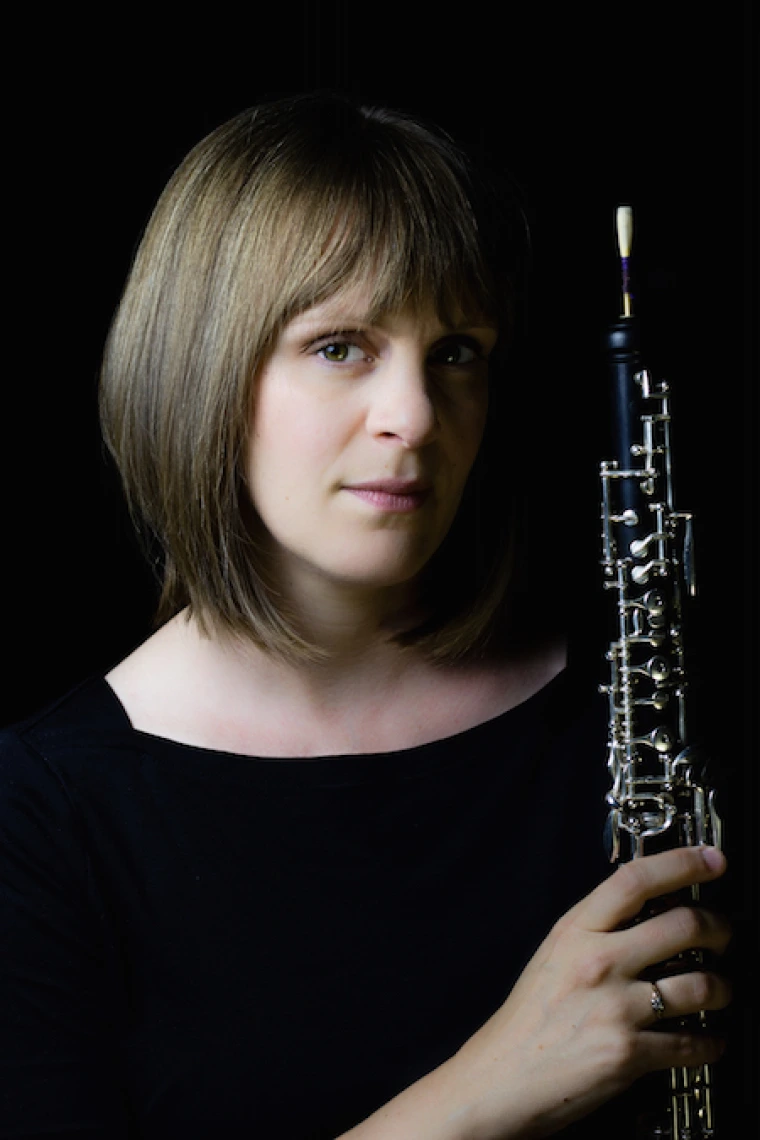
Sara Fraker is an Associate Professor of Oboe at the University of Arizona 's School of Music within the College of Fine Arts . She combines her academic role with performance commitments as a member of the Tucson Symphony Orchestra , principal oboist of True Concord Voices & Orchestra , and collaborator with the Arizona Wind Quintet . Education: DMA from University of Illinois at Urbana-Champaign (2009), MM from New England Conservatory (2002), BA from Swarthmore College (1999) Performance Roles: Tucson Symphony Orchestra | True Concord Voices & Orchestra | Arizona Wind Quintet Her research explores intersections of music and ecology , including collaborations with dendrochronologists and environmental scientists . Recent projects include Pine Chant (2021), using tree-ring data in musical composition, and Braiding (2020), integrating ecological themes with composer Asha Srinivasan and ecologist Robin Wall Kimmerer. Key focus areas include: Environmental soundscapes Interdisciplinary performance Contemporary oboe repertoire Korean music analysis Her 2021-2024 works demonstrate trends in ecological music composition , technology integration , and historical music recovery . Notable compositions include Pine Chant (2021), Oboe Quartet (2024 premiere), and White Sand & Gray Sand (2020). Scientific Awards & Honors 2023 Australian Art Music Awards - Work of the Year, Chamber Music Arizona Commission on the Arts - Artist Research and Development Grant Garrigues Scholarship National Merit Scholar Kate Neal Kinley Memorial Fellowship Gillet Fellowship (Tanglewood Music Center) Peter Gram Swing Prize As an educator, she teaches oboe pedagogy , reedmaking , and Music in World Cultures . She also contributes to interdisciplinary initiatives as affiliated faculty at UArizona’s Institute for Resilience (AIR) .
Charlotte Daniel, DMA is an Associate Professor of Flute at the Baylor University School of Music in Waco, Texas. She performs as a member of the Baylor Winds and serves as Principal Flutist of the Waco Symphony Orchestra , with additional experience as a chamber soloist and guest faculty. Doctor of Musical Arts (DMA) from The University of Texas at Austin Master of Music in Chamber Music and Performance from University of Michigan Bachelor of Music from Oklahoma State University (Presser Scholar Award) Her expertise spans flute performance , chamber music , and orchestral studies , with a focus on collaborative and solo engagements. Awards Presser Scholar Award 2016 Fischoff National Chamber Music Competition: Silver Medal 2015 Coleman Chamber Ensemble Competition: Coleman-Saunderson Prize Contact: Charlotte_Daniel@baylor.edu
Professor Vasileios Chatziioannou serves as Faculty Member and PhD Supervisor within the Department of Music Acoustics at the University of Music and Performing Arts Vienna. His academic leadership spans the Faculty of Music, where he guides doctoral candidates through the Structured Doctoral Program Performing Matters. His institutional role encompasses supervision across Ethnomusicology, Music in Society, and Musicology programs. His research focuses on the physics of musical instruments, with particular expertise in wind instrument aerodynamics and string-bow interaction mechanics. He employs advanced experimental techniques including particle image velocimetry (PIV) and high-speed motion capture alongside computational modeling. His work bridges theoretical acoustics with practical instrument design considerations, examining phenomena from tone hole geometry effects to friction dynamics in bowed strings. Analysis of his recent publications reveals a strong emphasis on energy-stable numerical methods for real-time simulation of musical instrument physics. His work consistently addresses the challenge of balancing computational efficiency with physical accuracy, particularly in modeling nonlinear phenomena like stick-slip friction and collision dynamics. The research trajectory shows increasing integration of experimental validation with computational models. While no specific scientific awards are documented in the provided materials, his sustained publication record in high-impact acoustics journals demonstrates significant scholarly contribution. His work regularly appears in specialized forums like the Journal of the Acoustical Society of America, particularly within special issues on musical instrument modeling. Professor Chatziioannou's supervision activities focus on computational and experimental approaches to musical instrument physics. His research program involves interdisciplinary collaboration between acousticians, instrument makers, and performers. Current projects include robotic replication of bowing techniques and 3D-printed instrument component optimization, reflecting his commitment to translating theoretical findings into practical applications for musicians and instrument designers.
Dr. Scott Brickman is a Professor of Music and Education at the University of Maine at Fort Kent, affiliated with the Humanities and Professional Studies school. He holds a Ph.D. in Music Composition/Theory from Brandeis University (1996) and a B.M. in Music Composition/Theory from the University of Wisconsin (1987). His research focuses on electronic music composition, orchestral works, 19th-century music theory, and music pedagogy for K-8 students. Notable compositions include Restoration – Symphony #4 (2018), Bagatelles (2018), and Epic Suite (2012). His works have been recorded by renowned ensembles like the Janacek Philharmonic Orchestra and released through labels like Navona and Phasma. Brickman is an active academic contributor, presenting papers on topics such as Romantic era music (Fanny Mendelssohn Hensel) and music education methodologies. He maintains memberships in the College Music Society, Society of Composers Inc., and SEAMUS (electro-acoustic music society). His pedagogical innovations include developing music theory curricula for young learners and pioneering collaborative composition projects with pre-school students. He continues to explore intersections between traditional composition techniques and modern digital music technologies.
Juliette Chabassier is a Researcher at the MAGIQUE-3D project team within Inria Bordeaux Sud-Ouest and affiliated with Université de Pau et des Pays de l'Adour . She holds a Ph.D. in Applied Mathematics from École Polytechnique (2012), advised by Patrick Joly and Antoine Chaigne. Roles: Junior Research Scientist (since 2013), Post-Doc at University of Pau (2012-2013) Research Focus: Acoustics of musical instruments, wave propagation modeling, numerical simulation of piano and wind instruments, energy-preserving discretization schemes, and viscothermal effects in ducts. Her work emphasizes physical modeling and computational acoustics , particularly in piano acoustics, wind instrument design, and heritage instrument digitization. She develops tools like OpenWind for simulating instrument responses and collaborates on projects involving piano soundboard analysis and historical instrument reconstruction. Her recent articles explore topics such as: Simulation of brass instruments using finite element models Thermoviscous effects in conical tubes Energy-conserving discretization for nonlinear wave equations Digital twins for heritage instruments like Besson trumpets She advises doctoral students including Elvira Shishenina and Izar Azpiroz , focusing on applied mathematics and acoustics. Her contributions include advanced numerical methods for acoustic-elastic coupling and boundary layer phenomena in exponential media. Current projects involve homogenization techniques for porous materials, real-time instrument simulation tools, and interdisciplinary work on acoustics education through open-source software.
Prof. Nikolay Kaufman is a distinguished scholar and arranger of Jewish musical folklore, specializing in Ashkenazic and Sephardic traditions. Over five decades, he has meticulously documented songs from synagogues and communities, preserving both unaltered melodies and his own complex arrangements. His work bridges musicology and performance, emphasizing cultural heritage and vocal techniques. He has published extensively on Jewish musicology and contributed to Bulgarian choral traditions. His research focuses on the interplay between religious/secular contexts, vocal ensembles (choirs, solos), and cultural influences. Notable techniques include multi-colored harmony, ornamentation, and 'instrumental' choir effects. His upcoming publication will categorize songs by ensemble, culture, and occasion. Kaufman’s arrangements often require specialized interpretation for languages like Yiddish and Ladino, using Cyrillic and Latin scripts. Kaufman’s articles analyze historical and contemporary music, from Beethoven’s compositional methods to Bulgarian folk ensembles. He advocates for interdisciplinary approaches, linking music to drama, psychoacoustics, and education. His contributions span pedagogy (solfège, cello schools) and cultural preservation, reflecting a deep engagement with both Eastern European and global musical traditions. Key Projects: Arrangements of Jewish songs, hybrid cultural pieces (e.g., Mira la Mar), Bulgarian-Jewish fusion. Publications: Over 15 articles (2013–2015) on musicology, education, and performance. Legacy: Preservation of fading traditions and professional choir techniques.
Ivan Andrić serves as a permanent Lecturer at the Department of Liturgy within the Faculty of Theology at Josip Juraj Strossmayer University of Osijek. Since 2017, he has held this full-time academic position, having previously worked as a part-time lecturer from 2013 to 2017. His academic career is deeply intertwined with his ecclesiastical service within the Đakovo-Osijek Archdiocese, where he has held multiple leadership positions in church music. Andrić earned his philosophical and theological education in Đakovo (1997), followed by advanced studies at the Pontifical Institute for Church Music in Rome, where he completed his Master's degree in choral conducting under Professor Walter Marzilli. His academic foundation combines theological training with specialized musical expertise, particularly in liturgical musicology and choral direction. His research focuses on liturgical musicology, with particular emphasis on the musical heritage of Slavonia and the Đakovo-Osijek Archdiocese. Andrić has made significant contributions through historical and musical research on Slavonian church musicians including Jakob Haibel, the Trischler family, Pero Ivanišić-Crnkovački, Stjepan Lovrić, Josip Vallinger, and Mitar Dragutinac. His scholarly work bridges historical musicology with practical liturgical applications, evidenced by his extensive editorial work on historical musical compositions. Andrić has published numerous articles and edited significant musical works, particularly focusing on the Austrian-Đakovo composer Jakob Haibel. His recent publications demonstrate a consistent scholarly output in musicology, liturgical studies, and sacred music composition, with particular attention to historical context and practical liturgical application. Professionally, Andrić has directed multiple choirs including the Cathedral Mixed Choir, Theological Seminary Choir, and cathedral choristers Coram Domino since 2004. He has organized approximately twenty sacred concerts in Croatia and abroad (Italy, Hungary, Bosnia and Herzegovina, Serbia), and has recorded a CD titled Mysterium Paschale with Coram Domino. His editorial work includes the liturgical-pastoral magazine Živo vrelo, where he has served on the editorial board since 2004, specifically editing the musical content. Andrić also serves as head of the Archdiocesan Music School and the Office for Church Music within the Đakovo-Osijek Archdiocese. In these capacities, he organizes expert seminars for parish music associates and reviews of church choirs, significantly influencing liturgical music practice throughout the region. His collaborative work with the Croatian Association of Orchestral and Chamber Musicians and Croatia Records demonstrates his commitment to preserving and promoting Croatia's sacred musical heritage.