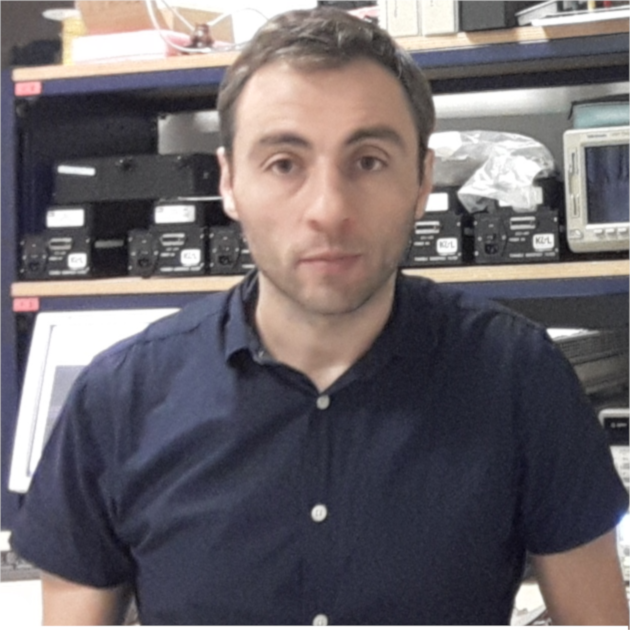
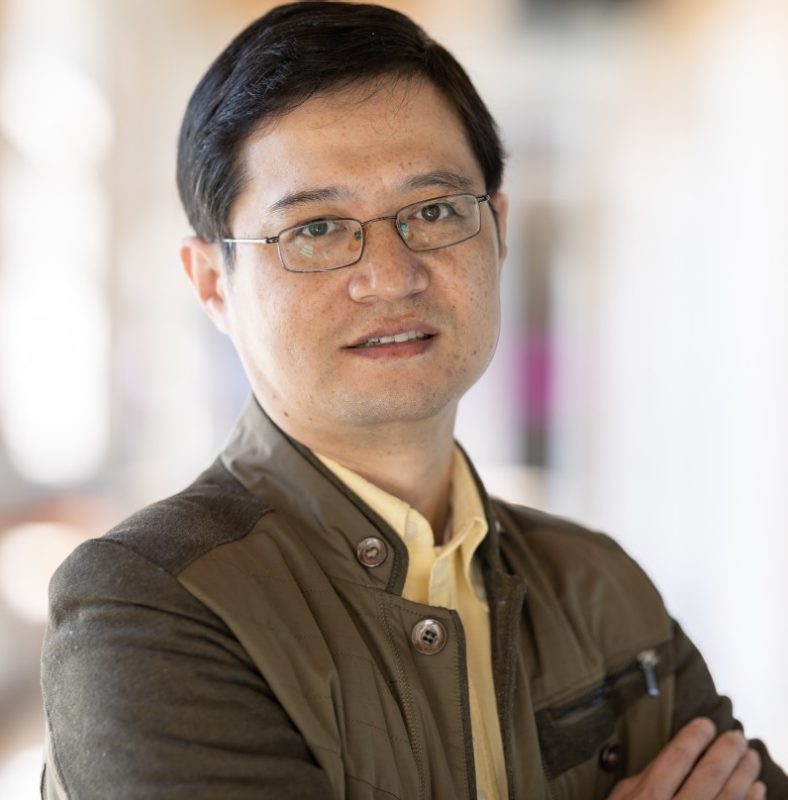
Mohammadmahdi Asgari is a Doctoral Researcher at Aalto University's Department of Electronics and Nanoengineering. His research focuses on advanced electromagnetic and photonic materials, particularly metasurfaces , metamaterials , and photonic time crystals . His work explores applications in wireless communication enhancement, inverse topology design for multifunctional surfaces, and non-reciprocal optical phenomena. Key research themes include: Wave propagation control Spontaneous magnetization effects Space-time modulated materials Passive metacrystal systems Publications reveal a concentration on both theoretical frameworks and practical implementations in electromagnetic and optical engineering. Asgari collaborates with prominent researchers including Shanhui Fan and Viktar Asadchy.
Ahmad Lotfi is a Professor of Computational Intelligence and Head of Department of Computer Science at Nottingham Trent University , with a Visiting Professor role at Tokyo Metropolitan University . He leads the Computational Intelligence and Applications (CIA) research group and has supervised over 30 PhD students to completion. PhD in Learning Fuzzy Systems (University of Queensland, 1995) MTech in Control Systems (Indian Institute of Technology, India) BSc in Control Systems (Isfahan University of Technology, Iran) His research spans computational intelligence , ambient intelligence , robotics , and machine learning , with applications in dementia monitoring , smart environments , and healthcare technology . Recent work focuses on using thermal sensor arrays for privacy-preserving human activity analysis. He has secured funding from Innovate UK , EPSRC , The Royal Society , and Horizon 2020 , with projects like iCarer (assistive living), SmartBerry (agricultural AI), and BigSpark (financial data augmentation). His 15 most recent articles demonstrate expertise in Wi-Fi-based activity recognition , EEG fall detection , and thermal sensor fusion . Senior Member IEEE Member of British Computer Society (MBCS) Editorial roles in Soft Computing and Journal of Ambient Intelligence and Smart Environments He has served as Program Chair for conferences like PETRA and ICCRT , and as Keynote Speaker at PETRA 2023 . His 28+ years of academic leadership include organizing UKCI and UKRAS conferences.
Mahbubur Rahman is an Assistant Professor in the Department of Computer Science at Queens College and the Graduate Center, City University of New York (CUNY). He earned his PhD in Computer Science from Wayne State University in 2020 and a BSc in Computer Science & Engineering from Bangladesh University of Engineering and Technology in 2012.
Prof. Dr. Selcuk Paker is a faculty member at the Department of Electronics and Communication Engineering , Faculty of Electrical and Electronics Engineering , Istanbul Technical University. His research spans electromagnetic field theory, microwave systems, and telecommunications, with a focus on antenna design, radar imaging algorithms, and bioelectromagnetics. Research Interests : Electromagnetic scattering, inverse scattering, radar systems, SAR imaging, GNSS algorithms, microwave heating, and wireless communication. Recent publications highlight his work in 5G antenna design , radar-based earthquake detection , and biological effects of RF exposure . He contributes to microwave and radar technologies, including applications in structural diagnostics and sensor networks.
Dr. Saibal Mukhopadhyay is a Professor in the Department of Electrical and Computer Engineering at the Georgia Institute of Technology, where he joined in 2007. He holds the Joseph M. Pettit Professorship and is recognized as an IEEE Fellow for his contributions to low-power and reliable VLSI systems. Education: BEng (Jadavpur University, India), Ph.D. (Purdue University) Labs: Gigascale Reliable Energy Efficient Nanosystem (GREEN) Lab His research focuses on VLSI Systems , Nanotechnology , and Low-Power Electronics , with emphasis on technology-circuit co-design for energy-efficient computing. Recent work explores Compute-in-Memory (CIM) architectures and Spiking Neural Networks for edge AI. Key article themes include Transformer Model Acceleration , Quantum Computing Calibration , 3D Object Detection , and Device Aging Analysis , reflecting his interdisciplinary approach bridging hardware design and machine learning. Scientific Awards IEEE Fellow (2018) ONR Young Investigator (2012) NSF CAREER Award (2011) IBM Faculty Awards (2009, 2010) Best Paper Awards (IEEE-Nano 2003, ICCD 2004)
Dr. Fendy Santoso is a Visiting Fellow at UNSW Canberra's School of Engineering and Information Technology, where he conducts cutting-edge research at the intersection of cyber-physical systems, cybersecurity, and artificial intelligence. His work focuses on developing robust security mechanisms for autonomous systems, particularly UAVs and robotics operating in adversarial environments. His educational background includes a PhD in Electrical Engineering from UNSW Sydney and a Master of Engineering (Electrical and Computer Systems) from Monash University. Dr. Santoso's research interests span cyber-physical systems security, adversarial machine learning, trustworthy autonomy, and AI-driven cybersecurity for autonomous platforms. His work specifically targets penetration-resistant architectures and secure decision-making frameworks for UAVs and robotic systems operating in dynamic, threat-prone environments. His approach integrates advanced fuzzy logic systems with deep learning techniques to create resilient control mechanisms that can withstand cyberattacks and operational uncertainties. Analysis of his recent publications reveals a consistent focus on applying type-2 fuzzy systems, deep learning, and negative imaginary control theory to solve critical challenges in autonomous systems security and control. His work demonstrates strong interdisciplinary connections between cybersecurity, control theory, and artificial intelligence, with particular emphasis on real-world implementation and experimental validation. Distinguished Early Career Travel Fellowship 2019, University of Wollongong ARC Linkage Project: Robust Defenses Against Adversarial Machine Learning for UAV Systems (2023) CSIRO Next Generation Grant for AgriTwins: Bridging Cyber-Secure Emerging Technologies and Data-Centric Twin Tech for Resilient Agriculture of the Future (2024) Dr. Santoso has secured over AUD 3 million in competitive research funding from prestigious sources including the Australian Research Council, U.S. Army Ground Vehicle Systems Centre, and Defence Science and Technology Group. He leads multi-disciplinary research teams and maintains strategic partnerships with defense and government agencies to translate theoretical advances into practical cybersecurity frameworks. His laboratory work centers around the Autonomous System Laboratory at UNSW Canberra, where he conducts experimental validation of security protocols for military ground robots and UAVs under realistic cyberattack scenarios.
Ramavarapu S Sreenivas is a Professor in the Industrial and Enterprise Systems Engineering department at the University of Illinois at Urbana-Champaign , with research appointments at the Coordinated Science Laboratory (CSL) and the Information Trust Institute (ITI ). He holds a joint affiliation with the Electrical and Computer Engineering department and serves as the Arthur Davis Faculty Scholar since 2016. Ph.D. , Electrical and Computer Engineering, Carnegie Mellon University (1990) M.S.E.E. , Carnegie Mellon University (1987) B.Tech , Electrical Engineering, Indian Institute of Technology Madras (1985) His research focuses on Discrete-Event/Discrete-State (DEDS) systems , applying Coding Theory, Machine Learning, and Information Theory to develop near-optimal supervisory policies for applications in wireless networks, automated manufacturing, and healthcare systems . He leads the Center for Autonomous Construction and Manufacturing at Scale (CACMS) , established in 2023. Recent publications highlight advancements in liveness enforcement in Petri nets , fault-tolerant control , and IoT-based load scheduling . His work bridges theoretical rigor with practical implementations in Distributed Control, Network Coding , and Reinforcement Learning . UIUC Campus Award for Excellence in Graduate and Professional Teaching (2023) Arthur Davis Faculty Scholar (2016) Senior Member, IEEE (2002) James Franklin Sharp Outstanding Teaching Award in Industrial Engineering (2017, 2012) Sreenivas has taught graduate and undergraduate courses in Control Systems, Integer Programming, and Financial Computing since 1992. He co-instructed courses in Health Technology and contributed to the Master of Science in Financial Engineering (MSFE) program, which ranks 4th nationally.
Dr. Sirojan Tharmakulasingam serves as a Lecturer and Research and Development Coordinator at the Signals, Information & Machine Intelligence lab within the Faculty of Engineering at the University of New South Wales (UNSW) Sydney. His work bridges theoretical machine learning with practical applications in edge computing and high-performance systems. His research spans multiple cutting-edge domains including machine learning, artificial intelligence, data science, edge computing, and high-performance computing. Dr. Tharmakulasingam specializes in developing next-generation inference models by integrating machine learning, signal processing, mathematical modeling, and computing across diverse data types including images, video, audio, and quantum molecular data. His work has significant implications for scientific computing, telecommunications, and healthcare applications. Analysis of his publication trends reveals a strong focus on practical AI implementations, with increasing emphasis on edge computing solutions, quantum applications, and energy-efficient models. His recent work demonstrates progression from foundational machine learning techniques toward specialized applications in scientific computing and real-time systems. Dr. Tharmakulasingam holds a Doctor of Philosophy from UNSW Sydney and a Bachelor of Science of Engineering from the University of Moratuwa in Sri Lanka. His academic journey reflects a strong foundation in both theoretical and applied engineering principles. As Research and Development Coordinator for the Signals, Information & Machine Intelligence lab, he oversees critical research infrastructure and collaborations. His work location in Room 447 of the EE&T Building (G17) places him at the heart of UNSW's engineering research ecosystem, with access to the Mark Wainwright Analytical Centre's extensive facilities.
Chadi Jabbour is a Professor at Institut Polytechnique de Paris , specializing in analog/digital converter design, communication system linearization, and flexible receiver architectures. He leads the Communication Circuits and Systems (C2S) team at the Information Processing and Communication Laboratory (LTCI) in the Communications and Electronics (Comelec) department.
Andreas Johnsson is an Adjunct Senior Lecturer at the Department of Information Technology , Uppsala University, Sweden. His research spans Machine Learning , Network Performance , and IoT Security in the context of 5G/6G Networks and Edge Computing . Research interests include federated learning, transfer learning, and network optimization techniques. His recent work (2024-2021) focuses on self-regulated learning models for 6G, multi-objective neural architecture search, IoT intrusion detection generalizability, and delay prediction in heterogeneous networks. He has co-authored over 15 publications in high-impact venues like IEEE Transactions on Machine Learning in Communications and Networking and IEEE NOMS . Andreas actively collaborates with researchers such as Jalil Taghia, Farnaz Moradi, and Hannes Larsson. His contributions extend to change detection algorithms, policy adaptation frameworks, and feature selection methodologies in dynamic network environments. No formal scientific awards or student advisement details are currently documented.
Nancy A. Lynch is the NEC Professor of Software Science and Engineering and Professor of Electrical Engineering and Computer Science at the Massachusetts Institute of Technology, where she heads the Theory of Distributed Systems (TDS) group within CSAIL. Research Interests Distributed computing algorithms and lower bounds Real-time and fault-tolerant systems Formal modelling and verification Wireless network algorithms Biological distributed algorithms Neural computation and spiking networks Across her work, Lynch blends rigorous theoretical analysis with practical relevance, tackling problems ranging from consensus and leader election in unreliable networks to modelling decision-making circuits in the brain. Publications & Trends Since 2020 she has published extensively on distributed algorithms , swarm robotics , neuromorphic architectures , and biologically-inspired computation . Notable recent directions include hierarchical concept learning in spiking neural networks, nanobot locomotion modelling for cancer detection, and superconducting nanowire platforms for energy-efficient neural hardware. Scientific Awards & Honors Best Paper Award, OPODIS 2018 Best Paper Award, IEEE NCA 2014 Highlight Paper, Neuromorphic Computing and Engineering 2022 Teaching & Advising Lynch teaches core graduate and undergraduate subjects at MIT including 6.042J Mathematics for Computer Science , 6.852J/18.437 Distributed Algorithms , and 6.885/6.006 Algorithms . She has supervised dozens of PhD students and post-docs whose names are listed on her Past Students page. Laboratory & Teams She leads the Theory of Distributed Systems (TDS) Group , a vibrant research team within MIT CSAIL . TDS is part of the larger Theory of Computation group and hosts weekly seminars, reading groups, and collaborative projects with partners across MIT and worldwide.
Prof. Dr. Haris Gačanin is a faculty member at RWTH Aachen University, affiliated with the Institute for Distributed Signal Processing under the College of Electrical Engineering. His research focuses on integrating machine learning with wireless communication systems, particularly in industrial IoT, edge computing, and network optimization. Current academic rank: Professor Contact: harisg@dsp.rwth-aachen.de Research Interests: Wireless systems, machine learning, signal processing, and network optimization. Key contributions include: Adaptive resource allocation in IIoT and vehicular networks AI-driven channel estimation and feedback mechanisms Security-oriented emitter identification via metric learning Federated/transfer learning for edge environments Hardware-efficient deep learning models for mmWave and THz communications Methodological Focus: Combines reinforcement learning, attention mechanisms, and robust neural architectures with practical implementations on FPGA and vehicular systems.
Dr. Arish Sateesan serves as Professor and Chair of the Institute for Networked Systems at RWTH Aachen University's Faculty of Electrical Engineering and Information Technology, located at Kackertstrasse 9 in Aachen, Germany. His research group operates from House C (Room C046) with direct contact via asa@inets.rwth-aachen.de. His primary research domains center on hardware-accelerated network security solutions, specializing in FPGA implementations for high-speed networking. Key focus areas include: Real-time network monitoring and intrusion detection systems Hardware-optimized cryptographic and non-cryptographic algorithms Machine learning integration for wireless beamforming and LiDAR processing Ultra-high-speed flow measurement architectures His work bridges theoretical computer science with practical hardware constraints, emphasizing throughput optimization for security-critical applications. Analysis of his 15 most recent publications (2021-2025) reveals a pronounced shift toward hardware-software co-design for next-generation networks. The research trajectory shows increasing integration of quantized neural networks with traditional security primitives, particularly for mm-Wave and 5G/6G applications. A consistent theme across all publications is the prioritization of hardware friendliness through algorithmic simplification and architectural innovation. As Institute Chair, he leads a research ecosystem focused on developing deployable security solutions for modern network infrastructures, with current projects targeting autonomous vehicle communication systems and infrastructure protection against distributed denial-of-service attacks.
Professor Ai-Chun Pang is affiliated with the National Taiwan University , serving in both the Department of Computer Science and Information Engineering and the Graduate Institute of Networking and Multimedia . He held leadership roles including Associate Dean (2018-2022) and Director (2013-2016) within the College of Electrical Engineering and Computer Science. His research spans Fog/Edge Computing , Wireless Networking , Mobile Computing , and AIoT Systems , with recent advancements in federated learning security, energy-efficient network design, and 5G/6G optimization. Collaborative work includes applications in vehicular networks, industrial control systems, and non-terrestrial connectivity. Key publication themes: Edge Intelligence and Privacy (2024) Federated Learning for Heterogeneous Devices (2023-2024) 5G Backhaul Optimization (2017-2021) Wireless Energy Transfer (2022) Awarded IEEE Fellow 2021 for contributions to mobile edge networks, he has received multiple IEEE Vehicular Technology Society awards, the CES 2019 Innovation Award , and teaching accolades including National Taiwan University Distinguished Teaching Award (2010) . His lab has produced 16 PhD students now in academia and industry. As Editor-in-Chief of IEEE Wireless Communications Letters and active in conference organization, he shapes global research directions. Current projects focus on GenAI for Networking and Non-Terrestrial Networks , with recent 2024 admissions for new students.
Lingjia Liu is a Professor and Bradley Senior Faculty Fellow at Virginia Tech's Bradley Department of Electrical and Computer Engineering. Her research focuses on enabling technologies for 5G/6G networks, including massive MIMO systems, dynamic spectrum access, and AI-driven communication networks. She holds a Ph.D. from Texas A&M University (2008). Research Interests : 5G/6G Network Architectures (3D MIMO, cloud-RAN, ultra-low latency) AI in Communications (Reservoir Computing, federated learning) IoT & Cyber-Physical Systems (energy harvesting, privacy protection) Non-Terrestrial Networks (satellite-based connectivity) Recent work emphasizes generative AI for network simulation, explainable AI in communication systems, and secure dynamic spectrum sharing. Her research spans theoretical foundations (e.g., OTFS modulation analysis) and practical implementations (e.g., FPGA-based reservoir computing). Awards : Bradley Senior Faculty Fellow (Virginia Tech). Her contributions bridge communication theory and AI, addressing 6G challenges through innovative algorithmic and architectural solutions. Current projects explore agentic protocol learning, federated multi-agent RL for spectrum access, and resilient ML under adversarial conditions.