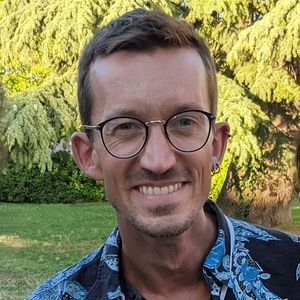
Carlos Ramisch is an Assistant Professor in Computer Science at Aix Marseille University, France, affiliated with the TALEP research group at LIS (Laboratoire d'Informatique et Systèmes). His work centers on computational linguistics and natural language processing, with a primary focus on multiword expressions (MWEs), language models, and semantic analysis. He actively contributes to the PARSEME community, organizing shared tasks on verbal MWE identification. His research includes developing the mwetoolkit for MWE discovery and SLICE for interpretable contextual embeddings. He has led funded projects such as SELEXINI (2022-2026) and PARSEME-FR (2016-2021). His methodological innovations span cross-lingual dependency parsing via typological features (NAACL 2019), compositionality prediction for nominal compounds (Computational Linguistics 2022), and lexical substitution datasets (IWCS 2017). He supervises students in NLP internships and co-authored the educational comic strip La grande aventure du TAL . His editorial roles include the LSP series on Phraseology and MWEs, and he has chaired multiple MWE workshops (2010-2022).
Bruno Gaujal is a Research Professor at Inria Grenoble-Rhône-Alpes, affiliated with Université Grenoble Alpes. He obtained his PhD from the University of Nice in 1994 under François Baccelli's supervision and has held positions at AT&T Bell Labs, INRIA, and École Normale Supérieure de Lyon. He previously led the MESCAL (now POLARIS) research group focused on large-scale computing until 2015. His research interests center on performance evaluation, optimization, and control of discrete event dynamic systems with stochastic inputs. Specific areas include: Markov Chains and Markov Decision Processes Reinforcement Learning and stochastic optimization Queueing theory and scheduling algorithms Energy-efficient computing in distributed systems Game-theoretic approaches in network optimization Gaujal's recent publications show strong emphasis on reinforcement learning applications in queueing networks, energy optimization for real-time systems, and scalable algorithms for Markov Decision Processes. His work bridges theoretical frameworks like Whittle indices with practical implementations in cloud computing and distributed systems. He has supervised numerous PhD students including Nicolas Gast (now Inria researcher), Anne Bouillard (Huawei researcher), and Emmanuel Hyon (Paris Nanterre professor). Current students include Hélène Arvis and Romain Cravic. Gaujal co-founded RTaW, a startup specializing in real-time network design tools. At Inria, he leads research in the POLARIS group, focusing on optimization methods for large-scale distributed computing infrastructures. His work involves collaborations with 85+ co-authors across institutions globally.
Mehmet Can Yavuz is an Assistant Professor at Işık University's Faculty of Engineering and Natural Sciences, Department of Computer Engineering. As Principal Investigator of the Multimedia Lab, he bridges machine learning with artistic expression through projects like Arky Multimedia, ConvergedMachine, and Duyukoru. His research spans biomedical imaging, human-computer interaction, and cross-modal analysis of multimedia storytelling. 2019-2023: PhD in Computer Science & Engineering, Sabancı University 2010-2016: MS in Physics, Boğaziçi University 2006-2010: BS in Physics, Işık University 2004-2010: BS in Electrical-Electronics Engineering, Işık University Current research explores: Advanced machine learning architectures (Variational Contrastive Learning, Cross-D Convolution) Biomedical imaging applications for disease detection Computational analysis of dramatic/literary works through graph theory and sentiment analysis AI-driven threat detection systems using sensor fusion Creative technology intersections in multimedia production His lab develops frameworks for: Noisy data processing in semi-supervised learning Cross-dimensional knowledge transfer Ensemble approaches in 2D/3D medical imaging Temporal-sentiment analysis of urban events Document embedding-based character analysis Projects include: ARKY MULTIMEDIA - Combining creative exploration with ML DUYUKORU - Machine learning-enhanced sensor threat detection CONVERGEDMACHINE - Multimodal ML research repository He oversees the Işık University Multimedia Lab , which integrates medical image computing with animation production, pushing boundaries in both scientific and artistic domains.
Huijuan Xu is an Assistant Professor in the Department of Computer Science and Engineering. Her research spans artificial intelligence, computer vision, and knowledge representation, with a focus on temporal modeling, semantic reasoning, and multimodal learning. She has contributed to advancements in virtual reality streaming, knowledge graph completion, and weakly-supervised video analysis. Research output: 32 publications (2015-2025), including 15 peer-reviewed articles and conference contributions Core research areas: Representation Learning (100% match), Knowledge Graph (100% match), Temporal Action Detection (86% match), and Motion Feature Learning (73% match) Her recent work explores: 2025 : Bandwidth-optimized VR streaming for edge devices 2024 : Neural concept reasoning for image retrieval and avatar generation from sparse data 2023 : Zero-shot scene graph generation and bias mitigation in visual QA
Cédric Wemmert is a Full Professor in Computer Science at the University of Strasbourg, where he heads the SDC team at the ICube laboratory (Engineering, Computer and Imaging Sciences Laboratory). He is a member of CNU 27 and teaches in the Computer Science department of the Technology Institute Robert Schuman. His research focuses on Data Science and Machine Learning , with key applications in: Digital Pathology (colon cancer, renal diseases) Air Pollution Modeling Network Analysis His recent publications demonstrate a strong trend in applying deep learning to histopathological image analysis, with contributions in stain invariant segmentation, virtual stain transfer, and colon cancer classification. His work bridges computer science and medicine, resulting in high-impact publications in journals like Knowledge-Based Systems and Artificial Intelligence in Medicine. Professor Wemmert actively supervises PhD researchers: Current PhD students: 4 Graduated PhD students: 11 His research is funded by: ANR (TURFU-Net, HistoGraph, AIR&D, CHOICED) INSERM (MAIA, IMPULSE) Regional bodies (ReSP-Ir, Grand-Est) He leads the SDC team at ICube, which develops machine learning and computer vision techniques for health, environmental, and urban infrastructure applications.
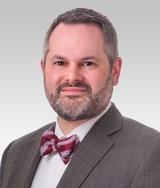
Andrew M Naidech is Professor at Northwestern University's Feinberg School of Medicine with appointments across multiple departments including Neurology (Neurocritical Care), Medical Social Sciences (Outcome and Measurement Science), Preventive Medicine (Biostatistics and Informatics), Anesthesiology, and Neurological Surgery. He serves as leader of the Master of Public Health program and directs research at the intersection of neurocritical care and artificial intelligence. Dr. Naidech earned his MD from Temple University (1997) and MSPH from Tulane University (2001), completed residency at Tulane University Hospital & Clinics (2002), and fellowship at Columbia Presbyterian Hospital (2004). He holds board certifications in Neurology, Vascular Neurology, Clinical Informatics, and Neurocritical Care from the American Board of Psychiatry and Neurology. His research focuses primarily on intracerebral hemorrhage, with significant contributions to understanding hematoma expansion mechanisms, developing AI applications for stroke management, and analyzing critical care outcomes. Recent publications demonstrate a strong emphasis on machine learning for medical image analysis, thromboelastography biomarkers, and patient-centered AI implementation in stroke care. Dr. Naidech has received prestigious honors including Fellowship in the American Academy of Neurology (2017) and election to Fellowship in the American Neurological Association (2012). He maintains active professional service as Member of American Schools and Programs of Public Health (2024-present), MCCKAP committee member at Society of Critical Care Medicine (2012-present), and previously served on FDA's Peripheral and Central Nervous System Committee (2010-2019). Fellowship, American Academy of Neurology (2017) Fellowship (elected), American Neurological Association (2012) AOA - Tulane University, Alpha Omega Alpha Honor Medical Society (2001) He contributes significantly to editorial work as former Editorial Board Member of Neurocritical Care (2015-2020) and maintains active membership in multiple professional societies including the American Neurological Association, American Academy of Neurology, American Heart Association, Neurocritical Care Society, and Society of Critical Care Medicine. Dr. Naidech's work is supported through affiliations with the Institute for Augmented Intelligence in Medicine, Center for Health Services & Outcomes Research, and Northwestern University Clinical and Translational Sciences Institute.
Dr. Jun Li is a Senior Lecturer at the School of Computer Science, Faculty of Engineering and Information Technology, University of Technology Sydney (UTS), Australia. He received his Ph.D. in Computer Science from Queen Mary University of London in 2009 and is affiliated with the Australian Artificial Intelligence Institute (AAII) at UTS. His research spans multiple domains within artificial intelligence, with primary focus on Machine Learning applications in computer vision and 3D geometry. Dr. Li has published extensively in high-impact journals including IEEE Transactions (TPAMI, TIP, TNNSLS) and Pattern Recognition, with recent work expanding into interdisciplinary research in earth science and marine applications. His research output demonstrates consistent productivity with numerous publications each year across diverse AI application areas. Dr. Li's work shows strong thematic progression from foundational computer vision techniques to applied interdisciplinary research. Early work focused on face hallucination and video super-resolution, while more recent publications address environmental applications using Graph Neural Networks for wave prediction and damage classification for disaster response. His research consistently bridges theoretical AI advances with practical real-world applications across healthcare, autonomous systems, and environmental science. AI to assist disaster emergency response (2023-2026) Applying Generative Adversarial Network in Medical Image Analysis (2020-2021) Big Massive Open Online Course (MOOC) Data Retrieval (2017-2020) As an educator, Dr. Li teaches core courses including '31005 Machine Learning' and '32513 Advanced Data Analytics Algorithms' at UTS, and is available for Masters Research and PhD student supervision, contributing to the development of next-generation AI researchers.