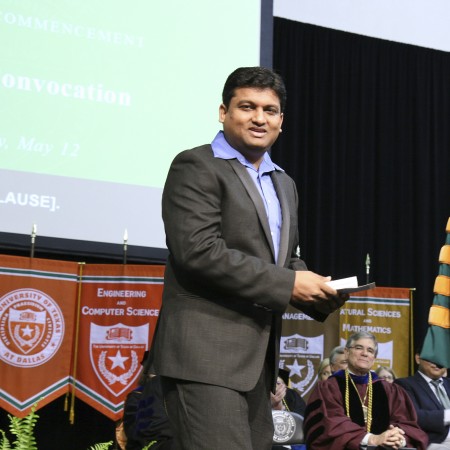
Jigarkumar Patel is a Teaching Professor of Mathematical Sciences at the University of Texas at Dallas , affiliated with the School of Natural Sciences and Mathematics. He holds the President's Teaching Excellence Award (2016) and focuses on instructional excellence in mathematics education. His research interests span applied mathematics, computational mechanics, and optical network systems. Dr. Patel’s academic contributions include developing advanced class materials for differential equations and pioneering studies in optical WDM networks. His work addresses dynamic network resource allocation, multicast traffic optimization, and computational modeling of elastic structures with defects. He maintains an active research profile with publications across mathematics education and engineering disciplines. In addition to his teaching role, Patel contributes to interdisciplinary research at UTD. His office is located in FO 2.410E, and he can be reached at jigarkumar.patel@utdallas.edu for academic inquiries.
Carmen Mas Machuca is an Adjunct Teaching Professor at the Chair of Communication Networks at Technical University of Munich (TUM), Germany. She holds a Dipl.-Ing. from Universitat Politècnica de Catalunya (1996), a Dr.-Ing. from École polytechnique fédérale de Lausanne (2000), and a Habilitation from TUM (2017). As an IEEE Senior member, her research focuses on converged optical access networks, network resilience, quantum communication systems, and techno-economic analysis. Affiliations: Chair of Communication Networks (Prof. Kellerer), TUM Munich Current Projects: BMBF OptiCON, DFG Software Dependability, AI-NET ANTILLAS, 6G Future Lab Bavaria Her research emphasizes dependable virtualized networks and has contributed to projects like EU 5GPPP VirtuWind, HARMONICS, and OASE. She co-chairs major conferences (ICIN 2024, ONDM 2023) and serves as guest editor for IEEE Transactions on Network and Service Management. Key research areas include quantum key distribution networks, railway communication systems, and network sovereignty metrics. She advises PhD candidates on topics like optical access planning and network reliability, and leads labs such as the FlexComNetsLab. Her work bridges theoretical network design with practical implementation, including tools like SDR-MDNet for multi-domain routing and PyRBD for reliability analysis.
Marc-Antoine Weisser is a researcher with a focus on network optimization, algorithm design, and graph theory. His work spans telecommunications, electrical networks, and computational complexity. He has contributed to studies on inter-domain network hierarchies, optical network optimization, and combinatorial problems such as Steiner trees and bin packing. Weisser's research often involves developing polynomial and approximation algorithms for real-world network challenges. Key research areas: Network topology analysis, algorithmic design for resource allocation, and optimization in electrical/optical networks His publications highlight contributions to congestion avoidance mechanisms, optical ring networks, and inter-domain routing architectures. Weisser collaborates frequently with institutions like the University of ... [university name missing in source text].
Lan Kong is an Assistant Professor at Eastern Kentucky University specializing in computer science and engineering, with research spanning digital forensics, cyber security, and artificial intelligence. Education: Renmin University of China (degree unspecified) Ph.D. in Computer Science and Engineering from the University of Nebraska His research focuses on digital forensics (evidence collection methodologies), cyber security (network resilience and optical network recovery systems), and artificial intelligence applications across domains. Work in optical networking demonstrates expertise in multicast tree architectures and wavelength conversion protocols. Publication trends reveal two distinct phases: foundational work (2002-2006) on optical network recovery mechanisms, followed by recent interdisciplinary collaborations (2020) in entomology involving chemosensory protein functions and transcriptome analysis of insect reproduction. This evolution highlights cross-disciplinary adaptability while maintaining core expertise in network security frameworks.
Evi Zouganeli is an Associate Professor at the University of Oslo's Faculty of Mathematics and Natural Sciences, Department of Informatics. Her research spans from smart home technologies for elderly care to cognitive robotics and earlier work in optical networking. She leads interdisciplinary research in the "Assisted Living Project" funded by the Research Council of Norway under the SAMANSVAR programme (247620/O70), focusing on responsible innovations for dignified lives at home for people with mild cognitive impairment or dementia. Her research interests center around smart home technology, activity recognition, and sensor data analysis for elderly care applications. She develops advanced machine learning approaches including probabilistic models like SPEED and Active LeZi, as well as deep learning techniques like LSTM networks for predicting sensor events and activities of daily living. Her work involves collecting data from real homes with older adult residents using binary sensors and depth video cameras, with applications in healthcare monitoring and assistive living technologies. More recently, she has expanded into cognitive robotics, investigating how cognitive architectures can enhance AI-enabled robotic systems. Professor Zouganeli's publications show a clear research trajectory from optical networking in the early 2000s to her current focus on AI applications for healthcare. Her most recent work demonstrates strong interdisciplinary collaboration across computer science, healthcare, and gerontology fields. The research shows consistent improvement in prediction accuracy, with recent implementations achieving 77-87% accuracy for sensor event prediction and 61-90% for activity recognition depending on the apartment setup. As a supervisor, she has guided PhD students in the Faculty of Mathematics and Natural Sciences at the University of Oslo, with research funded by the Research Council of Norway. Her work involves collaboration with researchers from multiple disciplines, as indicated by the interdisciplinary nature of the "Assisted Living Project." She has also contributed to educational research, particularly in project-based learning approaches for programming education in electrical engineering.
Professor Wojciech Kabaciński is a distinguished academic at the Poznań University of Technology, where he serves in the Faculty of Computer Science and Telecommunications within the Institute of Teleinformatics Networks. With the title of 'prof. dr hab. inż.', he holds the position of full professor with habilitation in engineering. His academic profile is marked by extensive research contributions and active supervision of doctoral students in the field of optical networking. Professor Kabaciński's research interests center on optical networks, with particular expertise in elastic optical switching, wavelength-space-wavelength switching architectures, network routing algorithms, and non-blocking network design. His work spans both theoretical foundations and practical implementations for telecommunications infrastructure and data center applications. He has made significant contributions to understanding WSW1 and WSW2 switching architectures, defragmentation algorithms, and control mechanisms for elastic optical networks. Analysis of Professor Kabaciński's recent publications (2017-2025) reveals a consistent focus on optimizing optical switching networks, with increasing emphasis on elastic optical networks and flexible switching architectures. His research demonstrates a progression from fundamental network theory to practical implementations addressing contemporary challenges in telecommunications. The trend shows growing complexity in network architectures and more sophisticated algorithms for resource allocation and connection management. Professor Kabaciński has supervised five doctoral dissertations and has been active in reviewing academic work. His research output includes 56 scientific articles, 60 book chapters, 3 books, and 14 research reports, demonstrating sustained scholarly productivity throughout his career. As an academic supervisor, Professor Kabaciński has guided doctoral students through research on simultaneous connections routing, non-blocking switching fabrics, multiplane banyan networks, self-controlling switching fields, and broadcast-capable switching architectures. His supervision reflects a commitment to advancing knowledge in optical networking while developing the next generation of researchers in the field. His current research continues to push boundaries in optical networking, with recent publications addressing cutting-edge challenges in rearrangeable wavelength-space-wavelength switches and flexible optical network architectures, positioning him at the forefront of developments in telecommunications infrastructure.