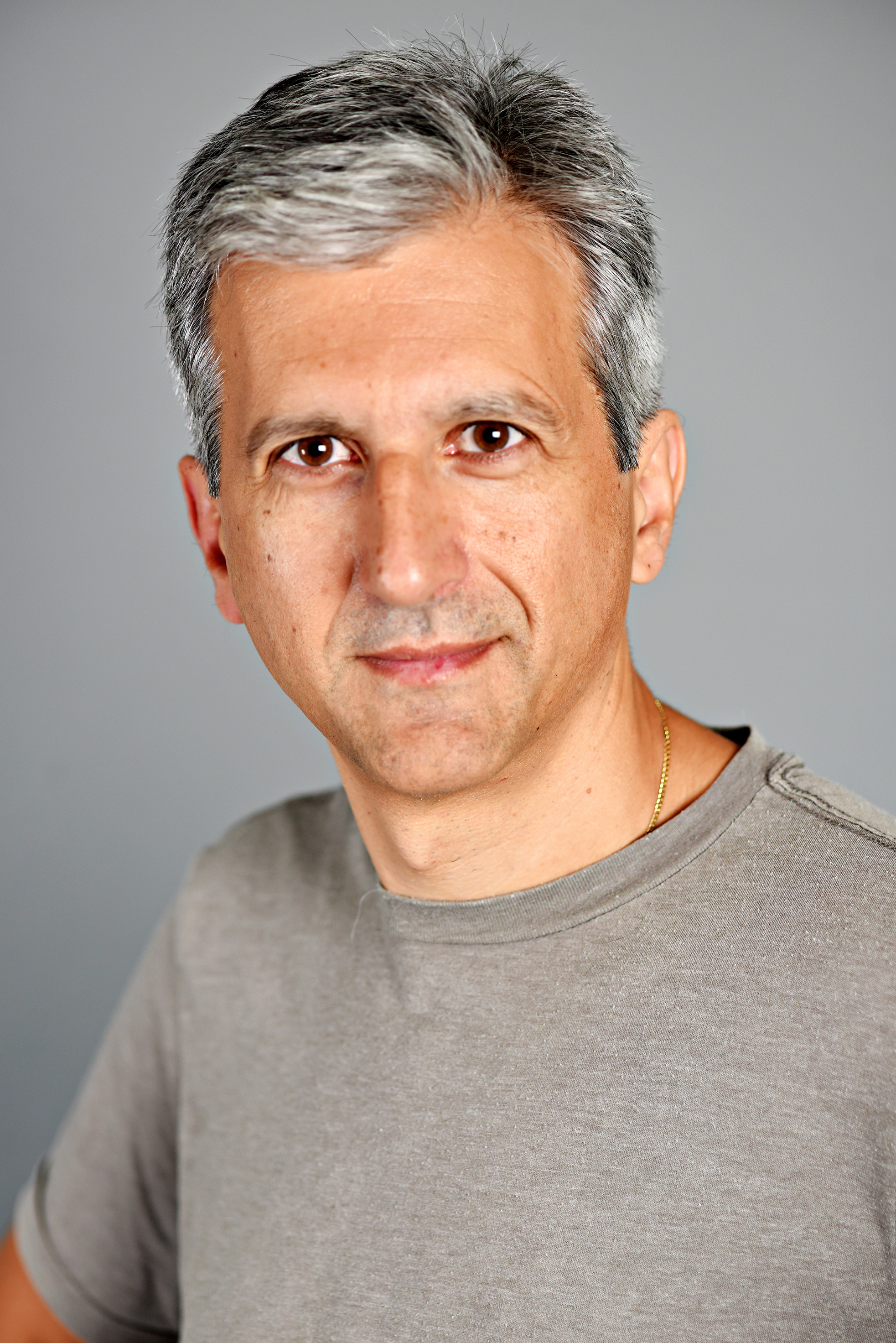
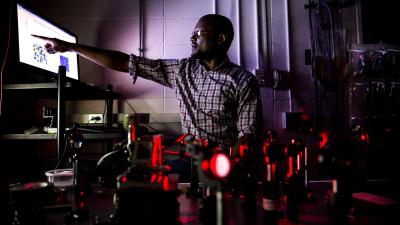
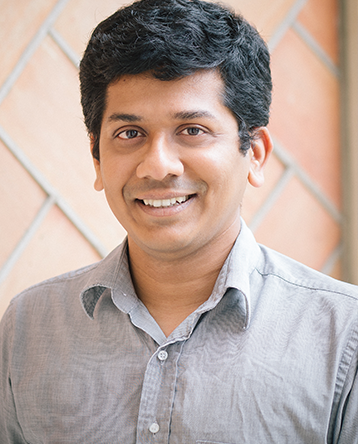
Kyros Kutulakos is a Professor in the Department of Computer Science at the University of Toronto, where he leads research in computational imaging and 3D sensing. His affiliations include the Toronto Computational Imaging Group, Computer Vision Group, Dynamic Graphics Project (DGP), and Vector Institute Group. He teaches graduate and undergraduate courses such as CSC320 (Introduction to Visual Computing) and CSC2530 (Computational Imaging & 3D Sensing). His research interests span computational imaging, non-line-of-sight imaging, single-photon detectors, 3D sensing, and neural rendering. Notable contributions include advancements in structured-light imaging, time-of-flight systems, and super-oscillatory microscopy. He has advised numerous PhD and MSc students, fostering cutting-edge research in imaging technologies. Kutulakos has received prestigious awards, including the Dean’s Research Excellence Award (2023) and multiple best paper prizes (e.g., Marr Prize at ICCV 2023). He has served as program chair for ICCV 2013, ICCP 2010, and CVPR 2003, contributing to academic leadership in computer vision. His work bridges optics, photonics, and computation, with applications in autonomous systems, medical imaging, and astronomy. Current research focuses on extreme imaging scenarios, such as imaging in pitch-black environments and around corners, leveraging novel sensor designs and computational techniques.
Changxi Zheng is an Associate Professor in the Department of Computer Science at Columbia University's School of Engineering and Applied Science (SEAS). He directs Columbia's Computer Graphics Group (C2G2) within the Columbia Vision and Graphics Center (CVGC). After receiving his PhD from Cornell University, he joined the faculty of Computer Science Department at Columbia, where he has established himself as a leading researcher in computer graphics and scientific computing. Dr. Zheng's research spans multiple areas of applied computer science with a particular focus on computer graphics and scientific computing. His work centers around developing numerical models for simulating physical phenomena involving complex motions such as fluids, bubbles, and thin rods, along with their resulting acoustic waves. Leveraging computational insights from these models, he devises methods for improving tangible object creation, enabling novel human-computer interactions, and developing software tools for acoustic and photonic devices. His research has attracted significant public interest and media coverage, including projects like FontCode, AirCode, and Computational Metallophone Design. His recent publications reveal a strong interdisciplinary approach, bridging computer graphics, physics simulation, machine learning, and hardware design. His work demonstrates consistent innovation in computational methods for simulating physical phenomena and applying these techniques to practical problems in 3D printing, acoustic modeling, and interactive systems. The breadth of his research spans from fundamental physics-based simulations to practical applications in industry. Columbia SEAS Dean's Fellow (for advised students) NSF Graduate Research Fellow (for Ruilin Xu) Snap Research Fellow (for Rundi Wu) CKGSB Fellow (for Yun Fei) Adobe Research Fellow (for Gabriel Cirio) Marie Sklodowska-Curie Individual Fellow (for Rundi Wu) Best Paper Award at ACM International Conference on Multimedia (ACMMM), 2019 Dr. Zheng actively mentors a diverse group of students, including current PhD candidates and postdoctoral researchers. His research group has received support from various sources that enable their innovative work in computational graphics and physics-based simulation. He has supervised numerous successful students who have gone on to positions at leading technology companies including Adobe, Tencent, Facebook, and academic institutions. As director of Columbia's Computer Graphics Group (C2G2) within the Columbia Vision and Graphics Center (CVGC), Dr. Zheng leads a vibrant research team focused on advancing the state of the art in computer graphics, physics-based simulation, and their applications. The group maintains strong collaborations with industry partners and academic institutions worldwide, fostering an environment of innovation and practical application of theoretical concepts.
Gabriel Birzu is an Assistant Professor in the Department of Physics at the University of Florida. He develops quantitative models of microbial ecology and evolution using statistical physics approaches. His research investigates fine-scale diversity in microbial communities, examining how spatial processes shape evolutionary trajectories. Recent work analyzes hybridization barriers in cyanobacteria and genealogical patterns during range expansions. Birzu's interdisciplinary approach combines theory, computation, and data analysis to understand microbial diversification mechanisms and community responses to environmental perturbations.
Professor Stefan Maier holds the position of Head of School in Physics and Astronomy at Monash University. Previously, he served as the Lee Lucas Chair in Experimental Physics at Imperial College London (2007–2018) and built a new chair at Ludwig-Maximilians-Universität München (2019–2022). His research focuses on nanophotonics, plasmonics, and metasurface engineering, with emphasis on optical trapping, nonlinear optics, and novel photonic devices. Education: Bachelor’s degree in Physics, Technical University of Munich M.Sc. and Ph.D. in Applied Physics, California Institute of Technology (Caltech) Research Interests: Development of metamaterials and metasurfaces for light manipulation Applications of nanophotonics in sensing, imaging, and quantum technologies Optical trapping and plasmonic catalysis Nonlinear optical phenomena in nanostructured materials Articles Trends: Recent work emphasizes bound states in the continuum (BICs), 3D nanoprinted optical platforms, and active metasurfaces with tunable properties. Key themes include hybrid nanophotonics, ultra-high-Q resonators, and plasmonic nanomaterials for energy applications. Awards: ISI Highly Cited Researcher (2017–present) Grants/Projects: Chief Investigator in the All-on-chip twisted light modulator project (2022–2025) Leadership in Monash’s nanophotonics research team Labs/Teams: Directs a multidisciplinary lab at Monash focused on integrating 3D nanofabrication with optical physics, including collaborations in metafiber development and plasmonic biosensing.
Moussa Ngom is an Associate Professor in the Department of Physics, Applied Physics and Astronomy at Rensselaer Polytechnic Institute (RPI), affiliated with the School of Science and research centers including the Center for Ultrafast Optical Sciences (CUOS) and the Center for Materials, Devices, and Integrated Systems (CMDIS). His work focuses on wavefront shaping, quantum optics, and structured light manipulation to address challenges in biological imaging, quantum communication, and nuclear security.
California Institute of Technology (Caltech)United States
Changhuei Yang is the Thomas G. Myers Professor of Electrical Engineering, Bioengineering, and Medical Engineering at California Institute of Technology, serving as Executive Officer for Electrical Engineering and Investigator at Heritage Medical Research Institute. He holds a Ph.D. and three master's degrees from MIT, with appointments at Caltech since 2003. Research focuses on: Advanced microscopy techniques including Fourier Ptychography Wavefront shaping for biological tissue imaging Optical phase conjugation for deep-tissue applications Compact medical devices for cerebral monitoring Publications demonstrate leadership in computational imaging, with recent advances in stain-free embryo analysis, portable cerebral blood flow monitors, and high-resolution volumetric imaging techniques using neural representations. Honored as National Academy of Inventors member. Research applications span deep-tissue biochemical imaging, incisionless surgery, and optogenetic activation systems.
Thomas M. Antonsen Jr. is a Distinguished University Professor at the University of Maryland, holding joint appointments in the Department of Electrical and Computer Engineering and the Department of Physics. He is affiliated with the Institute for Research in Electronics & Applied Physics (IREAP), Maryland Energy Innovation Institute, and the Institute of Physical Science and Technology. His research focuses on plasma physics, nonlinear dynamics, and high-power coherent radiation sources. Antonsen earned his B.S., M.S., and Ph.D. in electrical engineering from Cornell University (1973–1977) and has held visiting positions at institutions such as the University of California, Santa Barbara, and the École Polytechnique in France. **Education:** B.S., Electrical Engineering, Cornell University, 1973 M.S., Electrical Engineering, Cornell University, 1976 Ph.D., Electrical Engineering, Cornell University, 1977 **Research Interests:** Antonsen’s work spans magnetically confined plasmas, laser-plasma interactions, and advanced vacuum electronics. He has pioneered adjoint methods for optimizing beam-wave interaction systems and contributed to the development of high-power microwave amplifiers. His recent projects include wave chaos in complex systems and machine learning applications in nonlinear dynamics. **Awards & Honors:** James Clerk Maxwell Award (American Physical Society, 2023) IEEE Marie Sklodowska-Curie Award (2022) University of Maryland Distinguished University Professor (2017) IEEE Fellow (2012) **Teaching & Mentorship:** Antonsen teaches courses such as Physics 132 (Biophysics), Electrodynamics, and Plasma Physics. He mentors graduate students in plasma physics and vacuum electronics through his research groups at IREAP and the Bright Beams Collective. **Labs & Collaborations:** His research is supported by grants from the Department of Energy, NASA, and the Office of Naval Research. Key collaborations include the National Institute of Standards and Technology (NIST) and the European XFEL facility.
California Institute of Technology (Caltech)United States
Dr. Ruzan Sokhoyan is a Nanophotonics Research Scientist specializing in plasmonics and active metasurfaces. Her work focuses on advancing optical imaging, communication, and computation through tunable photonic structures. Core research in metasurface design for beam steering and polarization control Collaborative contributions with Harry A. Atwater and other leading researchers Publications in high-impact journals like ACS Nano and Advanced Optical Materials Her research explores electro-optic modulation , high-power laser beam manipulation , and dynamic photonic devices , with applications in optical communication and imaging. Recent work emphasizes inverse design approaches and liquid crystal-based tunable metasurfaces , reflecting trends toward reconfigurable and multifunctional photonic systems.
Jonathan Fan is an Associate Professor at Stanford University in the Department of Electrical Engineering. His teaching portfolio includes graduate and undergraduate courses in electromagnetics, integrated circuit fabrication, and specialized studies across all quarters. EE 242: Electromagnetic Waves (Autumn) EE 312: Integrated Circuit Fabrication Laboratory (Winter) ENGR 42/EE 42: Electromagnetics and Applications (Spring) 11 independent studies and thesis courses (EE 190, EE 191, EE 300, etc.) His research focuses on nanophotonics and metasurface engineering , with particular emphasis on inverse design methodologies, machine learning -driven photonic optimization, and machine learning in electromagnetic simulation. His recent publications demonstrate a strong trend toward deep learning-enabled photonic design and high-speed optimization of complex optical systems. His work spans metamaterial fabrication , nonlocal effects in metasurfaces, and multi-functional optical devices such as spaceplates for aberration correction. Key technical contributions include physics-augmented neural networks , reparameterization techniques for design constraints, and topology-optimized metasurfaces .
Prof. Dr. Johan Robertsson is a Full Professor of Applied Geophysics and Head of the Exploration and Environmental Geophysics (EEG) Group at ETH Zürich's Department of Earth and Planetary Sciences. He holds a MSc from Uppsala University (1991) and a PhD in Geophysics from Rice University (1994). Before joining ETH in 2012, he spent 15 years at Schlumberger in R&D roles, leading projects that revolutionized marine seismic data acquisition. His research focuses on wave propagation physics, seismic data inversion, and applications in exploration and environmental geophysics. He pioneered the use of Distributed Acoustic Sensing (DAS) for landslide monitoring and contributed to Mars seismology via the InSight mission. Education: MSc in Engineering Physics, Uppsala University (1991) PhD in Geophysics, Rice University (1994) Research Interests: Seismic wavefield modeling and inversion Planetary seismology (Mars, Moon) Acoustic metamaterials and wave control Environmental geohazard monitoring Marine seismic acquisition techniques His work on the Martian soil properties using InSight data and lunar exploration instrumentation (ALGEP) reflects his cross-disciplinary approach. He holds 90+ patents and has secured prestigious grants like the ERC Advanced Grant. Awards: EAGE Guido Bonarelli Award (2020) ERC Advanced Grant MATRIX (2017) EAGE Conrad Schlumberger Award (2018) Grants & Advising: Led the MATRIX ERC project advancing seismic imaging algorithms Advised over 20 PhD/MS students (names not listed) Secured Schlumberger's largest R&D project in marine seismic sampling His EEG Group operates cutting-edge labs for immersive wave experimentation and planetary geophysical instrumentation. Current initiatives include lunar subsurface exploration and acoustic invisibility experiments.
Aswin Sankaranarayanan is a Professor in the Department of Electrical and Computer Engineering at Carnegie Mellon University (CMU) , where he leads the Image Science Lab . His research focuses on computational photography , 3D shape estimation , and novel imaging system design . He earned his Ph.D. in Electrical and Computer Engineering (2009) from the University of Maryland and completed a postdoctoral fellowship at Rice University (2012) . Research Themes: Developing imaging systems that exploit low-dimensional signal models to overcome traditional sensing limitations Co-design of optics and processing algorithms for efficient sensing Application of non-linear signal models to high-dimensional data Advancing compressed sensing and big data processing techniques Scientific Recognition: SIGGRAPH 2023 Best Paper Award (Split-Lohmann Multifocal Displays) CVPR 2019 Best Paper Award (Fermat Paths for NLOS Reconstruction) NSF CAREER Award (2017) Dean’s Early Career Fellowship (2018-2021) Herschel Rich Invention Award (2016) Technical Contributions: His recent publications reveal expertise in non-line-of-sight shape reconstruction , VR/AR display systems , and biomedical imaging . Collaborations span institutions like University College London and University of Toronto.
Lawrence H. Staib is a Professor of Biomedical Engineering at Yale University, with additional academic appointments in Electrical & Computer Engineering and Radiology & Biomedical Imaging. He holds a Ph.D. from Yale University and specializes in automated medical image analysis, including techniques like model-based segmentation, nonrigid registration, and diffusion tensor imaging (DTI). His research focuses on applications in neuroscience, cardiology, and cancer imaging, emphasizing machine learning and functional MRI analysis. His key contributions include advancements in white matter tractography via anisotropic wavefront evolution, real-time neural tract parcellation (Fasciculography), and noise reduction in diffusion tensor fields. Staib is a Fellow of the American Institute for Medical and Biological Engineering (2015), recognizing his impactful work in medical imaging technologies. Staib's research also encompasses statistical deformation models, perturbation-based shape analysis, and 3D deformable models for volumetric segmentation. He has developed patented 3D ultrasound computed tomography systems (USPTO #6878115, 7025725). His work bridges clinical needs with computational methods, addressing challenges in image registration, structural connectivity analysis, and medical robotics.
Vivek Boominathan is an Assistant Research Professor in the Department of Electrical and Computer Engineering at Rice University. He is affiliated with the GLEE lab (Geometry, Light, & Imaging lab). His research focuses on computational imaging, combining computer vision, machine learning, applied optics, and nanofabrication to develop innovative imaging systems for applications such as robotics, medical sensing, and virtual/augmented reality. He has contributed to projects like PhlatCam (a lensless camera) and NeuWS (neural wavefront shaping). His work bridges optics, algorithms, and materials science to overcome traditional limitations in imaging systems. Boominathan's research interests include lensless imaging, optical meta-devices, turbulence mitigation, and bio-inspired imaging systems. He has developed systems like Foveated thermal imaging prototypes and real-time lensless microscopes. His lab emphasizes interdisciplinary approaches, integrating hardware design with machine learning. Key projects include: NeuWS: Neural wavefront shaping for imaging through scattering media CoIR: Compressive implicit radar for sensing applications FlatCam and PhlatCam: Ultra-thin lensless imaging devices Bioluminescence imaging in marine species His work has been published in top venues like Science Advances, Optica, and IEEE TPAMI. He collaborates with institutions like NASA JPL and industry partners on applied imaging solutions. Current research trends emphasize sensor-algorithm co-design and high-speed imaging systems for AR/VR applications. Boominathan holds a PhD in Electrical Engineering and has extensive postdoctoral experience in computational imaging. He advises projects in the GLEE lab and mentors students in hardware-software co-design for imaging systems. His lab focuses on translating theoretical innovations into practical devices with commercial potential.
Hui Cao is the John C. Malone Professor of Applied Physics, Professor of Physics, and Professor of Electrical Engineering at Yale University. Her research focuses on mesoscopic physics, complex photonic materials, nanophotonics, and biophotonics, with experimental investigations into unconventional lasers, coherent light control, and disordered photonic systems. She leads a lab exploring applications in speckle-based imaging, deep-tissue optics, and chip-scale spectrometers. Education: Ph.D. in Physics from Stanford University (1997). Awards include the William E. Lamb Medal (2015), Guggenheim Fellowship (2013), and fellowships from the American Physical Society and Optical Society of America (2007). Research emphasizes random lasers, microcavity lasers, and wavefront shaping to control light in diffusive media. Key innovations include a disordered photonic chip spectrometer and methods to suppress nonlinear instabilities in fiber amplifiers. Awards: 12 major honors including AAAS Fellowship and multiple endowed professorships Patents: 3 core photonic technologies including random laser imaging and fiber amplifier control systems Lab Activities: Developing novel optical devices leveraging disorder and nonlinear effects
Dr. Xu Fang is a Lecturer (Assistant Professor) in the School of Electronics and Computer Science at the University of Southampton. His research focuses on metasurfaces and nanophotonics, with applications in automotive sensing and healthcare. He earned a bachelor's degree in Materials Science and Engineering from Tsinghua University (2004) and a Ph.D. in Condensed Matter Physics from the Chinese Academy of Sciences (2009). Before joining Southampton in 2012, he held a RIKEN research fellowship in Japan, where he also gained fluency in Japanese. Dr. Fang's work includes groundbreaking contributions to metasurface technologies, such as metamaterial thin-film logic gates and excitation-selective spectroscopy. He has received five grants from the Royal Society, EPSRC, and Daiwa Anglo-Japanese Foundation as Principal Investigator. His group collaborates with institutions like MIT and the Tokyo University of Agriculture and Technology, hosting visiting scholars and supervising numerous PhD students. Notable achievements include the 2019 Academic Award from the University of Southampton Student Union for teaching excellence. His research group actively explores topics such as tunable metalenses, surface wave generation for THz sensing, and quantum behavior mimicking with classical optics.