Assoc Prof Daniel T.H. New is an Associate Professor at the Division of Aerospace Engineering, School of Mechanical & Aerospace Engineering, Nanyang Technological University (NTU), Singapore. His academic journey includes a B.Eng. (Honors) and PhD from the National University of Singapore (NUS), followed by postdoctoral research at the University of Texas, Arlington, and a Lecturer role at the University of Liverpool. His research focuses on fluid dynamics, jet-in-crossflow phenomena, vortex dynamics, and flow control strategies, supported by agencies like MINDEF, DSO, and industry partners. Education: B.Eng. Mechanical Engineering, NUS (1998) PhD in Fluid Dynamics, NUS (2004) His research interests span jet mixing enhancement , bio-inspired flow control , and high-speed aerodynamics . Current projects include vortex-ring collision dynamics, jet-cylinder impingement, and tandem jets-in-crossflow analysis. He has contributed to defense-related research and holds grants from multiple national and industrial sponsors. Teaching responsibilities include courses like Aerodynamics I and Engineering Fluid Mechanics . His lab focuses on experimental fluid dynamics using facilities like low-speed water tunnels.
Dr. Indrani Roy is an Honorary Associate Professor in the Department of Earth Sciences at University College London (UCL). She holds a PhD from Imperial College London and has extensive research experience at institutions including Imperial College and the University of Exeter. Previously, she served as a permanent employee at the India Meteorological Department (Government of India). She is a Fellow of the Royal Meteorological Society (FRMetS) and serves as its Trustee. Dr. Roy contributes to international scientific governance as a panel member for the UK's Natural Environmental Research Council (NERC) and the Romanian National Research Council. Her multidisciplinary research spans: Solar-atmosphere-ocean coupling mechanisms Monsoon dynamics and teleconnection patterns Climate change processes and extreme events Stratosphere-troposphere interactions Climate variability across decadal scales She actively investigates how solar cycles influence regional climates and extreme weather phenomena. Dr. Roy's publications demonstrate consistent focus on climate dynamics with recent emphasis on African and Asian monsoon systems, COVID-19 climate interactions, and improving predictive capabilities for extreme rainfall events. Her work increasingly integrates public health perspectives with climate science. Scientific Recognition: Fellow of the Royal Meteorological Society (FRMetS) Teaching & Advising: As an Associate Fellow of the Higher Education Academy (HEA), she currently teaches the Literature Project module (NSCI0004) for Natural Sciences at UCL. Her past teaching includes: Undergraduate research supervision (University of Exeter) Masters project supervision and guest lecturing (UCL) Instruction of Masters/PhD candidates (University of Oulu, Finland) Professional Engagement: Dr. Roy serves as reviewer for over 40 international journals (including Nature Geoscience and Science Reports) and grant agencies such as NSF, Royal Society, and French National Research Agency. She co-convenes sessions at major conferences (AOGS) and previously held editorial roles at Frontiers journals.
Rupert Klein is a Professor at Freie Universität Berlin in the Department of Mathematics and Computer Science , specializing in Geophysical Fluid Dynamics . His research spans atmospheric dynamics, numerical methods, and gas dynamics of combustion. Research Interests : Geophysical Fluid Dynamics and Atmospheric Modeling Multiscale Asymptotic Analysis Wave Propagation and Turbulence Combustion and Pressure Gain Combustion Climate Dynamics and Data Assimilation Scientific Awards : DRS Award for Excellent Supervision (2014) ECMWF Fellowship (renewed 2017) His recent work includes multiscale models for atmospheric flows, vortex dynamics, and combustion processes. Key collaborations involve DFG SPP 1276, CRC 1029 (TurbIn), and CRC 1114 (SCCS) projects. He contributes to numerical methods for low-Mach-number flows and geophysical simulations.
Dr. David R. Themens is an Associate Professor in Space Environment within the Space Environment and Radio Engineering (SERENE) group in the School of Engineering at the University of Birmingham. He specializes in modeling and mitigating the impacts of space weather on radio communications and navigation systems, with a particular focus on the ionosphere's effects on these technologies. Dr. Themens earned his academic credentials from Canadian institutions: BSc (Hons) in Physics from the University of New Brunswick (2011) MSc in Atmospheric and Oceanic Science from McGill University (2013) PhD in Physics from the University of New Brunswick (2018) His research primarily focuses on four interconnected areas: ionospheric modeling, ionospheric physics, measurement techniques, and radio propagation. Dr. Themens is particularly interested in the interaction between the ionosphere and the atmosphere, specifically how lower atmospheric forcing drives variability within the ionosphere and the interactions between the ionosphere and thermosphere. He is the principal developer of the Empirical Canadian High Arctic Ionospheric Model (E-CHAIM) , a high-latitude alternative to the International Reference Ionosphere (IRI) used for HF/UHF signal propagation modeling. His work includes exploring synergistic properties of different earth observation instruments, measurement technique development, data assimilation, and empirical modeling. Analysis of Dr. Themens' recent publication record reveals a strong emphasis on space weather phenomena, ionospheric modeling, and radio propagation. His work spans from fundamental ionospheric physics to practical applications in navigation and communication systems. Key themes include the development and validation of ionospheric models, analysis of space weather events (including the May 2024 geomagnetic superstorm), and the impact of solar phenomena on Earth's upper atmosphere. His research increasingly incorporates advanced data assimilation techniques and leverages multiple observational platforms including radar systems, GNSS networks, and satellite measurements. Dr. Themens holds significant leadership positions in the international space science community: Co-Chair of IAG-GGOS Joint Study Group on Understanding Ionospheric and Plasmaspheric Processes (2023-present) Chair of URSI Data Assimilation Working Group (2023-present) Co-Chair of IAGA Geospace Data Assimilation Working Group (2023-2027) URSI Commission G Early Career Representative (2023-2029) Chair of Canadian Association of Physicists Division of Atmospheric and Space Physics (2022-present) Dr. Themens actively mentors graduate students and is 'always looking for new Ph.D. students interested in the ionosphere, data assimilation, and radio propagation.' His research has been supported through contracts with Defence Research and Development Canada (DRDC) and various international collaborations. He leads the Canadian High Arctic Ionospheric Models (CHAIMs) project, which builds upon his doctoral work developing the E-CHAIM model. At the University of Birmingham, he teaches courses in Space System Engineering and Design, Space Mission Analysis and Design, and Space Environment.
Emanuele Di Lorenzo is a Professor in the Department of Earth, Environmental, and Planetary Sciences at Brown University. Previously, he held roles as Professor and Director (2016–2022) of the Ocean Science and Engineering program at Georgia Tech, which he co-founded. He is the Chairman and co-founder of Ocean Visions, a non-profit transforming academic research into actionable ocean-based climate solutions, and co-leads the United Nations Ocean Decade Collaborative Center on Ocean-Climate Solutions. He earned a Ph.D. in ocean and climate sciences from Scripps Institution of Oceanography (2003) and has been at Brown since 2022. Education: B.S. in Marine Environmental Sciences, University of Bologna (1997) Ph.D. in Climate Sciences, Scripps Institution of Oceanography (2003) Research focuses on ocean climate dynamics, coastal systems, and solutions to climate challenges. Key areas include Large-scale ocean and climate modeling, Impacts of climate variability on marine ecosystems, Social-ecological-environmental systems, Coastal resilience strategies. He leads initiatives like the Ocean Vital Signs Network and the Global Ecosystem for Ocean Solutions (GEOS), fostering international collaboration. Publications emphasize marine heatwaves, Pacific decadal variability, and coastal flooding. Awards include the PICES SB Award (2013) and Georgia Tech’s Class of 1964 Teaching Award (2012). He advises over 36 Ph.D. students in ocean science programs and co-founded the OCE Data Science High School Internship to advance STEM equity. Labs/Teams: Leads the Di Lorenzo Research Group and collaborates with Woods Hole Oceanographic Institution. Current efforts prioritize equitable ocean solutions, coastal inundation modeling, and climate adaptation frameworks.
Prof. Juan Alonso is the Vance D. and Arlene C. Coffman Professor and James & Anna Marie Spilker Chair in the Department of Aeronautics & Astronautics at Stanford University. He directs the Aerospace Design Laboratory (ADL), focusing on high-fidelity computational methods for aerospace system design. His expertise spans transonic/supersonic/hypersonic aircraft, rotorcraft, and launch vehicles. Alumni include record-holding teams for human-powered watercraft and lightweight unmanned aerial vehicles. Education: PhD (1997) from Princeton University in Mechanical & Aerospace Engineering; M.A. (1993) Princeton; B.S. (1991) MIT Aeronautics/Astronautics. Research emphasizes multi-disciplinary optimization, numerical methods, and parallel computing applied to advanced aircraft design, sustainable aviation, and UAS systems. Notable contributions include computational design frameworks like SU2 and SUAVE, and initiatives in curriculum development for engineering education. Recent work focuses on: GPU-accelerated CFD solvers, multi-fidelity surrogate models (e.g., VortexNet), contrail simulation frameworks, and battery degradation modeling for electric aircraft. Active in urban air mobility and high-fidelity trajectory optimization for hypersonic systems. Labs/Teams: Aerospace Design Laboratory (ADL) leading open-source computational tools development. Involved in NASA-funded projects and industry partnerships for advanced propulsion systems.
Karen Mulleners is an Associate Professor at the École polytechnique fédérale de Lausanne (EPFL), affiliated with the School of Engineering (STI), the Institute of Mechanical Engineering (IGM), and the UNFOLD Laboratory (Laboratoire de diagnostic des écoulements instationnaires). She also serves in the SGM-ENS teaching department and is a member of the EDEY-GE doctoral program commission. Her research focuses on experimental fluid dynamics, particularly unsteady flow phenomena and vortex dynamics. Professor Mulleners specializes in the intersection of fluid dynamics and bio-inspired engineering, with research interests including: Unsteady vortex-dominated flow phenomena Fluid-structure interaction in flexible systems Experimental methods for flow visualization and measurement Application of fluid dynamics principles to bio-inspired robotics Aerodynamic performance optimization of wind turbine systems Vortex dynamics in flapping and rotating wing systems Her recent publications (2022-2025) demonstrate a strong experimental focus on understanding complex fluid phenomena, particularly in bio-inspired robotics and renewable energy applications. Mulleners' work consistently addresses fundamental questions about vortex formation, flow control, and fluid-structure interactions, with significant contributions to understanding dynamic stall in wind turbines and undulatory swimming mechanics. Her research group employs advanced diagnostic techniques to study unsteady flows, often bridging engineering and biological principles. Professor Mulleners actively supervises PhD students and has directed multiple EPFL theses. Her teaching responsibilities include courses on Measurement Techniques and Aerodynamics, where she imparts knowledge on experimental methods for observing and measuring physical variables such as force, resistance, temperature, flow velocity, and structural deformation. The UNFOLD Laboratory, which Professor Mulleners leads, focuses on diagnostic techniques for unsteady flow phenomena, employing advanced experimental methods including flow visualization, particle image velocimetry, and force measurement systems to study complex fluid dynamics problems with applications in renewable energy and bio-inspired engineering.
Antonio Alguacil Cabrerizo is an Assistant Professor (starting 2025) at Université de Sherbrooke, where he currently serves as a Postdoctoral Fellow (2023-2025). His academic trajectory includes dual doctoral degrees in Mechanical Engineering from Université de Sherbrooke and École Nationale Supérieure d'Aéronautique et de l'Espace, complemented by aerospace engineering degrees from ENSEEIHT and Universidad Politécnica de Madrid. His research integrates computational fluid dynamics with machine learning, focusing on: Aeroacoustic prediction and noise source identification Deep learning surrogates for fluid and acoustic systems Turbomachinery and airfoil aerodynamics Data-driven modeling of spatiotemporal physical systems This work advances computational efficiency in simulating complex wave propagation, turbulence effects, and fluid-structure interactions. Publication analysis reveals consistent focus on developing neural network-based computational methods for aeroacoustics and fluid dynamics. His 15 most recent works demonstrate progressive refinement in applying convolutional architectures to predict acoustic scattering, refraction phenomena, and turbomachinery noise with increasing physical accuracy and computational efficiency. Awards and recognition include: Top 5 in AIAA Best Student Paper in Aeroacoustics (2024) Graduate Scholarship Award from CFD Society of Canada (2022) Eureka Scholarship from Université de Sherbrooke (2021) Best Poster Prize at CRASH Day (2021) He secured a $70,000 CAD startup grant (2025-2028) from Université de Sherbrooke for establishing his research program. No student advising relationships or laboratory affiliations are currently documented.
Dr. Rameeza Moideen is a Researcher at the University of Edinburgh's School of Engineering, affiliated with the Energy Systems Research Institute. Her work focuses on offshore renewable energy infrastructure, coastal structural resilience, and fluid-structure interaction dynamics. Research Interests Her research spans vortex-induced vibrations in marine power cables, extreme wave impacts on coastal decks, and climate change adaptation for port infrastructure. She applies advanced numerical simulations to analyze hydrodynamic forces, structural stresses, and material degradation mechanisms. Key Research Trends Recent work emphasizes lazy wave dynamic cables under varying currents (2025), focused wave impacts on bridge decks (2023-2021), and marine growth effects on tubular structures (2021). These studies combine computational modeling with real-world climate scenarios to improve offshore energy systems and coastal infrastructure durability. Awards & Grants No specific awards or grants mentioned in available texts. Research is likely funded through institutional and collaborative projects within the Energy Systems Institute. Labs & Teams Active within the Energy Systems Research Institute at Edinburgh, collaborating on offshore renewable energy projects and coastal engineering initiatives.
Dr. Horia Hangan is a Professor of Mechanical Engineering and Canada Research Chair in Adaptive Aerodynamics at Ontario Tech University's Faculty of Engineering and Applied Science. He holds an adjunct professorship at Western University. His research focuses on Experimental Fluid Mechanics, particularly bluff body aerodynamics, turbulent coherent structures, and aerodynamic control, with applications to buildings, vehicles, and aerostructures. He pioneered the WindEEE Dome, a unique facility simulating complex 3D wind flows, enabling studies of tornado-like vortices and non-Gaussian wind phenomena. Education: PhD in Wind Engineering from Western University (1996), Diplomat Engineering Degree in Aeronautics from the Polytechnic University of Bucharest (1985). Research interests include downburst dynamics, wind–structure interaction, and renewable energy. Over 150 publications span experimental and numerical studies of tornado-like vortices, downburst flows, and wind turbine performance. Notable awards include the CSME Fellowship (2016), ENR News Maker of the Year (2015), and the ASME Lewis F. Moody Award (2010). His work bridges fundamental aerodynamics with practical engineering solutions for wind-related challenges.
Scott T. M. Dawson is an Assistant Professor in the Mechanical, Materials, and Aerospace Engineering Department at Illinois Institute of Technology (Illinois Tech). He holds positions in the Armour College of Engineering and leads research at the intersection of fluid mechanics, dynamical systems, control theory, and data science. His work focuses on extracting dynamic models from large datasets to analyze and control turbulent flows and unsteady aerodynamic systems. Education includes a Ph.D. and M.A. from Princeton University (2017, 2013), and B.Eng. and B.S. degrees from Monash University (2010, 2009). Prior to Illinois Tech, he was a postdoctoral scholar at Caltech’s Graduate Aerospace Laboratories under Prof. Beverley McKeon. Research interests emphasize reduced-order modeling, data-driven techniques for fluid flows, and flow control applications. His group’s work is supported by NSF, AFOSR, and DOE grants. Recent projects include sparsity-promoting methods for flow analysis, wavelet-based resolvent analysis, and neural network-driven flow control systems. Publications span over 60 peer-reviewed articles, with a focus on turbulence modeling, transient flow dynamics, and machine learning integration in fluid mechanics. Key contributions include novel algorithms for isolating amplification mechanisms in wall-bounded flows and robust neural network frameworks for closed-loop flow stabilization. Grants and collaborations include multi-year NSF CAREER funding for automated distillation of coherent flow structures. Ongoing efforts explore time-localized spectral methods, nonlinear dimensionality reduction, and hydrogen decarbonization in vehicular systems.
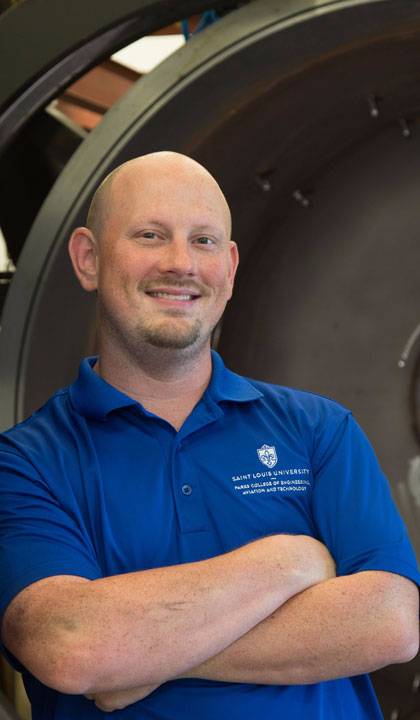
Mark McQuilling is an Associate Professor of Aerospace and Mechanical Engineering at Saint Louis University's School of Science and Engineering. He holds a Ph.D. in Engineering from Wright State University, alongside M.S. and B.S. degrees in Mechanical Engineering from the University of Kentucky. His research focuses on experimental fluid mechanics, low Reynolds number flows, laminar-to-turbulent transition, airfoil design, unsteady aerodynamics (turbomachinery and airdrop systems), bio-fluid flows, and flow control. His work integrates advanced fluid dynamics techniques with practical applications in aerospace and biomedical engineering. Dr. McQuilling oversees the Fluid Systems Laboratory, which includes subsonic and supersonic wind tunnels, a water tunnel, and thermal system facilities. These labs support undergraduate and graduate research, with capabilities such as Laser Doppler Velocimetry, DPIV systems, and strain gauge balances. His thermal research spans micro-scale fluid phenomena to planetary atmospheric modeling, including studies on Uranus/Neptune vortex dynamics and airdrop parachute aerodynamics. Highlighted research areas include low-pressure turbine blade aerodynamics, parachute drag prediction, and bio-fluid studies like pharyngeal airflow analysis in sleep apnea patients. His peer-reviewed publications (over 20 entries) address topics ranging from micro-air vehicle wing design to thermal management in turbine blades. McQuilling is active in professional organizations like AIAA, ASME, and ASEE, and previously worked at the Air Force Research Laboratory. His email is mark.mcquilling@slu.edu.
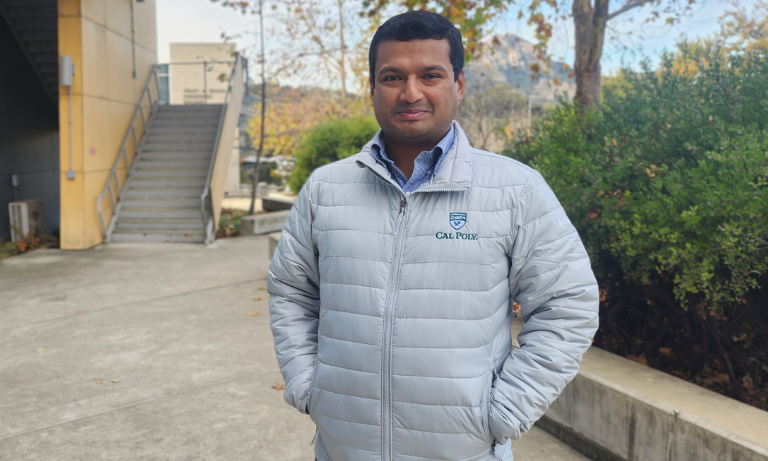
Fahim Khan is an Assistant Professor in the Department of Computer Science and Software Engineering at California Polytechnic State University’s College of Engineering. He specializes in computer graphics, data visualization, computer vision, and machine learning, with a focus on applying these technologies to education, environmental monitoring, and public safety. His research emphasizes making complex data accessible through advanced tools, bridging the gap between raw data and actionable insights. He is deeply committed to inclusive education and fostering interdisciplinary collaboration. His work often integrates citizen science initiatives, empowering communities through mobile applications and machine learning. Notable projects include real-time rip current detection systems and platforms for high school students to engage in research. Khan advocates for equity in technology, designing inclusive learning environments and promoting diversity in STEM. He actively supports the university’s Learn by Doing philosophy, blending practical education with theoretical rigor. Professionally, he contributes to coastal observation networks and autonomous vehicle datasets while maintaining a balance through outdoor activities like exploring Pismo Beach. His research trends reflect a strong focus on mobile computing, environmental applications, and education technology, with recent efforts emphasizing citizen science and data-driven solutions. While no formal grants or advising records are detailed, his projects implicitly involve collaborative efforts. He is affiliated with labs focused on environmental monitoring and mobile technology development, though specific lab names are not mentioned.
Dr Xinchen Zhang is a Grant-Funded Researcher (A) at the University of Adelaide's Department of Mechanical Engineering within the School of Electrical and Mechanical Engineering. His research focuses on integrating machine learning with computational fluid dynamics (CFD) to enhance predictive capabilities for multiphase flow solutions, particularly in sustainable energy applications like decarbonization technologies. He holds a PhD (2022) with a Dean's Commendation for Doctoral Thesis Excellence, emphasizing fluid and particle dynamics in particle-laden flows. His work addresses challenges in net-zero industrial processes such as limestone calcination and hydrogen production via methane pyrolysis, leveraging advanced CFD and ML-augmented methodologies. Key research areas include turbulence modeling, particle dispersion in jets, and flow regime analysis in horizontal particle-laden pipe systems. He is eligible to supervise Masters and PhD students as a co-supervisor. Dr Zhang's publications span 2018–2024, with recent trends focusing on physics-informed machine learning for turbulence modeling and multiphase flow optimization. His contributions advance computational efficiency and accuracy in predicting complex fluid-particle interactions.
Jay D. Sau is a Professor of Physics at the University of Maryland, College Park, and Co-Director of the Joint Quantum Institute (JQI). His research focuses on theoretical condensed matter physics, particularly topological quantum computing, quantum many-body systems, and Majorana fermions. He holds affiliations with the Condensed Matter Theory Center (CMTC) and JQI. Sau received his Ph.D. from UC Berkeley in 2008. His work bridges theoretical concepts in topological materials, superconductivity, and quantum information processing. Research Interests: Sau's primary interests include applying topological principles to solid-state and cold-atomic systems for quantum computation. Key areas include topological superconductivity, Majorana fermions, quantum Hall effects, and spin-orbit coupled systems. His group explores phenomena like topological degeneracy, Weyl semimetals, and cold atomic gases. Awards: He has been recognized with the National Science Foundation CAREER Award (2016) and the Sloan Research Fellowship (2016). His work has been published extensively in high-impact journals and covers topics ranging from Majorana physics to quantum phase transitions. Advising & Labs: Sau mentors graduate students including Tamoghna Barik, Stuart Thomas, Huan-Kuang Wu, and Shuyang Wang. His research group collaborates on projects at JQI and CMTC, focusing on experimental realizations of topological qubits and quantum devices.