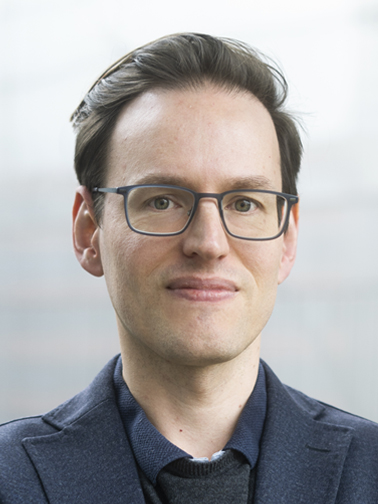
Chao Zhang is an Associate Professor at the Department of Chemistry-Ångström Laboratory, Uppsala University, specializing in computational electrochemistry and multi-scale modeling of electrolyte materials. His research bridges atomistic simulations with machine learning approaches to address challenges in energy storage and conversion systems. Education: Dr. rer. nat. from RWTH Aachen University (2013); Docent from Uppsala University (2020) Appointments: Postdoctoral researcher at the University of Cambridge (prior to joining Uppsala in 2017) His group develops finite-field methods for computational electrochemistry and investigates electrified solid-liquid interfaces. Recent research trends include neural rendering for underwater SLAM systems (2025), robust path-following control in marine robotics, and event-based localization in LiDAR-integrated environments. Scientific Awards: ERC Starting Grant (2020) Junior Research Fellowship, Wolfson College (2015) Jülich Excellence Prize for Young Scientists (2013)
Kristian Muri Knausgård is a Lecturer at the Department of Engineering Sciences , University of Agder , Norway. He teaches courses in embedded systems, software development, and robotics. Current courses: MAS245 (Embedded Computer Systems), MAS417 (Software Development), MAS418 (Robotics Programming) Previous courses: MAS218 (Electrical Circuits), MAS234 (Embedded Systems) His research focuses on embedded systems , real-time systems , and technical cybernetics , with applications in artificial intelligence , computer vision , and systems engineering . He contributes to the university's research groups on Robotics and Automation and Systems Engineering and Modeling . Recent publications show a strong emphasis on: Autonomous systems (robotics, docking algorithms) Deep learning applications in marine ecology 3D reconstruction and computer vision techniques Fish detection/classification using neural networks Industrial automation for aquaponic systems His work bridges theoretical research with practical implementations in mechatronic systems and environmental monitoring.
Dr. Markus Tatzgern serves as Professor for Mixed Reality and Game Development and Head of Research at the Department for Creative Technologies, Salzburg University of Applied Sciences. He leads the Digital Realities Lab, a multi-disciplinary research group focused on human-centered solutions at the intersection of software, design, and creative engineering for technology interaction. His academic foundation includes a Master of Science and Doctorate with highest distinction from Graz University of Technology. He furthered his expertise through post-doctoral research at the Christian Doppler Laboratory for Handheld Augmented Reality, recognized as a world-leading facility in mobile AR. Tatzgern's research spans Augmented Reality, Virtual Reality, Mixed Reality, and Human-Computer Interaction with emphasis on practical applications. His work addresses critical challenges in view management, haptic feedback systems, industrial procedure visualization, medical imaging interfaces, and game development. Key contributions include novel techniques for eye-perspective rendering, breathing-based VR interaction, and latency compensation in medical robotics. His publication trajectory reveals evolving focus from foundational AR visualization (2010-2016) toward applied XR solutions in healthcare, industrial training, and user experience optimization (2017-2024). Recent work demonstrates increasing integration of physiological inputs, real-world safety applications, and enterprise-grade XR prototyping. Scientific recognition includes: Honorable Mention for Best Paper at CHI 2022 for 'AirRes Mask' breathing interface Honorable Mention for Best Paper at IEEE 3DUI 2017 for adaptive rendering techniques As Head of Research, Tatzgern actively shapes the field through program committee roles and peer review for top venues including ACM CHI and IEEE VR. His four patents in AR visualization demonstrate translational impact from academic research to practical applications. The Digital Realities Lab operates as an innovation hub where software engineers, designers, and creative technologists collaborate on next-generation interaction paradigms. Current projects emphasize medical XR applications, industrial training systems, and accessibility-focused AR solutions for vulnerable populations.
Dr. Yiqin Xue is a Lecturer at the Cardiff University School of Engineering . With a focus on control systems and mechatronics, their work bridges automotive engineering, energy recovery systems, and combustion dynamics. Research spans 2001-2024 with recent work on sliding mode control optimization for linear DC motors. Key collaborations include Industrial Vision Systems Ltd and Harman Becker Automotive Systems . Research Interests include: Advanced control algorithms for mechanical systems Energy recuperation in regenerative braking Combustion instability mitigation Hydraulic/pneumatic system modeling Publications (2001-2024) demonstrate expertise in: Electro-hydraulic actuator control Combustion-acoustic interaction Neural network predictive modeling Automotive system optimization Time-delay system compensation Energy-efficient actuation methods Grants & Collaborations : Multiple Royal Academy of Engineering travel grants (2001-2005) Institution of Mechanical Engineers conference support Industrial projects with Harman Becker Automotive Systems and Industrial Vision Systems
Hu Cao is a postdoctoral research associate at the Chair of Robotics, Artificial Intelligence and Real-Time Systems (Prof. Alois Knoll) at the Technical University of Munich (TUM) . Holding a Ph.D. from TUM, his research bridges autonomous driving , robotic grasping , medical image analysis , and dense prediction (classification, detection, segmentation). Education : Ph.D. from TUM Hu's work explores: Autonomous Driving : Perception under adverse conditions, multi-sensor fusion, and risk-based safety models Robotic Grasping : Vision-language integration for 6D pose estimation Medical Imaging : Transformer-based segmentation techniques (e.g., Swin-Unet) His recent publications include 15+ works at top venues like CVPR , ICCV , IEEE TPAMI , and IEEE TIV , with 6052+ Google Scholar citations . Notably, Swin-Unet ranks among the top 3 most cited ECCV papers in 5 years, and his work on event-based autonomous driving perception was featured in IEEE Xplore Innovation Spotlight . Editorial roles include: Associate Editor for Visual Intelligence and Frontiers in Neurorobotics Editorial Board member of Artificial Intelligence and Autonomous Systems (AIAS) Topic Editor for Frontiers in Robotics and AI and Frontiers in Neuroscience He has reviewed for 20+ top journals (e.g., Nature Computational Science , IEEE TRO ) and served on program committees for NeurIPS , CVPR , ICCV , and MICCAI .
Thomas G. Thomas is an Associate Professor in the Department of Electrical and Computer Engineering at the University of South Alabama , where he contributes to both undergraduate and graduate education in electrical and computer engineering disciplines. Education: Ph.D. Electrical Engineering, University of Alabama Huntsville (1997) M.S. Electrical Engineering, University of Alabama Birmingham (1987) B.S. Electrical Engineering, University of South Alabama (1984) B.S. Chemistry, University of South Alabama (1977) Research Interests: Dr. Thomas's work spans robotics , smart grid systems , hyperspectral imaging , neural networks , and cybersecurity for industrial control systems . His research often integrates advanced machine learning techniques with practical engineering applications, particularly in autonomous systems and educational technology. Publication Trends: His recent publications (2004–2024) demonstrate a strong focus on robotics , machine learning , and engineering education . Notable contributions include autonomous navigation systems, cybersecurity in SCADA/PLC networks, and innovative educational programs to enhance student retention in engineering. Teaching: He instructs courses such as Virtual Instrumentation , Programmable Logic Controllers , and Introduction to Robotics , fostering hands-on learning in electrical and computer engineering.
Daniele Leonardis serves as Associate Professor of Applied Mechanics at the Institute of Mechanical Intelligence (IIM) of the Sant'Anna School of Advanced Studies in Pisa since October 2025. His research centers on wearable haptic interfaces and hand exoskeletons for clinical neurorehabilitation, virtual reality, and teleoperation applications. His primary research domains include: Development of miniaturized actuators for high-fidelity haptic rendering in wearable devices Clinical neurorehabilitation using serious games for children with Cerebral Palsy Integration of tactile feedback in teleoperation systems for complex manipulation tasks Soft exoskeletal devices for movement assistance in spinal/neurological patients Industrial robotics for railway infrastructure inspection Leonardis leads significant research initiatives: Coordinator and scientific director of the completed TELOS project (2024) for VR-based cerebral palsy rehabilitation Scientific director for SSSA in the European SUN project on augmented reality and haptic feedback Director of the SmartNest third-party research project Collaborator in TATTO, LEARN, and AVATAR projects Supervisor for RFI's mobile railway inspection system design His recent publications (2024-2025) demonstrate concentrated advancements in teleoperation interfaces, soft exoskeleton validation, and novel actuation methods for tactile feedback, with strong clinical and industrial validation components. He actively disseminates research through editorial roles in leading robotics journals and public demonstrations at international conferences. As founding partner of Next-Generation-Robotics spin-off, Leonardis bridges academic research and commercial applications in railway inspection robotics, reflecting his commitment to translational impact.
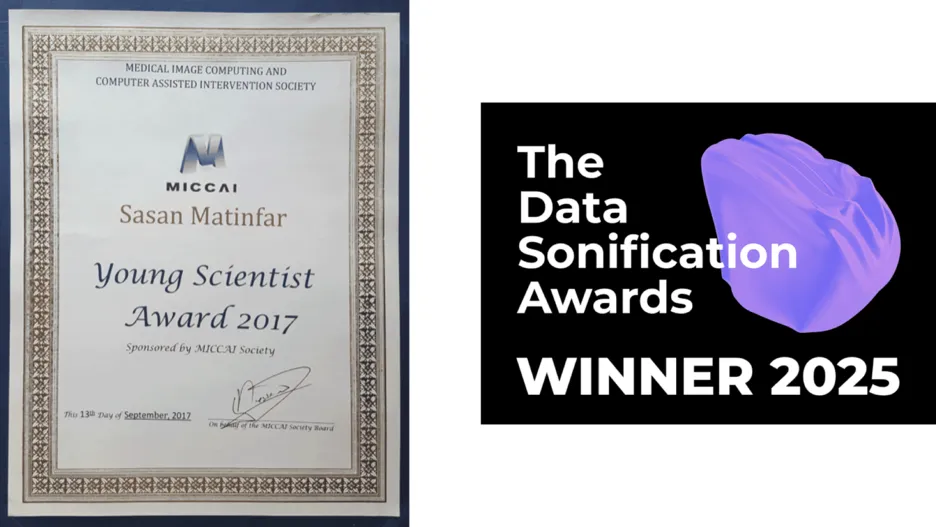
Sasan Matinfar is a research scientist at the Technical University of Munich (TUM), affiliated with the Chair of Computer Aided Medical Procedures (Prof. Navab) and the Munich Center for Machine Learning (MCML). He serves as scientific staff at Rechts der Isar Hospital, developing XR and sonification systems for surgical environments since 2020. His educational background includes: Master’s and Bachelor’s in Computer Science, Ludwig Maximilian University of Munich (LMU) Musicology, Franz Liszt University of Music, Weimar Piano Interpretation, Art University of Tehran Matinfar pioneers medical sonification and multisensory XR, creating auditory interfaces that convert tissue properties into sound for surgical guidance. His work in user-centered design produces clinically viable tools like the Ocular Stethoscope for retinal procedures and physics-based BioSonix frameworks, merging computer vision with perceptual audio engineering to enhance intraoperative precision without visual overload. Analysis of his 12 recent publications (2017-2025) reveals an evolving research arc from foundational surgical soundtracks to sophisticated context-aware sonification. Current work integrates generative AI with real-time tissue deformation modeling, focusing on multimodal frameworks where auditory feedback complements visual navigation in complex surgeries like cardiac interventions and retinal peeling. Key recognitions include: The Data Sonification Award (2025) MICCAI 2023 Best Paper Nominee (top 3% of submissions) MICCAI Young Scientist Award (2017, top 2% of papers) As an educator, Matinfar mentors students through TUM courses including Medical Augmented Reality (WS 2025/26) and Surgical Robotics, while co-organizing the Medical Augmented Reality Summer School and IEEE ISMAR 2025’s MIX Workshop. His patented technologies emerge from collaborations with Politecnico di Milano, TU Dresden’s CeTI, and Balgrist Hospital Zurich, securing interdisciplinary grants in surgical data science. Matinfar operates within TUM’s NARVIS Lab for medical image analysis and RobUSt for robotics-ultrasound integration, leveraging the German Heart Center Munich (DHM) infrastructure to validate XR systems in live surgical workflows and advance vision-language models for intraoperative decision support.
Dr. Winncy Y Du is a Professor in the Department of Mechanical Engineering at San José State University (SJSU) and directs the Robotics, Sensors, and Machine Intelligence Laboratory . She previously served as an assistant professor at Georgia Southern University and held a visiting professorship at MIT (2014-2015). PhD in Mechanical Engineering, Georgia Institute of Technology (1999) MS in Mechanical Engineering, West Virginia University (1994) MS in Electrical Engineering, Georgia Institute of Technology (1999) BS in Mechanical Engineering, Jilin University (1983) Her research focuses on sensors , robotics , and mechatronics applied to biomedical systems, automation, and control. Key projects include stroke rehabilitation robotics , pipeline leak detection , and spacecraft testbed control . Her publications span sensor technologies, medical robotics, and industrial automation. Notable scientific awards include: Fellow, American Society of Mechanical Engineers (ASME) (2010) ASME Diversity & Outreach Award (2004) Newman Brothers Award for Faculty Excellence (2014) She has led over 23 research grants and 20 industry-sponsored projects, including collaborations with NASA, Boston Scientific, and KWJ Engineering, Inc.
Dr. Kosei Ishida is an Associate Professor at the School of Creative Science and Engineering, Waseda University, specializing in architectural and construction engineering. With a Doctor of Engineering degree from Waseda University, he focuses on improving construction workflow efficiency through 3D modeling, BIM integration, and motion analysis techniques. Faculty of Science and Engineering (2012-2014) Graduate School of Creative Science and Engineering (2014) School of Science and Engineering (2009) His research spans architectural planning, city planning, and information-based construction methods, with particular emphasis on work efficiency analysis, 3D laser scanning for structural assessment, and BIM technology adoption in construction companies. He has developed factor analysis frameworks for construction time studies and pioneered pre-cut component design methodologies using 3D scanning. Research trends show strong focus on: 3D modeling and point cloud analysis Construction process optimization Building lifecycle management systems Work environment assessment Material usage efficiency Digital fabrication techniques Scientific awards include: ISARC Best Paper Award (2012) Ono Azusa Memorial Award (2013) Multiple Building Construction Symposium Outstanding Presentation Awards (2014-2015) He teaches courses in construction measurement, building systems, architectural design, and construction management, while maintaining active involvement in industry committees and research projects including digital fabrication methodologies for building repairs.
Hiroyuki Ishii is a Professor at Waseda University's School of Creative Science and Engineering, Faculty of Science and Engineering. With over 15 years of academic experience at Waseda University, he was promoted to full Professor in 2022 after serving as Associate Professor from 2016-2022. His research spans robotics, control systems, and mechanical engineering, with particular expertise in soft robotics and continuum manipulators. His educational background includes: Ph.D. from Waseda University (2004-2007) Master's degree from Waseda University Graduate School of Science and Engineering (2002-2004) Bachelor's degree from Waseda University School of Science and Engineering (1998-2002) Professor Ishii's research focuses on Robotics and Intelligent Mechanics and Mechanical Systems , with particular emphasis on soft robotics, continuum manipulators, and human-robot interaction. His work bridges theoretical control systems with practical applications in medical robotics, rehabilitation devices, and inspection systems. He has pioneered novel approaches in pneumatic actuation, growing robots, and bimanual continuum robot control, demonstrating exceptional creativity in solving complex mechanical challenges. His recent publications reveal a strong trend toward medical applications of robotics, particularly in surgical assistance and rehabilitation. There's also significant work on soft growing robots and continuum manipulators with innovative actuation mechanisms. His research shows increasing interdisciplinary collaboration, spanning mechanical engineering, computer vision, and biomedical applications. His notable awards include: Best Paper Award Finalist at IEEE ICMA2024 The Robotics Society of Japan 3rd Outstanding Research and Technology Award (2022) Minister of Education, Culture, Sports, Science and Technology Young Scientists Award (2018) Advanced Robotics Best Paper Award (2015) ICRA2014 Best Cognitive Robotics Paper Award Finalist Professor Ishii actively participates in research committees and professional societies, serving as Director of the Robotics Society of Japan since 2024. His research has received substantial funding through competitive grants, supporting his work on innovative robotic systems with practical applications in healthcare, infrastructure inspection, and human-robot collaboration. His laboratory develops specialized robotic systems including small mobile robots for animal interaction, soft growing robots, and continuum manipulators for surgical applications. The team combines mechanical design expertise with advanced control algorithms to create robots capable of operating in complex environments.
J.M.P. Geraedts is a Professor in the Faculty of Industrial Design Engineering at Delft University of Technology, specializing in Emerging Materials. His interdisciplinary work bridges design, engineering, and advanced manufacturing technologies. His research focuses on digital fabrication , 3D printing of functional systems , soft robotics , and structural electronics . He explores how novel materials and computational methods can enable next-generation smart products and human-robot interaction. His interests span from inductive power transfer to embedded sensors and computational design . The recent publications highlight a strong trend in integrating electronics directly into 3D-printed structures, advancing soft robotics control through learning, and reconstructing cultural artifacts digitally. His work lies at the intersection of mechatronics , design engineering , and emerging materials . Member of EISA Green Awards 2012-2013 He has supervised multiple student projects (8 listed), delivered keynotes on mechatronics and digital manufacturing, and engaged with the public through media discussions on robotics and industry 4.0. His activities include presentations at major forums such as EUROGRAPHICS and workshops on the convergence of hardware and software. He is involved in research groups focusing on digital fabrication , soft robotics , and design innovation , contributing to both academic and industrial advancements in smart manufacturing.
Dr Thomas Madsen is a Lecturer and Lead for Teaching and Quality in the School of Computing and Engineering at the University of West London. He previously served as a Lecturer at the University of Buckingham and held academic positions at Aarhus University (Denmark), Centro di Ricerca Matematica Ennio De Giorgi (Pisa), and King’s College London. His academic work bridges pure mathematics and applied computing disciplines. His research interests include Differential Geometry , Partial Differential Equations in geometric contexts , Special Holonomy Manifolds , and Toric Geometry , with recent expansion into Neuromorphic Robotics , Spiking Neural Networks , and Computing Education . He applies symmetry techniques to solve geometric PDEs such as Einstein’s equations and explores practical implementations of neuromorphic systems on low-power hardware. The trend in his recent publications (2020–2025) shows a dual focus: one on deep mathematical structures in differential geometry and theoretical physics, and another on innovative applications in artificial intelligence, robotics, and pedagogy in computing education. His collaborative work with researchers like Nicola Russo and Konstantin Nikolic emphasizes interdisciplinary innovation. Self-learning neuromorphic robot based on reward-driven Spiking Neural Network (2025) Enhancing Learning and Teaching Experience for International Students in Computing Subjects (2025) An Implementation of Communication, Computing and Control Tasks for Neuromorphic Robotics on Conventional Low-Power CPU Hardware (2024) Special holonomy manifolds with torus symmetry (2023) An interface platform for robotic neuromorphic systems (2023) Dr Madsen teaches across a broad portfolio of programs including BSc and MSc degrees in Data Science, Mathematics and Computing, Artificial Intelligence, Cyber Security, and Biomedical Engineering. He supervises PhD students and contributes to curriculum development, particularly in enhancing educational experiences for international students. He has collaborated with advisees such as Sama Aleshaiker and Wei Jie on pedagogical research. While no specific grants are detailed, his active research output and teaching leadership suggest sustained scholarly engagement. He is associated with research groups or labs focused on neuromorphic computing and mathematics for computing, contributing to both theoretical and applied advancements. His work on teaching resources and educational practice indicates a strong commitment to academic quality and innovation in STEM education.
Kay Pompetzki is a Ph.D. student and Lecturer at the Intelligent Autonomous Systems Lab in the Department of Computer Science at Technische Universität Darmstadt . Previously known as Kay Hansel, his research focuses on Robot Learning , Machine Learning , and Human-Robot Interaction . He has contributed to projects involving optimal control , reinforcement learning , and visuo-tactile integration . Bachelor's in Applied Mathematics, RheinMain University of Applied Sciences Master's in Autonomous Systems, TU Darmstadt Visiting Scholar, Intelligent Robotics and Biomechatronics Laboratory (Nagoya University, 2023) Junior Expert Exchange Program delegate (2024) His publications span robot motion planning , goal inference , and sensor integration . Recent work includes tensor-based motion planning, kinematic graph matching, and telerobotics with haptic feedback. He has received recognition for Best Paper Awards in IEEE conferences. Advisor for 20+ theses and projects Reviewer for IEEE IROS, ICRA, CoRL, RSS, and ML workshops
Professor Andy Philippides is a faculty member in the School of Engineering and Informatics at the University of Sussex, where he holds the title of Professor of Biorobotics (Informatics). He has been continuously affiliated with the university since 1995, progressing from an MSc and PhD student to a permanent academic, achieving full professorship in 2017. His work is deeply interdisciplinary, bridging robotics, neuroscience, and artificial intelligence. His research interests focus on the mechanisms of intelligent behavior through the interaction of body, brain, and environment. Key areas include visual navigation in insects and robots, neuromodulation in neural networks (e.g., GasNets), evolutionary robotics, and computer vision. He leads and contributes to high-impact projects such as Brains-on-Board, INSIGHT, and be.AI, funded by EPSRC, BBSRC, MRC, and the European Union. His recent publications (2022–2025) reflect a strong trend in bio-inspired algorithms, particularly in insect navigation, spiking neural networks, and adaptive robotics. These works span journals like PLoS Computational Biology , Frontiers in Physiology , and Biomimetics , emphasizing visual route learning, memory networks, and neuromorphic computing. He has supervised over 50 MSc theses and numerous PhD students, many of whom now hold academic or industry positions. His collaborations include prominent researchers such as Paul Graham, Phil Husbands, and Tom Collett. He is actively involved in grant-funded research, with current projects extending into 2028. Action-based bio-inspired autonomous navigation (Universities UK) Emergent embodied cognition in shallow neural networks (BBSRC) be.AI - biomimetic embodied Artificial Intelligence (Leverhulme Trust) ActiveAI - active learning and selective attention (EPSRC) He teaches courses such as Intelligence in Animals and Machines and Research Methods in Neuroscience, and has previously taught in computational neuroscience and robotics. His lab, part of the Centre for Computational Neuroscience and Robotics (CCNR), fosters interdisciplinary research in biorobotics and neural modelling.