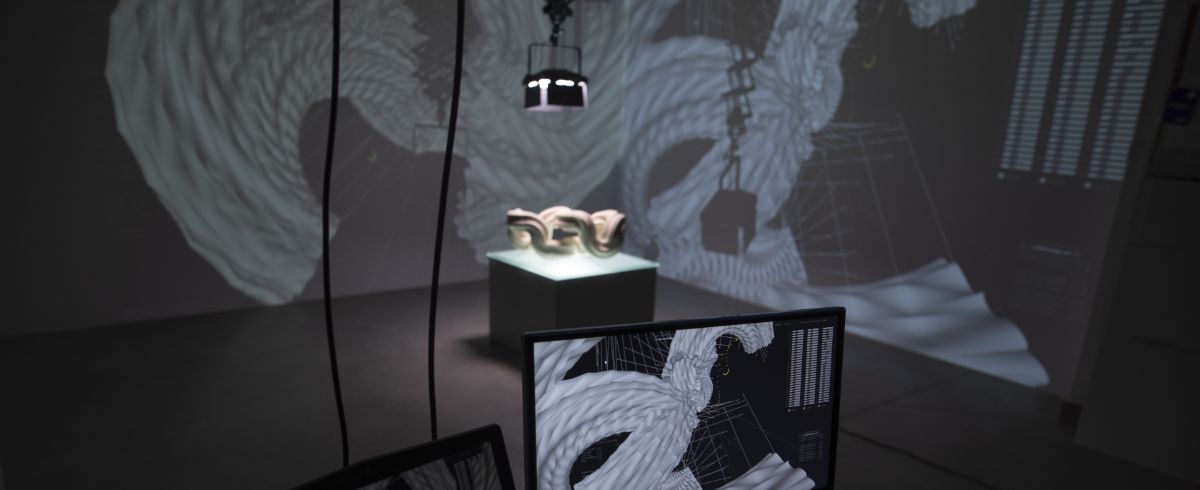
Abel Adam is a Professor at the Academy of Fine Arts in Wrocław , affiliated with the Faculty of Ceramics and Glass and Department of Interdisciplinary Activities in Ceramics and Glass. He specializes in combining creative coding , algorithmic design , and 3D printing with traditional ceramic art to explore digital anatomy and biological analogies. Email: adamabel@asp.wroc.pl Website: adamabel.com Research Focus: Abel's work materializes computational processes into physical ceramic forms, emphasizing the intersection of code, geometry, and organic aesthetics. His projects translate mathematical patterns into tactile objects through advanced digital fabrication techniques. Artistic Trends: Recent projects like Chrysallis (2021) and Cyberboros (2020-2021) demonstrate a recurring exploration of algorithms, metamorphosis, and hybrid materiality using 3D printing technologies. Contact: Available through adamabel@asp.wroc.pl or personal website.
Deniz Taşkın is an Associate Professor at the Department of Computer Engineering , Trakya University , Turkey. He has served in various academic and administrative roles since 2002, including Head of Department of Information Technology (since 2024) and Deputy Head of Department (since 2016). Education: PhD in Computer Engineering (2007) Master's in Computer Engineering (2004) BSc in Computer Engineering (2002) Edirne Science High School (1998) Research Interests: His research focuses on Internet of Things (IoT) , Embedded Systems , and Precision Agriculture , with applications in sensor networks, wireless communication, and agricultural monitoring. He explores 3D Modeling techniques for optical systems and contributes to Cybersecurity in multimedia and IoT environments. Publication Trends: Deniz has published 15+ articles on IoT architectures, Bluetooth Low Energy sensor networks, 3D calibration methods, and video encryption. His work bridges Digital Circuit Design with Agricultural Technology , emphasizing energy efficiency and real-time data processing. Scientific Awards: 2017 Trakya Project Market: Electric Motor Driver for Autonomous Vehicles 2016 TÜBİTAK: Electromobile Category Runner-Up and Promotion Award 2015 TÜBİTAK: Solar-Powered Vehicle Design Award 2015 Edirne Governorship: Provincial Achievement Certificate Advising and Grants: He has supervised 5 PhD theses and 7 Master's theses , including projects on IoT in Precision Agriculture and FPGA Circuit Design . As a principal investigator, he led 8 scientific projects funded by Trakya University and KOSGEB, focusing on embedded systems, data security, and smart automation. Labs and Teams: He contributes to IoT Research and Embedded Systems Development at Trakya University, collaborating with multidisciplinary teams in agricultural technology and digital design. His work includes designing self-powered sensor nodes and FPGA-based hardware.
Dr. Lu Gan is a Senior Lecturer in the Department of Electronic and Computer Engineering at Brunel University London, within the College of Engineering, Design, and Physical Sciences. She earned her B.Eng and M.Eng in Electronic and Information Engineering from Southeast University, China, in 1998 and 2000, followed by a Ph.D. in Information Engineering from Nanyang Technological University, Singapore, in 2004. Before joining Brunel in 2008, she held faculty positions at the University of Newcastle, Australia (2004-2006) and the University of Liverpool, UK (2006-2007). Her research spans fundamental signal processing theories, machine learning, and applications in image/video coding, non-destructive terahertz/ultrasound imaging, wireless communications, and sparse antenna arrays. Education: B.Eng (Electronic and Information Engineering), Southeast University, China (1998) M.Eng (Electronic and Information Engineering), Southeast University, China (2000) Ph.D (Information Engineering), Nanyang Technological University, Singapore (2004) Her research focuses on structured sparse signal processing for infrared/terahertz systems, super-resolution in non-destructive imaging, deep learning for terahertz data, non-orthogonal pilot design for 5G systems, and separation of singing voice from music. She has secured funding from EPSRC, Innovate UK, BBSRC, UK Atomic Energy Authority, and TWI. She actively contributes to academic service as an Associate Editor for IEEE Signal Processing Letters, IEEE Transactions on Circuits and Systems-I, and as a Meta Reviewer for ICASSP 2025. Her work has been recognized with a Best Paper Award from the Journal of The British Blockchain Association in 2022 and a Gold Medal at the IEEE Audio and Acoustic Signal Processing Challenge (DCASE) in 2022. Dr. Gan also serves as a reviewer for top journals like IEEE Transactions on Information Theory and IEEE Transactions on Signal Processing, and participates in grant panels for the Royal Society and EPSRC. Recent publications emphasize cross-domain speech enhancement architectures, terahertz data reconstruction via spatio-temporal dictionary learning, and coprime array designs using Chinese remaindering over quadratic fields. Her work bridges compressive sensing, lattice structures, and practical applications in healthcare and communication systems. She is a Senior Member of IEEE, Fellow of the Higher Education Academy (UK), and actively contributes to departmental leadership as Course Director for MSc Wireless Communication Systems, Level 3 Coordinator, and Social Media Administrator.
Dr. Stephen Swift is a Reader in the School of Information Systems, Computing and Mathematics at Brunel University London within the College of Engineering, Design and Physical Sciences. His research spans multiple domains including bioinformatics, ophthalmology, and software engineering, with a focus on developing computational methods for analyzing complex data. B.Sc. in Mathematics and Computing from University of Kent M.Sc. in Artificial Intelligence from Cranfield University Ph.D. in Intelligent Data Analysis from Birkbeck College, University of London Dr. Swift's research centers on multivariate time series analysis, heuristic search algorithms, data clustering techniques, and evolutionary computation methods. His work applies these computational approaches to real-world problems in bioinformatics (particularly gene expression analysis), ophthalmology (glaucoma progression modeling), and software engineering (code quality metrics). His interdisciplinary research bridges computer science with medical and biological applications, developing novel algorithms for complex data analysis tasks. Analysis of Dr. Swift's recent publications reveals a strong focus on applying computational intelligence to healthcare challenges, particularly in diabetes management, glaucoma progression, and genetic disorders. His work consistently combines machine learning techniques with domain-specific knowledge to develop practical solutions for medical diagnostics and treatment personalization. The publications also demonstrate his continued interest in software engineering methodologies and computer vision applications. Dr. Swift has secured research funding from major UK research councils including EPSRC (Engineering and Physical Sciences Research Council) and BBSRC (Biotechnology and Biological Sciences Research Council), supporting projects such as 'Modelling Short Multivariate Time Series' and 'Analysing Virus Gene Expression Data to understand Regulatory Interactions.' His research has been conducted through collaborations with multiple institutions including University College London, Moorfields Eye Hospital, and Birkbeck College, demonstrating his ability to work across disciplinary boundaries to address complex scientific challenges.
Márton Sipos is an academic at the Department of Automation and Applied Informatics , part of the Faculty of Electrical Engineering and Informatics at the Budapest University of Technology and Economics . His work bridges distributed storage , network coding , and IoT with interdisciplinary collaborations in biomedical research . Contact: Sipos.Marton@aut.bme.hu . Academic Rank : Lecturer Research Focus : Edge-cloud continuum, data security, and network coding His research explores heterogeneous systems for IoT and edge computing, including frameworks like SERRANO and EMPYREAN . He also investigates blockchain-based file sharing (FileTribe) and medical topics like cervical artery dissection . Recent work emphasizes AI-driven resource allocation and time-series compression (Titchy). Key publication trends include: Network Coding for fault-tolerant storage Edge-Cloud integration (2021–2024) Blockchain applications in secure storage (2019) Medical Informatics in neurological studies (2019) Peer-to-Peer optimization via BitTorrent and WebRTC (2015–2017) Erasure Coding in dynamic environments (2018–2019)
Henrik Walter is a Full Professor (W3) of Psychiatry with a focus on Psychiatric Neuroscience and Neurophilosophy at Charité – Universitätsmedizin Berlin. He serves as Director of the Mind and Brain Research Division and Deputy Medical Director (Research) at the Department of Psychiatry and Psychotherapy, Charité Campus Mitte. Walter is also a faculty member at the Berlin School of Mind and Brain , a faculty member of the Bernstein Computational Center Berlin , and a principal investigator at the Berlin Center for Advanced Neuroimaging . Clinical expertise: Schizophrenia and affective disorders Empirical research: Working memory, volition, reward mechanisms, emotion regulation, mentalization, imaging genetics, connectomics Philosophical research: Philosophy of mind, neurophilosophy, neuroethics, philosophy of psychiatry Research trends in his 15 most recent publications (2009-2024) emphasize connectome-based machine learning , dynamic network reconfiguration , self-control mechanisms , and predictive models for psychiatric relapse . His work explores the intersection of neural network organization , emotional processing , and philosophical frameworks in mental health. Walter oversees major projects including environMENTAL (data harmonization in large cohorts) and FOR5187 PREACT (personalized psychotherapy). His team actively trains students and researchers through internships, theses supervision, and doctoral programs.
Dr. Erhan Ekmekcioglu serves as a Visiting Fellow in Digital Technologies at Loughborough University, bringing over a decade of expertise in communication systems and human-computer interaction. Previously a Senior Lecturer (2017-2023) and Chief Programme Director (2019-2022) at the Institute for Digital Technologies, he now advises Ofcom on emerging technologies in UK telecommunications and broadcasting sectors. His academic credentials include: BSc (Hons) in Electrical and Electronic Engineering from Middle East Technical University, Turkey (2006) PhD in Multimedia Communication Technologies from University of Surrey, UK (2010) Ekmekcioglu's research centers on advanced multimedia systems with specific focus on multi-view video coding and next-generation communication interfaces. His work bridges theoretical innovation in signal processing with practical applications in media technologies, emphasizing user experience in emerging digital ecosystems. This expertise stems from his doctoral thesis on "Advanced Multi-view Video Coding Techniques" and subsequent industry-academia collaborations. He has secured research funding from the European Union and British Government as co-investigator on multiple projects, while his academic leadership encompassed curriculum development across MSc programmes and oversight of teaching quality during his tenure as Chief Programme Director. Current advisory work at Ofcom extends this expertise into regulatory frameworks for converging media and communications technologies.
Amy Pavel is an Assistant Professor in the Department of Computer Science at the University of Texas at Austin. Prior to this role, she was a Postdoctoral Fellow at Carnegie Mellon University and a Research Scientist at Apple. Her research bridges Human-Computer Interaction and Accessibility, focusing on AI-driven systems for efficient and inclusive communication. Education: PhD in Computer Science from UC Berkeley (2019), advised by Björn Hartmann and Maneesh Agrawala. Teaching: Regularly teaches Human-Computer Interaction courses at UT Austin and UC Berkeley. Her work addresses accessibility challenges through systems like Rescribe (audio descriptions), CrossA11y (video accessibility), and GenAssist (image generation). Recent projects explore AI applications for low-vision learners, photosensitivity warnings in VR, and collaborative video editing. Award highlights include 2023 UIST Best Paper 2022 UIST Best Paper 2020 CHI Honorable Mention (twice) 2018 UC Berkeley EECS Outstanding Graduate Student Instructor She advises PhD students like Mina Huh and Yi-Hao Peng, as well as undergraduates and masters students. Her lab collaborates with institutions including Google, Carnegie Mellon, and UC Berkeley.
Josef Bigun is a Professor at the School of Information Technology, Halmstad University , Sweden, since 1998. His research focuses on Computer Vision, Biometric Signal Analysis, and Artificial Intelligence , with emphasis on periocular recognition, iris biometrics, and motion analysis . He has been recognized as a Fellow of the IAPR (2000) and Fellow of the IEEE (2003) , becoming Sweden's first IEEE Fellow in image analysis. Education : M.Sc. and Ph.D. from Linköping University (1983, 1988) Key Projects : EU projects (BBfor2, BIOSECURE, ACTS-M2VTS), Swedish VR/SSF projects, Swiss Fonds National projects His recent publications focus on CNN optimization, periocular biometrics, and cross-spectral recognition . He has developed innovative Continuous Examination systems using spiral codes for educational assessment and contributed to biometric standards for the European Association for Biometrics . Scientific Awards : Fellow of the IAPR (2000) Fellow of the IEEE (2003) Top 10 Scientist in Sweden (Scopus AI & Image Processing, 2024 Stanford study) Listed on research.com's top Computer Science researchers (Sweden) He has served on organizing committees for ICPR, ICIP, ICB conferences and co-founded the Audio and Video Based Person Authentication conference (now ICB). His work appears in journals like Pattern Recognition Letters and IEEE Image Processing .
Prof. Dr. Uluğ Bayazıt is a Professor at Istanbul Technical University's Department of Computer Engineering. His research focuses on computer graphics, image processing, deep learning, and biomedical signal analysis. Doctorate: Rensselaer Polytechnic Institute (1993) BSc: Boğaziçi University Electrical and Electronic Engineering (1991) Research interests include: Smart city solutions using computer vision 3D mesh compression algorithms Electromyography signal analysis for prosthetics Deep learning applications in agricultural monitoring Recent publications span neural computing, multimedia tools, and graphical models. Key projects include: "Eye of the City" smart city initiative Plant phenology classification via image sequences Geometry video compression techniques As Principal Investigator (PI), he leads research grants funded by BAP and TTO. He has 46 research outputs and an h-index of 126 (Scopus). Active in IEEE from 1991-2014, with expertise in signal processing and mesh geometry.
Panayiota Kendeou is a Professor in Educational Psychology at the University of Minnesota. Her research focuses on reading comprehension, knowledge revision, and combating misinformation through digital literacy interventions. 2015: Early Career Impact Award 2012: Tom Trabasso Young Investigator Award 2009: UKLA Research in Literacy Award Key research themes include: Epistemic cognition and self-regulated learning Technology-based assessment tools Misinformation and fake news mitigation Language comprehension disparities Adaptive training for code comprehension Cognitive processes in refutation texts Current projects span partnerships with Arizona State University, McGill University, and the U.S. Department of Education. Her 2025 publications address AI's educational impact, knowledge revision mechanisms, and epistemic emotion dynamics. Active research areas include: Interactive Strategy Training (iSTART-Early) Code comprehension adaptive training Early language comprehension interventions Behavioral energy efficiency education
Alessandro Iscra is a Contract Professor at the Department of Naval, Electrical, Electronic, and Telecommunications Engineering (DITEN) at the University of Genova. He teaches DIGITAL COMMUNICATIONS 1 in the Master's program in Internet and Multimedia Engineering. His research focuses on telecommunications, network protocols, and Quality of Service (QoS) optimization. Research Interests : Digital communications systems Network protocol performance QoS-oriented flow control mechanisms Video coding and adaptation Cellular system protocols Publication Trends : His research spans two decades, with work on integrated video coding (2000) and cellular system protocols (1995). Key themes include telecommunications, network performance analysis, and signal processing. Contact : Email: alessandro.iscra@edu.unige.it
Juliana Schmidt is a Researcher at the Faculty of Health Sciences , Working Group 5 Health Economics and Health Management at Bielefeld University. She holds an M.Sc. in Public Health and a B.Sc. in Health Communication, both from Bielefeld University. Her research focuses on health-related quality of life , health economic evaluation , and respiratory syncytial virus (RSV) diagnostics. 2015: General higher education entrance qualification 2015-2016: Federal Voluntary Service (Bundesfreiwilligendienst) in a Munich hospital 2016-2019: B.Sc. in Health Communication at Bielefeld University 2019-2021: M.Sc. in Public Health at Bielefeld University Her recent publications analyze measurement properties of HRQoL instruments , statistical adjustments for RSV misclassification , and telemedicine adoption trends . She contributes to projects like DigiSep (funded by the German Federal Government) and Impact of medical diagnosis on German EQ-5D values . Her work combines empirical research with policy-relevant data analysis . Current research themes include: Comparative analysis of EQ-5D-5L and Stroke Impact Scale 2.0 Validity studies of ICD-10 codes for RSV Telemedicine utilization patterns in outpatient care Risk factor analysis for herpes zoster infections She actively participates in third-party funded projects and contributes to peer-reviewed journals and conference proceedings .
Neil Klingensmith is an Assistant Professor of Computer Science at Loyola University Chicago, specializing in hardware-software co-design for cyber-physical systems. His research focuses on making IoT systems more efficient, reliable, and secure while maintaining strong educational leadership in operating systems and embedded systems courses. PhD in Computer Engineering from University of Wisconsin (2019) MS in Computer Engineering from University of Wisconsin (2016) BS in Electrical Engineering from University of Wisconsin (2010) Klingensmith's research spans three major areas: IoT Security : Innovating secure device authentication through environmental signals (power line noise, electromagnetic radiation) and analyzing vulnerabilities in automotive and conferencing systems Low-power Embedded Systems : Developing energy-efficient sampling techniques and hypervisor-based privacy agents for mobile/IoT devices Operating System Design : Exploring userland containers, real-time hypervisors, and memory management frameworks His recent publications demonstrate focus areas in authentication mechanisms , secure device pairing , and mobile virtualization . With 15+ years of academic and industry experience, he has secured significant funding including: $500k NSA NCAE grant (2023-2024) $250k NSF OAC grant for low-power computer vision (2021-2024) $110k US Department of Energy Fellowship (2013-2015) His students have successfully placed at major companies including Amazon, Google, and Boeing while advancing research in: Secure firmware development Real-time OS implementation Hardware authentication techniques Memory management optimization Embedded system design As co-founder of Emonix, he bridges academic research with commercial applications in HVAC automation. His patents in context-based device pairing demonstrate practical impact of his theoretical work.
Rafał Mantiuk is a Professor of Graphics and Displays at the Department of Computer Science and Technology , University of Cambridge, UK. He leads the Rainbow Research Group and works on visual perception, display algorithms, and computational imaging. His academic journey includes a PhD (summa cum laude) from Max-Planck-Institut (2006) and an MSc from Technical University of Szczecin (2003). His research spans applied visual perception , high dynamic range imaging , display algorithms , and machine learning for image synthesis . Recent work focuses on ColorVideoVDP (HDR video metrics), AR-DAVID (AR display artifacts), and elaTCSF (flicker modeling). His methodologies combine psychophysics with computational models to enhance display technologies. His awards include: SIGGRAPH Test-of-Time Award (2023) ICME Grand Challenge Second Place (2025) CIC Best Paper Awards (2022, 2020) Human Vision and Electronic Imaging Best Paper (2020) Heinz Billing Award (2006) Key grants: ERC Consolidator Grant (2017) for EyeCode, MSCA RealVision (2018), and EPSRC funding (2017, 2011). He supervises projects involving novel display technologies like HDR multi-focal stereo displays and 10-bit LCD systems.