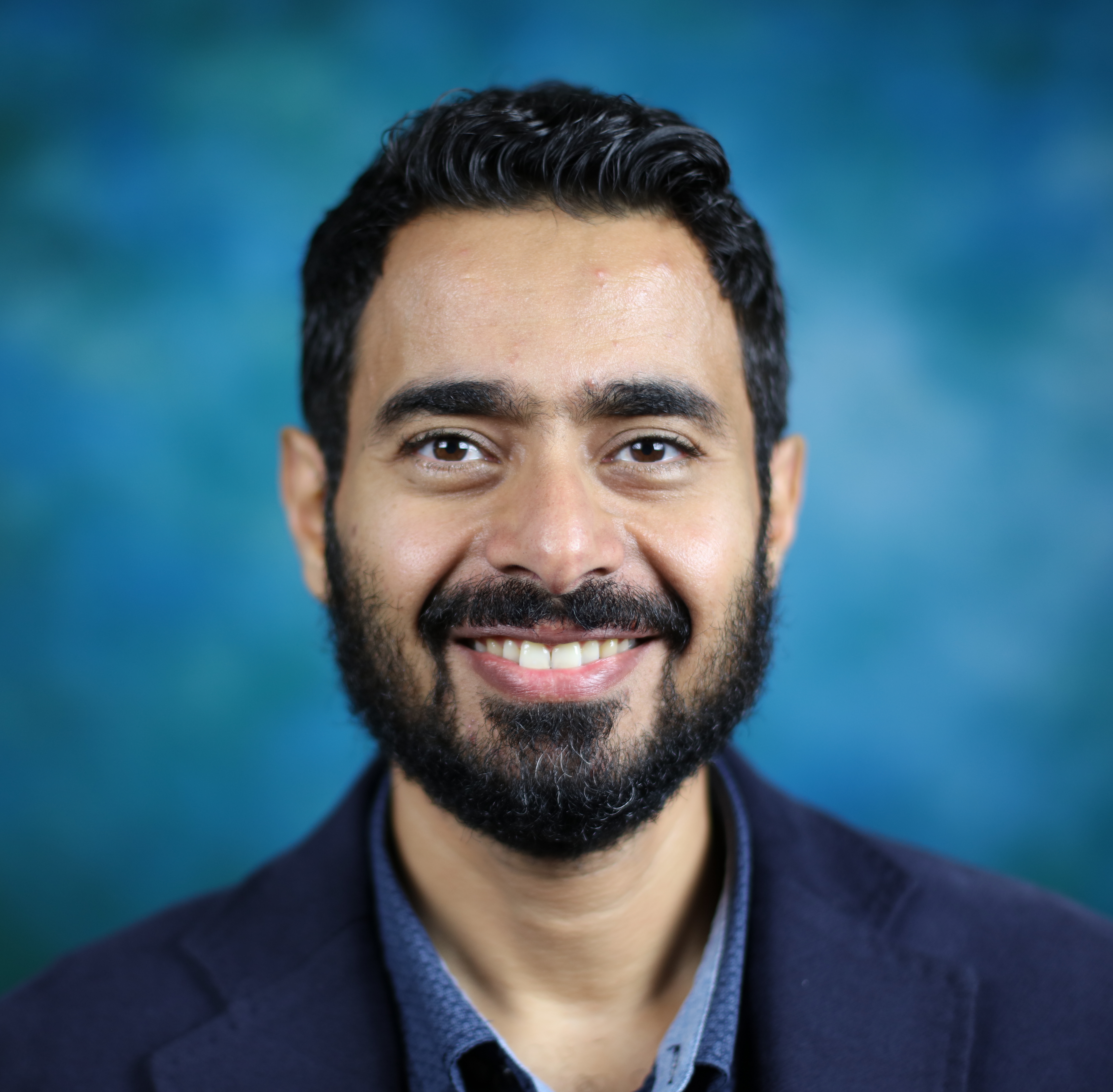
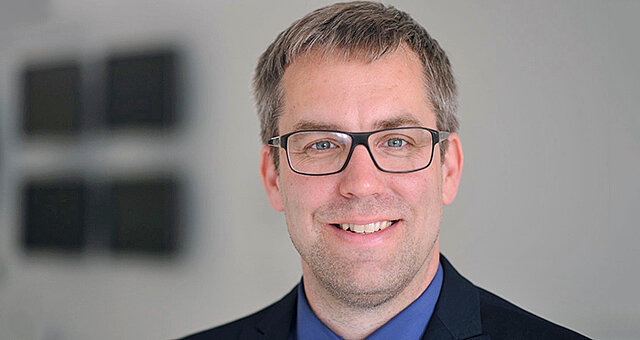
Dr. Thomas Schierl is the Head of the Video Communication and Applications Department at Fraunhofer Heinrich Hertz Institute (HHI) in Berlin. Since 2010, he has led research groups in multimedia communications and video coding, co-developing key video coding standards such as H.264 SVC and HEVC. He currently heads the Video Coding & Analytics department since 2015, focusing on video compression, wireless transmission, and standardization. Education: Diplom-Ingenieur (Computer Engineering) from Berlin University of Technology, 2003 Dr.-Ing. in Electrical Engineering and Computer Science, Berlin University of Technology, 2010 Research interests span video over wireless networks, system integration of video codecs, and cellular network protocols. He contributed to MPEG-2 Transport Stream standards and co-authored IETF RFCs for video payload formats. In 2014, he received the Emmy Award for MPEG-2 Transport Stream development. Active in standardization bodies: JCT-VC, MPEG, IETF, 3GPP, and DVB. His work includes high-level syntax for HEVC parallelism and V2X resource pooling for 5G NR. Labs/Teams: Leads the Video Coding & Analytics team at HHI, specializing in cutting-edge video compression and communication technologies.
Michel KIEFFER is a Professor in Signal Processing for Communications at Paris-Sud University and a researcher at the Laboratoire des Signaux et Systèmes (L2S), Gif-sur-Yvette, France. He holds a Ph.D. (1999) and Habilitation (2005) from Université Paris-Sud. Previously, he served on part-time leave at Laboratoire de Traitement et Communication de l’Information (CNRS-Télécom ParisTech, 2009–2016) and was a junior member of the Institut Universitaire de France (2011–2016). His research focuses on joint source-channel coding, signal processing for communication networks, and robust control systems. Key contributions include works on multimedia transmission reliability, UAV localization, and fault identification in power grids. He co-authored over 100 publications and books like Applied Interval Analysis (Springer, 2001) and Joint Source-Channel Decoding (Academic Press, 2009). He serves as Associate Editor for Signal Processing (since 2008) and IEEE Transactions on Communications (2012–2016). His work spans interdisciplinary areas such as energy systems, robotics, and telecommunications, addressing challenges in real-time data transmission, network slicing, and distributed control.
Romain Jacob is a Lecturer at the Department of Information Technology and Electrical Engineering at ETH Zürich, where he also holds a postdoctoral researcher position in Prof. Laurent Vanbever's group. His research focuses on computer networks, real-time systems, and sustainable networking, with an emphasis on reproducible experimental design and open science advocacy. He completed his PhD under Prof. Lothar Thiele at ETH Zürich in 2019, followed by a visiting scholar position at UC Berkeley in 2014. His academic background includes a Master of Science in Engineering of Complex Systems from École Normale Supérieure de Cachan (now ENS Paris-Saclay). Key research interests include: Time-triggered wireless architectures for cyber-physical systems Energy-efficient networking and sustainability Reproducibility frameworks like TriScale Real-time communication protocols Notable contributions include the Best Paper Award at HotCarbon'24 for work on router energy optimization. He actively promotes open science through initiatives like the ORCID Researcher Advisory Council and serves as Editor-in-Chief for JSys. His teaching includes a master's lecture on Sustainable Networking, emphasizing practical applications and open educational resources. He collaborates with the Swiss Reproducibility Network (SwissRN) to advance rigorous research practices.
Jong-Deok Kim is an active researcher in wireless communication and IoT systems, with frequent collaborations on publications spanning dynamic channel bonding, network optimization, and low-power protocols. His work addresses challenges in Wi-Fi, LoRa, and millimeter-wave networks, focusing on throughput, latency, and reliability. Research Focus: Wireless networks, edge computing, and blockchain for IoT. Key Topics: Channel allocation, federated learning, and error compensation methods. His recent publications highlight trends in adaptive algorithms for dense networks, hybrid positioning systems, and federated learning applications. Awards and grants are not explicitly mentioned in the provided data.
Christian Herglotz is a researcher affiliated with the University of Erlangen-Nuremberg , Germany. His work focuses on energy efficiency in video coding and decoding systems, with a particular emphasis on HEVC and VVC standards. He has published extensively in IEEE journals and conferences like ICIP, ICASSP, and QoMEX, often collaborating with André Kaup and Matthias Kränzler. Key research themes: energy-aware video compression, decoding power optimization, rate-energy-distortion modeling. Co-edited special sections on deep learning-based video coding. Recent Publications (2022-2025): Explored power reduction in HDR video encoding, motion prediction for 360-degree video, and heterogeneous quantization for DNN accelerators. His studies integrate machine learning with traditional codec design to improve energy efficiency. Technical Contributions: Developed models for decoding energy estimation, analyzed carbon impact of streaming devices, and proposed methods for viewport-adaptive motion compensation. Collaborative work spans thermal imaging for power analysis and reliability-aware DNN hardware optimization.
Dr. Kiki Adhinugraha is a Lecturer in the Department of Computer Science and Information Technology at La Trobe University, Melbourne, Australia. He holds a PhD in Information Technology from Monash University and is certified as an Oracle 11g OCA DBA. His research focuses on Spatial Data Science, Database Management, and Big Data applications, particularly in GIS, spatial query processing, and spatial crowdsourcing. He teaches courses such as Programming Environment, Cloud-based Web Applications, and Database Fundamentals. His academic contributions span geospatial accessibility analysis, machine learning applications in public health (e.g., tracking pandemic impacts), and optimizing video compression and network scheduling. He has published widely on spatial data structures, including Voronoi diagrams for IoT networks and trajectory analysis. Notable works include studies on education accessibility in Melbourne and AI-driven approaches for analyzing ALS comorbidity trajectories. Teaching responsibilities include programming, web development, and database management courses. His research often bridges theoretical computing with practical applications in urban planning, transportation systems, and healthcare analytics. He collaborates on interdisciplinary projects combining GIS, machine learning, and data-driven methodologies.
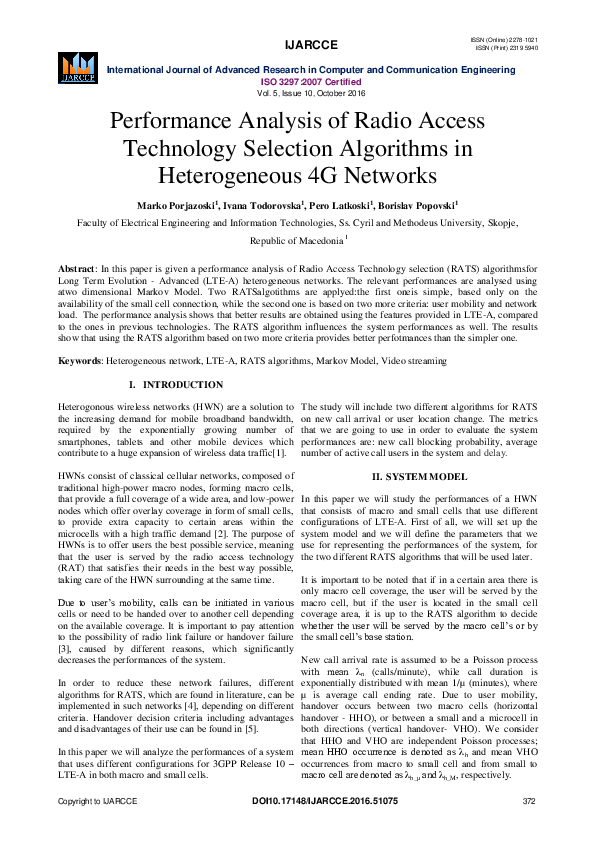
Marko Porjazoski is a Professor at the Faculty of Electrical Engineering and Information Technologies, University Ss. Cyril and Methodius, Macedonia. His academic roles include Professor (2021–present), Associate Professor (2017–2021), and Assistant Professor (2012–2017). He holds a Ph.D. in Telecommunications (2012), M.Sc. (2006), and Dipl.Ing. (2000) from the same institution. His research focuses on telecommunications, wireless networks, Quality of Service (QoS), LTE/LTE-Advanced, and network security. He has authored over 20 peer-reviewed publications, including works on network forensics, OTT billing systems, and interference coordination in LTE. His teaching spans undergraduate and postgraduate courses in network forensics, telecommunications services, and smart society ICT solutions. He leads projects on network performance analysis and security, with recent work emphasizing cloud-based video streaming and deep learning for cybersecurity. Education: Ph.D. in Telecommunications, 2012 M.Sc. in Telecommunications, 2006 Dipl.Ing. in Electronics and Telecommunications, 2000 Research Interests: Wireless network optimization, LTE/LTE-Advanced QoS management for video/OTT services Network forensics and cybersecurity Radio access technology selection Key Contributions: Developed a Service Quality Testing System for mobile networks Proposed architectures for OTT billing systems Analyzed fractional frequency reuse in LTE Designed algorithms for heterogeneous network performance Labs/Teams: Telecommunications Institute at FEIT.
Prof. Turhan TUNALI is a distinguished Professor in the Department of Computer Engineering at Izmir University of Economics' Faculty of Engineering. With a Ph.D. in Nonlinear Control Systems from Washington University in Saint Louis (1985), his academic career spans over three decades since beginning as an Assistant Professor at Ege University in 1986. Ph.D. - Nonlinear Control Systems, Washington University in Saint Louis (1985) M.S. - Applied Statistics, Ege University (1980) B.S. - Electrical Engineering, Middle East Technical University (1978) Professor TUNALI's research focuses primarily on computer networks, with specialized expertise in video streaming systems, optical networks, and intelligent transportation systems. His work bridges theoretical networking principles with practical implementations in multimedia delivery and transportation applications. He has made significant contributions to peer-to-peer video streaming architectures, bandwidth adaptation algorithms, and optical network resilience strategies. His research demonstrates a consistent trajectory from foundational network protocols to advanced multimedia delivery systems. Analysis of his 15 most recent publications reveals a strong concentration in networked multimedia systems, particularly peer-to-peer video streaming technologies and optical network architectures. His work shows evolution from basic streaming protocols to sophisticated hierarchical clustering frameworks, backup strategies for resilient networks, and security implementations for scalable video coding. The publications span high-impact journals including IEEE Access, Signal Processing: Image Communication, and Computer Standards and Interfaces. Professor TUNALI has served as Editor for the Turkish Journal of Electrical Engineering and Computer Sciences (2015-2016) and has contributed to TÜBİTAK projects. His research has been supported by various funding mechanisms, though specific grants are not detailed in the provided information. He has supervised an impressive 20 graduate students to completion, including 11 PhD candidates and 9 master's students, primarily at Ege University. His advisees have pursued research in areas including video streaming, optical networks, intelligent transportation systems, and healthcare information systems, reflecting his broad research influence. Professor TUNALI maintains an active research laboratory focused on networked multimedia systems, with particular emphasis on resilient video delivery architectures and intelligent transportation applications. His current work appears to be investigating advanced optical networking strategies and next-generation video streaming technologies.
Dr. Rebecca Balasundaram is a Lecturer and Module Director at York St John University's York Business School in London, UK, and an adjunct professor at Vellore Institute of Science and Technology, India. With over 20 years of teaching experience and a decade of research in Machine Learning, Artificial Intelligence, Blockchain, and Cybersecurity, she holds a PhD in Computer Science from Bharathiyar University. She previously served as an Associate Professor at SRMIST, India, and leads the research group 'MetaLearn AI Innovators.' Her teaching spans Python/R for Machine Learning, Cryptography, and Software Engineering. She has secured research funding, including a 2023 QR-funded project on AI for predicting premature births using Machine Learning. She actively publishes in top journals, filed five patents, and presents globally on AI, Blockchain, and security. Recent activities include keynote speeches at the International Conference on Resilience Management (2023) and a training session for Nigerian security operatives (2023). Her research focuses on AI-driven security solutions, blockchain optimization, and educational tech innovations like 'Teachable Machine Using Mixed Reality.' She mentors students through SAAR projects and collaborates with industry on applied research.
Distinguished Professor Jie Lu is Associate Dean (Research Excellence) in the Faculty of Engineering and Information Technology at the University of Technology Sydney (UTS), where she also serves as Director of the Australian Artificial Intelligence Institute (AAII). With over two decades of academic service at UTS, she has held progressively senior roles including Professor since 2007, Head of School of Software (2011-2014), and Director of the Centre for Artificial Intelligence (2017-2020) before assuming her current leadership positions. Professor Lu earned her PhD from Curtin University in 2000 and joined UTS the same year. Her academic journey progressed from Lecturer (2000-2001) to Senior Lecturer (2002-2004), Associate Professor (2005-2007), and ultimately Professor (2017-present). Professor Lu's research spans computational intelligence with particular expertise in decision support systems, fuzzy transfer learning, concept drift, and recommender systems. Her work bridges theoretical innovation with practical applications across transportation, telecommunications, healthcare, and education sectors. She has pioneered approaches in data-driven decision making that deliver tangible economic benefits and risk management solutions for industry partners. Her recent publications demonstrate continued leadership in AI research, with a focus on addressing challenges in non-stationary environments, out-of-distribution detection, cross-domain recommendation, and healthcare applications. Her work increasingly integrates large language models with specialized domain knowledge for enhanced decision support. Officer of the Order of Australia (2022) 2023 NSW Premier's Prize for Excellence in Engineering or Information & Communication Technology Australian Laureate Fellow (2019) IEEE Fellow for contributions to fuzzy machine learning and decision making (2018) Fellow of International Fuzzy Systems Association (2017) Australia's Most Innovative Engineer Award (2019) Multiple IEEE Transactions Outstanding Paper awards Professor Lu has supervised over 50 PhD students to completion, with half pursuing academic careers and half working in industry. She has secured over A$10 million in research funding as lead Chief Investigator, including 10 highly competitive ARC Discovery Projects. Her industry collaborations include significant projects with Optus, Sydney Trains, Domain Holdings, and healthcare organizations. As Director of the Australian AI Institute, Professor Lu leads Australia's largest AI research hub with over 250 researchers and PhD students. Under her leadership, AAII has secured 47 ARC grants and over 110 industry projects since 2017. She also serves as Editor-in-Chief of Knowledge-Based Systems, a leading journal in the field.
Paul L Bendich is an Adjunct Professor of Mathematics at Duke University's Trinity College of Arts & Sciences. He holds a Ph.D. from Duke University (2008). His research focuses on adapting topological and geometric methods for data analysis, particularly in topological data analysis (TDA). He has pioneered TDA methodologies for applications in machine learning, sensor fusion, and environmental modeling. Current appointments include leading research initiatives in multi-modal data analysis and reinforcement learning optimization. Key areas of expertise include computational topology, persistent homology, and topological signal processing. He teaches courses on topological data analysis (COMPSCI 434, MATH 412) and has developed educational programs like Data+ at Duke. Grants include NSF-funded projects (BIGDATA: F: DKA: CSD) and Air Force Office of Scientific Research initiatives. Recent work emphasizes topological methods in AI safety (topological parallax), reinforcement learning efficiency, and geophysical feature tracking. Professional activities include conference presentations on TDA applications and editorial work for journals. His research bridges theoretical mathematics with practical data-driven challenges in science and engineering.
Matti Siekkinen is a Lecturer in the Department of Computer Science at Aalto University. He is also affiliated with the Helsinki Institute for Information Technology (HIIT), the Professorship Di Francesco Mario, and the Computer Science Lecturers group. His research focuses on latency-critical mobile multimedia services, cloud-based virtual reality (VR), and edge computing solutions to optimize network performance and user experience. Education: Doctoral degree in Engineering and Technology (2007) from Université Côte d'Azur Master's degree in Engineering and Technology (2003) from Helsinki University of Technology Research Interests: His work emphasizes improving Quality-of-Experience (QoE) in mobile and cloud gaming, optimizing video streaming for VR applications, and deploying edge computing to reduce latency. Key topics include foveated rendering, dynamic resource allocation, and energy-efficient mobile service delivery. He has led projects such as CloudVR (2019–2020) and Latency-Critical Mobile Multimedia Services (2016–2019), which investigate network architecture and latency reduction strategies. Recent Research Trends: Recent publications highlight advancements in foveated compression techniques, head-pose prediction for remote VR, and neural network-based depth map packing. His work often bridges theoretical models with practical implementations in edge and cloud environments. Grants & Projects: Principal Investigator for CloudVR: High-Quality Mobile VR Using Cloud Acceleration (Business Finland) Principal Investigator for Latency-Critical Mobile Multimedia Services (Academy of Finland) Labs & Groups: He leads the Siekkinen Matti group, focusing on innovative solutions for mobile and cloud-based multimedia systems. Collaborations include Tsinghua University and industry partners like Elisa.
Ritske Jong is a Professor in Experimental Psychology at the Faculty of Behavioural and Social Sciences. His research utilizes electroencephalography (EEG) to explore cognitive mechanisms underlying attention, task-switching, and time perception. He investigates neural correlates of performance variability and decision-making under cognitive constraints. Research Focus: Jong's work spans attentional bias, temporal processing, and neurocognitive modeling. Key themes include EEG signatures of time perception, resit exam effects on learning investment, and implicit temporal regularities. His lab employs behavioral experiments and neuroimaging to dissect cognitive control mechanisms. Publication Trends: Recent articles (2017–2022) cluster in three domains: 1) EEG-informed temporal cognition studies, 2) attentional processing in learning environments, and 3) computational modeling of cognitive tasks. Cross-disciplinary collaborations extend to healthcare technology and educational psychology.
Eugene Belilovsky is an Associate Professor at the University of Montreal's Department of Computer Science and Operational Research and an Assistant Professor at Concordia University's Department of Computer Science and Software Engineering. He is also an Associate Member of Mila – Quebec Institute for Artificial Intelligence. His research focuses on computer vision, deep learning, and their applications in areas like continual learning and few-shot learning at the intersection of vision and natural language processing. Belilovsky's expertise includes distributed systems, federated learning, and optimization. His work addresses challenges in model generalization, spurious correlations, and efficient training strategies. He has advised numerous graduate students, including Charles-Étienne Joseph, Medric B. Djeafea Sonwa, Gwendolyne Legate, and Irene Tenison. His recent publications highlight contributions to federated learning, continual pre-training, and fairness in AI systems. Notable work includes optimizing distributed learning protocols and mitigating forgetting in evolving data streams. Belilovsky's research also explores clinical applications, such as diagnosing hepatic steatosis using ultrasound imaging through deep learning techniques. He collaborates with institutions like Mila and the DIRO department, advancing interdisciplinary projects in AI-driven healthcare, robotics, and language modeling.
Yehia Elkhatib is a Reader (Associate Professor) in Computing Science at the University of Glasgow, where he leads research in distributed systems that traverse infrastructural boundaries. His work focuses on developing data-driven approaches to improve performance and programmability of distributed systems, with particular emphasis on cloud interoperability, intent-driven networking, systems of systems composition, and edge computing. Dr. Elkhatib earned his PhD in Network Measurement & Grid Computing from Lancaster University in 2011, following an MSc with Distinction in Networking and Internet Systems from the same institution. His academic journey demonstrates a consistent focus on network systems and distributed computing. His research interests center on developing data-driven solutions to optimize complex systems, with particular emphasis on addressing resource utilization challenges from a user-centric perspective. His work spans decision-support systems for cost-effective cloud deployment, memory-aware ML scheduling to reduce training errors and GPU resource requirements, energy-efficient scheduling of scientific workflows, enabling seamless interoperability between services, developing systems of systems in IoT environments, designing intent-driven network architectures, and caching in information-centric networks. Analysis of his recent publications reveals a strong focus on sustainability in computing, with multiple papers on energy efficiency, carbon footprint estimation, and carbon-aware execution of scientific workflows. His research also shows significant contributions to IoT systems, cloud computing, and quality of experience in multimedia systems, demonstrating a diverse yet cohesive research portfolio addressing critical challenges in distributed computing. Dr. Elkhatib has secured substantial research funding including AI4ME (EPSRC) £3.8m, ABC (EPSRC) £775k, and DIONASYS (CHIST-ERA) €1.03m, demonstrating the significance and impact of his research. He actively supervises PhD students working on cutting-edge topics including DNS infrastructure placement, memory-aware scheduling, and carbon-aware execution of scientific workflows. His teaching responsibilities include Cloud Systems, Systems Programming, Advanced Programming, Building Big Data Systems, Distributed Systems, and Data Science Fundamentals, reflecting his expertise across multiple domains of computing science. His office is located in The Sir Alwyn Williams Building, room 322a at the University of Glasgow.



/prod01/yorksjacuk/media/content-assets/staff-profile-images/rebecca_balasundaram-_web_size-10.jpg)