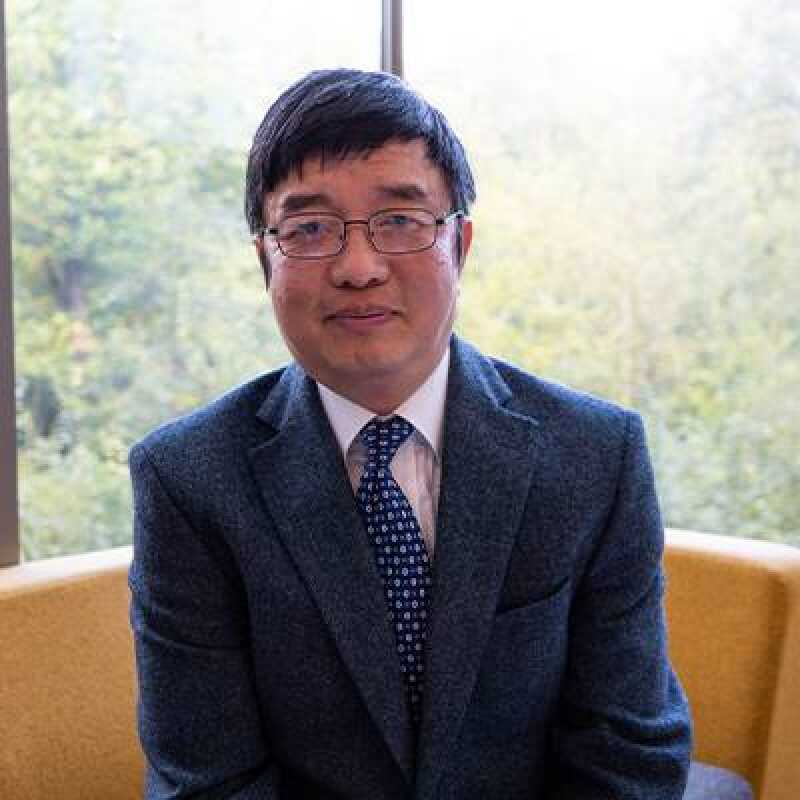
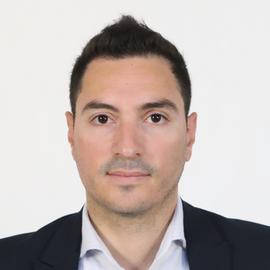
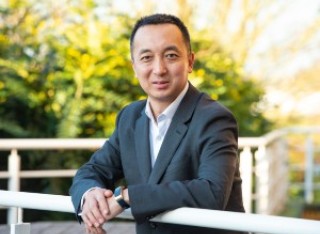
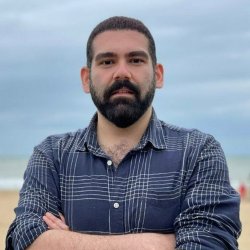
Professor Shaomin Wu is a faculty member at the University of Kent's Kent Business School, where he holds the academic rank of Professor of Business/Applied Statistics. He earned an MSc and PhD in applied statistics and has extensive industry experience, including a five-and-a-half-year stint at a global manufacturer in Shanghai before moving to the UK in 2001. He has held roles as a postdoctoral researcher and lecturer before joining Cranfield University and later the University of Kent. His research focuses on recurrent event data analysis, machine learning, and reliability mathematics, with funding from the EPSRC and ESRC. His research projects include managing risk in warranty servicing policies, smart data analytics for local government, and sustainable supply chain demand forecasting. He teaches modules such as risk analysis, reliability engineering, and machine learning. Currently supervising PhD students in time series forecasting, explainable AI, and recurrent event data analysis, he also serves as a co-chair of international conferences, editorial board member, and external examiner for doctoral degrees. Notably, he ranks among the top 2% of global scientists by Stanford University. His work integrates machine learning with business analytics, resilience engineering, and environmental sustainability. Key contributions include IoT-driven resilience methodologies for smart grids and unmanned systems, as well as frameworks for corporate carbon disclosure and maintenance optimization under uncertainty.
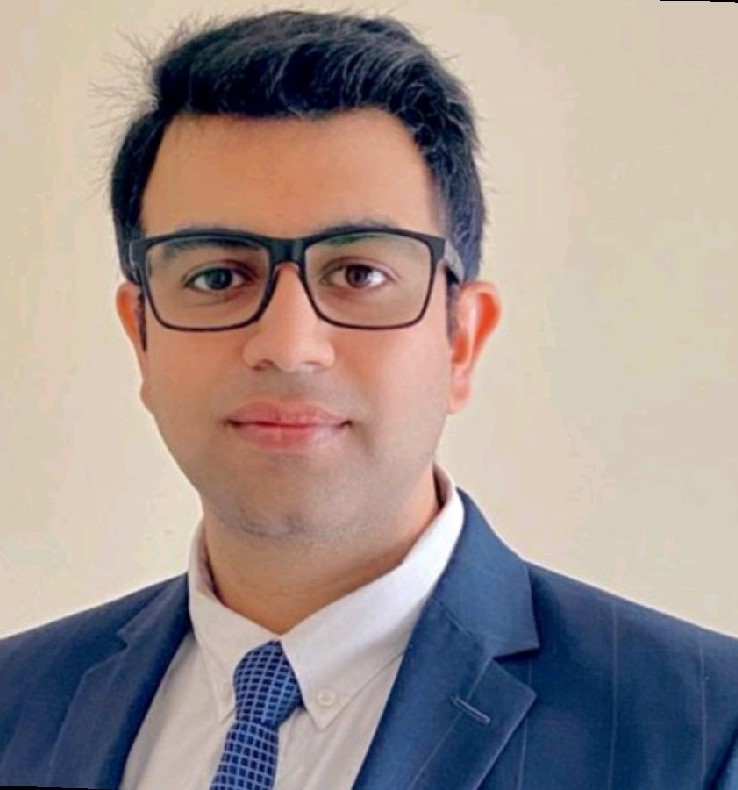
Dr. Vishal Sharma is a Senior Lecturer in the School of Electronics, Electrical Engineering and Computer Science at Queen's University Belfast. His research focuses on Cyber-Physical Systems (CPS), 5G/6G Security, Unmanned Aerial Vehicles (UAVs), Blockchain, and Digital Twins. He has held roles at institutions like Singapore University of Technology and Design (SUTD) and Soonchunhyang University, South Korea. Notable achievements include Best Paper Awards at ICCMIT 2017, IEEE SITE 2024, and HUCAPP/VISIGRAPP 2025. He leads the Innovation-by-Design Lab and is a Fellow of the Higher Education Academy (FHEA). Research Interests: Cyber Defence, UAV Security, Secure Computing, Network Security, and Sustainable Edge Computing. He has collaborated on projects like RapidRANDefender (QRICSec) and Traceable Procurement for Net-Zero Processes. Awards include the Royal Society International Exchanges Committee appointment (2025) and QUB's Individual Performance Award (2024). Grants and Projects: Principal Investigator for projects such as Exploring Operational Capabilities of Arm Morello for UAV Security (2023) and TUDOR: Ubiquitous 3D Open Resilient Network (2023). Active in editorial roles for IEEE Communications Magazine and IET Networks. His work aligns with UN Sustainable Development Goals (SDGs) related to climate action and innovation. Publications span 150+ articles in top journals/conferences, with a focus on secure communication, edge computing, and UAV networks. Supervises PhD students in cyber defence, AI security, and distributed ledger technologies.
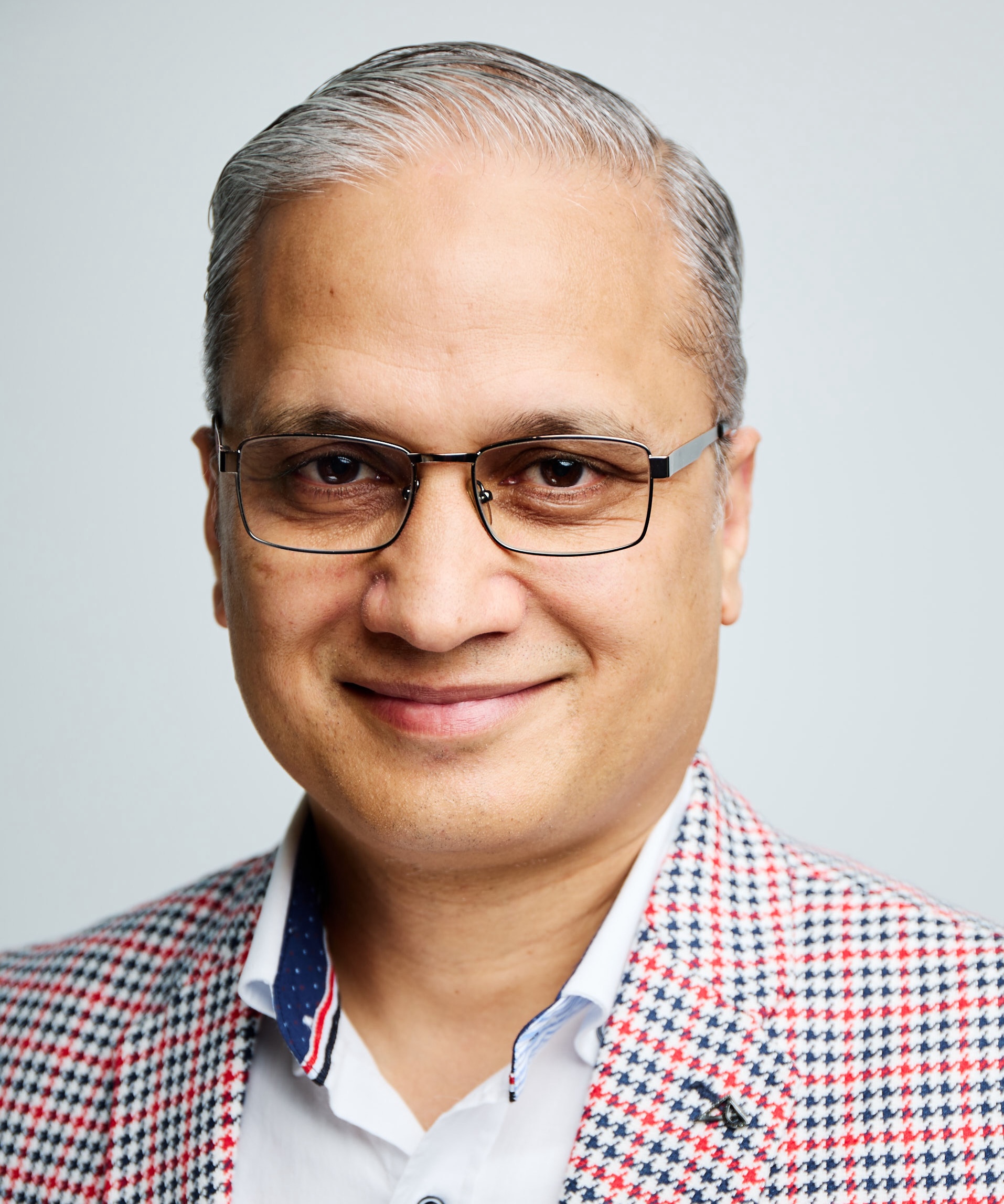
Shahid Raza is a Professor of Cybersecurity at the University of Glasgow's School of Computing Science. He previously led the RISE Cybersecurity Unit in Sweden, establishing it as a leading research group. His expertise spans IoT Security, PKI, AI-driven cybersecurity solutions, and hardware/data security. Raza holds a PhD and Docentship from Uppsala University, alongside a Bachelor's with a Gold Medal for academic excellence. Education: B.Sc. (Computer Science, 3.99/4.0 CGPA, Gold Medal), Licentiate, PhD, and Docentship in Cybersecurity from Sweden. He leads EU-funded projects like H2020 CONCORDIA and Horizon Europe CUSTODES, coordinating initiatives such as the Cyber Node and Cyber Range. Active in cybersecurity policy, he serves on the EU SCCG, ECSO, and EARTO Security & Defence Research working groups. Research Interests Public Key Infrastructure (PKI) for IoT AIAgent-Driven Cybersecurity Solutions IoT Certification Standards Hardware Security for Low-Power Devices Grants & Projects Coordinator: Horizon Europe CUSTODES Technical Leader: H2020 Arcadian-IoT Founder: RISE Cyber Range (Sweden's largest cybersecurity test facility) Awards & Memberships IEEE Senior Member Gold Medal for Academic Excellence (Bachelor's)
Professor Lyudmila Mihaylova is a distinguished academic at the University of Sheffield's School of Electrical and Electronic Engineering, where she holds the position of Professor of Signal Processing and Control. She has established herself as a leading researcher in the fields of signal processing, Bayesian methods, and autonomous systems, with significant contributions to particle filtering techniques for intelligent transportation systems. Her work bridges theoretical developments with practical applications across multiple domains including transportation, healthcare, and industrial automation. Prof. Mihaylova's research interests center on nonlinear filtering, sequential Monte Carlo methods, statistical signal processing, and sensor data fusion. Her work spans both theoretical advancements and practical implementations, with particular focus on high-dimensional problems including vehicular traffic flow estimation, image processing, and localization in sensor networks. She has extensive experience with various image modalities such as optical, thermal, LIDAR, SAR, and hyperspectral imaging. Her group actively develops novel methods for autonomous intelligent systems focusing on sensing, tracking, decision making, and machine learning applications. Analysis of Prof. Mihaylova's recent publications reveals a strong trend toward uncertainty quantification in machine learning models, particularly for safety-critical applications. Her work increasingly integrates traditional signal processing techniques with modern deep learning approaches, with applications spanning sewer inspection robotics, medical diagnostics (particularly sleep apnea detection), UAV swarm tracking, industrial manufacturing, and autonomous vehicle systems. A significant portion of her recent research focuses on developing robust methods that can handle incomplete or outlier-corrupted data while providing reliable uncertainty estimates. Among her notable professional achievements: President of the International Society of Information Fusion (ISIF) Senior member of the IEEE Signal Processing Society Associate Editor for IEEE Transactions on Aerospace and Electronic Systems Associate Editor for Elsevier Signal Processing Journal Prof. Mihaylova has successfully mentored numerous PhD students and postdoctoral researchers, many of whom have gone on to prominent academic and industry positions. Her research has been supported by major funding bodies including EPSRC, EU, MOD/DSTL, and industry partners, with recent projects including 'Protecting Environments with UAV Swarms' (InnovateUK, 2022-2024), 'ShiRAS: Towards Safe and Reliable Autonomy in Sensor Driven Systems' (NSF-EPSRC, 2019-2023), and 'Confident safety integration for Cobots' (Lloyd's Register Foundation, 2019-2020). Her research group follows a collaborative approach with the philosophy 'We share knowledge, we grow.' Prof. Mihaylova maintains active research collaborations with institutions worldwide and has held previous academic positions at Lancaster University (2006-2013) and University of Bristol (2004-2006), along with research visiting positions at the University of Ghent, Katholic University of Leuven, and the Bulgarian Academy of Sciences.
Soteris Demetriou is a Senior Lecturer of Computer Systems Security at Imperial College London's Department of Computing, within the Faculty of Engineering. He leads the Applications, Platforms, and Systems Security (APSS) Research Lab and directs the Academic Centre of Excellence in Cyber Security Research (ACE-CSR). His research focuses on securing mobile, IoT, and cyber-physical systems through techniques like explainable AI, reverse engineering, and trusted computing. Notable contributions include tools for privacy preservation in machine learning models, detection of LiDAR spoofing attacks, and securing Android's middleware. Education: PhD and MSc in Computer Science (University of Illinois at Urbana-Champaign), Diploma in Electrical and Computer Engineering (University of Patras). Research Interests: Mobile/IoT security, AI security, trusted computing, and vulnerability analysis. Key areas include privacy in generative models, adversarial attacks on autonomous systems, and large-scale distributed systems. Publications: Over 50 peer-reviewed papers in top venues like NDSS, CCS, and SOSP. Recent work addresses privacy in speech generation, LiDAR security for autonomous vehicles, and hyperscale serverless architectures at Meta. Awards: Distinguished Paper Award at NDSS 2018, Best Paper at SafeThings 2024, and multiple travel grants. Served on technical committees for PETS, CCS, and AutoSec. Grants & Collaborations: SPRITE+ grant for Bio-IoT security, collaboration with Meta on distributed systems, and leadership in ACE-CSR. Labs: APSS Lab focuses on systems and AI security, with interdisciplinary projects in healthcare and autonomous systems.
Yue Gao is a Professor of Wireless Communications at the Institute for Communication Systems, University of Surrey. He holds a PhD from Queen Mary University of London (2007) and previously served as a lecturer, senior lecturer, and reader at QMUL. His research focuses on smart antennas, signal processing, spectrum sharing, millimeter-wave systems, and IoT in mobile/satellite communications. He has authored over 180 papers, two patents, a book, and five book chapters. Current roles include EPSRC Fellow (2018–2023) and editorial roles for IEEE Transactions on Cognitive Communications and Networking, Vehicular Technology, and Internet of Things Journal. Notable awards include the EU Horizon Prize (2016). His work spans interdisciplinary projects like GBSense (GHz Bandwidth Sensing) and contributes to 6G research. Collaborations include leadership roles at IEEE conferences and global spectrum sensing challenges. Research interests emphasize antenna design (e.g., 3D printed, Ka-band), sub-Nyquist sampling, and machine learning for spectrum reconstruction. Affiliated with Surrey’s antenna measurement facilities (NPL) for advanced testing (400 MHz to 110 GHz, THz spectroscopy). Active in mentoring PhD students in antennas/wireless communications and oversees projects like the GBSense Challenge, advancing sensor-driven spectrum management.
Dr. Richard Jiang is a Senior Lecturer (Associate Professor) at Lancaster University's School of Computing and Communications. His research focuses on Artificial Intelligence, Neurocomputing, Quantum AI, Privacy Computing, and Medical Computing. He has pioneered secure pattern recognition in encrypted domains and quantum neuromorphic computing. With over £1M in research grants from EPSRC and others, he has authored 100+ publications and supervised over 20 PhD students. Dr. Jiang's work includes the Face2Brain method for neurodegenerative assessment and explainable models for brain aging analysis. He contributes actively to academic committees, editorial boards, and conferences like the World Conference on eXplainable AI. His research spans ethical AI frameworks, quantum algorithms for medical imaging, and privacy-preserving biometric systems.
Soufiene Djahel is a Professor at the Centre for Future Transport and Cities (CFTC) at Coventry University, UK. His research focuses on connected and autonomous vehicles (CAVs), unmanned aerial vehicles (UAVs), cyber security, and smart cities. He holds a PhD in Secure Routing and Medium Access Protocols from Université des Sciences et Technologies de Lille (2010), and has held academic positions including Senior Lecturer at the University of Huddersfield and Manchester Metropolitan University. His research interests include CAV coordination protocols, cyber-physical security solutions, and intelligent transportation systems. Djahel leads projects such as the £1.2M AeroPharma Logistics initiative and has secured funding from the Newton Fund and JSPS. He is a recipient of the 2021 JSPS Invitational Fellowship and has published extensively in IEEE journals and conferences. Current projects explore UAVs-as-a-service, digital twins for CAVs, and B5G/6G for smart infrastructure. He advises PhD students on topics like AI-based threat mitigation and transport electrification. Djahel also serves as an external examiner and editorial board member for journals like IEEE Transactions on Intelligent Transportation Systems.
Prof. Ahmed Al-Dubai is a Professor at the School of Computing, Engineering and the Built Environment, Edinburgh Napier University, where he leads the IoT and Networked Systems Research Group and serves as Cybersecurity and Cyber Physical Systems Research Lead. His interdisciplinary research spans Multi-access Edge Computing, High-Performance Networks, Cognitive IoT Systems, VANETs, AI, E-Health, Smart Cities, and Security . He earned his PhD in Computing Science from the University of Glasgow in 2004. His recent publications focus on edge computing architectures, digital twin security, Arabic NLP, wireless energy harvesting, and vehicular communication . His work has been recognized with IEEE Outstanding Service Award, Best Paper Awards at IEEE IUCC 2015 and ACM MoMM 2013 , and fellowships like Senior IEEE Member and British Higher Education Academy Fellow . He supervises 20+ PhD students and has served on 60+ IEEE/ACM conference committees. Current projects include AI-driven fish identification (Innovate UK £265K) , secure IoT protocols (Royal Society £12K) , and COG-MHEAR (EPSRC £3.26M) . He has held visiting professorships at Universite de Valenciennes, University of Sydney, and University of Shenyang.
Dr. Pradip Sharma is an Associate Professor of Cybersecurity & AI at the University of Aberdeen, UK, within the School of Natural and Computing Sciences, Department of Computing Science. He is a globally recognized academic and researcher with expertise in Cybersecurity, Artificial Intelligence, Blockchain, and Edge Computing. His research interests span multiple domains including Cybersecurity, Blockchain, Edge Computing, Software-defined Networking, and IoT Security. Dr. Sharma's work focuses on developing innovative solutions for security challenges in emerging technologies, with particular emphasis on privacy-aware AI systems, secure data sharing frameworks, and intelligent network security mechanisms. His interdisciplinary approach bridges theoretical foundations with practical implementations across healthcare, smart mobility, and consumer electronics domains. Senior Fellowship Advance HE (SFHEA) IEEE Senior Member (SMIEEE) Dr. Sharma actively supervises doctoral researchers and is accepting new PhD students in Computing Science. His funded research portfolio exceeds £1M from sources including EPSRC, Innovate UK, and international agencies. Current projects include 'Secure, Privacy-aware, and Trusted Data Share in Smart Mobility' (EPSRC, £200K), 'ZECURE Data Exchange Platform' (Innovate UK, £236K), and 'Quantum-resistant Cybersecurity' (Royal Embassy of Saudi Arabia, £73K). He also serves as an editor for leading journals and is a regular keynote speaker at international conferences.
Mahdi Boloursaz Mashhadi is a Lecturer in Communications and AI at the Institute for Communication Systems (ICS), part of the School of Computer Science and Electronic Engineering at the University of Surrey, UK. He is a Surrey AI Fellow and an IEEE Senior Member, with a focus on advancing AI-driven wireless communication systems. He holds B.S., M.S., and Ph.D. degrees in mobile telecommunications from Sharif University of Technology, Tehran, Iran. Prior to joining Surrey, he served as a postdoctoral research associate at Imperial College London’s Intelligent Systems and Networks (ISN) Research Group (2019–2021). His research interests span AI/ML integration with wireless systems, including semantic communications, federated learning, generative AI for telecom, and beamforming optimization in massive MIMO architectures. He also explores edge computing, distributed deep learning frameworks, and energy-efficient communication designs using reconfigurable intelligent surfaces (RIS). Mahdi has been recognized with the IEEE EWDTS Best Paper Award and IEEE ComSoc Exemplary Reviewer Awards (2021–2022). He leads the UKTIN/DSIT 12M£ national project TUDOR and collaborates with industry on cutting-edge 5G/6G innovations. He has contributed to the ITU’s AI/ML in 5G challenge as a panel judge and serves as an editor for Springer’s Wireless Personal Communications Journal. His roles include advising on government/industry projects and advancing interdisciplinary research at the 5G/6G Innovation Centre. He emphasizes practical implementations of AI in telecommunications, aiming to bridge theoretical advancements with real-world applications.
Dr. Ramsey Faragher is a Senior Research Associate at the Computer Laboratory , University of Cambridge, and a Bye-Fellow at Queens' College. His work focuses on infrastructure-free indoor positioning systems, sensor fusion, and improvements to smartphone sensing capabilities. Academic Affiliation : University of Cambridge (Computer Laboratory) Professional Roles : Bye-Fellow at Queens' College, Senior Research Associate His research spans multiple disciplines within computer science and engineering, emphasizing innovative navigation solutions and signal processing techniques. Key areas include GNSS robustness, wireless security, and machine learning applications for positioning systems. Recent publications highlight advancements in supercorrelation for automotive GNSS, sensor data calibration, and motion-compensated signal processing. Articles frequently address challenges such as spoofing mitigation, urban navigation, and infrastructure-free localization. Scientific Recognition Fellow of the Royal Institute of Navigation Chartered Physicist (CPhys)
Dr. Luca Castiglione is a Research Associate in Resilience and Safety to Cyber Attacks at the Department of Computing, part of the Faculty of Engineering at Imperial College London. His work focuses on interdisciplinary cybersecurity challenges in cyber-physical systems (CPS), emphasizing the intersection of safety and security. Research interests include threat modeling for CPS, hazard analysis in smart grids and aviation systems, and secure file storage in cloud environments. His methodologies often combine systems theory with practical frameworks like assurance case generation and cooperative communication protocols over 5G. Recent publications explore automated detection of safety-critical attacks, impact analysis of cyber threats on flight management systems, and security-aware hazard analysis for infrastructure systems. While no awards or grants are explicitly mentioned, his research demonstrates expertise in cross-disciplinary approaches to system resilience. His location is listed as the Huxley Building on the South Kensington Campus, though no email or educational background details are provided in the available text.
Dr. Jaswinder Lota is a Reader in Engineering at the University of East London , School of Architecture, Computing and Engineering, Department of Engineering & Construction. He is also a Visiting Academic at University College London’s Department of Electronic and Electrical Engineering, and a Chartered Engineer with extensive industry and academic experience. Education: BSc BEng MEng PGCert HE PhD Research Interests: Dr. Lota specializes in signal processing, circuits and systems, wireless communication, and their applications in radar systems (weather/military), low-power sustainable networks beyond 5G/6G (robotics, automation, healthcare), and electronic technologies for hydrogen propulsion. His work integrates AI-driven channel modeling and impulsive noise analysis. Scientific Awards: IEEE CAS Society Certificate of Appreciation (2019) Grants and Collaborations: He has secured significant funding, including a £2.5K International Research Collaboration Award (2016), £2.5K Research Internship Award (2015), £76K Impact Grant (2014), and a £7M MoD-funded project (1999-2004). Collaborators include UCL and NYU. Leadership: Dr. Lota leads the Smart Cities Research group at UEL and contributed to the REF 2021 submission. He has served as Associate Editor for IEEE TCAS I and Guest Editor for multiple IEEE journals.
Dr. Aryan Kaushik is an Associate Professor at Manchester Metropolitan University (Manchester Met), UK, since 2024, affiliated with the Department of Computing and Mathematics. He also serves as Chief Advisor at RakFort, Ireland, since 2025. Previously, he was an Assistant Professor (senior grade) at the University of Sussex, UK, from 2021-24, and held roles as Recruitment and Admissions Tutor and Academic Advisor there. His academic journey includes a Research Fellow position at University College London (2020-21), and a PhD in Communications Engineering from the University of Edinburgh (2019). He holds an MSc in Telecommunications from the Hong Kong University of Science and Technology (2015). Education: PhD in Communications Engineering, University of Edinburgh (2019) MSc in Telecommunications, Hong Kong University of Science and Technology (2015) Professional Roles: Chair of IEEE ComSoc ETI on Electromagnetic Signal and Information Theory (since 2024) Core Member of IEEE P1955 Standard on 6G-Empowering Robotics Editorial roles across multiple IEEE journals and conferences His research focuses on 5G/6G wireless communications , integrated sensing and communications , reconfigurable holographic surfaces , non-terrestrial networks , and AI-driven network optimization . He has led UKRI-funded projects on topics like AI-assisted ISAC and Net Zero 6G, and collaborates globally with institutions like IIIT-Delhi, University of Bologna, and Imperial College London. Dr. Kaushik has received awards including the Top Editor Award 2025 (IEEE IoT Magazine), Best Editor Awards 2023-2024 (IEEE Open Journal), and was shortlisted for teaching excellence awards at Sussex. He actively contributes to standardization, serves on over 14 IEEE conference committees, and has delivered 110+ keynote/tutorial talks worldwide. His leadership extends to roles like TPC Co-Chair at IEEE ICC 2025 and Chair of Special Interest Groups on AI-driven Non-Terrestrial Networks and Fluid Antenna Systems.