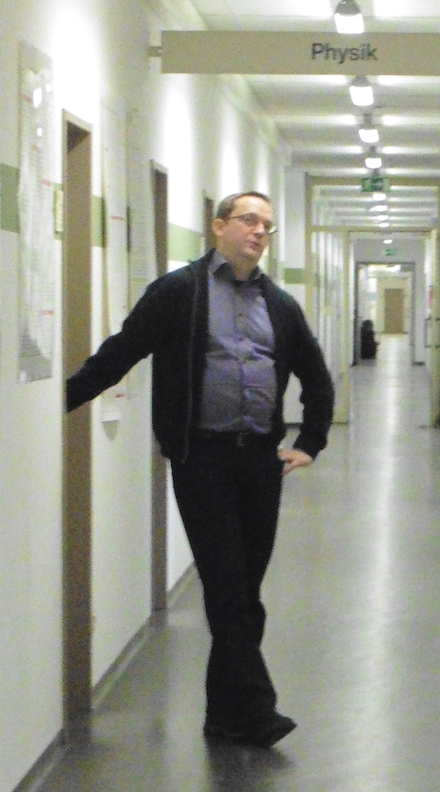
Olaf Kaczmarek is a researcher at the Faculty of Physics , Bielefeld University , specializing in Lattice Quantum Chromodynamics (QCD) and Strongly Interacting Matter . He leads projects related to QCD thermodynamics , quark-gluon plasma , and heavy quark transport . Principal Investigator in TRR 211/2 Subproject A06: Hadronic Excitations and Spectral Functions in the Medium (2025) Co-PI in TRR 211/2 Subproject Z02: Software Development Center (2025) Contributor to GPUHEP2014 and LATTICE2024 symposia Research Focus: Thermal QCD phase transitions, heavy quark diffusion , transport coefficients , lattice simulations , and quarkonium spectroscopy . His work bridges theoretical physics and high-performance computing , particularly in Multigpu Systems for QCD calculations. Recent Publications explore topics like the chiral crossover , spatial string tension , and thermal photon production , with keywords spanning Quantum Chromodynamics , Lattice Gauge Theory , and High Temperature Physics . Teaching: Offers courses in Lattice Field Theory , GPU Computing , and Gradient Flow for graduate students. Contributes to collaborative seminars in the CRC-TR211: Strong-interaction matter under extreme conditions .
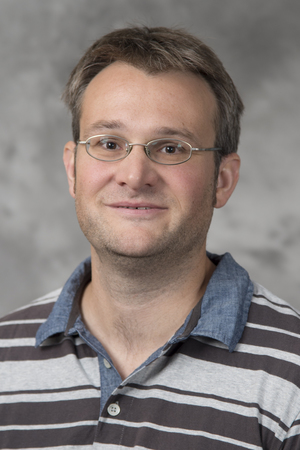
Didar Dobur is an Associate Professor at the Department of Physics and Astronomy , Faculty of Sciences , Ghent University . His research focuses on Experimental Particle Physics , particularly High-Energy Physics and Collider Studies . He leads projects at the CERN Large Hadron Collider using the CMS detector , investigating New Physics Beyond the Standard Model , including axion-like particles, supersymmetry, and Higgs-top couplings. Current projects: AxiTop , FLAMENCO , Unlocking the charm-Higgs coupling Grants: Research Foundation - Flanders (FWO) , Special Research Fund His recent publications (2023-2025) analyze top quark interactions , Higgs boson decays , and long-lived particle signatures using LHC data. Key subfields include Effective Field Theory , Muon Radiography , and Neutrino Experiments . As a PhD supervisor and promotor , he has guided researchers like Bob Oeyen and Luka Lambrecht in studies of CERN experiments and detector development . Current lab collaborations involve CMS Phase-2 Upgrade and SHiP experiment R&D.
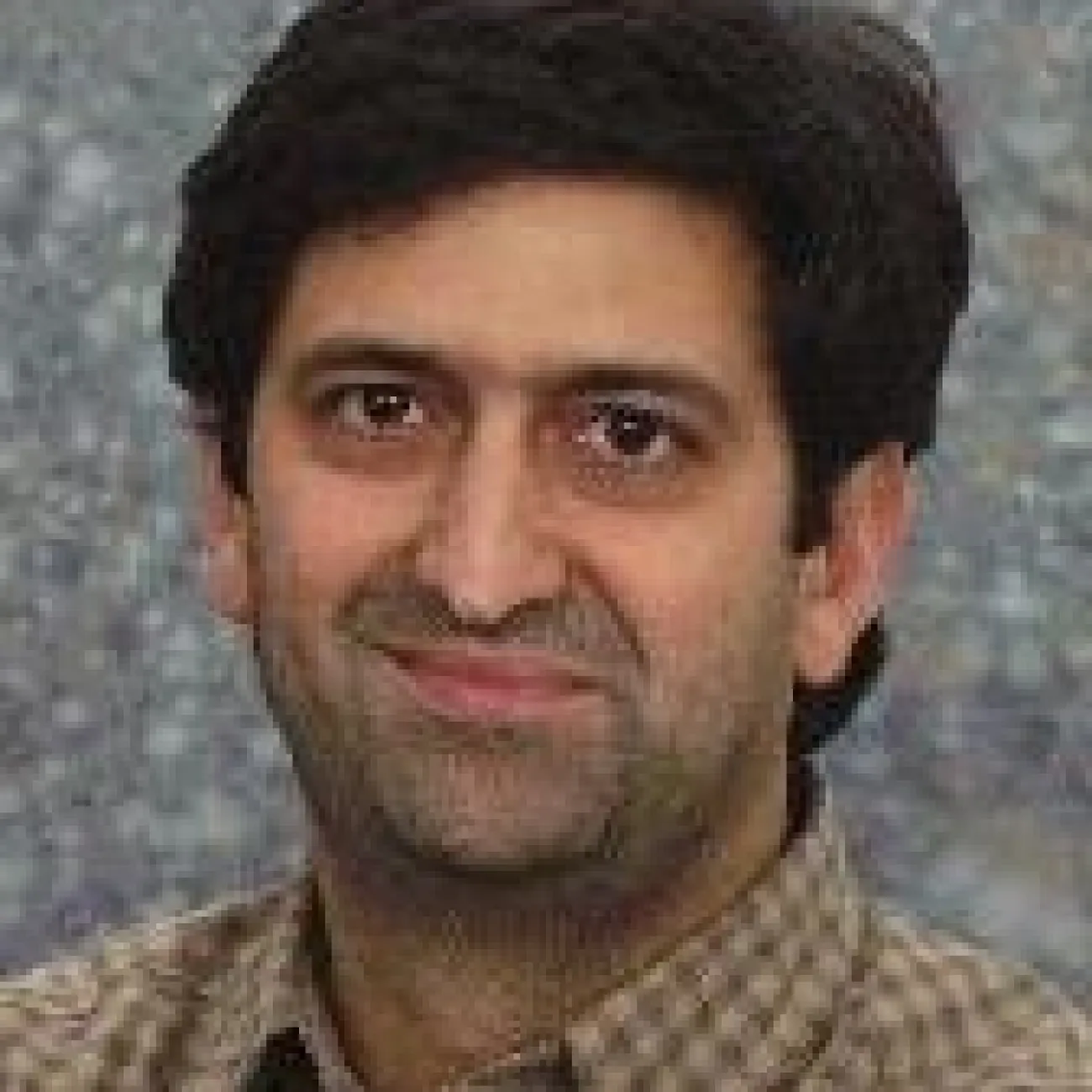
Aneta Iordanova is a Lecturer at the University of Illinois at Chicago (UIC), affiliated with the College of Engineering . She can be contacted at aiorda1@uic.edu , located in SES 2344 . Her research lies at the intersection of Particle Physics , Nuclear Physics , and Quantum Chromodynamics (QCD) , focusing on Heavy-Ion Collisions , Quark-Gluon Plasma , and Experimental Physics . Key trends in her work include measurements of Elliptic Flow , Jet Substructure , Meson Production , and Direct Photon Anisotropy across varying collision energies and rapidities. Dr. Iordanova's publications highlight her expertise in High-Energy Physics , with a focus on Collision Dynamics , Hadron Correlations , and Parton Energy Loss . Her work spans both Relativistic Heavy-Ion and Proton-Proton Collisions , utilizing data from experiments like PHENIX at RHIC.
Professor Guennadi Borissov is affiliated with the Department of Physics at Lancaster University , actively participating in the ATLAS experiment at CERN . His research focuses on CP violation in particles containing b quarks , aiming to explain the universe's matter-antimatter imbalance. Research Interests: Dr. Borissov investigates deviations from lepton flavor universality (LFU) using top quark decays to tauons. His work involves precision measurements of branching fractions and testing Standard Model predictions through ATLAS detector data . Recent Publications (2025): His contributions include studies on jet track functions, Higgs boson decays, W-boson cross-sections, and searches for new physics phenomena like heavy neutral leptons and long-lived particles. These articles emphasize Standard Model validation , CP violation , and detector performance . Grants & Projects: He is involved in responsive and consolidated grants funded by the STFC , supporting Lancaster's Experimental Particle Physics group and ATLAS-related research (2022–2026). PhD Supervision: Dr. Borissov supervises Beltran Fernandez Barbadillo , focusing on top quark decay measurements. Contact: Department of Physics, B016, B-Floor, Physics Building, Lancaster University. Email: g.borissov@lancaster.ac.uk .
Mihael Makek is a full professor at the Department of Experimental Physics within the Faculty of Natural Sciences and Mathematics at the University of Zagreb. His academic position places him at the forefront of nuclear and particle physics research in Croatia, with strong connections to international collaborations like PHENIX at the Relativistic Heavy Ion Collider (RHIC). He maintains active involvement in both teaching and research, contributing to the physics community through publications and mentorship. Professor Makek's research interests span multiple areas of experimental physics, with particular emphasis on nuclear physics and particle physics . His work focuses on heavy ion collisions, particle production mechanisms, jet measurements, and radiation detectors with medical applications. His recent publications demonstrate expertise in analyzing data from relativistic heavy ion collisions to study quark-gluon plasma properties, using techniques like elliptic flow measurements, direct photon production analysis, and jet quenching studies. Additionally, he has made contributions to medical physics through research on PET imaging systems and Compton scattering phenomena. An analysis of his recent publications reveals a strong focus on experimental measurements at forward rapidity in various collision systems (p+p, d+Au, Au+Au, etc.). His work frequently addresses fundamental questions about quark-gluon plasma formation, parton energy loss in nuclear matter, and the behavior of heavy flavor particles in extreme conditions. The consistent appearance of his name in PHENIX collaboration papers indicates his significant role in this major international research effort. Professor Makek teaches across multiple academic levels, including undergraduate courses in statistics and measurements, graduate courses in modern physics and nuclear physics, and doctoral courses on radiation detectors and medical applications of nuclear methods. His teaching portfolio reflects the interdisciplinary nature of his research, bridging fundamental physics with practical applications in medical technology.
Andreas Jung is an Associate Professor of Physics and Astronomy at Purdue University, affiliated with the CMS experiment at CERN. His research focuses on understanding the electroweak scale stabilization via precision measurements of top quark interactions, Higgs boson studies, and detector R&D. He also explores quantum algorithms for high-energy physics and supply chain optimization. Jung earned his Ph.D. from the University of Heidelberg (2009) and a diploma from the University of Dortmund (2004). Education: Ph.D. in Physics, University of Heidelberg, 2009 (Dissertation: D* Meson Cross Section Measurement) Diploma in Physics, University of Dortmund, 2004 (Commissioning of H1 Fast Track Trigger) Research Interests: High Energy Physics, Particle Physics, Detector Development, Quantum Computing Applications, Material Science for Detectors, and Collider Experiments. His work includes analyzing top quark spin correlations, quantum annealing for vertex reconstruction, and carbon fiber composites for CMS upgrades. Awards: Senior Distinguished Researcher fellowship at Fermilab LHC Physics Center (2019) 3-year PhD scholarship from German Research Society (2004–2007) Teaching & Leadership: Teaches courses on particle physics and data science. Serves as Convener of CMS TOP Physics Analysis Group and leads detector mechanics R&D. Engages in quantum computing collaborations with DoD and industry partners. Labs/Teams: Jung Research Group at Purdue, CMS Collaboration, and Purdue Quantum Science & Engineering Institute (PQSEI). Active in detector development for the High-Luminosity LHC upgrade, including carbon fiber support structures and silicon pixel detectors.
Professor Stefano Moretti holds a Professorship at the University of Southampton's Department of Physics & Astronomy and is a Full Professor at Uppsala University's Theoretical Particle Physics group. He is a member of the Southampton High Energy Physics (SHEP) group and the Southampton Theory Astrophysics and Gravity (STAG) Research Centre. His research focuses on particle phenomenology, particularly collider physics, with over 550 publications and 34,000 citations. He is also a Visiting Staff at RAL PPD and part of the CMS experiment at CERN. Education: PhD from the University of Torino, followed by postdoctoral roles at the University of Cambridge, Rutherford Appleton Laboratory (RAL), and the University of Oxford. He joined Southampton in 2003 via an STFC Advanced Fellowship. Research Interests : Standard Model (QCD/EW interactions), Supersymmetry, Non-minimal Higgs Models, Monte Carlo Event Generators, and Higher Order Corrections. He authored textbooks on Supersymmetry and SM Phenomenology. Awards : 2024 Lilly and Sven Thuréus Prize (Sweden), 2018 Honorary Doctorate from Uppsala University, and 2025 Breakthrough Prize in Fundamental Physics (shared with LHC experiments). Teaching : Coordinates the UG module PHYS2006 (Classical Mechanics) and teaches the PG Phenomenology course within the NExT PhD School. Grants/Projects : Lead researcher on multiple STFC, Royal Society, and EU-funded projects. Active in Horizon Europe evaluations and UK REF2021 panel work. Labs/Teams : Director of the NExT Institute, member of SHEP and STAG, collaborates with CMS at CERN, and advises on policy for science assessment frameworks.
Matt LeBlanc is an Assistant Professor of Physics (Research) at Brown University, affiliated with the CMS Collaboration since 2024 and previously a core member of the ATLAS Collaboration from 2010–2023. His research focuses on experimental particle physics, particularly the analysis of hadronic objects and final states at the Large Hadron Collider (LHC). He employs advanced data science techniques, including machine learning and optimal transport algorithms, to study jet physics and search for new particles beyond the Standard Model. LeBlanc has contributed to jet reconstruction, calibration, and novel analysis methods in LHC data. Education: Ph.D. in experimental particle physics from the University of Victoria (Canada). Postdoctoral appointments at the University of Arizona, CERN, and the University of Manchester (UK). Research Interests: Jet substructure, hadronic object reconstruction, dark matter searches, QCD studies, radiation-hard detector development (e.g., MALTA sensors), and applications of AI/ML in physics. His work bridges experimental particle physics with computational science, addressing challenges in data processing for the High-Luminosity LHC era. Key Contributions: Leader of physics analyses in the ATLAS Collaboration, coordinator for hadronic object reconstruction/calibration, developer of jet energy scale algorithms, and pioneer in applying optimal transport and topic modeling to particle physics data. His recent work emphasizes efficient data pipelines and simulations for future collider experiments.
Richard Brenner is a Professor and Head of Department at the Department of Physics and Astronomy , Uppsala University. He is a key member of the ATLAS detector team at the CERN Large Hadron Collider (LHC) , focusing on instrumentation development and real-time data processing for dark matter detection. His work bridges semiconductor detector signals with machine learning systems , emphasizing radiation resistance in high-energy environments. Role: Head of Department of Physics and Astronomy Affiliation: Uppsala University and CERN Research Focus: Dark Matter, Higgs Boson, Particle Physics His recent 15 publications (2025) span topics like dark matter searches , Higgs boson production , vector boson fusion , and machine learning applications in data analysis. Keywords include High Energy Physics , Experimental Physics , and Quantum Interactions , with subfields such as Collider Physics , Detector Engineering , and Theoretical Modeling
Lauren Tompkins is an Associate Professor of Physics in the School of Humanities and Sciences at Stanford University, holding appointments in the Physics Department. Her research focuses on fundamental particle interactions through participation in major international experiments including the ATLAS experiment at CERN's Large Hadron Collider, the Light Dark Matter Experiment (LDMX) at SLAC, and the Heavy Photon Search (HPS) at Jefferson Laboratory. Her research interests span particle physics , dark matter detection , and advanced trigger systems . She investigates the Higgs boson's properties, searches for evidence of dark sectors through heavy flavor fermions, and develops FPGA-based real-time processing systems for particle detectors. Her group specializes in custom electronics for high-rate collision environments, particularly focusing on identifying rare events like Higgs boson production and potential dark matter signatures. Professor Tompkins' recent publications demonstrate strong focus on dark matter searches, Higgs boson physics, and advanced computing techniques. Her work bridges experimental particle physics with cutting-edge computational methods, particularly in deep learning applications for vertex reconstruction and FPGA-based trigger systems for the High Luminosity LHC upgrade. CAREER Award, National Science Foundation (2016-2021) Terman Fellow, Stanford University (2014-2017) US ATLAS Education and Public Outreach Award (awarded to group member Rocky Bala Garg) She actively mentors doctoral students and postdoctoral researchers, currently advising Elizabeth Berzin, Noe Gonzalez, Sadaf Kadir, and Rory O'Dwyer as Doctoral Dissertation Advisor. Her group participates in multiple collaborative projects including the NSF Institute for Research and Innovation in Software for High Energy Physics (IRIS-HEP) and contributes to the development of the ACTS open source software project. The Tompkins Group maintains active research programs across three major experimental facilities in Switzerland, California, and Virginia.
Salvatore Rappoccio is a Professor in the Department of Physics at the University at Buffalo, part of the College of Arts and Sciences. His research focuses on high-energy particle physics experiments, particularly within the Compact Muon Solenoid (CMS) collaboration at the Large Hadron Collider (LHC). He explores solutions to the hierarchy problem, investigates boosted jets and top quark physics, and examines quantum chromodynamics (QCD) through jet substructure analysis. Education: BS in Physics, Boston University (2000) PhD in Physics, Harvard University (2005) Postdoctoral Research at Johns Hopkins University (2007–2012) Research Interests: Dr. Rappoccio’s work addresses the mass discrepancy between the Higgs boson and Planck scale, leveraging LHC collisions (up to 13 TeV) to study particles like the Higgs, top quark, and W/Z bosons. He specializes in boosted hadronic particles, jet substructure, and QCD dynamics within collider environments, particularly focusing on novel physics beyond the Standard Model. Awards: CMS LHC Physics Center Distinguished Researcher Award (2015) European Physical Society High Energy and Particle Physics Prize (2013) – Recognizing the Higgs boson discovery Research & Grants: His work involves analyzing proton-proton collision data to search for new physics phenomena, including heavy resonances, vector-like quarks, and top quark partners. He contributes to CMS detector development, particularly silicon pixel tracking systems. Labs/Teams: Active in the CMS Collaboration, focusing on jet physics and LHC-based experiments.
Robert Szafron serves as a Scientist in the High Energy Theory group at Brookhaven National Laboratory's Physics Department since 2021, having progressed from Assistant Scientist (2021-2022) to Associate Scientist (2023-2024) before attaining his current position in 2025. Prior to BNL, he held research appointments at CERN (Senior Research Fellow, 2019-2020), TU Munich (Postdoctoral Fellow, 2016-2019), and the University of Alberta (Postdoctoral Fellow, 2012-2016). His research centers on theoretical high-energy physics with core expertise in collider physics , precision computations , and effective field theories . Specialized areas include bound state physics, QCD and QED corrections, power corrections, and gravitational soft theorems. His methodological approach combines advanced perturbative techniques with resummation methods to address precision Standard Model calculations and beyond-Standard-Model phenomena. Analysis of his publication record (2011-2023) reveals consistent contributions to leading journals like Journal of High Energy Physics and Physical Review Letters, with recent work focusing on N3LO cross sections, muon g-2 anomalies, subleading-power corrections in B-physics, and wino dark matter calculations. His research demonstrates strong international collaboration patterns and addresses critical precision frontiers in particle physics. No scientific awards were mentioned in the available documentation. Information regarding student advising, research grants, or specific mentorship activities was not provided in the source materials. Szafron operates within Brookhaven National Laboratory's High Energy Theory group, a U.S. Department of Energy national lab facility specializing in theoretical particle physics. His work contributes to BNL's broader mission in advancing fundamental understanding of particle interactions through rigorous mathematical frameworks and computational techniques.
Roger William Lewis Jones is a Professor and Head of the Department of Physics at Lancaster University . His career spans experimental high-energy particle physics, QCD research, and global computing infrastructure development for large-scale scientific projects like ATLAS and the Rubin Observatory. ATLAS experiment (LHC) for CP violation studies in B-physics NA62 experiment for strange quark physics LEGEND collaboration for neutrino research Leadership in GridPP and Worldwide LHC Computing Grid Research Focus : Experimental particle physics with emphasis on CP violation, QCD dynamics, and data-intensive computing systems. His work bridges hardware development (e.g., tracking detectors) and software innovation (e.g., Grid computing farms across UK institutions). Recent Publications highlight precision measurements in jet physics, Higgs decays, and searches for new particles like heavy neutral leptons. Articles span 2025 with collaborations on ATLAS and NA62, focusing on detector calibration, cross-section analysis, and beyond-Standard-Model signatures. Leadership Roles : Chair of NorthGrid Management Board Former Chair of STFC Particle Physics Advisory Panel (2019-2022) Chair of Institute of Physics Head of Department Forum Steering Committee (2019-2024) Key contributor to GridPP and Worldwide LHC Computing Grid
Carlo Dallapiccola is a Professor and Graduate Program Director in the Department of Physics at the University of Massachusetts Amherst, actively contributing to the ATLAS experiment at CERN's Large Hadron Collider. His research is central to advancing experimental particle physics through searches for new phenomena and precision measurements of Standard Model processes. University: University of Massachusetts Amherst School: College of Natural Sciences Department: Department of Physics Academic Rank: Professor Emails: carlod@physics.umass.edu, carlo.dallapiccola@cern.ch Location: Lederle Graduate Research Tower, Amherst, MA His research interests lie at the forefront of high-energy physics, focusing on experimental searches for physics beyond the Standard Model , particularly long-lived new particles that decay with displaced vertices, a signature of models like gauge-mediated supersymmetry breaking and dark sectors. He is deeply involved in the performance and upgrade of the ATLAS detector , including the muon spectrometer and the new inner tracker (ITk) for the High-Luminosity LHC. His work also encompasses Higgs boson physics , top quark studies , and precision electroweak measurements , all requiring advanced data analysis and detector calibration techniques. The recent articles highlight a strong trend toward precision Higgs physics , including searches for rare decays (H→μμ, H→ZZγ), Higgs self-coupling via pair production, and CP properties in tau decays. There is also a significant focus on exotic and beyond-Standard-Model signatures , such as leptoquarks and vector-like quarks, alongside the development of advanced data analysis methods using machine learning and neural simulation-based inference for parameter estimation and jet flavor tagging. His leadership is evident in collaborative efforts, with no individual scientific awards listed in the provided text. He advises graduate students as Graduate Program Director, fostering the next generation of physicists. His work is supported by major international collaborations and grants from agencies funding high-energy physics research, though specific grants are not detailed here. He is a key member of the ATLAS collaboration and has contributed to major detector upgrade projects like the New Small Wheel and the ITk. His research integrates data from the LHC with sophisticated computing frameworks, placing him at the heart of one of the largest scientific endeavors in history.
Christophe Royon is a Foundation Distinguished Professor at the University of Kansas, leading research in high-energy particle physics with a focus on collider experiments at the Large Hadron Collider (LHC). His work primarily involves analyzing data from the CMS experiment to explore fundamental questions in particle physics, such as dark matter detection, Higgs boson properties, and quantum chromodynamics (QCD) dynamics. Research interests include probing new physics scenarios through precision measurements of top quark interactions, vector boson production, and jet substructure. He actively contributes to studies of heavy ion collisions to understand quark-gluon plasma behavior and gluon saturation effects. His experimental expertise spans detector calibration, systematic uncertainty quantification, and machine learning applications in data analysis. Notable achievements include the APS Award for collaboration with Brazil (2017-2018), recognizing his international research contributions. His recent publications (2024-2025) highlight advancements in measuring W boson properties, constraining Higgs Yukawa couplings, and discovering anomalous top quark pair production signals. Dr. Royon collaborates extensively with global physics communities, advancing experimental techniques for future collider projects like the Electron Ion Collider (ECCE). His work bridges theoretical predictions with experimental validation, contributing to both precision Standard Model tests and searches for physics beyond the Standard Model.