Carlos Sandoval Olascoaga is Assistant Professor of Human-Computer Interaction and Inclusive Design at Northeastern University's School of Architecture, with an affiliate appointment at Khoury College of Computer Sciences. He directs the Scalable Design Participation Lab and combines design, computing, and urban data to create formal computational methods for community-driven environmental shaping. PhD, Design and Computation, MIT MS, Computation, MIT MArch, UC Berkeley BArch, UNAM His research spans human-computer interaction, geo-computing, and collaborative computational design. Current projects focus on inclusive design tools, civic AI applications, and open-source urban analytics platforms, supported by grants from MIT Leventhal Prize, Autodesk, and the Open Knowledge Foundation. Recent publications address computational paradigms for design, participatory planning tools, and the political history of design technology. His upcoming book will establish critical frameworks for community-driven design tools. MIT Norman B. Leventhal City Prize Autodesk IDEA Studio Award MIT Presidential Fellowship
Dominique Jaccard is a Professor at the Haute école d'Ingénierie et de Gestion du Canton de Vaud (HEIG-VD) , specifically within the Institut d'ingénierie des Médias (MEI) . He leads the Serious Games and Edtech Competency Group , focusing on digital pedagogy, learning analytics, and project management education through game-based approaches. Developed HUMAn real-time patient simulation model for emergency triage training Created the co.LAB collaborative framework for serious game development Secured major grants from Innosuisse and Swiss National Science Foundation Collaborated with institutions like University of Agder, Université de Genève, and Université de Fribourg Research Interests: His work bridges educational sciences and computer science , emphasizing: Digital games for emergency medicine and oncology training Systemic approaches to collaborative design processes Holistic learning analytics systems Overcoming development barriers for non-programmers Scientific Contributions: Through 15+ years of research, he has: Validated serious games as educational tools Developed adaptive simulation frameworks for healthcare Explored NLP integration in educational games Published in International Journal of Serious Games and JMIR Serious Games Implementation: His projects have created: WEGAS authoring system for rapid simulation game development PRITS software prototype for patient rights education co.LAB digital platform for cross-disciplinary collaboration
Prof. Dr. Carsten Lucke is a faculty member at the Technische Hochschule Mittelhessen within the Department of Mathematics, Natural Sciences and Data Processing (MND), specifically affiliated with the Department of Business Informatics . He serves as Head of the M.Sc. Business Informatics program, Chair of the Master's program committee, and Chair of the admissions committee. His primary research focuses on software engineering , enterprise architecture (with emphasis on TOGAF, NAF, ADMBw), and IT security . Research Interests: Software Architecture, Architectural Modeling, Knowledge Management in Software Projects, Enterprise Architecture Frameworks Expertise: Stakeholder-Oriented Enterprise Modeling, ERP System Integration, PHP-based Software Development His publications reflect systematic approaches to integrating security management with enterprise architecture and addressing architectural complexity in large-scale systems. While no scientific awards are documented in the provided texts, his contributions span multiple empirical studies, conceptual frameworks, and practical implementations in software engineering.
Dr. Gergely Mezei is an Associate Professor and Deputy Head of the Department of Automation and Applied Informatics at the Budapest University of Technology and Economics (BME) , Hungary. He is affiliated with the Applied Computer Science Group within the department and is actively involved in research and education in model-driven engineering and formal methods. His research interests lie at the intersection of multi-level modeling , formal verification , and model transformation systems . He has contributed extensively to the development of modeling languages and tools, particularly in the context of DMLA (Deep Multi-Level Architecture) and Melanee , focusing on enabling rigorous, scalable, and verifiable modeling practices. Dr. Mezei's work emphasizes performance optimization in model transformations, visual modeling frameworks , and domain-specific languages . His research spans both theoretical foundations and practical tool implementations, with a strong focus on bridging the gap between formal semantics and usable modeling environments. His recent publications reflect a consistent focus on advancing the state-of-the-art in multi-level modeling and formal verification , with contributions to international workshops such as MULTI and MPM . These works explore challenges in model validation, transformation correctness, and the usability of modeling tools in complex systems engineering. Contact: Email: gmezei@aut.bme.hu Office: Q.B228, Budapest University of Technology and Economics, 1117 Budapest, Magyar tudósok krt. 2., Hungary Phone: +36 (1) 463-3491
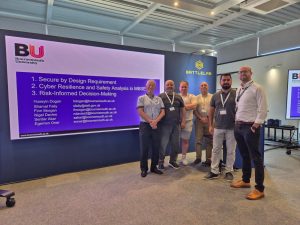
Professor Huseyin Dogan is a leading academic at Bournemouth University's Faculty of Science & Technology, specializing in Human-Computer Interaction and Digital Health . As Director of the Computing and Informatics Research Centre, he spearheads initiatives in Explainable AI , Assistive Technologies , and Systems Engineering . His work addresses critical challenges in healthcare equity through the NIHR Maternity Disparities Consortium and Maternal and Infant Health Equity Research Centre (MIHERC) , aiming to reduce inequalities via digital solutions. Engineering Doctorate (Loughborough University) MSc Human Computer Interaction with Ergonomics (University College London) BSc Computer Science (Queen Mary University of London) His research integrates AI , Cybersecurity , and Implementation Science to develop secure, equitable digital systems. Recent projects include: Digital tools for maternity health equity AI for police worker wellbeing Cyber resilience in defense systems Accessible authentication for disabled users Scientific recognitions include: 2025 IEEE Best Service Award 2025 IEEE Best Paper Award Google Research Funding (2025) As co-founder of the UK's first MSc Digital Health program, he shapes academic curricula while maintaining industry partnerships with organizations like Dstl, Google, and NHS Dorset.
Professor Clemens H. Cap is a Full Professor with tenure and Chair for Information and Communication Services at the University of Rostock, Germany, where he has held his position since 1997. He maintains leadership of the Information and Communication Services research group and has previously held academic appointments at the University of Zurich (including an adjunct professorship until June 2023) and the University of Mannheim. University of Rostock: Full Professor (1997-present) University of Zurich: Adjunct Professor (2004-2023) University of Zurich: Assistant Professor (1992-1995) University of Mannheim: Associate Professor (1994) Professor Cap's research focuses on distributed systems, system security, Internet applications, and social problems in computer science. His work demonstrates an evolution from early research on workstation clusters to contemporary investigations of blockchain technology, classroom response systems, and the social implications of digital technologies. His research interests encompass system architecture for distributed and ubiquitous applications, Internet services, system security, and applications of formal specification techniques. His work has been supported by the German Research Foundation (DFG), the Federal Ministry of Education and Research (BMBF), and the European Union, including participation in the European Fifth Framework Research Program. His recent publications (2014-2022) reveal a strong focus on blockchain applications, security management, and educational technologies, particularly classroom response systems. His research shows consistent thematic development with security, distributed systems, and the social impact of technology as throughlines. Professor Cap regularly gives guest lectures in the Baltic States and Switzerland, demonstrating international engagement. Honorary doctoral degree 'sub auspiciis praesidentis' by Austrian president (1989) Professor Cap is active in academic self-administration as a member of the board of the interdisciplinary research department 'Knowledge - Culture - Transformation' and as Head of the ICT Science Confederation. His teaching portfolio includes Computer Networking, Data Security, Architecture of network services, Methodology of Scientific Research, Software Development Project Distributed Systems, Research Topics in Internet Technology, Computer Science and Society, and Social Impact of IT. He has developed numerous modules that are part of summer schools and international cooperations (BaSoTI). His teaching languages are German and English, and his courses are available for continuous education programs and in-house seminars for companies.
Prof. Dr. Tolga Ovatman is a faculty member at the Department of Computer Engineering, Istanbul Technical University , where he has been serving as Head of Department since 2024. His academic career spans roles from Research Assistant (2004-2012) to Associate Professor (2019-2023) and full Professor (2023-present). He previously held administrative roles such as Vice Dean (2018-2022) and Deputy Head of Department (2016-2018). PhD in Computer Engineering (2005-2011) MS in Computer Engineering (2003-2005) BSc from Hacettepe University (1999-2003) His research focuses on model checking , replicated state machines , cloud computing , and object-oriented software . Recent work addresses computation offloading in 6G networks , collaborative text editing data structures , and energy-efficient environmental monitoring systems . Key projects led include Design of a Multiplexed State Machine Storage System for Edge Computing (2022-2024) and Microservice Compatible Symphony Infrastructure Research (2020). He has supervised numerous theses on topics ranging from collaborative text editing to AI applications in watershed management . Publications span IEEE Transactions , Springer , and conferences like CSCE and CLOSER .
Dr. Suren Chilingaryan is a Data Processing and Software Performance Expert at the Institute for Process Data Processing and Electronics (IPE) at Karlsruhe Institute of Technology (KIT), where he has been working since 2007. His expertise lies in developing high-performance computing solutions for scientific experiments, with a focus on data acquisition systems, parallel computing architectures, and optimization of image processing software for scientific applications. His educational background includes: PhD in Computer Science (2006) from the Institute for Informatics and Automation Problems of the National Academy of Science of the Republic of Armenia Diploma in Mechanics and Mathematics (2001) from Moscow State University, with thesis on neural networks Dr. Chilingaryan's research spans high-performance computing, parallel hardware architectures, and scientific data management. He specializes in developing efficient algorithms for data acquisition and control systems, particularly for particle physics experiments. His current activities include high-speed data acquisition and control, management of large data, and optimization of image processing software for parallel computing architectures. He has pioneered techniques for GPU-accelerated data processing that enable real-time analysis of massive datasets from experiments like KATRIN (neutrino mass measurement), PANDA, and ASEC (Aragats Space Environmental Center). His recent publications demonstrate a strong focus on neutrino physics, cosmic ray phenomena, and high-speed data acquisition systems. The integration of FPGA and GPU technologies in his research has enabled breakthroughs in real-time data processing for scientific experiments, particularly in synchrotron imaging and particle detection applications. His work bridges computer science and experimental physics, with particular emphasis on developing scalable infrastructure for managing and analyzing large scientific datasets. Dr. Chilingaryan leads development of key software infrastructure including: UFO (Ultra fast X-Ray imaging platform) for smart experiments using GPU computing ADEI (Advanced Data Extraction Infrastructure) for time-series data management High-throughput DAQ Platform for FPGA-based scientific experiments His technical leadership supports major international collaborations including KATRIN, PANDA, and ASEC, providing critical data management solutions that enable new types of scientific investigations across particle physics, astrophysics, and atmospheric science disciplines.
Cristina Stângaciu is a Lecturer at the Department of Computer and Information Technology, Politehnica University of Timisoara. Her research focuses on embedded systems, real-time systems, IoT, and energy-efficient computing. She has contributed to mixed criticality task scheduling and wireless sensor networks. PhD in Real-Time Systems (2015) Scientific Secretary of Department Involvement in projects: Bright Cityscapes - Synthia, CloudPUTing, TEEFIOS Her research interests span real-time task scheduling, embedded operating systems, and smart sensing systems. Recent work explores IoT security and multicore scheduling techniques. Key article trends include real-time scheduling frameworks, IoT protocol optimization, and energy-efficient embedded systems. Topics like lightweight cryptography and CAN FD improvements are prominent in her 2024-2025 publications. Merit Diplomas (2021, 2022) Merit Awards 2025 As advisor to PhD students, she contributes to advancements in real-time systems through grants and collaborative projects like SCMUPT 2025. Her work integrates practical and theoretical aspects of sensor networks and cloud platforms.
Nasrine Olson is a researcher at the Department of Library and Information Science, University of Borås. She serves as Director of INCLUDE - Center for Inclusion Research and coordinates the Horizon Europe MuseIT project, focusing on inclusive digital heritage technologies. Her work bridges accessibility research, human-centered design, and cultural heritage preservation.
Mohammad Zubair is a Professor in the Department of Computer Science at Old Dominion University's College of Sciences, specializing in high performance computing, digital libraries, autonomic computing, and peer-to-peer networks. His work bridges scientific computing and information systems with significant federal and industry collaborations. Education: Ph.D. in Computer Science, Indian Institute of Technology Delhi (1987) B.S. in Electrical & Electronics Engineering, University of Delhi (1981) Research Interests: Dr. Zubair's expertise centers on high performance computing for scientific applications and large scale data analytics. He develops scalable algorithms for scientific simulations (e.g., particle physics, structural health monitoring) and advances digital library systems through autonomic computing, collaborative classification, and metadata extraction. His work integrates parallel computing with domain-specific challenges in finance, physics, and digital preservation. Publication Trends: His recent publications (2017-2008) show strong focus on GPU-accelerated scientific computing (particle colliders, structural monitoring) and computational finance (binomial option pricing), while maintaining digital library research in collaborative classification and metadata extraction. The work increasingly addresses energy efficiency in cloud systems and leverages parallel architectures from multicore CPUs to GPUs. Scientific Awards: IBM Faculty Award (2006) IBM Faculty Award (2005) Grants and Funding: Dr. Zubair has secured over $800,000 in research funding since 2004, including projects like 'Design AMD Impl Scalable Opt Kernels for Lrg Sc Simu USN Fund3d On Emer' ($24,890, 2017-2018), 'Graduate Research Award Program On Public Sector Aviation Issues' ($35,519, 2016-2018), and foundational digital library work with the Library of Congress and NASA. He frequently collaborates with K. J. Maly and R. Mukkamala on autonomic systems and metadata extraction. Labs and Teams: His research integrates with ODU's high performance computing initiatives and digital library projects, particularly through collaborations with federal agencies (NASA, Library of Congress) and industry partners like IBM. Current work focuses on GPU-accelerated scientific simulations and energy-efficient cloud management systems.
Antonio Piccinno is an Associate Professor at the Department of Computer Science , University of Bari Aldo Moro (UNIBA). He is a founding member and coordinator of the IVU (Interaction, Visualization, Usability & UX) Laboratory , focusing on the interplay between Human-Computer Interaction (HCI) and Software Engineering through End-User Development (EUD) techniques. His career spans roles as Research Fellow , Assistant Professor , and now Associate Professor , with a Ph.D. in Computer Science from UNIBA (2005). His research interests include Human-Centered Design (HCD) , End-User Development (EUD) , Adaptive Interfaces , Secure Software Design , and Ambient Intelligence . He has authored over 150 publications and contributed to EU-funded projects like EUD-Net , FairsNet , and FAIRWIS . His work bridges academia and industry through collaborations with international institutions such as the University of Colorado at Boulder. His recent publications highlight trends in Human-AI Symbiosis , IoT for Cultural Heritage , and Security Education . He actively organizes conferences, including roles as Full Papers Co-Chair at INTERACT 2023/2021 and Founder/Co-Chair of workshops like CoPDA and PDEUD . He serves on the Steering Committee of IS-EUD and is a member of ACM , IEEE , and ACM SIGCHI . At UNIBA, he teaches Software Engineering (undergraduate) and Cloud Computing (graduate). He has supervised ~70 bachelor’s/master’s theses and one PhD student. The IVU Lab he co-founded investigates adaptive systems, ambient intelligence, and secure software design.
Yasmine Nahal serves as a Doctoral Researcher within the Department of Computer Science at Aalto University, Finland. Her position involves conducting cutting-edge research at the nexus of artificial intelligence and pharmaceutical sciences, specifically targeting the enhancement of drug discovery processes through human-AI collaboration. She is actively contributing to the development of novel computational frameworks that empower chemists with intelligent tools for molecule design and analysis. Her research expertise spans drug discovery, cheminformatics, machine learning, and human-computer interaction. Key focus areas include interpretable AI models for chemist preferences, robust detection of assay-interfering compounds, and goal-oriented molecule generation via active learning. She pioneers techniques that seamlessly integrate domain expert feedback into generative chemistry models, thereby bridging the gap between computational predictions and practical chemical intuition. Examining her publication record from 2023 to 2025, a clear trajectory emerges: advancing human-in-the-loop methodologies in drug discovery. Her contributions address critical challenges such as aligning proxy rewards with ground truth in molecular generation, creating user interfaces for expert feedback collection (Metis), and developing expert-guided augmentation strategies (E-GuARD) to improve compound screening reliability. This body of work underscores a commitment to making AI systems more transparent, reliable, and useful for medicinal chemists. No scientific awards are documented for Yasmine Nahal in the available sources. As a doctoral researcher, she is currently engaged in her PhD studies and does not supervise students. Information regarding research grants, laboratory affiliations, or team memberships was not provided in the source material.
Shawn BANASICK is a Professor in the Department of Global Studies at Kobe College, Japan. Originally from the United States, he brings extensive experience in International Relations and Geography to his teaching and research. His academic journey includes a Ph.D. in Geography from West Virginia University, followed by teaching geography at an American university before joining Kobe College. Professor BANASICK's research interests focus on Regional Security, Regional Economic Development, Social Constructionism, and Q Methodology. He has developed significant expertise in qualitative research methods, particularly in the application and development of Q Methodology tools. His work bridges the gap between traditional social science research and modern software development. He is the creator of several open-source software projects for Q Methodology analysis, including KADE (an open-source application for Q methodology data analysis) and Quincy Configurator (a tool for setting up and testing Q sorting projects). His GitHub profile shows active development in these areas with recent commits throughout 2024-2025, indicating ongoing research and development in this field. Professor BANASICK maintains an office in room L-21 at Kobe College with office hours on Thursdays from 9:30-10:15. His work represents a unique integration of social science research methodology with contemporary web technologies, making advanced qualitative research methods more accessible to scholars worldwide.
Prof. Dr. Yaşar Güneri ŞAHİN serves as the Dean of the Faculty of Engineering and Computer Sciences at Izmir University of Economics, where he also holds a professorship in the Department of Software Engineering. With over two decades of experience in both academia and industry, he has established himself as a prominent figure in software engineering, real-time systems, and educational technologies. His academic journey began with a Bachelor's degree in Computer Engineering from Middle East Technical University in 1994, followed by a Master's in Computer Education from Gazi University in 1999, and culminated with a Ph.D. in Industrial Technology from Gazi University in 2005. Prior to joining Izmir University of Economics in 2008, he served as a faculty member at Yaşar University starting in 2005, and before that, he gained nearly a decade of industry experience in high-level management roles overseeing numerous software projects for both public and private sectors. Prof. ŞAHİN's research spans several interconnected domains with a strong emphasis on practical applications. His work in software engineering focuses on project management methodologies, team building models for educational contexts, and database systems. In real-time systems, he has made significant contributions to forest fire detection technologies using innovative approaches like animal-based biological sensors and radio-acoustic sounding systems. His educational technology research addresses challenges in nursing education, special education for individuals with autism, and internet resource utilization by university students. Notably, his interdisciplinary approach bridges computer science with healthcare applications, particularly in medical informatics where he has developed public health information systems and tools for medical data entry. His scholarly output demonstrates a consistent trajectory of innovation across multiple domains, with particular concentration in the period from 2007-2013. While his early work focused on foundational software engineering concepts and database systems, his research evolved to address pressing societal challenges including forest fire detection, healthcare information systems, and educational technologies. This evolution reflects his ability to identify emerging technological needs and apply software engineering principles to diverse real-world problems. His contributions have been recognized through multiple prestigious awards: TÜBİTAK Scientific Publication Awards (2008-2012) İzmir University of Economics Scientific Publication Awards (2008-2011) As an academic advisor, Prof. ŞAHİN has supervised doctoral and master's theses on diverse topics including heart failure management, triage algorithms for multiple injuries, and software project selection metrics for small and medium enterprises. His administrative leadership extends beyond his deanship to include serving on juries for national art, design, and architecture competitions, as well as evaluating research projects for TEYDEB and TÜBİTAK. His grant activities include serving as a project reviewer and monitor for various technology development initiatives including "Bulut," "ARAGES," "SADE," and "SWH-ATLANTIS." Prof. ŞAHİN maintains an active research laboratory environment focused on real-time systems and software engineering applications. His work often involves interdisciplinary collaboration, particularly with medical professionals on health informatics projects and with education specialists on technology-enhanced learning initiatives. Current research directions appear to focus on the intersection of software engineering principles with healthcare applications and environmental monitoring systems.