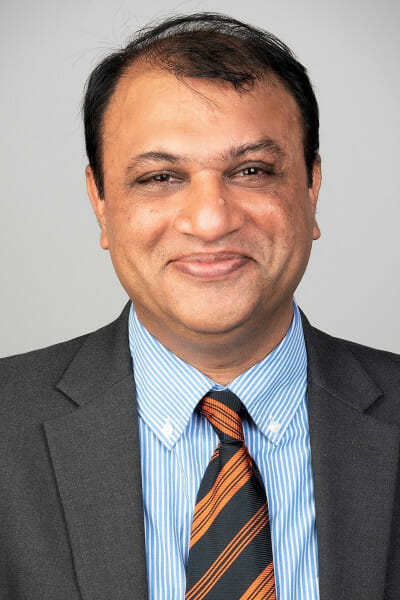
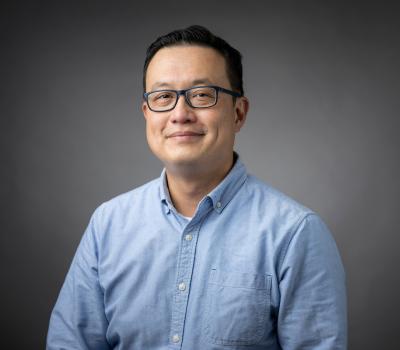
Dr. Joris Hulstijn is an Assistant Professor at Utrecht University's Faculty of Science, Department of Software Production. His research focuses on Responsible AI, AI and Law, cybersecurity, and regulatory supervision. He teaches in the Information Sciences (BSc) and Business Informatics (MSc) programs, coordinating master's theses in Business Informatics. His work addresses accountability in AI systems, ethical implications of government IT, and IT audit automation. He leads the Software Ecosystem Security lab with colleagues Kate Labunets and Slinger Jansen. Key research themes include Governing the Digital Society and Human-Centered AI. Recent publications (2023-2024) explore computational accountability, explainable AI for illiterate users, automated phishing detection, and ethical decision frameworks in AI. His work bridges technical systems with legal and societal governance, emphasizing transparency and compliance in digital ecosystems.
Sridhar Mahadevan is an Adjunct Professor in the College of Information and Computer Sciences at the University of Massachusetts Amherst. He has held previous academic positions at Michigan State University, the University of South Florida, and was a visiting scholar at Carnegie Mellon University. His research focuses on machine learning, multi-agent systems, planning, perception, robotics, and probabilistic models, with recent emphasis on hierarchical frameworks for autonomous learning and sequential decision-making using Markov decision processes. Mahadevan is an Associate Editor of Machine Learning and Journal of Machine Learning Research , and has contributed to editorial boards of major AI journals. He co-founded LookAhead Decisions Inc. and has been recognized with the NSF CAREER Award (1995) and best paper awards at international conferences. Education: PhD in Computer Science, Rutgers University, 1990 Research Interests: Mahadevan’s work spans foundational AI topics including reinforcement learning, causal inference, and generative models. His applied research includes robotics navigation, active vision systems, and spectroscopic analysis for space science. He pioneered methods for autonomous learning from perceptual data streams and developed frameworks like manifold alignment for cross-domain data integration. Key Contributions: Developed hierarchical hidden Markov processes and semi-Markov decision processes Advanced manifold learning techniques for spectroscopic calibration under non-stationary conditions Contributed to theoretical foundations of proximal reinforcement learning and variational inequalities Awards: NSF CAREER Award (1995) Best Student Paper Award at Autonomous Agents Conference (2001) Best Paper Award Runner-Up at International Conference on Machine Learning (1999) Advising & Grants: Advised students Rajbala Makar and Mohammad Ghavamzadeh. His NSF-funded projects include research on spectroscopic analysis and reinforcement learning theory. Collaborative grants include work on generative AI for Mars mineral analysis. Labs & Teams: Co-founder of LookAhead Decisions Inc., a company advancing decision-making systems using causal inference and reinforcement learning. Active in interdisciplinary teams applying AI to space science and robotics.
Neil Natarajan is a doctoral student at the University of Oxford, affiliated with the Department of Computer Science. His research focuses on the intersection of Human-Centered Computing and Artificial Intelligence, particularly in recruitment technologies and AI ethics.
Elliot Creager is an Assistant Professor at the University of Waterloo's Faculty of Engineering , Department of Electrical and Computer Engineering. He directs the Socially Embedded Machine Intelligence (SEMI) Lab , focusing on reliable and equitable AI systems that prioritize user data autonomy. His interdisciplinary research bridges technical machine learning with sociology and policy implications, and he actively mentors students across multiple institutions (University of Toronto, York University, Vector Institute). Recent research trends include algorithmic fairness in sequential decision-making, differential privacy applications, and LLM auditing frameworks . Collaborative projects span institutions like University of Toronto, York University, and Vector Institute. His work addresses fluid simulation generalization , invariant learning , and collective action algorithms . Scientific achievements include a CIFAR AI Catalyst Grant (2024) and recognition as NeurIPS 2022 Top Reviewer . As an active Area Chair for ICML 2025 and NeurIPS 2025, he contributes to advancing equitable AI standards. Current advisees include MASc and postdoc researchers, with former students from undergraduate programs.
Dr. Marc Conrad is a Principal Lecturer in Computing and Information Systems at the University of Bedfordshire , affiliated with the School of Computer Science and Technology . His academic career spans over two decades, with expertise in Cybersecurity , Virtual Reality , Education Technology , and Data Science . He has supervised sixteen PhD students to completion and authored over seventy peer-reviewed publications. Research interests include cross-cultural software development, secure applications, virtual learning environments, and data governance. Notable projects include collaborations with Bedfordshire Police on cyberharassment and the EU-funded EDISON initiative for Data Science professionalization. He is a Fellow of the Higher Education Academy (FHEA) and a member of the BCS, Institute of Mathematics and Applications, and Croatian Mathematical Society. Teaching focuses on IT Project Management , Full Stack Development , and innovative pedagogical approaches like virtual reality integration. He leads undergraduate computing programs and chairs PhD supervisory committees within the Institute for Research in Applicable Computing (IRAC). External roles include grant reviewing for MRC, NSERC, and ESRC. Dr. Conrad's work bridges academia and industry, addressing challenges in cybersecurity, e-government, and digital transformation. His labs explore AI, blockchain, and forensic imaging, with recent projects tackling cybercrime in post-pandemic contexts and scam prevention in online gaming.
Dushani Imesha Perera is a Researcher at Cardiff University's School of Computer Science & Informatics, focusing on Human-Computer Interaction (HCI), Computer Supported Cooperative Work (CSCW), and Sustainability. She holds a BSc (Hons) in Software Engineering from the University of Colombo School of Computing (UCSC), where she was recognized for Best Final-Year Research in Software Engineering (2019/2020). Prior to her PhD, she served as an Assistant Lecturer at UCSC. Her current research explores data physicalization for fostering sustainable practices and designing child-centric data engagement tools through the Grasping Data project. Her work bridges HCI with social sciences, emphasizing tangible interfaces for environmental behavior change. Notable achievements include developing the Eco-garden data sculpture and co-design frameworks for children's data literacy. She actively contributes to conferences as a Master of Ceremonies and has published extensively on topics ranging from neural signal analysis to AR in fashion design. Awards include the prestigious UCSC award and recognition in interdisciplinary sustainability research.
Christian Sandvig is the H. Marshall McLuhan Collegiate Professor of Digital Media at the University of Michigan, jointly appointed in Communication & Media, School of Information, Digital Studies Institute, Science, Technology & Society, Art & Design, and Science, Technology, and Public Policy. He directs ESC: The Center for Ethics, Society, and Computing. Education: Ph.D. Communication, Stanford University (2002) M.A. Communication, Stanford University (1999) B.A. Rhetoric & Communication, UC Davis (1997) His research investigates algorithmic systems that curate culture, pioneering methods in algorithm auditing . Key interests include ethical computing, digital infrastructure, and social consequences of automated decision systems. Research publications focus on: Algorithmic accountability frameworks Bias detection in digital platforms User experiences with algorithmic systems Legal implications of computing research Awards: ICA Outstanding Public Research Award (2024) UM President's Award for Public Engagement (2024) He led Sandvig v. Barr , a landmark lawsuit challenging the Computer Fraud and Abuse Act's constitutionality, which influenced DOJ policy and was cited by the Supreme Court. Directs the Ethics, Society, and Computing (ESC) Center, developing research at the intersection of technology and social justice.
Tahir Hameed is an Assistant Professor of Management at the Girard School of Business, Merrimack College. His research focuses on Information Technology Standardization, Healthcare Analytics, and Technology Innovation Management, with particular emphasis on socio-technical systems and their impact on healthcare and technology commercialization. He holds a Ph.D. in Information Technology Management from KAIST (Korea Advanced Institute of Science and Technology), an M.S. in Computer Science from Lahore University of Management Sciences, and a B.E. in Industrial Electronics Engineering from NED University of Engineering and Technology. Key research interests include AI-driven healthcare solutions, trustworthy biomedical content systems, and innovation policies in technology-intensive sectors. His work often explores the interplay between technical systems and human behavior in knowledge-intensive environments. Recent publications highlight contributions to AI audit frameworks for health information, decentralized biomedical content systems, and predictive models for hospital readmissions. His scholarship bridges healthcare informatics, technology management, and socio-cognitive innovation theories. Dr. Hameed's research has addressed challenges in South Korea's technology commercialization processes, fog computing for healthcare IoT, and semantic interoperability in biomedical data. He has contributed to both technical and policy-oriented solutions in eHealth standardization, information overload in health searches, and the social impacts of digital technologies.
Assoc. Prof. Dr. Elisabeth Lex is a tenured Associate Professor at Graz University of Technology (TUG) and PI of the Recommender Systems and Social Computing Lab. She serves as Dean of Study for the master's program in Computational Social Systems. With a habilitation in Applied Computer Science, her research focuses on psychology-informed recommender systems, user modeling, and computational social science. She has published over 100 articles in venues like WebConf, HT, and RecSys, and led major projects like the trans-university 'Polarization in Public Opinion.' Education : PhD in Computer Science (2011), TU Graz Postdoc at Universidad Nacional de San Luis (Argentina) and RWTH Aachen (Germany) Research Interests : Her work integrates cognitive science principles into AI systems, addressing fairness, privacy, and transparency in recommendations. She explores how human behavior and social dynamics influence algorithmic systems, with applications in music recommendation, misinformation detection, and polarization analysis. Article Trends : Recent work emphasizes trustworthy AI, including privacy-aware recommendation systems (e.g., differential privacy), bias mitigation in music recommendations, and computational framing analysis for political narratives. She bridges technical innovation with societal impacts, such as analyzing polarization in public health policies via social media. Scientific Awards & Grants : Outstanding Paper Award (ISSI 2015) EU H2020 grants (TRIPLE, AI4EU, OpenUP) Transuniversity Research Project on Polarization (€325k funding) Advising & Labs : Supervised over 20 PhD/Master students on topics like conspiracy narratives, privacy in recommendations, and job recommendation systems. Her lab develops open-source frameworks (e.g., TagRec, AFEL-REC) and collaborates with industry partners through the Know-Center. Labs/Teams : Leads the Recommender Systems and Social Computing Lab at TUG, part of the interdisciplinary Social Computing area at the Know-Center. Collaborates with global initiatives like OpenAire and Open Knowledge Maps.
Azzurra Ragone is a Professor at the University of Calabria's Department of Computer Science within the School of Engineering. Her research focuses on AI ethics, trustworthy AI systems, recommender systems, and automated testing. She collaborates extensively with peers like Maria Teresa Baldassarre, Vito Walter Anelli, and Fedelucio Narducci on projects addressing ethical AI frameworks (e.g., POLARIS), fairness in machine learning, and generative AI impact analysis. Her work bridges technical innovation with societal implications, particularly in child rights and industry standards. Key research areas include: Responsible AI development methodologies Ethical implications of generative AI (e.g., ChatGPT analysis) Automated testing using large language models Counterfactual reasoning for fairness auditing Publications highlight contributions to: Trustworthy AI frameworks (POLARIS) Child rights in AI contexts Recommender systems integration with knowledge graphs Her work is featured in venues like IEEE Trans. Artif. Intell., ECIR, and ACM RecSys conferences. She actively contributes to workshops like KaRS (Knowledge-aware Recommender Systems) and EASE (European Association for Software Engineering).
Weng-Keen Wong is a Full Professor in the School of Electrical Engineering and Computer Science at Oregon State University (OSU), part of the College of Engineering. He serves as the OSU Site Director for the NSF-funded Pervasive Personalized Intelligence Center. His academic journey includes a PhD and MS from Carnegie Mellon University (2004/2001) and a BS from the University of British Columbia (1997). Research focuses on machine learning, with specialties in anomaly detection, explainable AI, computational sustainability, and spatio-temporal data analysis. Notable projects include disease outbreak surveillance algorithms, bird species distribution modeling, and RF device authentication systems. He collaborates across disciplines in public health, ornithology, and environmental sciences. Teaching includes courses like Artificial Intelligence (CS 331), Probabilistic Graphical Models (CS 536), and Ethics in Computer Science (CS 391). He advises a team of 9 current students (4 PhD, 1 MS, 4 undergrad) and has mentored over 25 alumni in roles spanning academia and industry. Labs and initiatives include the Wong Lab focusing on anomaly detection and sustainability projects. He has led NSF grants and industry collaborations, emphasizing practical applications of machine learning in real-world challenges.
Luis Felipe Luna-Reyes serves as Associate Professor of Informatics at the University at Albany's College of Engineering and Applied Sciences, concurrently holding a Faculty Fellowship at the Center for Technology in Government (CTG). His academic career bridges information systems, public administration, and policy informatics with a focus on cross-border governance in North America. His educational background includes a Ph.D. in Information Science (Distinguished Dissertation Award, 2004) from University at Albany/SUNY, an MBA in MIS (Cum Laude, 1997) from Universidad de las Américas-Puebla, and a BA in Education (Cum Laude, 1992) from the same institution where he achieved the highest GPA in his department. Luna-Reyes' research centers on digital government transformation through system dynamics modeling, with particular expertise in interorganizational collaboration, open data ecosystems, and AI governance. His work examines how information technologies reshape public sector decision-making across governmental boundaries, with significant contributions to NAFTA-region economic exchange frameworks and sustainable consumption systems. His publication trajectory reveals evolving focus from foundational e-government portal studies (2012-2014) toward contemporary AI policy analysis (2024-2025), consistently applying system dynamics to complex public problems including pandemic response modeling, food system resilience, and algorithmic governance. Key thematic threads include trust dynamics in public-private partnerships and socio-technical integration challenges. Distinguished Dissertation Award (University at Albany) Member, Mexican National Research System (Sistema Nacional de Investigadores) Luna-Reyes has taught over a dozen courses spanning Information Management, Systems Thinking, and Quantitative Analysis at undergraduate, master's, and executive levels. His advisory work focuses on CTG's Fulbright-affiliated research initiatives, particularly in cross-border information policy. Current projects examine US state AI legislation frameworks and generative AI implications for public affairs education. He leads collaborative research through CTG's policy informatics lab, directing teams on open data visualization tools for policymakers and community resilience assessment frameworks. Recent work integrates system dynamics with machine learning for real-time policy simulation in food recovery systems and public health emergencies.
Ivana Bestvina Bukvić is an Associate Professor at the Department of Finance and Accounting, Faculty of Economics and Business, Josip Juraj Strossmayer University in Osijek. She serves as head of the Lifelong Learning Center and has extensive industry experience in corporate banking at Zagrebačka banka. Her academic roles include positions at the Academy of Arts and Culture in Osijek, where she developed accredited study programs. Education & Affiliations: PhD in Accounting and Financial Reporting (2012) Master's in Accounting, Auditing and Finance (2005) Member of J.J. Strossmayer University Lifelong Learning Programs Committee Research Focus: Her work bridges finance, cultural management, and EU funding mechanisms. Key interests include: Financial analysis of public investments EU fund utilization in cultural/ICT sectors Behavioral aspects of digital payments Sustainability in financial practices Publication Trends: Recent works demonstrate strong focus on pandemic-era economic adaptations, AI in finance, and green financing instruments. Methodologies combine empirical data analysis with policy evaluation, particularly in Central European contexts. Projects & Advising: Coordinates projects on fiscal policies and economic growth. Currently developing financial literacy frameworks for educational applications.
Logan Stapleton is an Assistant Professor of Computer Science at Vassar College, teaching data science, machine learning, and their societal implications. Their research critically examines AI applications in care domains such as child welfare systems and suicide prevention, focusing on rectifying systemic violence like racism and carcerality. They hold a BA from Macalester College and are a PhD candidate at the University of Minnesota’s GroupLens lab, advised by Haiyi Zhu and Zhiwei Steven Wu. Research Interests: Human-Computer Interaction (HCI) Critical algorithm studies Algorithmic fairness and ethics Mental health and crisis response systems Child welfare predictive systems Publications Highlight Trends in: Ethical AI design for marginalized communities Human-AI collaboration in social services Algorithmic bias mitigation strategies Awards: No awards explicitly listed in provided materials. Advising & Grants: No advisees listed. Their research has been supported through collaborations with institutions like Carnegie Mellon University and University of Minnesota. Labs/Teams: Associated with the GroupLens research lab at University of Minnesota, focusing on human-centered computing and AI ethics.
Alexander Hambley is a Senior Research Software Engineer at the eScience Lab within the Department of Computer Science, focusing on developing computational tools for efficient research practices, particularly in web accessibility and Human-Centered AI. He contributes to the HDR UK Federated Analytics project, emphasizing FAIR principles. Previously, he served as an Associate Lecturer at The Open University and held roles at the University of Leeds. Education: PhD in Computer Science, University of Manchester (Research in web accessibility and machine learning) BSc (Hons) Computer Science, University of Nottingham (First Class) Research interests include Human-Centered AI, Web Accessibility, Human-Computer Interaction, and Open Science. His work bridges assistive technologies for visually impaired users and data-driven approaches to enhance accessibility evaluation via clustering and optimization methods. Key trends in his articles focus on workflow systems, accessibility tool development, and integrating machine learning for efficient auditing. His contributions span both technical software tools (e.g., OPTIMAL-EM) and collaborative projects like WorkflowHub Knowledge Graph. Honors include the Best Communication Paper at W4A 2022. His professional activities include founding Build Humanly, an inclusive web design agency, and affiliations with the Information Management Group and Interaction Analysis and Modelling Laboratory.