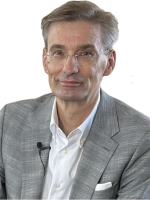
Caterina Cruciani is an Associate Professor at the Department of Management , Venice School of Management , Ca' Foscari University of Venice. She serves as a member of the University Scientific Instrumentation Service Center (CSA) Management Committee and is affiliated with the Research Institute for Social Innovation . Research Interests Trust dynamics in financial advisory Behavioral finance and investor decision-making Sustainability disclosure and ESG integration Digital transformation in financial services Regional economic development and SME financing Agent-based modeling of cooperative behavior Key Article Trends (2009-2024): Span 15 years of research on financial trust (12 publications), behavioral economics (10), sustainability (6), and digital finance (5). Methodologically combines experimental economics , structural equation modeling , and Supervised Topic Modeling for ESG discourse analysis.
Omprakash Gnawali is an Associate Professor in the Department of Computer Science at the University of Houston, with expertise in Internet of Things, wireless sensor networks, and artificial intelligence. His research focuses on advanced networking protocols, mobility analysis, and safety monitoring systems. Postdoctoral work at Stanford University PhD in Computer Science from University of Southern California Masters and Bachelors from Massachusetts Institute of Technology His research interests include Ultra-Wideband (UWB) localization, network protocol design, edge computing for monitoring systems, and mobile sensor networks. He leads the Networked Systems Laboratory , where he develops frameworks like the Collection Tree Protocol and CodeDrip for efficient data dissemination. Recent publications highlight trends in UWB-based safety monitoring, routing optimization in dual-radio networks, and deception detection in cybersecurity. He has secured NSF Student Travel Grants for ACM SenSys conferences in 2016 and 2017. Scientific Awards NSF Student Travel Grant (2017) NSF Student Travel Grant (2016) He actively mentors students in research projects and teaches courses such as Research Methods in Computer Science and Computer Networks . His service roles include Technical Program Committee memberships and chairing the TinyOS Network Protocol Working Group.
Ramana Vinjamuri is an Associate Professor in the Department of Computer Science and Electrical Engineering at the University of Maryland, Baltimore County (UMBC). He holds a secondary appointment as Visiting Professor at the Indian Institute of Technology, Hyderabad, India. His academic journey includes a Ph.D. in Electrical Engineering from the University of Pittsburgh (2008), M.S. in Bioinstrumentation from Villanova University (2004), and B.Tech. in Electrical and Electronics Engineering from Kakatiya University (2002). Dr. Vinjamuri's research focuses on Brain-Machine Interfaces (BMIs) for upper-limb prostheses control , neuroprosthetics and exoskeletons , machine learning in motor control , and neurophysiological signal processing . His work extends synergy-based models to control 37-dimensional hand movements, addresses human-robot interaction through emotionally intelligent systems, and develops neurotechnologies for substance use disorder using wearable sensors and AI. NSF CAREER Award (2019) NSF IUCRC BRAIN Center Planning Grant (2020) Harvey N Davis Distinguished Teaching Assistant Professor Award (2018) His publications demonstrate expertise in EEG and EMG signal analysis , deep learning for motor decoding , synergy modeling , and humanoid robot control . The Vinjamuri Lab at UMBC involves graduate, undergraduate, and high school researchers, with international collaborations in India and the US.
Dr. Vagelis Papalexakis is an Associate Professor and Ross Family Chair in the Computer Science & Engineering Department at the University of California, Riverside. His research focuses on data science, machine learning, and tensor methods, with applications in multi-aspect/multi-modal data analysis. He holds a Ph.D. from Carnegie Mellon University and a Diploma/M.Sc. from the Technical University of Crete. Affiliations: Ross Family Chair, Bourns College of Engineering, UCR Education: Ph.D. in Computer Science, Carnegie Mellon University M.Sc./Diploma in Electronic & Computer Engineering, Technical University of Crete His work emphasizes interpretable insights from complex datasets, including tensor-based defenses against adversarial attacks, graph representation learning, and scalable algorithms for high-dimensional data. Notable awards include the NSF CAREER Award (2021), IEEE DSAA Next Generation Award (2021), and ICDM Tao Li Award (2022). Grants include NSF funding for railway safety (CISE MSI: RPEP CPS), USDOT transportation research, and NVIDIA GPU grants. He leads projects in AI ethics, misinformation detection, and gravitational wave analysis. His lab collaborates with industry (e.g., Cisco, Instacart) and national labs (e.g., Lawrence Livermore).
Manxi Wu is an Assistant Professor in Cornell University's School of Operations Research and Information Engineering, specializing in societal networks and game-theoretic approaches to system design. Her research develops computational models for strategic learning and incentive mechanisms in socio-technical systems, with applications to transportation networks and digital platforms. Education: B.S. Applied Mathematics, Peking University (2015) M.S. Transportation, Massachusetts Institute of Technology (2017) Ph.D. Social and Engineering Systems, Massachusetts Institute of Technology (2021) Her research integrates game theory, optimization, and machine learning to address challenges in autonomous services, traffic management, and decentralized decision-making. Current investigations focus on adaptive incentive structures, spatial resource allocation, and equilibrium analysis in complex networked environments. Publication analysis reveals consistent emphasis on game-theoretic frameworks applied to urban mobility systems, with recent work exploring multi-agent reinforcement learning, congestion pricing equity, and electric fleet management. Methodological innovations include novel convergence proofs for decentralized algorithms and computational approaches to fairness constraints. Awards and Honors: Hammer Fellowship UTC Milton Pikarsky Memorial Award Siebel Scholarship EECS Rising Star recognition No information is currently available regarding student advising, research grants, or laboratory affiliations.
Jean-Louis Scartezzini is an Honorary Professor at École Polytechnique Fédérale de Lausanne (EPFL), affiliated with the School of Architecture, Civil and Environmental Engineering (ENAC) and the Solar Energy and Building Physics Laboratory (LESO-PB). His research focuses on natural/artificial lighting, solar energy systems, and building technology, with a strong emphasis on energy efficiency and sustainability. Director of LESO-PB since 1994 Founded and led several institutes, including the Institute for Infrastructure, Resources, and Environment (2002–2009) Doctorat in Physics from EPFL (1986) Extensive international collaborations, including visiting roles at NUS (2009) and LBNL/UCLA (1988) Research interests include: - Daylighting and lighting control systems - Passive/active solar technologies - Urban microclimate and energy systems - Stochastic simulation and predictive control Recent work addresses climate change impacts on energy systems, urban sustainability, and machine learning applications in energy optimization. Key publications span lighting health impacts, renewable integration, and microclimate modeling Awards include the European Solar Prize (2001/2002) and Walsh-Weston Bronze Medal (1998) Mentored over 20 PhD students, many leading in academia and industry (e.g., Marilyne Andersen at EPFL, Flavio Foradini at E4Tech).
Alex Kale is an Assistant Professor of Computer Science at the University of Chicago and a core member of the Data Science Institute. His research focuses on data visualization and human-computer interaction, emphasizing tools that explicitly represent users' cognitive processes during data analysis. He leads the Data Cognition Lab, exploring software for uncertainty visualization, causal inference, and decision-making support. Kale holds a PhD in Information Science from the University of Washington (2022), an MSc from UW (2020), and a BSc in Psychology with minors in Music and Philosophy (2015). Affiliations: University of Chicago, Data Science Institute, Data Cognition Lab Education: PhD, UW (2022); MSc, UW (2020); BSc, UW (2015) Research interests include human-computer interaction, statistical reasoning interfaces, and systems for managing large-scale data. He has developed tools like MetaExplorer for meta-analysis and EVM for exploratory visual modeling. Key awards include the Best Paper Honorable Mention at CHI 2023 and VIS 2021, and the Best Paper Award at VIS 2020. His work bridges visualization design, decision theory, and cognitive science, with applications in participatory budgeting, causal inference, and reproducible research. Courses taught include Visualization for Data Science and Statistical Rethinking.
Georgia Fragkouli is a Researcher affiliated with ETH Zürich's School of Computer and Communication Sciences, working within the Institute of Computer Engineering and Communication Systems. Her role is part of the Professorship for Networked Systems, focusing on advanced networking and distributed systems research. She specializes in analyzing network performance, security, and transparency, with a particular emphasis on BGP convergence dynamics, anomaly detection, and decentralized computing architectures. Her research interests include network protocol validation, machine learning-based traffic analysis, and improving internet transparency through innovative measurement frameworks. She has contributed to projects like MorphIT for packet-level transparency and explored failure mitigation in globally distributed systems. Notable recent work includes studies on transient forwarding anomalies, iBGP convergence effects, and data-plane performance consistency. Her publications span both theoretical advancements and practical implementations, aiming to bridge gaps between networking theory and real-world deployment challenges.
Dr. Amanda Gigliotti is a Senior Lecturer at the School of Education, University of Wollongong , with expertise in technology-enhanced learning and teacher design practice. Her research investigates how educators integrate technology into pedagogy, focusing on design decisions and professional development. Current role (2025–present): Senior Lecturer, University of Wollongong Previous appointments: Lecturer (2023–2024), Career Development Fellow (2020–2023) PhD in Education (2020), Bachelor of Primary Education (Honours) (2011) Her work emphasizes inclusive digital learning , with grants totaling $292,797.25 as lead investigator. She co-authored 6 journal articles, 2 book chapters, and 2 reports, often collaborating on topics like online curriculum design and WIL simulations. Key awards include the University of Wollongong's Vice Chancellor (Early Career) Award for teaching excellence. She chairs UOW’s Early Career Researcher Committee and founded ASSH’s Early Career Academic Network, mentoring over 100 international academics.
Professor Patrik Wikstrom is a computational communication scholar at Queensland University of Technology (QUT), leading the School of Communication. He serves as Chief Investigator in QUT's Digital Media Research Centre (DMRC) and Associate Investigator in the Australian Research Council's ADM+S Centre. His expertise spans digital media's impact on music and meme cultures, algorithmic systems, and cultural economics. Education: PhD in Media and Communication Studies (Karlstad University), MScEng (Chalmers University). Former roles include Director of DMRC, Associate Dean (Research) at QUT's Creative Industries Faculty, and academic leadership at Northeastern University, Jönköping International Business School, and Karlstad University. Research focuses on digital technologies' societal impacts, including recommender systems, platform governance, and music industry dynamics. Key publications include TikTok: Creativity and Culture in Short Video and The Music Industry: Music in the Cloud . Active in grants like the Australian Cultural and Creative Activity Analysis project (LP160101724). Supervised over 10 doctoral and master's students on topics ranging from platform governance to decolonizing copyright. Current projects explore algorithmic culture, AI ethics, and fair payment models for artists. Labs/Teams: DMRC and ADM+S collaborate on automated decision-making's societal implications. Advocates for responsible AI and interdisciplinary computational methods in social sciences.
Robert S. Laramee is a Professor at the University of Nottingham (previously at Swansea University), specializing in visualization research. His work focuses on data visualization, scientific visualization, and computational fluid dynamics. He has authored over 170 publications in top journals like IEEE Transactions on Visualization and Computer Graphics, Computer Graphics Forum, and IEEE Computer Graphics and Applications. Research Interests: His research spans information visualization, flow visualization, visual literacy, and educational aspects of visualization. He emphasizes practical applications in fields like healthcare, digital humanities, and computational science. Recent Trends: Recent work includes studies on treemap literacy, educational frameworks for visualization, and interactive systems for clinical data. He has also contributed to visualization resources and surveys, aiming to bridge academic and industry needs. Grants & Collaborations: Collaborations include projects on visualization for smart cities, protein-lipid interactions, and quantum chromodynamics data analysis. No specific grant details are provided in the text. Labs & Teams: Affiliated with visualization research groups at Nottingham and Swansea, though specific lab names are not mentioned.
Dr. Farzan Sasangohar is an Associate Professor in the Department of Industrial & Systems Engineering at Texas A&M University, holding the Mike and Sugar Barnes Faculty Fellowship. He also serves as an Assistant Professor at Houston Methodist Hospital's Center for Outcomes Research and Department of Surgery. His academic roles include affiliations with the Environmental and Occupational Health, Biomedical Engineering, and multiple centers focused on health technologies and systems design. Education: PhD in Industrial Engineering (Human Factors Engineering), University of Toronto (2015) Research Interests: Human factors in healthcare delivery and telehealth systems Wearable technology for stress/health monitoring Crisis management team cognition and decision-making Remote patient monitoring systems Mental health self-management interventions Awards: Jack A. Kraft Innovator Award (HFES, 2023) Dr. Hamed K. Eldin Early Career Award (2022) William C. Howell Young Investigator Award (2021) TEES Young Faculty Fellow (2021) Nominated for Ergonomics Journal Best Paper (2021) Advising & Grants: Mentored over 15 graduate students including Dr. Mahnoosh Sadeghi (PhD 2023) Recipient of NSF PATHS-UP Engineering Research Center funding Active grants in offshore worker fatigue management and telehealth integration Labs/Teams: Director of the Applied Cognitive Ergonomics Lab (ACE-lab) , focusing on human-system interactions in healthcare, aviation, and disaster management. Current projects include: - Wearable stress monitoring systems - Telehealth integration frameworks - Crisis team cognition analysis
Professor Gernot Sieg holds the Chair of Industrial Organization with a focus on Infrastructure and Transport Economics at the University of Münster, leading the Institute of Transport Economics. He previously served as Director of the Institute of Economics at TU Braunschweig and has held visiting positions at institutions like the University of Southern California. His academic background includes a Dr. rer. pol. (1993–1999) and Habilitation (1993–1999). Prof. Sieg’s research focuses on transport markets, regulatory economics, and infrastructure policy. Notable projects include the CRC 1385 on Law and Literature, evaluating bicycle traffic optimization (Leezenflow), and analyzing aviation slot regulations. He advises the Federal Ministry for Digital and Transport’s Scientific Advisory Board. His research interests span transport infrastructure financing, traffic flow dynamics, and environmental policy. Recent work addresses vehicle value externalities, phantom jam costs, and the economic impact of speed limits. He teaches courses on competition regulation, transport economics, and industrial organization. Prof. Sieg frequently engages with public policy debates, contributing to media discussions on infrastructure rehabilitation, climate policy, and mobility transitions. His work bridges academic research with practical policy solutions, emphasizing sustainable and equitable transport systems.
Dr. George Chalhoub is a Lecturer (Assistant Professor) in Human-Computer Interaction at the UCL Interaction Centre (UCLIC), Department of Computer Science, University College London (UCL). He is also an Associate Member at the Department of Computer Science, University of Oxford, and a 2024–2025 Berkman Klein Fellow at the Berkman Klein Center for Internet & Society, Harvard Law School, Harvard University. His multidisciplinary research bridges cybersecurity, privacy, and human-centered computing, focusing on real-world technology use. DPhil in Cyber Security, University of Oxford (supported by Information Commissioner’s Office) MSc in Computer Science, University of Southampton (supported by Lloyd’s Register) BS in Computer Science, Lebanese American University His research centers on the security, privacy, and safety of digital technologies through a user-centered lens. Key areas include AI-powered systems (e.g., LLMs, smart assistants), emerging technologies in the wild (e.g., smart homes, IoT), embedded devices (e.g., routers), marginalized communities, data workers in AI, and online content creators. His work integrates UX principles to improve data protection in healthcare (e.g., NHS records) and children’s apps, with implications for GDPR compliance and responsible AI innovation. The analysis of his recent publications reveals a consistent focus on empirical studies of user experience in security and privacy, particularly in smart homes and data-intensive applications. His work spans design interventions, ethical frameworks, and policy-relevant findings, published in top venues like CHI, CSCW, SOUPS, and IJHCS. Themes include consent design, communal privacy, vulnerability patching, and developer support for privacy. UK Global Talent Visa recipient, UK Research and Innovation 2024–2025 Berkman Klein Fellow, Harvard University Dr. Chalhoub has advised on research projects related to secure networking by design and responsible AI (e.g., EWADA, RoboTIPS). He has received grant support from the Information Commissioner’s Office for his doctoral work. He is available for consultancy, collaborative research, grant assessment, and supervision of research degrees. His professional experience includes internships at Microsoft Research (Calc Intelligence) and Nokia Bell Labs (Social Dynamics), contributing to projects in AI and social computing. He is affiliated with research groups including the Human-Centered Computing group at Oxford, the UCL Interaction Centre (UCLIC), and the Berkman Klein Center at Harvard. His work is supported by tools and frameworks developed in collaboration with interdisciplinary teams focused on cybersecurity ethics, data governance, and platform accountability.
Dr. Matt Bonney is a Lecturer in Space Engineering at Swansea University, affiliated with the School of Aerospace, Civil, Electrical and Mechanical Engineering. He holds a position in the Department of Aerospace Engineering and is actively involved in postgraduate supervision. His research focuses on digital twin technology, nonlinear structural dynamics, mechanical joint modeling, seismic reliability, and uncertainty quantification, with recent emphasis on digital twin security and thermo-mechanical coupling in assembled structures. Dr. Bonney's expertise spans multi-physics joint modeling and multi-disciplinary development of digital twins, with international collaborations. He teaches modules such as 'Advanced Space Systems' (EG-M334) and 'Aerospace Systems' (EGA220), emphasizing space system design, orbital mechanics, and cyber-physical security. His research highlights include the development of a Python Flask-based digital twin operational platform, contextualization of information in digital twin processes, and experimental studies on frictional interfaces. His work on uncertainty quantification and seismic reliability has applications in nuclear reactor systems and civil engineering structures. Dr. Bonney currently supervises a PhD student focusing on nonlinearities in thermal-mechanical joints. His research outputs include over 30 peer-reviewed publications, with contributions to journals like Mechanical Systems and Signal Processing and Data-Centric Engineering .