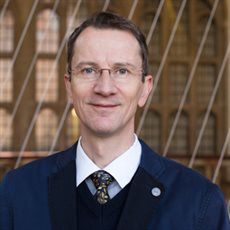
Jan G. Voelkel is an Assistant Professor at the Jeb E. Brooks School of Public Policy and the Department of Sociology at Cornell University. His research explores how micro-level preferences for equality and unity translate into macro-level political decisions, focusing on democratic attitudes, partisan dynamics, and moral framing. Ph.D. and M.A. in Sociology, Stanford University M.S. in Social and Behavioral Sciences, Tilburg University B.S. in Social Sciences, University of Cologne Voelkel’s work spans political psychology, metascience, and social policy, with a focus on interventions to reduce anti-democratic attitudes, partisan animosity, and gender bias in political leadership. His recent articles emphasize large-scale collaborations, reproducibility, and cross-partisan empathy. Scientific awards include: New Investigator Award (Behavioral Science & Policy Association) Public Sociology Award (American Sociological Association) Open Science Innovator Award (Stanford) Centennial Teaching Assistant Award (Stanford)
Tiraana Bains is an Assistant Professor of History at Brown University, specializing in modern Britain and the global British Empire. Her research investigates the contested formation of the British imperial state in South Asia between the 18th and 20th centuries, emphasizing participatory and revolutionary dimensions of imperial governance. PhD, Yale University, 2021 MA, Yale University, 2015 BA, Yale University, 2015 Postdoctoral Fellowship, Modern Intellectual History, Dartmouth College, 2021–2023 Her research interests lie at the intersection of imperial history, political authority, and intellectual frameworks of empire. She examines how both elite and non-elite actors across Britain and South Asia contested and shaped imperial rule, taxation, and labor systems. Her work positions British imperial formation not merely as coercion but as a dynamic, ideologically charged process comparable to revolutionary state-building in America and France. The recent publications reflect a deep engagement with sovereignty, imperial connectivity, and the intellectual history of empire. Her articles explore the collapse and reconstitution of imperial presidencies, dual sovereignty between Mughal and British powers, and broader conceptual attempts to 'think the empire whole.' These works span journals in British, global, and South Asian history, indicating a transregional and interdisciplinary approach. While no formal scientific awards are listed, her publications in leading historical journals and her active research program suggest strong scholarly recognition. Tiraana Bains teaches undergraduate courses at Brown, including HIST 1267: The Global British Empire, 1600–The Present and HIST 1974E: The Intellectual History of Imperialism . She is currently completing a book titled Instituting Empire: The Contested Makings of a British Imperial State in South Asia, 1750–1800 , which promises to make a significant contribution to the field. Her postdoctoral training at Dartmouth further underscores her expertise in intellectual history. Though no lab or research team is mentioned, her collaborative publications suggest engagement with a broader scholarly network at Brown and beyond.
Margus Pärtlas is Professor of Music Theory and Vice Rector for Academic Affairs and Research at the Estonian Academy of Music and Theatre (EAMT). He earned his Doctorate from the St. Petersburg Conservatory in 1992 with a dissertation on Eduard Tubin's symphonies. His career includes positions as Associate Professor (1993-2003), Senior Teacher (1987-1993), and Fulbright Visiting Scholar at the University of North Texas (1999-2000). Pärtlas's research focuses on music analysis methodologies , specializing in the works of Eduard Tubin and Richard Strauss. Key areas include symphonic form, tonal transformation in Romantic music, semiotic analysis of choral works, and cultural identity in exile compositions. His publications consistently explore structural innovation in 19th-20th century European music. His recent articles reflect a thematic emphasis on Estonian musical heritage , institutional development of music academies, and analytical studies of concerti/symphonies. A significant trend involves examining how composers negotiate cultural identity through structural elements. Awards & Honors: Fulbright Visiting Scholar Grant (1999) Best Music Article Award from 'Teater. Muusika. Kino' (1992) Academic Leadership: Chaired accreditation committees internationally (Latvia, Lithuania, Russia, Armenia), serves on editorial boards of Res Musica and Eduard Tubin's Complete Works, and organized major conferences including 'Eduard Tubin 100'. Doctoral Supervision: Guided 4 PhD students in music analysis and interpretation, focusing on topics like Tubin's piano sonatas, Estonian song traditions, and analytical approaches to contemporary performance.
Andrea Lanza serves as Associate Professor in the Department of Italian Studies within the Faculty of Arts & Science at the University of Toronto. Originally from Italy, he completed his academic training in France at the École des Hautes Études en Sciences Sociales (EHESS), earning both his Diplôme d'Études Avancées and Doctorat degrees, following his Laurea from Università degli Studi di Milano La Statale. His scholarly profile demonstrates extensive transnational engagement with French political thought while maintaining institutional affiliation with Italian Studies. Doctorat, École des Hautes Études en Sciences Sociales (Paris) Diplôme d'Études Avancées, École des Hautes Études en Sciences Sociales (Paris) Laurea, Università degli Studi di Milano La Statale Lanza's research focuses on the historical intersections between political thought and social science, with particular emphasis on Early French Socialism (1800-1850), the making of French working classes, and Contemporary French Political Thought. His scholarly trajectory follows two interrelated axes: the emergence of socialist discourse in 19th century France and historic-philosophical debates on democratic society, especially regarding French thinkers like Lefort, Gauchet, Rosanvallon, Foucault, and Rancière. His work demonstrates remarkable interdisciplinary range, connecting political philosophy with historical anthropology, sociology, and religious studies. His recent publications reveal a growing engagement with contemporary issues including decolonization debates, cancel culture, and the epistemological challenges facing social sciences today. Lanza has also held significant administrative roles, serving as Associate Chair for Undergraduate Studies in the Department of Italian Studies during 2022-2023. Administrative Service: Associate Chair - Undergraduate, Department of Italian Studies (2022-2023) Lanza's scholarly network extends across North America and Europe, with collaborations spanning multiple disciplines. His recent editorial work on Claude Lefort's political philosophy and Marcel Gauchet's theories of democratic society demonstrates his position at the forefront of contemporary political thought scholarship.
Ana Celia Zentella is a distinguished Professor in the Department of Ethnic Studies at the University of California, San Diego, renowned for pioneering "anthro-political linguistics" that examines language through sociopolitical and justice-oriented frameworks. Her work centers on U.S. Latin@ language communities, challenging linguistic discrimination and advocating for language rights. Education: Ph.D. in Educational Linguistics, University of Pennsylvania M.A. in Romance Languages and Literatures, Pennsylvania State University B.A. in Spanish, Hunter College (Bronx) Zentella's research critically analyzes U.S. Latin@ varieties of Spanish and English, Spanglish, and language socialization in families, with particular focus on Puerto Rican communities. She exposes how English-only laws and anti-bilingual education policies facilitate linguistic profiling that marginalizes communities. Her scholarship consistently bridges academic rigor and community advocacy, emphasizing "el habla del pueblo" (the people's speech) as resistance against top-down language classifications. Her publications reveal enduring themes: language as a site of political struggle (2018-2023), border linguistics examining Tijuana-San Diego dynamics (2013-2016), and historical analyses of Nuyorican language (2004). She challenges harmful frameworks like the U.S. Census Bureau's "linguistically isolated" category while documenting language revitalization efforts in multilingual urban centers. Scientific Awards: British Association of Applied Linguistics Book Prize (1997) Association of Latina and Latino Anthropologists Book Award (1997) Manhattan's "Doctor Ana Celia Zentella Day" declaration (1997) LASA Public Intellectual of the Year (2014) Society for Linguistic Anthropology Public Outreach Award (2016) American Academy of Arts and Sciences induction (2023) Choice Outstanding Academic Title (2018) Zentella actively mentors through community-engaged scholarship, co-authoring Multilingual San Diego (2008) and Multilingual Philadelphia (2010) with undergraduates. Her public outreach includes challenging linguistic erasure and advising policymakers on language-inclusive practices, demonstrating consistent commitment to translating academic work into tangible community impact.
Professor Phil Clark is a Professor of International Politics at SOAS University of London, specializing in conflict and post-conflict issues with a focus on transitional justice, peacebuilding, and reconciliation after mass atrocity in Rwanda, Uganda, the Democratic Republic of Congo, and Burundi. He holds a DPhil in Politics from the University of Oxford, where he studied as a Rhodes Scholar, and a Bachelor of International Studies from Flinders University. His research focuses on international, national, and community-based responses to mass violence in Central Africa, particularly examining the gacaca community courts in post-genocide Rwanda and the International Criminal Court (ICC). Professor Clark has advised multiple governments (Danish, Sudanese, Swedish, Ugandan, and UK), international organizations (ICC, International Criminal Tribunal for Rwanda), and NGOs (Human Rights Watch, Crisis Group) on conflict issues in Africa. Professor Clark's work spans several key areas including the History, Politics and Law of the African Great Lakes; Transitional Justice Theory and Practice; the Politics of Violence; Community-Based and Customary Law; Conflict Resolution and Reconciliation; the Politics of International Criminal Justice; Peacebuilding, Security and Post-Conflict Reconstruction; and Moral and Political Philosophy. His approach often combines theoretical analysis with practical fieldwork in post-conflict societies. His publications reveal a consistent focus on the tension between international legal frameworks and local justice mechanisms, particularly examining how post-genocide societies navigate complex reconciliation processes. Over time, his work has evolved from documenting specific cases (like the gacaca courts) to analyzing broader patterns of transitional justice and international criminal law across the African continent. Shortlisted for the Raphael Lemkin Award for best book on genocide and mass violence (for "Distant Justice: The Impact of the International Criminal Court on African Politics") Regular contributor to major media outlets including The New York Times, Foreign Affairs, Washington Post, The Guardian, and BBC Frequent media commentator on international news networks including BBC, France 24, Al Jazeera, CNN, and Deutsche Welle Professor Clark has supervised multiple PhD students working on topics related to conflict analysis, women's access to transitional justice, China-Africa relations, and conflict transformation. His current research includes "Intergenerational Justice in Eastern Africa" and "Reframing Justice after Atrocity," which examines justice interactions beyond the linear international-to-national transmission of norms and practices. He has led significant research projects, including serving as technical advisor and co-author of a 2007 UN Office of the High Commissioner for Human Rights project surveying popular perceptions of transitional justice and peacebuilding in northern Uganda. His ongoing work continues to shape academic and policy discussions about justice mechanisms in post-conflict societies.
Professor Rachel Muers is the Chair of Divinity at the University of Edinburgh’s School of Divinity, a historic position she became the first woman to hold. Her work bridges disciplinary, confessional, and institutional boundaries, focusing on 20th-century Christian theology and contemporary theological responses to urgent societal questions. She holds a PhD from the University of Cambridge (2002), where she also served as Margaret Smith Research Fellow. Previously, she held academic roles at the University of Exeter and the University of Leeds, achieving a personal chair in 2018. Her research explores intersections between theology, ethics, and social practice, with notable focus on Quaker theology, environmental stewardship, and ecumenical dialogue. She serves on the World Council of Churches Faith and Order Commission and is affiliated with organizations like the Society for the Study of Christian Ethics. Her teaching emphasizes practical theology and ethical discernment. Key themes in her scholarship include liturgical practices, pacifism, and the relevance of theology to modern challenges. She advocates for interdisciplinary approaches, integrating anthropology and the social sciences into theological inquiry. Her publications reflect a commitment to actionable theology, addressing issues from climate change to interfaith relations.
Gert-Jan van Norden is a Full Professor at Tilburg Law School’s Department of Tax Law and a key member of the Fiscal Institute Tilburg (FIT). He specializes in cross-border taxation, EU tax law, and fiscal policy, with a focus on VAT and corporate tax compliance. His recent research examines: EU tax rulings on pricing mechanisms (e.g., Novo Nordisk case) Legal implications of sugartax policies Permanent establishment criteria in multinational corporate structures VAT treatment of pension funds Fiscal unity and digital service taxation His publications from 2024–2025 reflect trends in EU tax harmonization, corporate social responsibility, and cross-border transaction challenges. Van Norden contributes to Weekblad Fiscaal Recht and NLFiscaal , with case notes analyzing EU Court decisions. He also served as a reviewer for editorial activities in 2023.
Revd Professor Andrew Atherstone is the Professor of Modern Anglicanism , Tutorial Fellow in Church History , and Latimer Research Fellow at Wycliffe Hall, University of Oxford. His career spans academic scholarship, parish ministry, and ecclesiastical advisory roles. Institutional Affiliation: University of Oxford (Wycliffe Hall) Academic Roles: Professor, Tutorial Fellow, Research Fellow Church Roles: Served on Church of England's Faith and Order Commission and Liturgical Commission Andrew’s research focuses on the intersection of Anglicanism and Evangelicalism , with particular emphasis on historical and theological dynamics. He has authored and edited numerous volumes exploring: Christian Fundamentalism (2023 Oxford Handbook) Charismatic Renewal (2021 Transatlantic Study) Reformation History (2011-2015 publications) Modern Anglican Leadership (2014 Welby biography) His work combines rigorous historical analysis with practical ecclesiological insights, examining how theological movements shape denominational identity and practice. Scientific contributions and awards include: Latimer Research Fellow (successor to Latimer House, Oxford-based Anglican Evangelical institute) Editorial leadership in key theological handbooks Andrew teaches courses on Anglicanism, Church History, Ecclesiology, and Evangelicalism, maintaining active engagement with contemporary church governance and theological discourse.
Michael Christopher Low is an Assistant Professor of History and Director of the Middle East Center at the University of Utah. He specializes in late Ottoman Empire, Arabian Peninsula history, Indian Ocean World studies, and environmental history. His research focuses on the intersections of empire, environment, and global networks, particularly through the lens of the Hajj pilgrimage and water infrastructure in the Middle East. Low earned his Ph.D. in History from Columbia University (2015). Before joining Utah, he was an Assistant Professor at Iowa State University (2015–2022). His major work, *Imperial Mecca: Ottoman Arabia and the Indian Ocean Hajj* (2020), won the Middle East Studies Association’s Albert Hourani Book Award and explores Ottoman modernization and global health dynamics in the Hijaz region. He is currently working on a new book project, *Saltwater Kingdoms*, examining desalination’s environmental and energy impacts in Arabia. Key affiliations include the Environmental Humanities Program (as Research Professor, 2023–2025), NYU Abu Dhabi (Senior Humanities Fellow, 2020–2021), and Koç University (Visiting Fellowship, 2016). He serves as Series Editor for *Transregional Middle Easts* and on editorial boards for journals like *Journal of Global History*. Awards include the Alice Hamilton Prize (2016) for environmental history, and grants from Columbia University, the Social Sciences and Humanities Research Council, and the William Lind Foundation. His research spans Ottoman public health policies, colonial Hajj logistics, and the hydraulic history of the Saudi state.
Giorgis Petridis is an Associate Professor at the University of Georgia, specializing in arithmetic combinatorics, a field rooted in combinatorial number theory with modern extensions into discrete analysis and finite field geometry. Born in Athens, Greece, he earned his PhD from the University of Cambridge under Tim Gowers and held a Visiting Assistant Professor position at the University of Rochester. He serves as an editor for Combinatorial Theory and is affiliated with the Number Theory and Arithmetic Geometry group, particularly its additive combinatorics and discrete analysis subgroup. Doctor of Philosophy (2011), University of Cambridge Certificate of Advanced Studies in Mathematics (2002), St John’s College, Cambridge BA (Hons) in Mathematics (2001), St John’s College, Cambridge His research focuses on additive combinatorics, exploring sumset estimates, polynomial configurations in prime lattices, and geometric incidence problems over finite fields. He investigates combinatorial geometry, including pinned distance problems and bisector arrangements, while also contributing to exponential sum bounds and expander graph theory. His work bridges theoretical mathematics with applications in pseudorandomness and discrete geometry. Recent publications highlight trends in finite field analysis, with 6 of 15 articles addressing arithmetic structures in prime-order fields. Key keywords include Combinatorics , Number Theory , and Finite Fields , with sub-fields spanning polynomial configurations, energy bounds, and geometric combinatorics. Scientific awards include the Creative Research Medal (2024) from the University of Georgia for mid-career research impact. Grants from the Simons Foundation (MPS-TSM-00007816) and multiple NSF DMS Awards (2054214, 1723016, 1500984, 1804049) support his work on discrete analysis and conferences. He co-advises five PhD students and has supervised multiple Master’s theses on topics like point-plane incidences and additive energy. Outreach includes leading high school math teams, organizing discrete analysis sessions, and contributing to public science communication guides.
Nicholas Boylston is an Assistant Professor of Near Eastern Languages and Civilizations at Harvard University's Faculty of Arts and Sciences (FAS). His research focuses on classical Persian literature and Persianate Islam, exploring themes of diversity and unity in Sufi, philosophical, and literary works. He holds a BA from Harvard College, MA from the University of Tehran, and PhD from Georgetown University (2017). Previously, he served as a College Fellow/Lecturer at Harvard (2018-21) and Assistant Professor at Seattle University (2021-23). His scholarship examines interactions between Twelver Shiʿism and Sufism in Quranic commentaries, as well as perspectivist thought in classical Persian literature. Current projects include a book on pluralistic modes of thought in Persian literature's formative phase. Education: B.A., Harvard College M.A., University of Tehran Ph.D., Georgetown University (2017) Publications emphasize Quranic exegesis, Sufi philosophy, and medieval Persian intellectual history. His work bridges theological debates, literary analysis, and historical contextualization.
Dr Tanya Harmer is a Lecturer in the Department of International History at the London School of Economics and Political Science (LSE). She is a leading scholar in Latin American Cold War history, with a focus on Chile, transnational revolutionary movements, and gender politics. She is closely associated with the LSE’s Latin America and Caribbean Centre (LACC) and convenes the Latin America-Europe Cold War Research Network. BA, University of Leeds MA and PhD, London School of Economics and Political Science Dr Harmer specializes in the international and transnational dimensions of Cold War struggles in Latin America. Her research emphasizes the global dynamics of revolutionary movements, particularly in Chile and their connections to Cuba and broader solidarity networks. She explores themes such as women and gender in revolutionary politics, exile, resistance, and inter-American diplomacy. Her work bridges diplomatic, social, and cultural history to offer a nuanced understanding of the Cold War beyond superpower confrontation. Her recent publications include the acclaimed biography Beatriz Allende: A Revolutionary Life in Cold War Latin America (2020) and the co-edited volume Toward a Global History of Latin America’s Revolutionary Left (2021). Her articles examine topics such as the 'Cuban Question,' Kissinger’s diplomacy in Latin America, and transnational militant networks. Her research consistently highlights the agency of Latin American actors and the interconnectedness of regional and global histories. Luciano Tomassini International Relations Book Award (2013) LSE Major Review Teaching Prize (2014) Student-led Teaching Excellence Award for Research Support and Guidance (2015) LSE Excellence in Education Award (2016–17, 2019–20) British Academy Newton Mobility Award (2015) Michael Dockrill Memorial Thesis Prize (supervised student, 2021) Dr Harmer supervises PhD students working on twentieth-century Latin American history and has directed the MA in History programme at LSE. She has received grants from the British Academy to support international collaborative research and has organized major conferences on the global history of Latin America’s revolutionary left. She has held visiting teaching positions at Columbia University and the Pontificia Universidad Católica de Chile, where she was appointed Visiting Professor in 2023. She is actively involved in public engagement, having contributed to BBC Newsnight, Jacobin Magazine, and the Historias podcast. She also leads educational initiatives such as the 'Diversifying the Curriculum' project at LSE and has hosted interdisciplinary workshops on memory and resistance.
Mahmoud Abdallah is a Researcher at the Center for Islamic Theology , University of Tübingen, where he has worked since 2020. His career includes roles as Senior Scientist at the University of Innsbruck (2019–2020), Project Leader at ZITh (2016–2019), and Post-Doc researcher (2013–2018). He also held guest lectures at Marmara University (2017) and served as an Arabic Editor (2012–2013). Education : PhD in Comparative Linguistics (2012, Heinrich Heine University Düsseldorf), Master’s summa cum laude (2002, University of Minia), State Examination (1998, Al-Azhar University). Research Interests focus on Islamic Theology , Pastoral Care , Interreligious Dialogue , and Religious Institutions in Pluralistic Societies . He explores hermeneutics in Islamic counseling, Ḥisba in public order, and Umma dynamics in multicultural contexts. Recent Publications (2014–2022) analyze Qur’anic ambiguity , interfaith education , religious responses to crises (e.g., pandemic pastoral care), and Islamic social ethics . Key themes include Abrahamic unity , contextual theology , and religious hermeneutics . Scientific Awards : Master’s degree with summa cum laude distinction (University of Minia, 2002). Advising & Projects : Co-editor of Grundlagen muslimischer Seelsorge (2020) and Theologie des Zusammenlebens series (2017–2022). Led the 2016 project Scientific Education and Social Responsibility (Baden-Württemberg Ministry). Currently working on books about Prophetic Hermeneutics (2023) and Religious Transformations in Crisis (2022). Committee Memberships : Member of the German Islam Conference (since 2018), Scientific Advisory Boards at Zukunftsforum Islam e.V. (since 2017), and the DAVO (German Working Group on the Middle East, since 2009).
Professor Wolfgang Vondey serves as Professor of Christian Theology and Pentecostal Studies in the Department of Theology and Religion at the University of Birmingham, where he directs the Centre for Pentecostal and Charismatic Studies. A classically trained systematic theologian with expertise spanning philosophy, linguistics, and ethics, Vondey teaches in the Master of Arts programme in Evangelical and Charismatic Studies while maintaining an active research agenda that bridges academic theology with practical ecclesial concerns. His academic journey includes: MA in Japanese Studies, Japanese Linguistics, and Media Science from Philipps University Marburg, Germany (1994) MDiv from Pentecostal Theological Seminary, USA (1999) PhD in systematic theology and ethics from Marquette University, USA (2003) Postdoctoral fellowship at Boston College Faculty position at Regent University Divinity School (2005-2015), where he founded and directed the Regent Center for Renewal Studies Vondey's research focuses on Pentecostal and Charismatic theology with particular emphasis on pneumatology, ecclesiology, ecumenical theology, and the intersection of theology and science. His scholarly work spans diverse theological traditions from Catholic to postmodern thought, exploring ritual and liturgical studies, theological method, Christology, soteriology, and political theology. With a multilingual background (German, French, Italian, Spanish, Dutch, and Japanese), he brings international perspective to his analysis of global Pentecostalism. His publications reveal consistent engagement with contemporary Pentecostal theological challenges, examining political dimensions of glossolalia, corporate embodiment in Pentecostal tradition, synodality, and the public nature of Pentecostal ecclesiology. Vondey's work demonstrates how Pentecostal theology navigates tensions between mainstream and extreme expressions while maintaining theological coherence in global contexts. As an academic leader, Vondey co-edits the 'Christianity and Renewal – Interdisciplinary Studies' book series with Amos Yong and serves as founding chair of the ecumenical studies group of the Society for Pentecostal Studies. His supervision of numerous PhD students across diverse topics—from Pentecostal orality in Denmark to Word of Faith theology in Bolivia—demonstrates his commitment to developing the next generation of Pentecostal scholars worldwide.