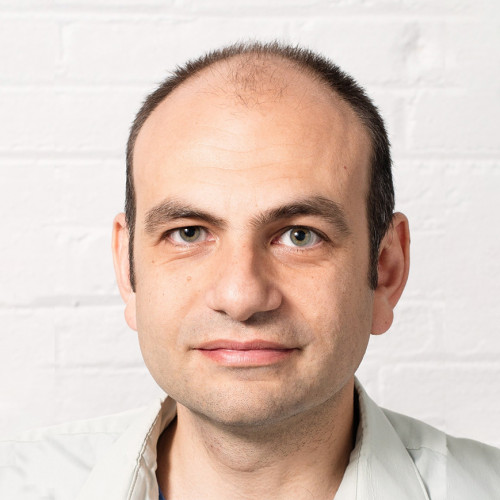
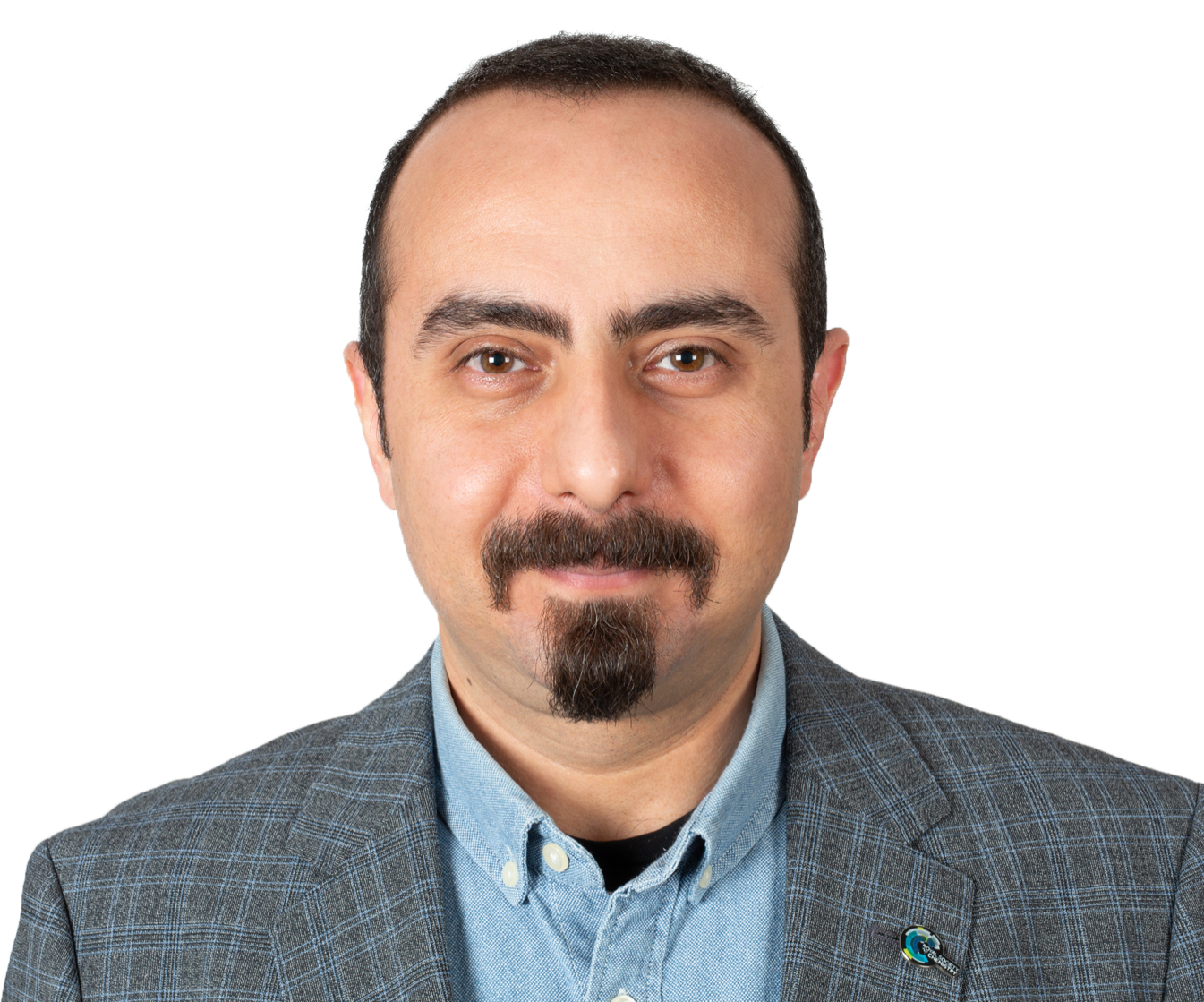
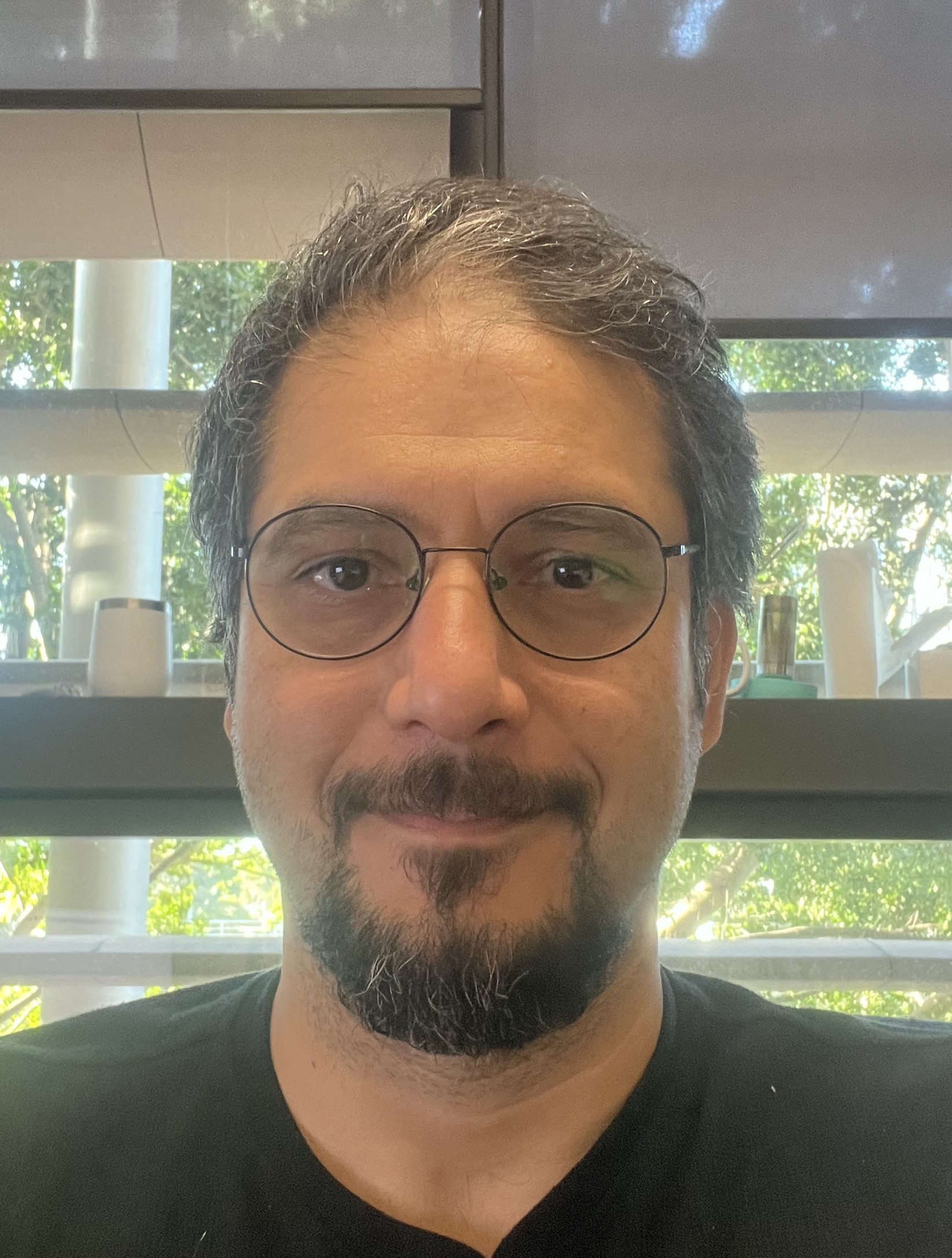
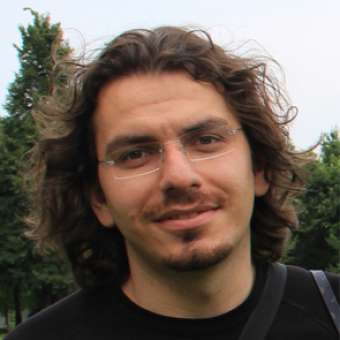
Ioannis (John) Kymissis is a Professor of Electrical Engineering at Columbia University, serving as Vice Dean of Infrastructure and Innovation and Chair of the Department of Electrical Engineering. He is the Kenneth Brayer Professor of Electrical Engineering and Co-Director of the Maker Space Facility. SB in Electrical Engineering and Computer Science, MIT (1998) M.Eng. in Electrical Engineering and Computer Science, MIT (1999) PhD in Electrical Engineering and Computer Science, MIT (2003) His research focuses on the application of thin film materials in novel electronic and optical systems. Key areas include organic semiconductors , piezoelectric materials , and recrystallized semiconductor materials , enabling devices for energy storage , medical sensors , and compact spectrometers . His group emphasizes interdisciplinary collaboration with chemists, physicists, and physicians to advance technologies in healthcare , environmental monitoring , and security . The work also integrates robotics , displays , and communication systems . NSF CAREER award IEEE EDS Paul Rappaport award Vodaphone Americas Foundation Wireless Innovation Award MIT Clean Energy Prize Verizon Powerful Answers award Kymissis has co-founded companies such as Chromation , Lumiode , and Radiator Labs to commercialize his research. He leads the Columbia Laboratory for Unconventional Electronics (CLUE) , which develops hybrid systems for sensing, energy conversion, and display technologies using low thermal budget fabrication and advanced characterization techniques like synchrotron x-ray studies .
Martin Sarott is a Postdoctoral Researcher in Complex Oxides at the University of Groningen, affiliated with the Zernike Institute for Advanced Materials and the Faculty of Science and Engineering. His research focuses on epitaxial ferroic thin films, domain configurations, optical control of ferroic order, and complex oxides for unconventional computing. He specializes in experimental techniques including pulsed laser deposition, nonlinear optics, X-ray diffraction, and advanced microscopy methods. His work addresses challenges in material synthesis, domain engineering, and device fabrication, with applications in next-generation electronics and energy-efficient systems. Notably, he explores strain effects on polar phases in WO3 thin films and optical manipulation of ferroelectric polarization states. Recent publications highlight contributions to understanding structure-property relationships in epitaxial systems, polar skyrmions, and novel diffraction strategies for hidden order detection. Sarott collaborates on projects involving 2D materials, plasmonic membranes, and quantum sensing for domain imaging. His experimental toolkit includes advanced lithography (photolithography, electron beam lithography) and in-situ characterization methods.
Shanshan Yao, PhD, is an ATS Assistant Teaching Professor in the Department of Civil and Environmental Engineering at the University of Alberta's Faculty of Engineering. She specializes in teaching and research focusing on unconventional resources, hydraulic fracturing, reservoir characterization, and drilling engineering. Her courses include PET E 275 (Petroleum Reservoir Fluids), PET E 364 (Drilling Engineering), and advanced reservoir and production engineering modules. Dr. Yao's research interests span pore-scale processes in porous media, pneumatic percussion drilling, and pumped storage hydropower systems. Her recent articles highlight contributions to proppant dynamics, fluid mechanics in fracturing, and optimization of drilling technologies. While no awards or grants are explicitly listed, her work reflects active engagement in petroleum engineering and reservoir science. She currently teaches across multiple terms, demonstrating a commitment to both education and applied research in energy systems.
Ronghao Cui is a Postdoctoral Fellow at the Department of Mathematics, University of Bergen, Norway, conducting advanced research in computational fluid dynamics within porous media systems. His work bridges petroleum engineering and environmental science through high-resolution modeling of nanoscale fluid behavior. His core research interests include porous media transport phenomena, multiphase fluid dynamics, computational pore-network modeling, molecular simulation techniques, interfacial chemistry in complex fluids, and nanofluidics applications. He specializes in simulating shale reservoir systems and clay mineral interactions using multiscale approaches that integrate molecular dynamics with continuum-scale principles. Analysis of his publication record reveals a concentrated focus on pore-scale mechanisms in unconventional reservoirs, with recent work emphasizing CO2-brine-silica interactions for carbon sequestration and ethanol-clay systems for enhanced recovery. His methodologies consistently combine Earth science principles with chemical engineering applications, demonstrating strong interdisciplinary connections between computational mathematics, petroleum engineering, and environmental fluid mechanics.
Neil Phillips is a Senior Research Fellow at the University of the West of England. His work focuses on unconventional solutions at the intersection of technology and environmental science. Department: Computer Science and Creative Technologies Research Interests: Phillips explores diverse fields such as unconventional computing, biomimicry, and sustainable development. His expertise spans technical domains like power electronics and control circuits, alongside environmental challenges including climate change and sustainable development. He also investigates niche areas like liquid marbles, slime, and citizen science. Additional Focus: His interdisciplinary approach combines TRIZ methodology with bio-sensing and high-temperature superconductors to innovate in energy systems and bio-reactor design.
Dr. Sabine Wurmehl is the head of the Department of Synthesis and Crystal Growth at the Leibniz Institute for Solid State and Materials Research Dresden (IFW Dresden), Germany. She has held this leadership position since 2015, overseeing research on functional intermetallic materials, unconventional superconductors, and frustrated magnetic systems. Prior to becoming department head, she led an Emmy Noether research group at IFW Dresden from 2010 to 2015. Her work bridges materials synthesis, crystal growth, and advanced physical characterization to understand structure-property relationships in quantum materials. Dr. Wurmehl received her chemistry education at the University of Mainz, Germany, earning her Diploma in 2002 and her Doctorate (Dr., summa cum laude) in 2006 under the supervision of Prof. C. Felser. Following her PhD, she conducted postdoctoral research at TU Eindhoven in the Netherlands (2007-2009) before returning to IFW Dresden as a postdoc (2009-2010). Her research focuses on the synthesis and characterization of quantum materials, particularly exploring the relationship between crystal structure and physical properties. She specializes in growing high-quality single crystals of complex materials including iron-based superconductors, Heusler compounds, and frustrated magnetic systems. Her work employs nuclear magnetic resonance spectroscopy to study ferromagnetic materials and other advanced characterization techniques to probe electronic and magnetic properties. Dr. Wurmehl has made significant contributions to understanding unconventional superconductivity, frustrated magnetism, and the physics of intermetallic compounds. Dr. Wurmehl's publication record demonstrates consistent leadership in condensed matter physics, with over 200 publications spanning two decades. Her recent work shows increasing focus on complex quantum materials, particularly iron-based superconductors and Heusler compounds, with emphasis on crystal growth techniques, structure-property relationships, and nematic phenomena. She has developed expertise in advanced characterization methods including ARPES, neutron scattering, and ultrafast spectroscopy to probe electronic structure and dynamics. IFW research award (2014) IFF research award of the IFW Dresden (2012) Emmy-Noether fellowship of the DFG (2010) Research fellowship of the DFG (Eindhoven, Netherlands) (2007) Dr. Wurmehl has supervised an extensive research group since 2010, mentoring 14 postdoctoral researchers, 14 PhD students, 8 diploma and master students, and 12 additional students. She has secured significant research funding through the Emmy-Noether program and other competitive grants, enabling her to establish a world-class crystal growth facility at IFW Dresden. Her group collaborates extensively with international partners, including institutions in the Netherlands, Poland, Japan, and the United States. At IFW Dresden, Dr. Wurmehl leads the Synthesis and Crystal Growth Department, which houses specialized facilities for growing high-quality single crystals of complex quantum materials. Her team employs various crystal growth techniques including the optical floating-zone method, flux growth, and solid-state synthesis to produce materials for fundamental research on superconductivity, magnetism, and topological phenomena. The department serves as a central resource for the Dresden physics community, providing high-quality crystals for numerous collaborative projects.
Assoc. Prof. Cina Foroutan-Nejad is affiliated with the Institute of Organic Chemistry, Polish Academy of Sciences , where they lead a research group focused on molecular electronics. Their academic rank as Associate Professor reflects their expertise in theoretical and computational chemistry. University: Institute of Organic Chemistry, Polish Academy of Sciences Academic Rank: Associate Professor Research interests include: Design of molecular devices for molecular electronics and in-memory processing Application of quantum chemical topology methods to analyze chemical bonds Theoretical studies on chemical reactivity and aromaticity Smart catalysis under external electric fields Recent publications highlight work on memristors , actinide compounds , and collective atomic interactions , with a focus on unconventional bonding and aromaticity. The group has secured funding through the NCN OPUS grant 2020/39/B/ST4/02022 for "Design of Functional Organic Memristors (DOOM)." PhD students under their supervision include Minu Sheeja and Muhammad Yasir Mehboob . The research team collaborates with scientists across disciplines, including computational chemists and experimentalists.
Jörg Schmalian is a Professor at the Karlsruhe Institute of Technology (KIT), where he leads the Institute for Theoretical Condensed Matter Physics (TKM) and heads the division Theory of Quantum Materials at the Institute for Quantum Materials and Technologies (IQMT). After 2011, he transitioned from a Full Professor role at Iowa State University and a Senior Scientist position at the DOE Ames Laboratory to KIT. His research focuses on strongly correlated electron systems, quantum criticality, and unconventional superconductivity in materials like kagome metals, altermagnets, and topological superconductors. His work bridges quantum field theory, statistical mechanics, and materials science, with notable contributions to electron hydrodynamics in graphene, nematic order in iron-based systems, and the Sachdev-Ye-Kitaev model. He has co-authored over 230 peer-reviewed articles and received accolades including the John Bardeen Prize and Physics-Award Dresden . Key Research Themes : Superconductivity without quasiparticles, quantum phase transitions, hydrodynamic transport, and non-equilibrium dynamics. Awards : Fellow of the American Physical Society 2022 John Bardeen Prize 2023 Physics-Award Dresden Teaching Awards at Iowa State and KIT Labs/Teams : Leads the Schmalian Group at KIT's TKM institute and the Theory of Quantum Materials division at IQMT.
Dr Alexandra ‘Ally’ Gormally-Sutton is Senior Lecturer in Subsurface and Society at Lancaster University’s Lancaster Environment Centre (LEC). She is a human geographer whose work bridges energy geographies, political geology and sustainability transitions, with an emerging focus on subsurface governance and speculative geologies. Ally leads or co-leads several multi-million-pound projects funded by EPSRC, ESRC and NERC, sits on the Management Board of the Supergen Energy Storage Network+, and is Project Lead for the NERC-funded Inclusive Natural Environment Futures initiative. Education: Ally completed her interdisciplinary PhD in 2013, funded by the UK Energy Research Centre, examining renewable energy potential in upland communities. Research interests: Her research interrogates the relationship between social processes and earth systems, especially the underground. Core themes include: Energy geographies and community energy Subsurface governance, pore-space politics and NetZero transitions Political geology, speculative volcanology and extreme energy futures Thermal comfort, digital technologies and invisible energy policies EDI in higher education and environmental disciplines Across 18 peer-reviewed outputs since 2011, her publications chart a trajectory from regional renewable resource assessments to critical interrogations of energy governance and the societal dimensions of the subsurface. Recent work (2022-2025) centres on social housing retrofits, groundwater governance in South Africa, post-pandemic coastal experiences, and thermal comfort policies in universities. Scientific awards & honours: Fellow of the Higher Education Academy (FHEA) Fellow of the Royal Geographical Society (RGS-IBG) Doctoral supervision & grants: Ally supervises 3 current PhD students (Rachael Glassey, Kathy New, Lydia Parsons) and has successfully completed 4 PhDs since 2019. She has been PI or Co-I on grants totalling >£2 million, including: EPSRC CREDS £1.6M (Co-I) ESRC-CASE studentship £75k (PI) NERC Opening Up The Environment 2025/26 (PI) EPSRC Supergen Energy Storage Network+ (Co-I 2019-2023) Labs, teams & outreach: As LEC’s academic lead for Athena SWAN (Silver award 2023), Ally champions equity, diversity and inclusion in Geography and Environmental Science, curating the LEC Voices blog series and leading initiatives to widen participation among minority ethnic students in the natural environment sector.
Professor Hamid Roshan is a faculty member at the School of Minerals and Energy Resources Engineering within the Faculty of Engineering at UNSW Sydney. He graduated with a PhD in Petroleum Geomechanics Engineering from UNSW Sydney in 2012, followed by 3.5 years of postdoctoral training in the School of Civil and Environmental Engineering. He was appointed to his current position in 2016 after gaining valuable industry experience with the Underground Gas Storage Company, where he worked on the Sarajeh field gas storage project. Professor Roshan's research spans multiphysics geomechanics and rock characterization, with applications across Mining, Civil, and Petroleum Engineering sectors. His work integrates theoretical, numerical, and experimental approaches to solve complex geomechanical problems. Since 2017, he has developed the advanced GeoEngineering Research Lab at UNSW, where next-generation equipment for coupled geomechanics-rock characterization has been designed and built, offering state-of-the-art services to industry. His research interests include THMC Experimental and Computational Modelling in CCUS, Coal Seam Gas and Shale Gas Engineering, Geophysics and Data-driven Rock Mass Characterization, Borehole Geotechnical Logging, In-situ Stress Measurement and Estimation, and Fundamentals of Rock Mechanics with a focus on Multiphysics Geomechanics. His recent publications demonstrate expertise in ultramafic rock interactions, geothermal energy storage, shale gas reservoirs, and advanced computational modeling techniques. Professor Roshan has developed and patented field-scale downhole logging tools for stress-mechanical property measurements along with software solutions for the mining industry. His work has practical applications in carbon sequestration, underground hydrogen storage, and unconventional gas extraction. Professional Recognition: American Rock Mechanics Association Future Leader Professional Memberships: Australian Geomechanics Society, International Society of Rock Mechanics, Society of Petroleum Engineers Professor Roshan teaches Petrophysics (PTRL2020), Formation Evaluation (PTRL5107), Integrated Oil and Gas Reservoir Evaluation (PTRL4010), and Geomechanics A, while actively seeking students with strong academic backgrounds for research opportunities.
Dr. İsmail AKTÜRK serves as an Assistant Professor in the Computer Science Department within Ozyegin University's Faculty of Engineering. Previously, he held an Assistant Professor position at the University of Missouri - Columbia's Department of Electrical Engineering and Computer Science for four years. His academic foundation includes a Ph.D. in Electrical and Computer Engineering from the University of Minnesota, Twin Cities. Education: Ph.D. in Electrical and Computer Engineering, University of Minnesota, Twin Cities, 2017 M.S. in Computer Engineering, Bilkent University, 2013 M.S. in Electrical Engineering, Louisiana State University, 2009 B.S. in Computer Engineering, Doğuş University, 2007 Dr. AKTÜRK's research centers on Computer Architecture with specialized expertise in brain-inspired computing and neuromorphic systems . He pioneers unconventional computing paradigms that integrate memory and processing units to eliminate energy-intensive data transfers inherent in traditional von Neumann architectures. His work employs hardware/software co-design methodologies to enhance energy efficiency for data-intensive applications like deep learning through spatial and temporal approximations. He directs the Computer Architecture and System Technologies Lab, where his research group develops application-specific systems exploiting novel devices and algorithmic advancements. Dr. AKTÜRK actively mentors graduate students in creating energy-efficient computing solutions for emerging computational challenges.
Darcy Bird is a Researcher at the University of Florida, affiliated with the Florida Museum of Natural History. He earned his PhD in Anthropology at Washington State University under Dr. Tim Kohler and collaborates with Dr. Nicolas Gauthier. Bird serves as Data Steward for the p3k14c global radiocarbon database, Liaison for the PEOPLE3000 Early Career Network, and a member of PAGES. His research integrates computational archaeology, socio-ecological systems, and paleodemography to study human population dynamics across millennia. Key themes include the Agricultural Demographic Transition, human-environment interactions in the American Southwest, and global analyses of population density. Bird's work employs large radiocarbon datasets, dendrochronology, and Bayesian modeling to evaluate stability, resilience, and collapse in prehistoric societies. Recent publications highlight Bird's interdisciplinary approach, spanning climate modeling with machine learning (2024) settlement persistence in the Mesa Verde region (2024) wealth inequality in prehispanic societies (2023) radiocarbon-database development (2022) landscape engineering impacts (2021) and global paleo-demographic trends (2020) . Bird's methodological contributions include synthesizing radiocarbon datasets, validating demographic proxies, and proposing frameworks for understanding population stability. His findings suggest agricultural societies, while stable under normal conditions, face vulnerabilities during rare environmental shocks, contrasting with the flexibility of hunter-gatherer systems. He also explores unconventional topics like space debris dynamics, reflecting broader interests in sustainability and collapse mechanisms.
Julia Wildeboer is a Researcher in the Condensed Matter Physics and Materials Science Department at Brookhaven National Laboratory . Her work bridges condensed matter theory , quantum information science , and computational physics , focusing on non-equilibrium quantum systems, topological phases, and quantum memory design. Ph.D. : Washington University in St. Louis (advisor: Prof. Alexander Seidel, Thesis: "Physics of Resonating Valence Bond Spin Liquids") M.Sc. : Technical University of Dresden, Germany Her research spans quantum many-body scars , topological order in 2D systems , quantum dimer models , and non-Abelian anyons . She develops exactly solvable models for unconventional quantum phenomena and investigates entanglement entropy as a probe of topology. Recent work explores quantum phase transitions in kagome metals and symmetry-protected quantum memory . Scientific contributions include designing novel quantum scars , solving sign-problems in Monte Carlo simulations , and proposing probes for topological order . Her publications highlight expertise in DMRG , exact diagonalization , and Monte Carlo methods . Contact: jwildeboe@bnl.gov .
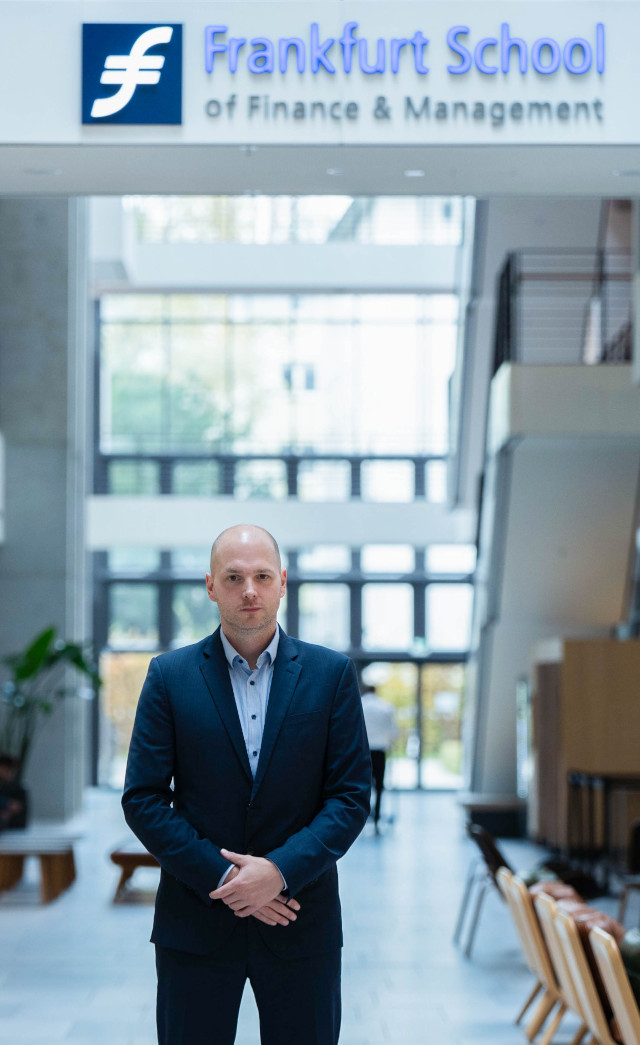
Co-Pierre Georg is a Professor at the Frankfurt School of Finance & Management and Director of the Frankfurt School Blockchain Center. His research spans financial technology, blockchain, systemic risk, and network theory. He previously held the DSI-NRF SARChI Chair in Blockchain Research at the University of Cape Town and worked at the Deutsche Bundesbank's Research Centre. Education: PhD in Economics (Friedrich Schiller University Jena), MSc (Karlsruhe Institute of Technology) Affiliations: Research Associate at Columbia University's Center for Global Legal Transformation and Oxford Martin School Research Interests: Georg specializes in financial networks, systemic risk, and regulatory complexity. He applies network theory to analyze contagion in banking systems, vaccine allocation during pandemics, and software vulnerability propagation. His interdisciplinary work bridges economics, computer science, and complex systems theory. Scientific Awards: No awards explicitly mentioned in the text. Advising: Georg has mentored numerous PhD students and postdocs including Changyeop Lee, Xueying Zhao, and Gideon du Rand. His advisees hold positions at institutions like Oxford, Groningen, and the Bank for International Settlements.
LUO Bin is an Assistant Professor in the Department of Ocean Science and Engineering at Southern University of Science and Technology (SUSTech), where he has been affiliated since 2022. He holds a Ph.D. in Geophysics from Texas A&M University (2018) and a B.S. in Geophysics from the University of Science and Technology of China (2013). Prior to his current position, he served as a Postdoctoral Scholar at Stanford University (2021-2022) and a Postdoctoral Fellow at Colorado School of Mines (2019-2021). Research Focus: Dr. Luo's research centers on earthquake physics and seismology, with specialized expertise in elastic wave propagation modeling, dynamic rupture simulation, and seismic cycle analysis. He pioneers applications of fiber-optic distributed acoustic sensing (DAS) technology for seismic monitoring in diverse environments including urban areas, submarine settings, and hydrocarbon reservoirs. His work integrates computational methods with field data analysis to advance understanding of seismic hazards and subsurface characterization. Publication Trends: His recent articles (2018-2022) demonstrate a strong focus on distributed acoustic sensing applications in microseismic monitoring, guided wave analysis, and seismic inversion techniques. Computational modeling of earthquake dynamics and fault mechanics constitutes another major thematic cluster, featuring advanced finite-element simulations of complex fault systems. Honors and Awards: 2022: Honorable Mention for Best Paper (Geophysics Journal) 2022: Top 25 Presenter at SEG Annual Meeting (IMAGE Conference) 2021: Honorable Mention for Best Paper (The Leading Edge) 2013: Departmental Fellowship (Texas A&M University) Professional Activities: Serves as peer reviewer for leading geophysics journals including Geophysics , Geophysical Research Letters , and Journal of Geophysical Research , contributing to scholarly quality control in seismology and exploration geophysics.