Glenn Harvel is an Adjunct Associate Professor in the Department of Engineering Physics at McMaster University. His research spans nuclear engineering, thermal hydraulics, neutron radiography, and supercritical fluid dynamics, with a focus on reactor safety, decommissioning, and advanced cooling systems. Research Interests: His work integrates experimental and computational approaches to address challenges in nuclear technology. Key areas include: Thermal-hydraulic behavior of supercritical fluids in reactor cores Neutron radiography for non-invasive flow measurement Electrohydrodynamic applications in plasma-based systems Machine learning for nuclear maintenance optimization Small modular reactor (SMR) deployment for remote communities Publication Trends: Recent articles emphasize data-driven methods for nuclear maintenance, SMR feasibility studies, and decontamination tool development. Earlier work focused on experimental characterization of heat transfer fluids and CFD validation for supercritical water systems. Labs and Teams: Implied collaboration through conference papers and multidisciplinary topics (e.g., plasma physics, materials science, AI), though no specific labs or teams are named.
Gregory Beaune is a Research Fellow at Aalto University's Department of Applied Physics within the College of Science. His work spans interdisciplinary areas of Materials Science, Biophysics, and Chemical Biology, focusing on bioinspired materials engineering and active matter systems. Research highlights: Developed hydrophobin-coated microbubbles for tumor cell targeting (2025) Investigated protein condensates and silk-based biomaterials Explored ferrofluid-based bioinks for 3D muscle tissue printing Studied vesicle dynamics and droplet splitting mechanisms Key collaborations include researchers like Jaakko V.I. Timonen, Françoise Brochard-Wyart, and Robin H.A. Ras. His work integrates synthetic biology with materials design, emphasizing functional nanosystems and soft matter physics.
Coty Jen is an Assistant Professor in the Department of Chemical Engineering at Carnegie Mellon University. She is a prominent researcher in atmospheric aerosol science and a member of the Center for Atmospheric Particle Studies (CAPS), where her work focuses on understanding how chemical composition and physical properties of atmospheric aerosol particles influence air quality and climate. Education: Ph.D. in Mechanical Engineering, University of Minnesota, Twin Cities, 2015 M.S. in Chemical Engineering, University of Minnesota, Twin Cities, 2013 B.S. in Chemical Engineering, Columbia University, 2010 Postdoc in Environmental Science, Policy, and Management, University of California, Berkeley, 2018 Professor Jen's research program centers on atmospheric aerosol science, with emphasis on disentangling the chemical complexity of the atmosphere through innovative measurement techniques and model development. Her group specializes in designing instruments to measure physical characteristics and molecular composition of atmospheric particles from molecular clusters to 2.5 µm diameter. This work is critical for predicting how human activities will alter air quality over coming decades, as atmospheric nucleation produces approximately 50% of global cloud condensation nuclei. Analysis of Jen's publication record reveals consistent focus on atmospheric nucleation mechanisms, particularly sulfuric acid-amine interactions, wildfire emissions characterization, and nanoparticle instrumentation development. Her interdisciplinary research bridges atmospheric chemistry, environmental engineering, and analytical chemistry, with significant contributions to understanding particle formation pathways under various atmospheric conditions. Scientific Awards: American Association for Aerosol Research Sheldon K. Friedlander Award, 2018 National Science Foundation AGS Postdoctoral Fellowship, 2015-2017 University of Minnesota Twin Cities Best Dissertation Award (Honorable Mention), 2016 University of Minnesota Twin Cities Dissertation Fellowship, 2014-2015 National Science Foundation Graduate Research Fellowship, 2011-2014 Achievement Rewards for College Scientists Scholarship, 2010-2012 Professor Jen currently leads the Jen Research Lab, which is actively recruiting undergraduate and graduate students. Her research is funded by the National Science Foundation (NSF AGS Atmospheric Chemistry) and the Department of Energy (DOE Atmospheric System Research). The lab focuses on three main areas: nanoparticle instrumentation development, atmospheric nucleation kinetics & growth modeling, and organic nitrogen speciation in the atmosphere. The Jen Research Lab operates within the Center for Atmospheric Particle Studies (CAPS) at Carnegie Mellon University, taking a holistic approach to characterizing atmospheric nanoparticles. They examine the complete life cycle of aerosol particles, from formation through growth to their ultimate impacts on air quality and climate. The lab specializes in designing nanoparticle sizers, counters, and chemical speciation instruments to advance understanding of atmospheric particle dynamics.
Seungjin Kim serves as the Capt. James McCarthy, Jr. and Cheryl E. McCarthy Head of Nuclear Engineering and Professor of Nuclear Engineering at Purdue University's College of Engineering. His research focuses on advanced nuclear reactor technologies, thermal-hydraulic systems, and computational fluid dynamics (CFD) modeling. Key areas include two-phase flow phenomena in nuclear systems, reactor safety, and experimental validation of reactor components. He leads efforts in developing testing facilities for fast reactors and innovative irradiation environments. Kim's work emphasizes experimental and numerical analysis of multiphase flows, particularly in complex geometries like rod bundles and elbows. He has contributed to scaling analysis for sodium cartridge loops and LBE (lead-bismuth eutectic) systems, advancing reactor design and safety. His expertise extends to jet impingement in high-energy piping and interfacial area transport modeling, with applications in reactor core simulation and thermal management. His research has been published extensively in top-tier journals, covering topics such as pressure drop in wire-wrapped rod bundles, CFD validation for reactor loops, and bubble dynamics in horizontal flows. Collaborations involve developing correlations for reactor core power estimation and improving safety guidelines for high-energy fluid systems.
Mamoru Ishii is the Walter Zinn Distinguished Professor of Nuclear Engineering at Purdue University's College of Engineering. His research focuses on two-phase flow modeling, reactor safety systems, and multiphase flow phenomena with applications in nuclear reactor design and cryogenic systems. He holds a Ph.D. from Georgia Institute of Technology and has been a Fellow of the American Nuclear Society since 2021. Education: Ph.D. Mechanical Engineering, Georgia Institute of Technology, 1971 M.S. Mechanical Engineering, New York University, 1968 B.S. Mechanical Engineering, Yokohama National University, 1966 His research interests span two-phase flow experiments, 3-D two-fluid models, interfacial transfer phenomena, severe accident analysis, and advanced light water reactor safety codes. He has pioneered instrumentation development for multiphase flow characterization, including conductivity probes and neural network-based analysis tools. Recent work emphasizes cryogenic propellant tank behavior modeling, stochastic interfacial area predictions using reinforcement learning, and flow instability analysis in natural circulation systems. His studies often combine CFD simulations with experimental validation in facilities like the Versatile Test Reactor Sodium Cartridge Loop. Awards: Fellow, American Nuclear Society (ANS) Honorary Member, Japanese Society of Multiphase Flow Advising activity includes leading a research group focused on thermal-hydraulics and multiphase flow instrumentation, with contributions to reactor safety codes like RELAP5. His lab develops advanced sensors and computational frameworks for nuclear systems analysis.
Davide Ziviani is an Associate Professor of Mechanical Engineering and Associate Director of the Center for High Performance Buildings at Purdue University. He holds a Ph.D. from Ghent University (2017), M.S. and B.S. from the University of Ferrara (2011 and 2008). His research focuses on advanced heat pumps, deep space habitats, and thermal management systems, with applications in sustainable energy and high-performance buildings. He leads the Ziviani Research Group and collaborates with institutions like ASHRAE, the International Institute of Refrigeration (IIR), and the Resilient Extra Terrestrial Habitats Institute. Key roles include Chair of ASHRAE TC 8.1 and TC 8.11, and member of IIR Commission B2. He has secured grants from the U.S. DOE, Bechtel Corporation, and DoD, advancing projects like electrochemical looping heat pumps and battlefield air conditioning systems. Notable recognitions include the 2023 ASHRAE New Investigator Award and multiple teaching accolades. Ziviani’s work bridges fundamental thermodynamics with applied engineering, addressing challenges in space habitats, industrial heat pumps, and energy-efficient buildings. His research integrates computational modeling, experimental validation, and interdisciplinary collaboration, aiming to enhance sustainability and resilience in built and extraterrestrial environments.
Riley Barta is an Assistant Professor of Mechanical Engineering at Purdue University’s Ray W. Herrick Laboratories. His research focuses on thermal systems technology, particularly the characterization and implementation of environmentally-friendly working fluids. He leads the Barta Research Group, which explores energy efficiency in heat pumps, refrigeration systems, and waste heat recovery. Previously, he held the Schaufler Chair for Refrigeration, Cryogenics, and Compressor Technology at TU Dresden, Germany, where he conducted experimental and numerical studies on vapor compression systems. Dr. Barta earned his B.S. and Ph.D. in Mechanical Engineering from Purdue University. Education: B.S. and Ph.D. in Mechanical Engineering (Purdue University, 2016 and 2020 respectively). Research Interests: Thermal systems, low-GWP refrigerants, heat pumps, refrigerant-lubricant interactions, and sustainable energy solutions. His work spans system-level design, component analysis, and fluid property characterization. Awards: Recipient of the ASHRAE New Investigator Award, DKV Young Talent Award, Alexander von Humboldt Fellowship, Perry Teaching Fellowship, and ASHRAE Grant-in-Aid. Advising & Grants: Supervises graduate students (e.g., Ganesh Venkatesan, Joshua Cox) and undergraduate researchers. Active in projects like the Indiana Digital Crossroads initiative and collaborations with industry partners. Teaches Thermodynamics courses (ME200, ME300, ME500) and the International Refrigeration and Compressor Course (IRCC). Labs/Teams: Principal Investigator at the Barta Research Group and affiliated with the Center for High Performance Buildings. Collaborates internationally, including with TU Dresden and the University of Kassel.
Kazuki Maeda is an Assistant Professor in the School of Aeronautics and Astronautics at Purdue University. He holds a Ph.D. from the California Institute of Technology (2018), an M.S. from Caltech (2014), and a B.S. from The University of Tokyo (2013). His research focuses on complex flow dynamics, rocket propulsion, hypersonics, and cyberphysical integration, combining physics-based modeling, high-performance computing, and machine learning. He leads the Maeda Research Group, which develops advanced frameworks for simulating and optimizing engineering systems. Key awards include the Richard Bruce Chapman Memorial Award and Stanford-CTR Postdoctoral Fellowship. Research interests emphasize propulsion systems, high-speed flows, and computational methods. Publications span bubble dynamics, reactive shock waves, and neural network applications in flow analysis. The group collaborates on heterogeneous computing frameworks for combustion and fluid dynamics simulations. Prospective students and postdocs are encouraged to apply through Purdue’s AAE programs. Awards: Richard Bruce Chapman Memorial Award, Funai Foundation Scholarship, Stanford-CTR Fellowship Labs/Teams: Maeda Research Group (Complex Flow & Cyber-physical Laboratory) Grants: Not explicitly listed, but research is supported by institutional and collaborative initiatives.
Tom Shih is a Professor of Aeronautics and Astronautics at Purdue University's School of Aeronautics and Astronautics since 2009. He holds degrees from National Cheng Kung University (B.S.E., 1976), University of Michigan (M.S.E., 1977; Ph.D., 1981). His research focuses on computational fluid dynamics, thermal management, and gas turbine aero-thermal systems. He serves as Editor-in-Chief of the AIAA Journal and chairs multiple professional committees. Education: B.S.E., National Cheng Kung University, 1976 M.S.E., University of Michigan, 1977 Ph.D., University of Michigan, 1981 Research Interests: Computational fluid dynamics (CFD), thermal management systems, gas turbine aerothermal analysis, shock-wave/boundary-layer interactions, aircraft icing mechanisms, and advanced cooling technologies for aerospace applications. Key Publications Trends: Recent work emphasizes hybrid LES/RANS modeling, film cooling optimization, and thermal management in rotating systems. Studies often bridge CFD methodology with experimental validation in turbine cooling and heat transfer. Awards: Fellowships: ASME (200?), AIAA (200?) Ralph R. Teetor Award (SAE, 1986) AIAA Energy Systems Award (2015) AIAA Thermophysics Award (2020) Grants & Advising: Advises on turbine cooling projects. Leads editorial efforts at AIAA Journal. Active in professional societies including AIAA Terrestrial Energy Systems Technical Committee and ASME IGTI K-14 Committee. Labs/Teams: Engaged in Purdue's aerothermodynamics research group, collaborating on turbine cooling and CFD methodology advancements.
Amanda Young is an Assistant Professor in the Department of Mathematics at the University of Illinois Urbana-Champaign (UIUC), part of the College of Liberal Arts & Sciences. She is also a member of the Illinois Quantum Information Science and Technology Center (IQUIST). Her research focuses on mathematical physics, particularly the classification of quantum phases of matter, with an emphasis on spectral and dynamical properties of quantum lattice models. Young earned her PhD in Mathematics from the University of California, Davis in 2016. Prior to joining UIUC, she held postdoctoral positions at the University of Arizona (2016–2019) and a joint appointment at the Munich Center for Quantum Science and Technology and the Technical University of Munich (2019–2023). Her research interests include analysis, mathematical physics, and applied mathematics. Specific topics encompass proving spectral gaps in quantum lattice models, developing analytical methods for quantum phases, and studying quasi-locality estimates. Notable areas of exploration involve decorated AKLT models, fractional quantum Hall systems, and bulk-edge correspondence in condensed matter physics. Her recent publications highlight contributions to understanding spectral gap stability, topological order in quantum systems, and the interplay between edge states and bulk properties. Young’s work bridges theoretical mathematics and quantum information science, leveraging advanced analytical techniques to address foundational questions in quantum many-body systems. While no formal advisees are listed, her academic trajectory reflects sustained engagement with postdoctoral research and collaborative projects. Her affiliation with IQUIST underscores her involvement in interdisciplinary quantum initiatives and cutting-edge research in quantum science.
Laura Schaefer is the Burton J. and Ann M. McMurtry Chair in Engineering and Professor of Mechanical Engineering at Rice University's George R. Brown School of Engineering. She joined Rice in 2015 after serving as faculty at the University of Pittsburgh from 2000–2015, where she held roles including Deputy Director of the Mascaro Center for Sustainable Innovation and Associate Director of the Center for Energy. Her research focuses on energy systems optimization, sustainability, and thermofluid modeling, with $11M+ in funding from NSF, AFOSR, and others. Education includes a B.S./B.A. in Mechanical Engineering/English from Rice (1995) and M.S./Ph.D. in Mechanical Engineering from Georgia Tech (1997/2000). She has held visiting roles at Imperial College London (2011–2012) and serves as Editor-in-Chief of Sustainable Energy Technologies and Assessments . Awards include NSF Career Award and ASHRAE recognition, alongside ASME Fellowship. Research spans energy efficiency, solar-thermal integration, and advanced heat transfer techniques. She leads the Energy Systems Lab at Rice, emphasizing interdisciplinary approaches to sustainable energy challenges. Her work combines computational methods (e.g., lattice Boltzmann modeling) with real-world applications in renewable energy systems, heat pumps, and thermal storage. Key grants and projects include NSF-funded studies on hybrid energy systems and ASHRAE-supported innovations. She collaborates on dynamic life cycle assessments for buildings and has pioneered smart insulation technologies. Her portfolio reflects a balance between fundamental science and societal/environmental impact.
Filip Moortgat is a Voluntary Visiting Professor at Ghent University's Faculty of Sciences, Department of Physics and Astronomy. His research focuses on experimental particle physics at the energy frontier, particularly through involvement with the CMS experiment at CERN's Large Hadron Collider. He supervises multiple PhD students investigating fundamental particle phenomena including searches for long-lived particles, heavy neutral leptons, and physics beyond the Standard Model. Moortgat's research interests span elementary particle physics, high-energy collisions, and precision measurements of Standard Model processes. His group specializes in searches for exotic particles and phenomena including: Heavy neutral leptons and long-lived particle signatures Top quark physics and rare decay processes Supersymmetry and exotic Higgs boson decays Beyond-Standard-Model physics at energy and intensity frontiers Development of machine learning techniques for particle identification His recent publications primarily explore LHC Run 2 data analysis, focusing on precision measurements of Standard Model processes and searches for new physics. Common themes include top quark physics, Higgs boson characterization, heavy neutral leptons, and supersymmetric extensions. The research shows consistent emphasis on developing advanced analysis techniques for rare process identification. Moortgat currently supervises four PhD students working on projects including: Search for new physics using LHC data (Maarten De Coen) Measurements of rare processes with top quarks (Luka Lambrecht) Search for long-lived heavy neutral leptons (Basile Vermassen) Searches for undiscovered processes using multilepton final states (Willem Verbeke) His research group collaborates extensively within the CMS collaboration, contributing to detector operations and physics analysis across multiple working groups focused on beyond-Standard-Model physics and long-lived particle searches.
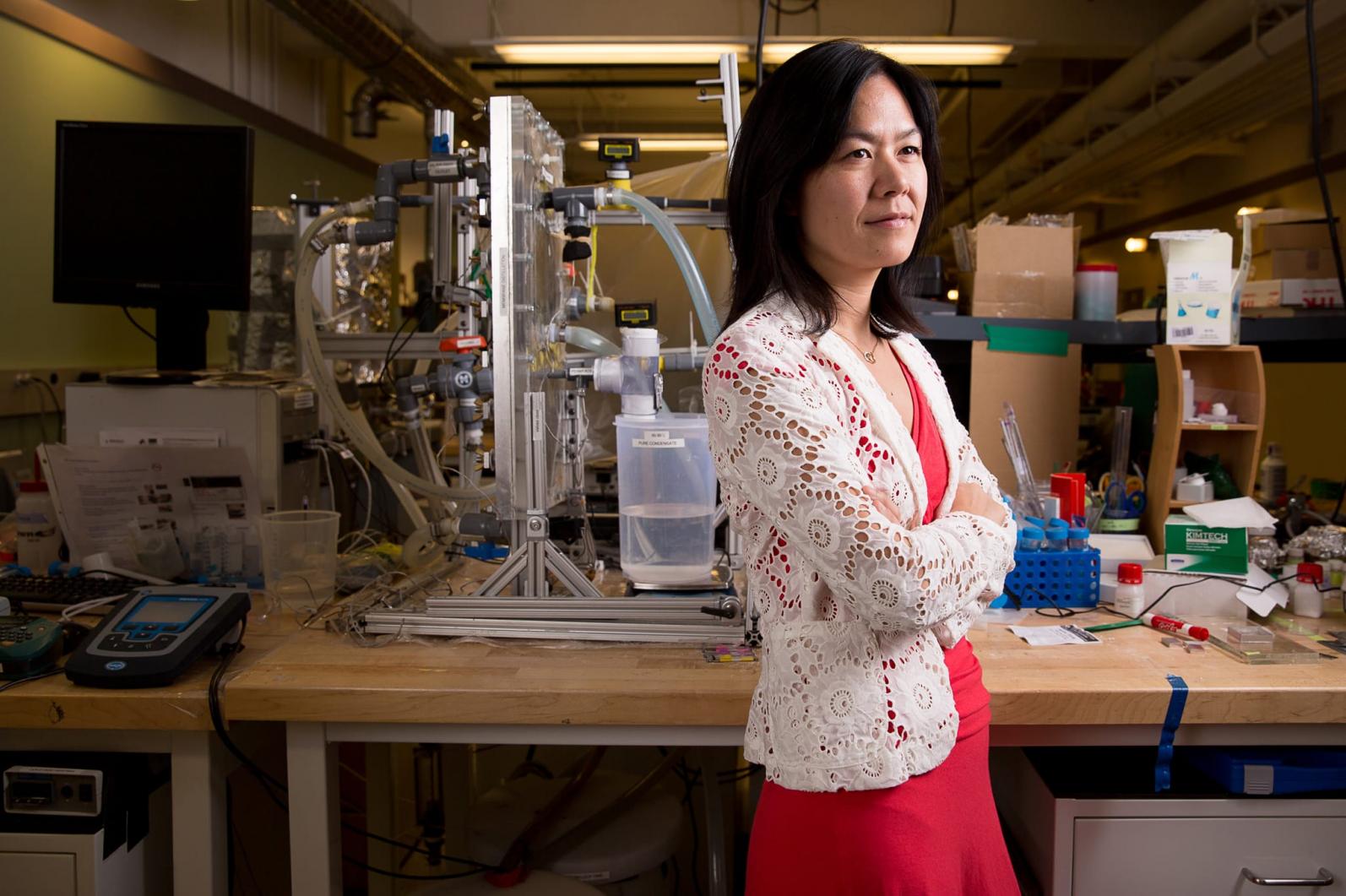
Evelyn N. Wang serves as Vice President for Energy and Climate and Professor of Mechanical Engineering at the Massachusetts Institute of Technology, where she has been Department Head since 2018. Her leadership extends to the Device Research Lab (DRL), focusing on energy and water challenges through fundamental heat and mass transport research. Her educational background includes a B.Eng from MIT (2000), M.Sc (2001), and Ph.D. (2006) from Stanford University. Wang's research centers on thermal management systems, nanoengineered materials for energy conversion, and atmospheric water harvesting technologies that operate in arid conditions. Her work bridges fundamental nanoscale phenomena with practical devices for global sustainability challenges. Wang's publication portfolio demonstrates consistent innovation in phase-change heat transfer and water technologies, with recent focus shifting toward scalable atmospheric water harvesting systems and solar thermal desalination. Her 2018 Nature Communications paper on adsorption-based water harvesting represents a significant advancement for arid climate applications. Member of National Academy of Engineering (2025) American Academy of Arts and Sciences Fellow (2023) Highly Cited Researcher by Clarivate (2022) AAAS Fellow (2021) ASME Gustus L. Larson Memorial Award (2017) As Department Head, Wang mentors numerous graduate researchers including Yang Zhong (Forbes 30 Under 30 2025) and Lenan Zhang, who have developed award-winning water desalination systems. Her lab receives substantial funding from ARPA-E and NSF, including leadership of the Solid State Solar Thermal Energy Conversion Center (2013-2018). Current projects focus on carbon-nanotube electrodes for energy storage and solar-powered atmospheric water harvesters. The Device Research Lab operates under Wang's direction with four primary research thrusts: phase-change systems, solar thermal conversion, advanced thermal management, and atmospheric water technologies. Recent lab achievements include ultrathin nanoporous membrane evaporators and jumping-droplet enhanced condensation systems that have attracted significant media attention including CNN coverage for World Water Day 2024.
Professor Ramesh Narayanaswamy is a faculty member at Curtin University's School of Civil and Mechanical Engineering, serving as Deputy Head of School and holding a position in the Office of the Provost. He holds academic qualifications including B.Tech, MS, and PhD from IIT Madras. His teaching focuses on Applied Fluid Mechanics, Heat Transfer, and Measurement Science and Technology. His research interests span Heat Transfer and Fluid Dynamics, with a focus on jet impingement, phase change phenomena, and thermal system optimization. Research highlights include investigations into turbulent boundary layer dynamics, droplet impingement heat transfer, and pulsating jet boiling. Over 30 publications since 2001 reflect contributions to experimental and computational fluid dynamics, heat transfer analysis, and thermal system design. Collaborations include work at institutions like IIT Madras, the University of Western Australia, and international conferences such as the Symposium on Fluid-Structure-Sound Interactions. No scientific awards are explicitly mentioned in the profile. His professional roles extend to academic administration and research supervision, though specific advising or grant details are not detailed here. His work contributes to advancing fluid mechanics and thermal engineering through rigorous experimental and numerical studies.
Dr. Nima Nadim is a Senior Lecturer in Curtin University's School of Civil and Mechanical Engineering, specializing in multiphase heat transfer and advanced thermal systems. His research develops computational and experimental methods for energy systems, including thermal storage reactors, laser-assisted manufacturing, and microscale thermal management. Core research areas: Multiphase heat transfer in turbulent boundary layers High-temperature thermal energy storage systems Phase-change material applications Computational fluid dynamics methodologies Laser-material interactions in manufacturing Publications show 40% focus on energy storage, 30% on multiphase flow, and 30% on computational methods. Professional honors include FHEA fellowship and CPEng certification.