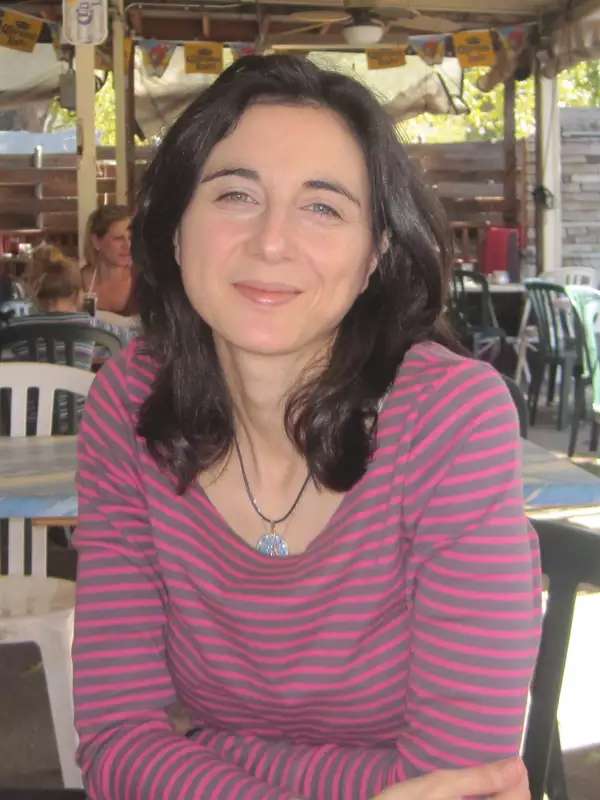
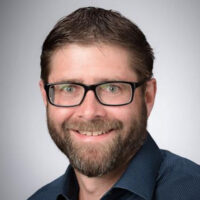
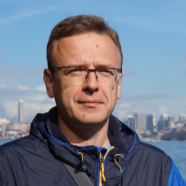
Daniela De Silva is the Olin Professor of Mathematics and Chair of the Department of Mathematics at Barnard College, Columbia University. She holds a B.A. from the University of Naples Federico II and a Ph.D. from the Massachusetts Institute of Technology (MIT). Her research focuses on partial differential equations (PDEs), particularly free boundary problems and geometric analysis. She teaches advanced courses such as Calculus and Analysis at Barnard and organizes the Geometry and Analysis seminar at Columbia University. Her work explores regularity theory for free boundaries, phase transitions, and harmonic analysis. Notably, her contributions include studies on energy-minimizing free boundaries and monotonicity formulas. De Silva has also contributed to nonlinear Schrödinger equations and has held academic positions at institutions like Johns Hopkins University and MIT before joining Barnard in 2007. Her research interests span theoretical and applied aspects of PDEs, with a focus on geometric implications and singularities. While her work has been featured in prestigious journals like Comm. on Pure and Applied Math , Duke Math. J. , and Indiana Univ. Math. J. , she remains active in academic outreach, including discussions on topics like the mathematics of melting ice and the significance of π in popular media.
Prof. Patrick Jenny is a Full Professor at the Department of Mechanical and Process Engineering and Head of the Institute of Fluid Dynamics at ETH Zurich. His research focuses on computational fluid dynamics (CFD), numerical methods for turbulent and multiphase flows, and reservoir simulation. He has held positions at ChevronTexaco and Cornell University, and received the National Latsis Prize 2005. PhD in CFD from ETH Zurich (1997) Postdoctoral work at Cornell University (1997–1999) Senior Researcher at ChevronTexaco (1999–2003) Research interests include: turbulent reactive flows, PDF modeling, multi-scale reservoir simulation, and data assimilation in engineering systems. He teaches courses on fluid dynamics, turbulence, and computational methods. Over 100 peer-reviewed publications span topics like fracture modeling, LES/RANS coupling, and particle-laden flows. His work bridges academia and industry, addressing challenges in energy systems, environmental engineering, and numerical algorithms. Winner: National Latsis Prize 2005 Led over 20 PhD projects and collaborates with institutions globally. His lab develops open-source tools for CFD and energy systems analysis.
Lorenzo Cremaschi is an Associate Professor in the Department of Mechanical Engineering at Auburn University, where he leads the High Performance Scalable Building Energy Systems and Technologies (HPS-BEST) Laboratory. His research focuses on enhancing energy efficiency in buildings and transportation systems through advanced thermal-fluid technologies. Education Ph.D. Mechanical Engineering, University of Maryland M.S. Mechanical Engineering, University of Modena and Reggio Emilia B.S. Mechanical Engineering, University of Modena and Reggio Emilia Research Focus Dr. Cremaschi's research encompasses energy efficiency, scalable energy systems, and advanced heat/mass transfer processes. His laboratory investigates refrigeration systems, low-GWP refrigerants, frost/defrost phenomena, and novel dehumidification technologies. Current projects examine electrospray-enhanced heat exchangers, two-phase flow dynamics, and spray evaporation in HVAC systems. Research Output Recent publications demonstrate strong focus on thermal-fluid phenomena in energy systems, including experimental and numerical studies of two-phase flow, refrigerant performance, frost formation dynamics, and novel dehumidification technologies. Emerging themes include electrospray applications, low-GWP refrigerants, and system optimization for sustainable HVAC. Funding and Recognition Recipient of $150,000+ grant from ASHRAE for climate lab research Laboratory Leadership The HPS-BEST Laboratory under Dr. Cremaschi's direction collaborates with national laboratories and industry partners to develop scalable energy solutions. The lab specializes in experimental analysis of heat transfer fluids, phase-change processes, and system performance optimization for refrigeration and HVAC applications.
Kan Wu is an Associate Professor in the Harold Vance Department of Petroleum Engineering at Texas A&M University, part of the College of Engineering. He holds the Class of ’75 DVG Associate Professorship and is a Chancellor EDGES Fellow. His research focuses on advanced modeling techniques for subsurface systems, including data interpretation of fiber optic sensing, hydraulic fracture optimization, and carbon storage monitoring. He earned his Ph.D. from the University of Texas at Austin and degrees from China University of Petroleum (East). Education : Ph.D., Petroleum Engineering, University of Texas at Austin M.S., Petroleum Engineering, China University of Petroleum (East) B.S., Petroleum Engineering, China University of Petroleum (East) Research Highlights : Dr. Wu’s work bridges physics-based and data-driven approaches, addressing challenges in fracture propagation, subsurface monitoring, and multi-scale modeling. His team develops real-time data interpretation tools for distributed fiber optic measurements and investigates fracture interactions in unconventional reservoirs. Key Awards : 2024: Completions Optimization and Technology Award (SPE Gulf Coast) 2023: Best of Paper Award (URTEC) 2023: Karen E. Olson & Louis H. Turner Research Award Grants & Leadership : He leads the Advanced Geomechanics Fracture & Reservoir Application Consortium (AGFRAC), focusing on subsurface engineering systems. His Chevron Corporation Faculty Fellowship (2017–2022) supported collaborative industry research. Office: RICH 501Q.
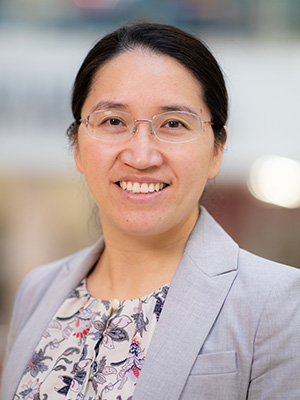
Jungeun (Jenny) Won is an Assistant Professor of Research in the Department of Biomedical Engineering at the School of Engineering and Applied Sciences, University at Buffalo. Her research focuses on optical imaging , biomedical device development , medical image analysis , and artificial intelligence in OCT . She leads the Translational Biophotonics Laboratory , where she develops advanced OCT techniques for medical applications such as diabetic retinopathy , otitis media , and biofilm analysis . Contact: 215J Bonner Hall, Buffalo NY 14260, jungeunw@buffalo.edu Related Links: CV PDF , Google Scholar , Lab Website Her recent work involves high-resolution OCT for longitudinal studies on retinal degeneration, VISTA OCTA for blood flow analysis, and 3D motion correction algorithms to enhance image quality. She also explores multimodal imaging combining OCT with Raman spectroscopy for bacterial differentiation and microplasma-based therapies for ear infections.
Professor Dinos Arcoumanis FREng is a distinguished academic at City, University of London, where he has served as Professor since 2000. He previously held academic positions at Imperial College London from 1988-2000, progressing from Lecturer to Reader and ultimately to Professor of Internal Combustion Engines. At City University, he has held significant leadership roles including Head of the Aeronautical, Civil and Mechanical Engineering Department, Dean of the School of Engineering & Mathematical Sciences, Pro-Vice-Chancellor for Research and International Links, and Deputy Vice-Chancellor (Research & International) until August 2014. He remains actively involved in research and academic leadership, currently serving as Director of the International Institute of Cavitation Research and Coordinator of the World Cities World Class (WC2) University Network. Professor Arcoumanis holds undergraduate and graduate degrees in Physics, Engineering and Mechanical Engineering from the Aristotelian University of Thessaloniki, Greece (1973), the University of California at Irvine, USA (1980), and the Imperial College of Science, Technology and Medicine, London (1984), respectively. His primary research focuses on internal combustion engines, with specific expertise in combustion, exhaust emissions, and engine lubrication. Professor Arcoumanis has pioneered the application of laser diagnostics and computational fluid dynamics to study internal combustion engines, with particular interest in automotive fuels including renewable and alternative fuels. His work bridges fundamental fluid mechanics with practical engine applications, addressing critical environmental engineering challenges in the transportation sector. His recent research has expanded into cavitation phenomena, fuel cell technology, and the development of sustainable propulsion systems for future transportation needs. Professor Arcoumanis's extensive publication record demonstrates a clear evolution in research focus, beginning with fundamental studies of diesel engine combustion and progressing toward advanced fuel injection systems, alternative fuels, and environmental sustainability. His work consistently bridges theoretical fluid mechanics with practical engine applications, with recent emphasis on cavitation phenomena in fuel systems and the integration of renewable energy technologies with traditional combustion systems. The interdisciplinary nature of his research connects mechanical engineering principles with environmental science, materials science, and energy systems engineering. Professor Arcoumanis has received numerous prestigious awards and honors throughout his career: 1991 Dugald Clerk Prize of IMechE 1995 and 1998 Arch T. Colwell Merit Award of the Society of Automotive Engineers Elected Fellow of the Royal Academy of Engineering (FREng) in 2001 Honorary doctorate from St. Petersburg State Polytechnic University of Russia (2009) Professor Arcoumanis has made significant contributions to academic leadership and professional service. He founded the International Journal of Engine Research (JER) in 1999 and serves as its Editor for Europe. He has coordinated the World Cities World Class (WC2) University Network since 2010, which brings together international institutions in major cities to address research challenges in transport, global health, business, and cultural industries. He has also served as a consultant to Brussels (DG17) and Bechtel Ltd. on the Auto-oil II European Programme (1998-2000), and was appointed Ambassador-at-Large of the Hellenic Republic for Energy Policy and New Technologies in September 2012. His research has been supported by various funding bodies including the Lloyd's Register Educational Trust, which funds the International Institute of Cavitation Research that he directs. Professor Arcoumanis leads the International Institute of Cavitation Research, a partnership between City University London, Loughborough University, and Delft University of the Netherlands. He has established collaborative research teams focused on engine combustion, fuel injection systems, and alternative propulsion technologies. His research group has developed advanced experimental facilities for studying fuel spray dynamics, combustion processes, and cavitation phenomena in engine systems. These teams regularly collaborate with automotive industry partners and international research institutions to address cutting-edge challenges in engine technology and sustainable transportation.
Aniket Ambekar is a Research Fellow at the Department of Chemical Engineering and Chemistry, Eindhoven University of Technology. His research focuses on multiphase flow dynamics in porous media, with expertise in computational fluid dynamics (CFD) and experimental validation techniques. He holds a PhD in Chemical Engineering from the Indian Institute of Technology Delhi (2022), an MSc in Computational Fluid Dynamics from National Institute of Technology (2016), and a BSc in Chemical Technology from the University of Pune (2013). Research interests include packed bed hydrodynamics, gas-liquid flow mechanisms, and the role of wettability in two-phase systems. His work combines high-resolution simulations (e.g., volume-of-fluid method) with experimental measurements to study flow regimes, interfacial dynamics, and phase distribution. Notable contributions address perforation effects in structured packings, particle aspect ratio impacts, and monolith gas-liquid interactions. He has received prestigious awards including the Marie Skłodowska-Curie postdoctoral fellowship (2022) and the Outstanding Ph.D. Thesis Award (2024). Collaborations span European institutions, focusing on energy-efficient separation processes and reactor design optimization.
Nikita Kavokine serves as Tenure Track Assistant Professor at École Polytechnique Fédérale de Lausanne (EPFL) within the School of Basic Sciences . His dual appointments span the Institute of Chemical Sciences and Engineering (ISIC) and the School of Chemical Sciences and Engineering (SCGC) , where he leads the Quantum Plumbing Lab (LNQ) and contributes to graduate teaching. Based at Building CH A2 398 in Lausanne, he maintains active research and instructional roles across EPFL's chemistry and chemical engineering programs. His research pioneers quantum nanofluidics and nanoscale transport phenomena , focusing on electron-ion coupling mechanisms in confined geometries. Key investigations include quantum friction in water-carbon interfaces, hydroelectric energy conversion through nanochannels, and plasmon-hydron resonances in two-dimensional materials. His work bridges condensed matter physics, electrochemistry, and fluid dynamics to develop fundamental principles for next-generation nanofluidic devices and quantum sensors. Analysis of his 15 most recent publications (2023-2025) reveals three dominant research thrusts: quantum-enhanced energy conversion (evident in hydroelectric drag and electron cooling studies), non-classical ion transport (including ionic Coulomb blockade and interaction confinement), and emergent quantum hydrodynamics (momentum tunneling, collective modes). These publications consistently integrate advanced numerical methods with nanoscale experimental systems, establishing new paradigms for solid-liquid quantum interactions. Kavokine currently supervises three PhD students: Gispert Peter , Lu Hao , and Rigaux Killian David . His teaching portfolio includes graduate courses in Statistical Mechanics for Chemistry and Nanofluidics , emphasizing theoretical frameworks for many-particle systems and nanoscale fluid dynamics. Research funding supports his laboratory's exploration of quantum effects in nanofluidic channels, though specific grant details are not provided in source materials. The Quantum Plumbing Lab (LNQ) operates at the forefront of nanoscale quantum transport research, utilizing advanced nanofabrication and characterization techniques to probe electron-ion coupling phenomena. The lab's interdisciplinary team combines expertise in quantum physics, electrochemistry, and fluid dynamics to investigate fundamental limits of energy conversion and transport at atomic scales, with particular focus on graphene-based systems and angstrom-scale confinement.
Davide Cassi serves as Associate Professor of Physics of Matter at the University of Parma's Department of Mathematical, Physical and Computer Sciences since 2001, following his appointment as Researcher in Theoretical Physics (1995-2001). With over 30 years of academic service, he teaches Condensed Matter Physics, Soft Matter Physics, and Physics Applied to Gastronomy across undergraduate and graduate programs in Physics and Gastronomic Science. His educational background includes: Ph.D. in Physics, University of Parma (1988-1992) Master’s degree in Materials Science and Technology, University of Parma (1986-1988) Degree in Physics, University of Parma (1982-1986) Cassi's research integrates statistical mechanics with real-world applications through two primary lenses: complex network theory for ecological and social systems, and soft matter physics applied to culinary processes. His work on biodiversity loss prediction in agricultural networks and food preservation technologies demonstrates exceptional interdisciplinary reach. Recent publications reveal a strategic pivot toward AI-driven biodiversity conservation and network robustness modeling. Analysis of his 15 most recent publications (2023-2025) shows dominant themes in network vulnerability analysis (68% of works) and food-physics applications (27%), with emerging focus on machine learning integration for ecological modeling. His research bridges theoretical physics with practical solutions in food safety and ecosystem management. Key recognitions include: Grand Prix de la Science de l'Alimentation from Académie Internationale de la Gastronomie (2012-2013) Dual National Scientific Qualifications for Full Professorship (2022) in Theoretical Physics of Fundamental Interactions and Matter Cassi's academic contributions extend beyond publications to two international patents in food preservation technology and editorial leadership since 2007 for World Scientific's Series on Advances in Statistical Mechanics . His research program demonstrates consistent translation of theoretical physics into practical applications across gastronomy and ecology, with growing emphasis on AI-enhanced network analysis for sustainability challenges.
Malte Laurens Kampschulte serves as Assistant Professor at the Department of Mathematical Analysis, Faculty of Mathematics and Physics, Charles University in Prague. He leads research within S. Schwarzacher's fluid structure interaction group and the OP JAK project FerrMion, following his role as Substitute Professor at the University of Leipzig during Summer 2024. His academic credentials include: B.Sc in Mathematics (2009) and Computer Science (2010) from RWTH Aachen M.Sc in Mathematics (2012) from RWTH Aachen Ph.D. in Mathematics (2018) with thesis "Gradient flows and a generalized Wasserstein distance in the space of Cartesian currents" Dr. Kampschulte's research centers on fluid structure interaction, calculus of variations, partial differential equations, and geometric measure theory. His work examines variational aspects of Eulerian-Lagrangian frameworks, relaxation methods for generalized solutions, topological invariants in PDEs, and current transport on manifolds. This integrated approach bridges theoretical analysis with physical applications in continuum mechanics. Analysis of his 2023-2024 publications reveals concentrated focus on three-dimensional fluid-structure systems with viscoelastic solids, compressible fluids, and self-collision phenomena. Key contributions include global weak solution frameworks for contact problems, variational approaches to hyperbolic evolutions, and regularity analysis for free surface dynamics—demonstrating both mathematical rigor and physical relevance. As Principal Investigator for the PRIMUS grant "Qualitative and quantitative Analysis for non-linear non-uniformly elliptic models" (previously held by Anna Balci), he oversees active research funding while mentoring through an open PostDoc position. His leadership extends to the FerrMion project where he develops mathematical frameworks for fluid-matter interactions. Based in the Department of Mathematical Analysis at Charles University, Dr. Kampschulte collaborates within S. Schwarzacher's research group to advance mathematical understanding of fluid-structure systems through both theoretical innovation and computational modeling.
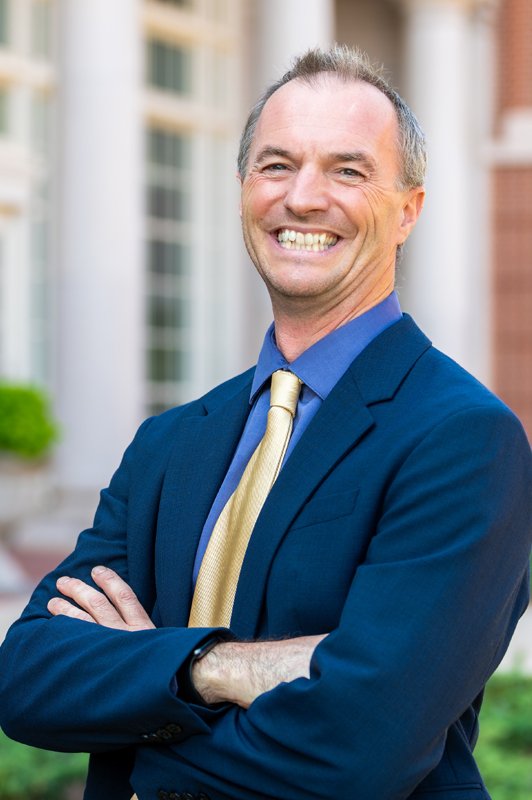
Professor James S. Cotton is a faculty member in the Department of Mechanical Engineering at McMaster University , specializing in Thermo-Fluid Sciences with a focus on energy sustainability and thermal management. Current research explores thermal energy harvesting , non-thermal plasma flue gas cleaning , and smart electrohydrodynamic heat exchangers . Active in community energy planning as a member of the Burlington Climate Action Plan (2019-2021) and Green Venture board (2016-2021). Research spans both fundamental and applied domains, including two-phase flow , electrohydrodynamic heat transfer modulation , and flow accelerated corrosion analysis. His work integrates modeling and experimental validation for real-world thermal systems. Scientific Contributions: Developed two novel patents for advanced thermal management and soot removal systems during his industrial career at Dana Corp. (until 2007). Current projects involve community energy corridors and next-generation sustainable energy solutions , including the 2025 Hamilton Energy Harvesting Study . Active mentor in graduate education, teaching courses like MECH ENG 4O04: Sustainable Energy Systems and MECH ENG 708: Two Phase Flow and Heat Transfer .
Prof. Vladimir Krasnov is a leading researcher in Experimental Condensed Matter Physics at Stockholm University , focusing on mesoscopic superconductivity, Josephson junctions, and nanoscale quantum phenomena. He heads the Experimental Condensed Matter Physics Group since 2005. Department: Department of Physics Lab: EKMF Lab (SU-KTH collaboration) Key Methodologies: Pulsed laser deposition, FIB nanofabrication, cryogenic measurements (0.25-300 K), THz spectroscopy Research Themes: His work bridges fundamental superconductivity studies (high-Tc cuprates, iron-pnictides) with applied quantum electronics. Notable contributions include Developing vortex-based cryogenic memory Controllable spin-triplet supercurrents in magnetic junctions THz emission from intrinsic Josephson stacks Quantum phase transitions via electrical doping Magnetic field effects on mesoscopic systems Scientific Trends: Analysis of 15 recent publications reveals strong emphasis on Josephson vortex dynamics, superconducting/ferromagnetic hybrid systems, THz applications, and non-equilibrium phenomena in quantum circuits. Facilities: Utilizes Nano-Fab clean-room for sample engineering and Low-T lab for high-field (17T), cryogenic experiments.
Prof.dr.ir. C. Poelma is a Professor in the Department of Process and Energy at Delft University of Technology (TU Delft). His research focuses on experimental fluid dynamics, multiphase flows, and measurement engineering. Research Areas: Cavity Engineering, Turbulent Flow, Reynolds Number Analysis, Air Lubrication, Velocity Field Measurement, and Wave Propagation. Projects: Led the Flows Unveiled project on multimodal measurement in opaque two-phase flows (2017-2022). Scientific Contributions: His work includes pioneering studies on ventilated cavities, bubbly shock waves, and particle-laden flows using X-ray and LED-based PIV techniques. He has received an ERC Advanced Grant for his research. Key Publications: 125+ research outputs, including articles in Journal of Fluid Mechanics , Ocean Engineering , and International Journal of Multiphase Flow . Datasets: Generated critical datasets for void fraction analysis, nozzle flow, and biomedical velociometry. Supervised Students: Mentored 9 PhD candidates and collaborated with researchers across fluid mechanics and biomedical engineering.
Summary Adam Szymkiewicz is a full Professor and Vice-Dean for Scientific Research at the Faculty of Civil and Environmental Engineering, Gdańsk University of Technology. He leads the Department of Geotechnics and Water Engineering and holds academic positions since 2021. His research focuses on groundwater flow, contaminant transport, and numerical modeling in porous media. Key roles include Head of Department (2022–present) and Vice-Dean (2024–present). Education includes a PhD from Joseph Fourier University (2004) and habilitation from Gdańsk University of Technology (2013). Research Interests: Hydraulic properties of porous media, multiphase fluid flow, climate change impacts, and integrated hydrological modeling. Notable projects include AQUIGROW (HORIZON EUROPE) and SOILPROM. Publications: Over 50 peer-reviewed articles on topics like PFAS migration, groundwater recharge, and MODFLOW coupling. Recent work emphasizes climate change effects on aquifers and coastal hydrogeology. Awards: Multiple Rector awards (2012–2022) and Polish Academy of Sciences Award (2013). Membership: AGU, EGU, InterPore, and Polish Hydrogeologists Society. Editorial roles include Associate Editor of Acta Geophysica .
Professor Yoav Peles is Chair of the Department of Mechanical and Aerospace Engineering at the University of Central Florida (UCF). Previously, he served as director of the mechanical engineering program and associate department head for graduate studies at Rensselaer Polytechnic Institute's Department of Mechanical, Aerospace and Nuclear Engineering. Research Focus: Convective heat transfer in micro domains, phase change heat transfer, supercritical CO2 cooling, and thermal management systems Labs: Leads the Microfluidic Heat Lab, advancing cutting-edge cooling technologies His publication record includes close to 110 peer-reviewed journal papers, about 55 conference papers, several patents, four book chapters, and a book titled Contemporary Perspective on Flow Boiling Instabilities in Microchannels . Research trends show a strong focus on supercritical CO2 cooling systems, microchannel flow dynamics, and innovative thermal management techniques. Scientific Awards Prominent Researcher Award, ASME International Conference on Nanochannels, Microchannels, and Minichannels (2016) Best Paper Award, ASME International Technical Conference and Exhibition on Packaging and Integration of Electronics and Photonic Microsystems (2015) Peles has organized multiple international conferences including the ASME International Conference on Nanochannels, Microchannels, and Minichannels (2013) and the first Gordon Research Conference on Micro and Nanoscale Phase Change Heat Transfer. He is a Fellow of the American Society of Mechanical Engineering (ASME).