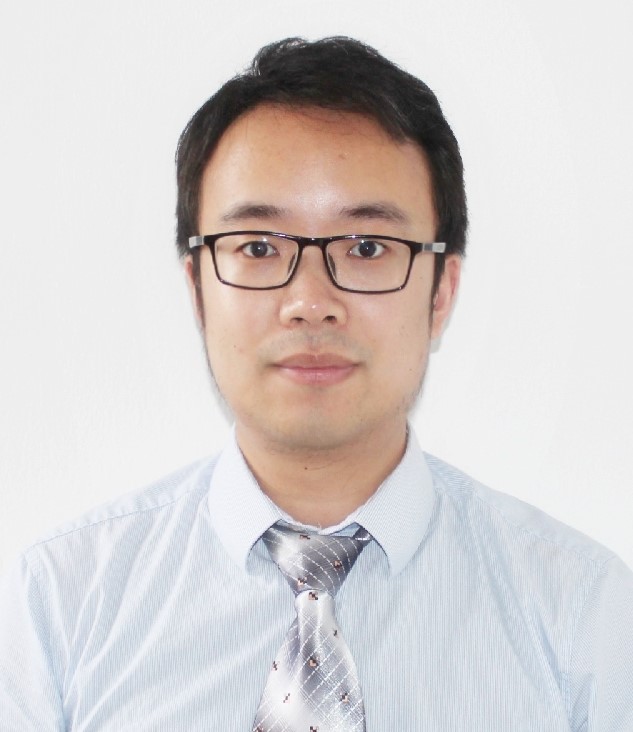
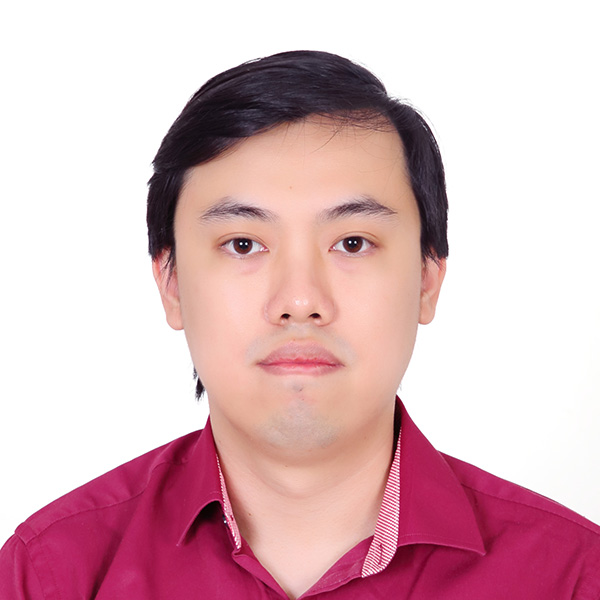
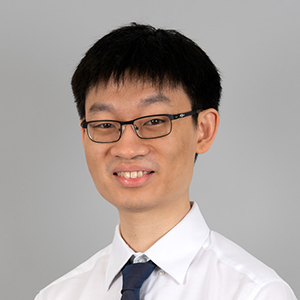
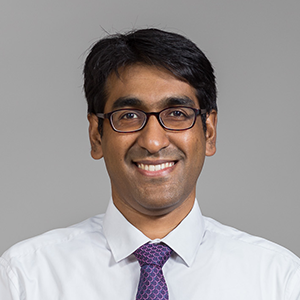
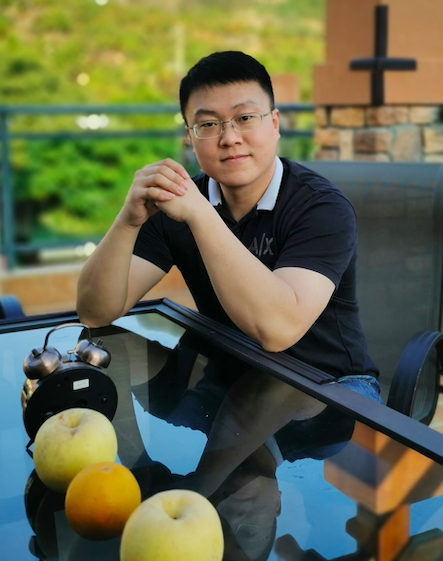
Dr. Yang Deng is a tenure-track Assistant Professor at the School of Computing and Information Systems, Singapore Management University, and a Lee Kong Chian Fellow. Previously, he was a Postdoctoral Research Fellow at NExT++ (National University of Singapore). His research focuses on Natural Language Processing, Information Retrieval, and Large Language Models, with special interests in Proactive Conversational AI, Trustworthiness of LLMs, and Human-Centered Information Seeking. He has published over 40 papers in top-tier venues including ACL, EMNLP, WWW, and SIGIR. PhD from The Chinese University of Hong Kong (2023) Research Advisor to CHEANG Chi Seng Research Domains: Natural Language Processing Information Retrieval Large Language Models Human-Agent Interaction Digital Transformation Trustworthy AI Scientific Recognition: Lee Kong Chian Fellowship Google South Asia & Southeast Asia Research Awards 2024 EMNLP 2024 Outstanding Area Chair NeurIPS 2024 Best Reviewer
Associate Professor at Nanyang Technological University's College of Computing and Data Science, serving as Deputy Director of the Cyber Security Research Centre @ NTU (CYSREN) and Associate Director of the NTU Centre Computational Technologies for Finance (CCTF). His research focuses on building trustworthy, efficient, and intelligent systems with emphasis on security and privacy across AI, robotics, and cloud infrastructures. Educational background: Bachelor of Physics, Peking University, 2011 Ph.D. in Electrical Engineering, Princeton University, 2017 Research spans five core domains: Generative AI Safety (vulnerability identification, safety testing, misuse detection), Deep learning security (adversarial examples, backdoor attacks, privacy protection), Robotics security (perception system attacks, safety testing), Machine learning optimization (workload scheduling, acceleration), and Computer architecture security (side-channel defenses, cloud security). His work bridges theoretical security with practical system implementations across diverse applications. Recent publications (2024-2026) reveal intense focus on securing generative AI systems, particularly text-to-image models and large language models, with significant contributions to red teaming methodologies, backdoor attack mitigation, and multimodal security. Emerging trends show expanding research into autonomous vehicle security and privacy-preserving machine learning with cryptographic techniques. Key awards include: Distinguished Artifact Award (CCS 2024) Stamatis Vassiliadis Best Paper Award Nominee (FPL 2024) Outstanding Paper Award (ACL 2024) Distinguished Artifact Award (Usenix Security 2024) Actively supervises PhD students and research staff while leading multiple high-impact grants: Ongoing: NRF CREATE Quantum Security (2025-2029), Continental NTU Corp Lab Automotive HPC (2025-2028), CRPO EV Charging Security (2025-2027) Completed: MoE AcRF Tier2 IP Protection (2022-2025), NTU S-Lab Efficient GPU Scheduler (2020-2025) Leads research within CYSREN and TAICeN (Trustworthy AI Centre NTU), directing interdisciplinary teams that investigate security threats across AI deployment stacks while developing practical defenses for real-world systems.
Dr. Zhiguang Cao is an Assistant Professor at the School of Computing and Information Systems (SCIS), Singapore Management University (SMU). With a PhD from Nanyang Technological University (2017), his work bridges Artificial Intelligence , Deep Learning , and Combinatorial Optimization to tackle complex logistics and urban mobility challenges. Research Advisor to PhD/Master's students: XIAO Xiangjie, YI Hang, ZHANG Ni Recipient of the World’s Top 2% Scientist recognition (2024), IEEE Transactions on Industrial Informatics Outstanding Paper Award (2022), and Nobert Wiener Review Award (2022) Completed degrees: PhD (NTU), MSc (NTU), BEng (GDUT, China) Research Interests focus on Learning to Optimize (L2Opt) and Neural Combinatorial Optimization , with applications in: Vehicle Routing Problems (TSP, CVRP, PDP) Job Shop Scheduling and Multimodal Optimization UAV Routing , Drone Delivery , and Stochastic Programming His 15 most recent publications (2024-2025) span top venues like NeurIPS , ICML , IJCAI , and IEEE Transactions journals, covering topics from multi-task vehicle routing to graph domain adaptation and learning with large language models . Scientific Awards : World’s Top 2% Scientist (Stanford, 2024) IEEE Transactions on Industrial Informatics Outstanding Paper (2022) Nobert Wiener Review Award (2022) BMW Summer School Excellent Research Work (2014) IEEE Singapore Chapter Tennis Prize (2012) Dr. Cao advises the L2Opt Research Group , which recruits PhD students and remote interns. He has served as Area Chair for ICLR, SIGKDD, ICML, and Senior PC for AAAI and IJCAI. His ongoing projects include Trustworthy Human-AI Optimization (AISG, 2025-2027) and Mobile Crowdsourcing Emergency Supplies (SMU-UofT, 2025-2026).
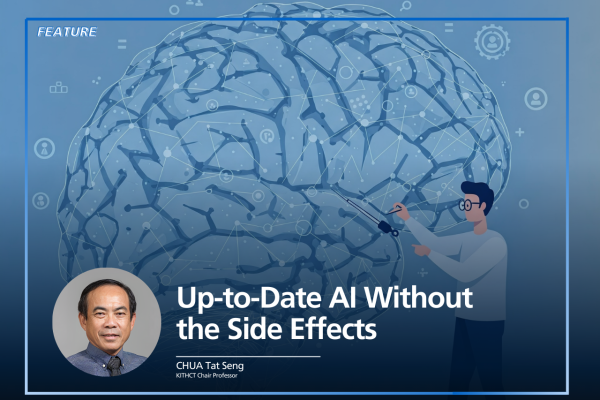
Professor Chua Tat Seng is a distinguished academic at the National University of Singapore's School of Computing, serving as KITHCT Chair Professor and Director of the NUS-Tsinghua Extreme Search Center (NExT). He also holds Distinguished Visiting Professorships at Tsinghua and Zhejiang Universities in China. PhD in Computer Science (University of Leeds, 1983) Founding Dean of School of Computing (1998-2000) Co-founded ViSenze and 6Estates technology startups His research focuses on unstructured multimodal data analytics, with particular emphasis on multimedia information retrieval, social media analytics, recommendation systems, and trustworthy AI. He has pioneered work in computational wellness and fintech applications, establishing the Lab for Media Search and leading NExT++ research initiatives. Over 300 publications in leading venues (CVPR, SIGIR, WWW, AAAI) Recipient of ACM SIGMM Technical Achievement Award (2015) Supervised 37 PhD students since 2004 Editorial leadership in ACM Transactions and IEEE Multimedia Recent work explores multimodal LLMs, knowledge editing techniques (AlphaEdit), and 3D generation frameworks, reflecting his commitment to advancing web intelligence and user empowerment.
Nghia Hoang is a tenure-track Assistant Professor at the School of Electrical Engineering and Computer Science, Washington State University. Prior to his current appointment, he held positions as a Senior Research Scientist at AWS AI Labs (Amazon, 2020-2022), Research Staff Member at the MIT-IBM Watson AI Lab (2018-2020), Postdoctoral Research Associate at MIT's Laboratory for Information and Decision Systems (2017-2018), and Research Fellow at the National University of Singapore (2015-2017). Dr. Hoang earned his B.Sc. from the University of Science (Vietnam) in 2009 and completed his Ph.D. in Computer Science at the National University of Singapore in 2015 under the supervision of Associate Professor Kian Hsiang Low. His research focuses on Machine Learning , particularly in Federated Learning , Bayesian Methods , Optimization , and Deep Learning . He has made significant contributions to probabilistic federated learning, offline optimization techniques, and knowledge representation for collaborative learning across heterogeneous systems. His work often bridges theoretical foundations with practical applications in diverse domains including healthcare and multi-agent systems, with recent publications addressing challenges of data heterogeneity and scarcity in distributed learning environments. Dr. Hoang's publication record reveals strong trends in making federated learning more robust to non-IID data distributions, improving offline optimization through surrogate modeling, and developing techniques for knowledge transfer across heterogeneous systems without requiring orthologue mappings. His work spans both theoretical contributions and practical implementations, with increasing emphasis on real-world applicability of machine learning techniques. Dr. Hoang actively mentors students in research, with several publications led by his advisees including PhD students Pei-Yau Weng and Long Bui, as well as undergraduate mentee Cuong Dao. He has successfully guided multiple students to publish at top-tier conferences including NeurIPS, ICML, and UAI, demonstrating his commitment to student development and collaborative research. Professionally, Dr. Hoang serves on the boards of prestigious journals including Machine Learning Journal and Neural Networks as an Action Editor. He has been a program committee member for major AI conferences including AAAI, ICLR, ICML, NeurIPS, and IJCAI across multiple years (2018-2024), and organized workshops such as the Practical Bayesian Methods for Big Data workshop at IBM Research AI Week and the NeurIPS-21 Workshop on New Frontiers in Federated Learning.
Bryan HOOI Kuen-Yew is an Assistant Professor in the Department of Computer Science at the National University of Singapore (NUS), affiliated with the School of Computing and the Institute of Data Science. His research focuses on enhancing the reliability and applicability of machine learning systems, particularly in trustworthiness, graph learning, and real-world applications such as cybersecurity and biomedical informatics. He holds a PhD in Machine Learning from Carnegie Mellon University (2019), and dual MSc (Computer Science) and BSc (Mathematics) degrees from Stanford University (2014). His work has been recognized with awards including the KDD 2016 Best Paper Award (Research Track) and the ECML-PKDD 2018 Runner-Up Best Student Data Mining Paper Award. Research Interests: Trustworthy AI: Mitigating hallucinations, biases, and distribution shifts in large language models. Graph Algorithms: Developing robust methods for graph mining, anomaly detection, and fraud detection in dynamic networks. Multimodal Learning: Leveraging vision-language models and knowledge graphs for improved reasoning and security. Biomedical Applications: Applying AI to healthcare challenges, including drug design and medical data analysis. Selected Awards: ECML-PKDD 2018 Runner-Up Best Student Data Mining Paper Award KDD 2016 Best Paper Award (Research Track) NUS Computing Teaching Excellence Award (2024) Advising and Grants: Actively supervises PhD and master’s students, with research supported by grants focusing on AI security, graph learning, and trustworthy systems. Collaborates on projects such as PhishAgent (multimodal phishing detection) and UniGraph (cross-domain graph foundation models).
Prateek SAXENA is an Associate Professor in the Computer Science Department at the School of Computing, National University of Singapore. He serves as Co-Director of the CRYSTAL Centre and teaches courses including CS3235 Computer Security and CS5562 Trustworthy Machine Learning. His research spans multiple domains within computer security and systems. Dr. SAXENA earned his Ph.D. in Computer Science from the University of California, Berkeley (2012), an M.S. in Computer Science from Stony Brook University (2007), and a B.E. in Computer Engineering from the University of Pune, India (2004). His research focuses on building better security and privacy in practical systems through principled approaches combining formal reasoning, tools and ideas from several computer science domains. Current research thrusts include machine learning security, decentralized systems security, security processors, and automatic program translation. His work has resulted in several practical artifacts powering real-world systems, including spinoffs like Zilliqa and Kyber Network. His publication record demonstrates consistent high-impact research across security domains including web security, blockchain, trusted execution environments, and machine learning security. His work shows a progression from foundational web security research to cutting-edge work on blockchain systems and machine learning security. MIT Technical Review, Top 10 Innovators under 35, Asia - 2017 Security and Privacy Research Award, 2018 Young Research Award, NUS, 2017 David J. Sakrison Memorial Prize for outstanding doctoral work, UC Berkeley, 2012 AT&T Best Applied Security Research Paper Award 2010 Dr. SAXENA has advised numerous successful PhD students who have gone on to prominent positions at Microsoft Research, Georgia Tech, ETH Zurich, and industry leaders like Zilliqa and Kyber. His research has been generously supported by CISCO Research, Google, Intel, Symantec, MoE-Singapore, DSO Labs, and NRF-Singapore. He leads the KISP Lab (Keep It Secure and Private), which has produced influential research in blockchain, trusted execution environments, and security tools.
Dr. Meera Radhakrishnan is a Research Fellow at the Data Science Institute, University of Technology Sydney (UTS). Her research focuses on mobile and pervasive computing, wearable/IoT sensing systems, and applied machine learning for healthcare. She holds a PhD in Computer Science from Singapore Management University (SMU) and conducted postdoctoral research at Carnegie Mellon University (CMU). Prior to academia, she worked as a Senior Systems Engineer at Infosys and a Research Scientist at SMU and A*STAR's IHPC. Her work includes developing systems like W8-Scope for gym exercise monitoring, ERICA for free-weight mistake detection, and LiLoc for LiDAR-based localization. She has secured grants totaling AUD 315k+ for projects in wearable healthcare and trustworthy digital systems. Dr. Radhakrishnan actively serves on TPCs of top conferences (e.g., IEEE PerCom, IROS) and chairs sessions at IEEE events. She was recognized as one of Australia's top 25 women in data science (2024) and received the Abbe Grant (2023) and Best Paper Award (WristSense 2019).
Jingfeng Zhang is a Lecturer at the University of Auckland's School of Computer Science and a Visiting Research Scientist at RIKEN Center for Advanced Intelligence Project. Holding a PhD from the National University of Singapore, he's supervised by Prof. Masashi Sugiyama at RIKEN and Prof. Mohan Kankanhalli at NUS. Education: PhD (2016-2020) at NUS, BEng (2012-2016) at Shandong University's Taishan College Current research focuses on Trustworthy Machine Learning , Adversarial Robustness , and Foundation Model Security His publication history shows a strong focus on adversarial learning techniques across multiple top conferences (ICML, NeurIPS, ICLR). He's developed methods for improving model robustness against various attacks including backdoor attacks, clean-label poisoning, and adversarial noise. The work spans from theoretical foundations to practical implementations in neural network training. He supervises several students including: Zihao Luo (Master's, UoA) Xin Chen (PhD, UoA with Prof. Gill Dobbie) Di Zhao (PhD, UoA with Prof. Yun Sun Koh and Prof. Gill Dobbie) Professional service includes organizing workshops at ACML and TrustML, serving as Area Chair at SOICT, and reviewing for top venues in machine learning and AI.
Debin GAO is a Full-time Professor of Computer Science at the Singapore Management University , affiliated with the School of Computing and Information Systems (SCIS) . He serves as Co-Director of the Centre on Security, Mobile Applications & Cryptography and Faculty Manager for the SMU BSc (IS)-CMU Fast-Track Programme . His research focuses on Android security , trusted execution environments , and malware detection . PhD from Carnegie Mellon University (2006) Supervisor to SCIS undergraduate instructors Research Advisor to EE Fook Ming GAO's research explores security vulnerabilities in mobile platforms , with emphasis on cache side-channel attacks and Android app debloating . His recent work investigates LLM-driven malware classification and secure code partitioning for smart contracts . His publications demonstrate a focus on mobile security (15/15), including malware analysis (9/15), trusted execution environments (5/15), and side-channel attack mitigation (4/15). Notable contributions include DynDebloater (2025), AutoTEE (2025), and CacheAlarm (2025). As Co-Director of the Centre on Security, Mobile Applications & Cryptography , GAO leads initiatives in trustworthy app delegation (AGChain, 2024) and user-centric security (OTO, 2012). His teaching covers Information Security & Trust , Networking , and Software Engineering .
Professor Yan Pang is a distinguished academic at the National University of Singapore (NUS), holding the position of Professor in the Department of Analytics and Operations (DAO) at the NUS Business School. He also serves as the Co-Director of the NUS Business Analytics Center (NUS BAC) and the Assistant Dean (Industry Relations) at NUS Business School. With over a decade of academic leadership and industry experience, Professor Pang has established himself as a leading expert in AI, analytics, and blockchain technologies. Professor Pang's educational background includes: Ph.D. from National University of Singapore jointly with Massachusetts Institute of Technology (MIT) Master's degree from Zhejiang University (ZJU), China Bachelor's degree from Zhejiang University (ZJU), China His research interests span Trustworthy AI, Federated Learning, Blockchain, Supply Chain Analytics, and Healthcare Analytics, with applications across Manufacturing, Supply Chain/Logistics, Finance, Healthcare, and Retail sectors. Professor Pang's recent publications demonstrate significant contributions to privacy-preserving techniques in AI systems, federated learning frameworks, and blockchain applications for enterprise solutions, particularly in pharmaceutical supply chains and digital asset management. Professor Pang's scholarly work shows a clear progression toward addressing critical challenges in AI trustworthiness and data privacy, with his most recent publications focusing on federated learning security, large language model protection, and blockchain interoperability. His research bridges theoretical innovation with practical implementation, as evidenced by commercial applications like Zuellig Pharma's eZTracker system. Professor Pang's contributions have been recognized through prestigious awards: Leading Academic Data Leader by CDO Magazine IBM Outstanding Technical Achievement Award (OTAA) Master Certified Architect in the Open Group IBM Invention Plateau Award Finalist of the Andrew Fraser Prize 2007 of IMechE With over ten patents across the United States, China, and Singapore, Professor Pang maintains strong industry connections through advisory roles with Singapore Tourism Board, SAP APCJ, IBM architecture boards, and China's development advisory boards. His extensive industry experience prior to academia, including leadership roles at IBM as Chief Architect in Analytics and Optimization, informs his practical research approach and industry-relevant teaching in AI, analytics, blockchain, and digital transformation. Professor Pang leads the NUS Business Analytics Center, driving research in trustworthy AI systems and blockchain solutions for enterprise applications, with particular focus on supply chain optimization, digital asset management, and healthcare analytics. His work demonstrates consistent translation of academic research into real-world implementations through strategic industry partnerships.
Brian Lim Youliang is an Associate Professor at the National University of Singapore (NUS) in the Department of Computer Science . He holds a BSc in Engineering Physics with a minor in Computer Science from Cornell University , an MSc in Human-Computer Interaction from Carnegie Mellon University , and a PhD in Human-Computer Interaction from Carnegie Mellon University . His research focuses on Explainable AI (XAI) , Human-Computer Interaction (HCI) , and Ubiquitous Computing , with applications in healthcare analytics , wellness, and urban sustainability . He leads the NUS Ubicomp Lab , which develops AI-driven technologies for user-centric and trustworthy systems. From analyzing his publications, the research trends show expertise in machine learning interpretability , cognitive load optimization , crowd ideation algorithms , and context-aware systems . His work bridges cognitive psychology with technical AI to create more human-relatable explanations for machine learning models. Scientific achievements include: CHI'22 Best Paper Award (Top 1%) IMWUT Distinguished Paper Award (Top 6/166 in 2019) MOE Outstanding Mentor Award (2016) CHI'09 Best Long Paper Nomination (Top 5%) He teaches courses in Machine Learning (CS3244) and Human-Computer Interaction Theories (CS4249) . The lab continues advancing human-AI collaboration through explainability frameworks and cognitive psychology integration.
Dong Jin Song is a full Professor at the National University of Singapore's School of Computing, Department of Computer Science. He joined NUS in 1998 and was promoted to Professor in 2016 after serving as Associate Professor (2005) and Assistant Professor. He has held various leadership roles including Deputy Head of CS Department (2023-2024), NUS Senate Member (2020-current), and Assistant Dean (Graduate Office, SoC). PhD, University of Queensland, Australia (1993-1995) BInfTech with First Class Honours, University of Queensland, Australia (1989-1992) - Major in Software Engineering Professor Dong's research spans formal methods, safety and security systems, probabilistic reasoning, sports analytics, and trusted machine learning. He is best known for co-founding the PAT verification system which has attracted thousands of registered users from over 150 countries and won the 20-year ICFEM Most Influential System Award in 2018. He also co-founded 'Silas: Trusted Machine Learning' and the Dependable Intelligence company. His work bridges formal verification with practical applications in security, AI, and even sports analytics where he developed Markov Decision Process models for tennis strategy analysis. His recent publications show a strong trend toward integrating formal methods with modern AI systems, particularly focusing on trustworthy AI, LLM verification, and security applications. The research spans multiple high-impact venues including ICML, NeurIPS, IEEE Transactions, and top security conferences like USENIX Security, reflecting his interdisciplinary approach that combines formal verification with machine learning, security, and practical applications. Professor Dong has received numerous honors including the ACM SIGSOFT Distinguished Paper Award for ICSE 2020, the 20-Year ICFEM Most Influential System Award (2018), and being named a Fellow of the Institute of Engineers Australia (2018). His awards reflect both theoretical contributions to formal methods and practical impact on software engineering. ACM SIGSOFT Distinguished Paper Award for ICSE 2020 NUS Research Recognition Award (2020) Fellow of Institute of Engineers Australia (2018) 20-Year ICFEM Most Influential System Award (2018) Best Paper Award at ICECCS (2015 and 2012) Professor Dong has successfully supervised 33 PhD students, many of whom have become tenured faculty members at leading universities worldwide including The University of Auckland, Aston University, Singapore Management University, and Monash University. His students have gone on to successful careers in both academia and industry at organizations like Google, Apple, HP Research Lab, and IBM. He has served on the editorial boards of prestigious journals including ACM Transactions on Software Engineering and Methodology and has been active in numerous conference organizing committees. Through his research group and commercial ventures (Dependable Intelligence), Professor Dong has built a strong team focused on formal verification, trusted AI systems, and practical applications of model checking. His work has evolved from foundational formal methods research to cutting-edge applications in AI safety and security, maintaining a consistent thread of rigorous verification throughout his career.
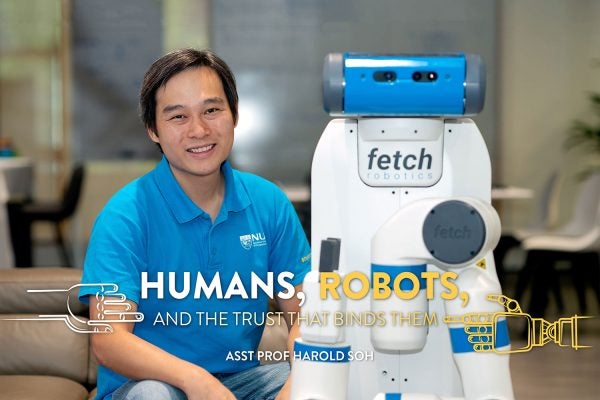
Harold SOH Soon Hong is an Associate Professor in the Department of Computer Science at the National University of Singapore (NUS), School of Computing. He serves as Associate Director of the NUS AI Lab and directs the Collaborative, Learning, and Adaptive Robots (CLeAR) Lab. His research focuses on developing trustworthy collaborative robots through advances in machine learning and human-robot interaction. Education: Ph.D. in Artificial Intelligence & Robotics, Imperial College London, UK (2014) M.S. in Software Engineering, University of Melbourne, Australia (2005) B.ASc. in Computer Science and Economics, University of California, Davis (2004) Professor Soh's research centers on machine learning and decision-making for trustworthy collaborative robots. His work spans cognitive modeling (particularly human trust) to physical systems (including novel e-skins for tactile perception). He has made significant contributions to human-robot interaction, especially in developing robots that can learn from and collaborate effectively with humans. His research integrates theoretical foundations with practical implementations in real-world robotic systems. His recent publications demonstrate a strong trend toward diffusion models, tactile sensing technologies, and trustworthy AI systems. The research spans fundamental machine learning advances to practical robotic applications, with particular emphasis on social navigation, human-robot handovers, and out-of-distribution detection. His work increasingly integrates large language models with physical robotic systems, creating new pathways for embodied AI. Scientific Awards: Best Paper Award at IROS 2021 for Extended Tactile Perception Best of IEEE Transactions on Affective Computing Award (2021) RSS Best Paper Award Finalist (2018) HRI Best Paper Award Finalist (2018) RSS Early Career Spotlight Award (2023) Multiple NUS Annual Teaching Excellence Awards Professor Soh actively supervises PhD students and mentors undergraduate research projects through FYP and UROP programs. He has developed and taught courses including CS3264 Foundations of Machine Learning and CS5340 Uncertainty Modelling in AI. His teaching philosophy emphasizes developing independent thinkers with strong analytical skills, fundamental computer science knowledge, and clear communication abilities. His students have won multiple Research Achievement Awards and the NUS Outstanding Undergraduate Researcher Prize. The CLeAR Lab, which he directs, focuses on developing physical and social intelligence for trustworthy robots. Current projects include Octopi (tactile-language models), Arena platform for social navigation, and GRaCE for robotic grasping. The lab has consistently produced high-impact publications at top venues including RSS, ICRA, and NeurIPS.
Zitong Yu is an Assistant Professor of Computer Science at Great Bay University, China, leading the YU Vision (YUV) Group. He holds a PhD in Computer Science from the University of Oulu and has conducted postdoctoral research at Nanyang Technological University. His research focuses on computer vision, biometric security, and multimodal learning, with notable contributions to face anti-spoofing, deepfake detection, and remote physiological measurement. Postdoctoral Researcher: ROSE Lab, Nanyang Technological University (NTU) Visiting Scholar: University of Oxford (2021) His work bridges theoretical advancements with real-world applications, such as healthcare advisory roles with BioTrillion, USA. Key achievements include organizing international conferences (e.g., IJCB'24 Special Session), serving as Area Chair for BMVC 2024, and contributing to influential datasets like GenFace and DOLOS. Research interests span facial presentation attack detection, multimodal learning, and generative models for security. He has received awards including the World's Top 2% Scientists (2023-2024) and the Chinese Government Award for Outstanding Self-financed Students Abroad (2021). Grants include the Natural Science Foundation of China's Young Scientists Fund (300k RMB) and the Guangdong Provincial Regional Joint Fund (300k RMB). His labs and teams focus on advancing trustworthy AI systems through robust and generalizable models.