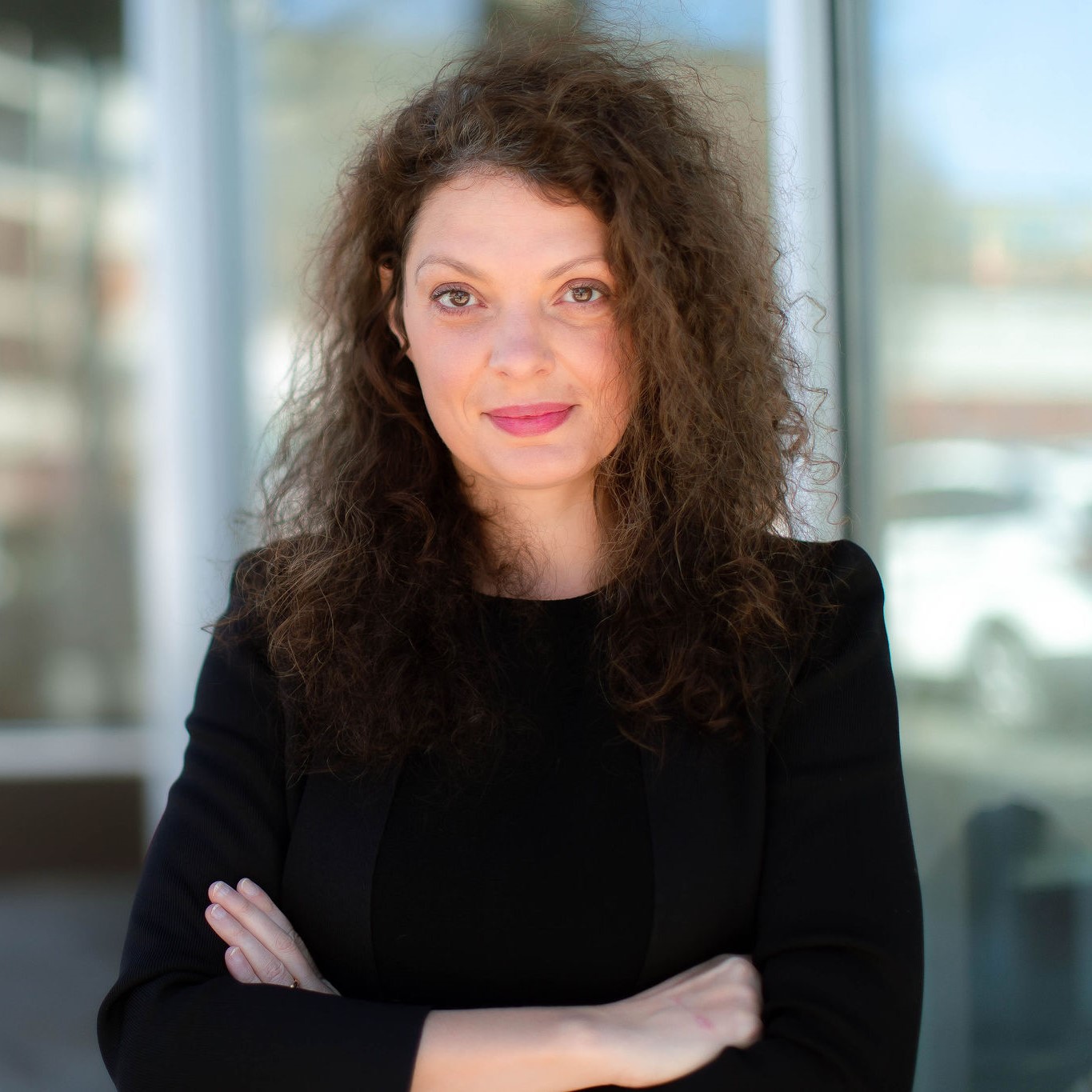
Jennifer Gómez Menjívar is Professor and Director of the M.A. in Media Industries and Critical Cultural Studies at the University of North Texas. Her research examines historical and ethno-linguistic movements influencing text production, circulation, and reception across print media, screen cultures, and digital communities. With over 18 years of teaching experience, she previously held positions at international organizations including the UNECE and UNDP. Her scholarly interests span media linguistics, film adaptation, digital activism, hemispheric animation histories, Indigenous sovereignty media, and Spanish-language media. Her publications demonstrate interdisciplinary work bridging media studies, cultural history, and postcolonial theory. Her extensive publication record includes books such as Tropical Tongues: Language Ideologies, Endangerment, and Minority Languages in Belize (2018) and Black in Print: Plotting the Coordinates of Blackness in Central America (2023), as well as co-edited volumes on Indigenous technology and hemispheric Blackness. She received a Senior Research Fellowship at Freie University Berlin for her upcoming work on Indigenous sovereignty media. Gómez Menjívar teaches courses including Introduction to Graduate Studies in Media Arts, Women in Film, and Global Media. She also mentors students in critical media analysis and serves as faculty advisor for media research projects.
Chi-Ming Yang is a Professor of English at the University of Pennsylvania's School of Arts & Sciences, where she has established herself as a leading scholar in literary and visual culture studies with a focus on race, empire, and East-West cultural exchanges. Her interdisciplinary approach bridges British, American, Asian, and Latin American studies while examining historical periods from the early modern era through the 18th century to contemporary contexts. Educational Background: Ph.D. in English from Cornell University B.A. in Comparative Literature from Stanford University with emphases in Spanish, Chinese, and English Professor Yang's research interrogates the intersections of race, visual culture, and imperial histories through multiple disciplinary lenses. Her work explores how objects, images, and texts function within global networks of power and representation, with particular attention to transpacific and transatlantic connections. She has developed significant expertise in chinoiserie, material culture, and the visual dimensions of racial formation across historical periods. Her recent publications demonstrate a growing interest in ecological perspectives on race and empire, particularly evident in her 2021 article 'The Song of the Rice Bird,' which innovatively examines plantation slavery through avian migration patterns. Her scholarship consistently bridges historical analysis with contemporary concerns about representation, power, and cultural exchange. Professional Recognition: 2022 Best Advisor Award in English, Sponsored by the English Undergraduate Advisory Board Professor Yang maintains an active advising role, having chaired doctoral dissertations including Jacob Myers' 'Noxious Life: Figuring Vermin in the Natural Histories of the Anglophone Caribbean' (2025) and Cassidy Holahan's 'Dramatizing the Novel: Transmedial Exchange in the Long Eighteenth Century' (2023). She regularly participates in departmental workshops and events, including the 2024 conversation with Sharon Holland exploring Black feminist perspectives on animal life in relation to Octavia E. Butler's work. Her teaching portfolio reflects her interdisciplinary approach, with recent courses including 'Science Fictions of Octavia E. Butler,' 'Orientalisms,' '18th-Century British Poetry,' and 'Arts of Abolition and Liberation,' demonstrating her commitment to connecting historical scholarship with contemporary social justice concerns.
Leo J. Garofalo is the Virginia Eason Weinmann '51 Professor of History at Connecticut College, where he joined in 2002. He coordinates the Social Justice and Sustainability Pathway and co-directs the Mellon Mays Undergraduate Fellowship program. His scholarship focuses on colonial Latin America with emphasis on racial dynamics and cultural exchange. Education: B.A. in History and Hispanic Studies from Brown University M.A. from Boston College Ph.D. from University of Wisconsin at Madison Research Focus: Garofalo investigates the intersection of African and Indigenous cultures in colonial Peru, examining how marketplaces, taverns, and religious practices shaped Afro-Andean identities. His current work traces West African diaspora routes to the Andes and analyzes Afro-Iberian influences on witchcraft traditions. He utilizes Inquisition records and Spanish imperial archives to reconstruct transatlantic cultural networks. Awards: Virginia Eason Weinmann '51 Professorship (endowed chair) Social Science Research Council Grant Fulbright-Hays Research Grant Academic Leadership: Garofalo has organized campus events featuring Afro-Peruvian performers (Negrura Peruana) and activists like former Colombian Governor Luis Murillo. In 2010, he co-led a Study Away Teach Away program in Oaxaca, Mexico, examining immigration and indigenous rights movements.
Marcela Echeverri Muñoz is an Associate Professor in the Department of History at Yale University, affiliated with the Faculty of Arts and Sciences. Her scholarship bridges history, anthropology, and political theory, with a focus on Latin America, the Atlantic World, and the Spanish Empire. She is recognized for her interdisciplinary approach to understanding political subjectivities, state formation, and social transformation during the Age of Revolutions. PhD in Latin American and Caribbean History, New York University, 2008 MA in History of the Hispanic World, Fundación MAPFRE-Tavera and CSIC, Madrid, 2006 MA in Social and Political Theory, The New School for Social Research, 2001 BA in Anthropology, Universidad de los Andes, Bogotá, 1997 Her research centers on the interplay of race, gender, law, and political theory in colonial and 19th-century Latin America. She investigates how enslaved and Indigenous peoples navigated imperial and republican transitions, particularly through royalist affiliations. Her work challenges peripheral narratives of Spanish America in Atlantic slavery studies, positioning the region as a central site of abolitionist and constitutional experimentation. The trends in her recent publications reveal a sustained focus on slavery, abolition, and political transformation in the Spanish American mainland. She analyzes how anti-slavery movements were intertwined with republicanism, citizenship, and state formation, especially in Gran Colombia. Her scholarship spans legal history, Atlantic processes, and transimperial dynamics, often highlighting marginalized voices in revolutionary contexts. She frequently contributes to major reference works and edited volumes on Atlantic revolutions and Latin American independence. Her scientific awards and fellowships reflect her standing in the field: James Alexander Robertson Prize Michael Jiménez Prize Bolton-Johnson Prize Honorable Mention Yale Heyman Prize for Outstanding Scholarly Publication Alexander von Humboldt Research Fellowship MacMillan Research Fellow, Yale Mellon Residential Fellow, CUNY NEH Summer Institute Participant, Johns Hopkins Fellowships from John Carter Brown Library, CSIC, Fundación Mapfre, and Instituto Colombiano de Antropología e Historia Echeverri has secured significant research grants from Harvard’s Atlantic History Seminar, CUNY Research Foundation, and Yale. She has co-edited special issues on Gran Colombian history and Spanish American abolition, and led key academic initiatives including the Race and Slavery in the Atlantic World Working Group and the Early Modern Empires Workshop at Yale. Though student advising is not explicitly detailed, her role as a senior scholar implies mentorship of graduate students. She is affiliated with several research networks and has been a visiting scholar at institutions such as Freie Universität Berlin. Her ongoing book project on Gran Colombian slavery underscores her commitment to redefining the hemispheric significance of Latin American abolition. She remains an active contributor to both scholarly and pedagogical conversations in Atlantic and Latin American history.
Renaud Morieux is Professor of European History at the University of Cambridge and Fellow of Pembroke College. His research explores borders between Britain, France, and the wider world since the 18th century, with focus on migration, oceans, incarceration, and the social history of war. He holds editorial responsibilities for journals including Past & Present and Revue d'Histoire Moderne et Contemporaine . Research Interests: Morieux investigates maritime borders through interdisciplinary lenses combining legal history, family studies, and global perspectives. His projects examine political deportation in the Indian Ocean and a reflexive history of European statelessness. His award-winning publications analyze cross-Channel relations, war captivity, and oceanic governance. Article Analysis: Morieux's scholarship demonstrates consistent focus on transnational networks, legal pluralism, and subaltern agency. Recent work explores colonial knowledge systems, penal transportation, and epistolary communities, reflecting innovative methodological approaches to reconstructing marginalized histories across imperial spaces. Awards and Honors: Philip Leverhulme Prize for History (2014) Leo Gershoy Award for The Channel: England, France and the Construction of a Maritime Border (2017) Mémoires de la Mer book prize (2009) Advising and Grants: Morieux has supervised 10+ PhD students on topics ranging from naval mutinies to famine philanthropy. Current doctoral candidates explore Sir Joseph Banks' networks, WWI prisoner repatriation, and oral culture in the French Atlantic. His research receives international funding including EU and UK research council support.
Arthur Weststeijn is an Assistant Professor in Political History at Utrecht University, specializing in the history of the Dutch Republic and its colonial empire, the history and contemporary politics of Italy, and the history of Spain and Latin America. He is affiliated with the Department of History and Art History within the Humanities faculty and is part of the Research Institute for History and Art History, focusing on International and Political History. Dr. Weststeijn's educational background includes: PhD in History, European University Institute, Florence (2010) RMA in History, European University Institute, Florence (2006) MA in Philosophy, University of Amsterdam (2005) MA in History, University of Amsterdam (2004) Erasmus Exchange, Universidad de Sevilla (2000-2001) His research focuses on the intellectual history of power, particularly examining ideas that express and contest political authority through two main themes: colonialism (how ideas have shaped European colonialism and resistance against it) and republicanism (how resistance to autocratic rule has given rise to ideas of liberty, citizenship, and democracy). His work spans early-modern Dutch colonialism, anticolonial thought, the history of democracy, and connections between ancient and modern forms of settler colonialism. He has published extensively on early modern republicanism, the political uses of classical heritage, and the making of modern Italy. Weststeijn's scholarly output demonstrates a consistent focus on the intersections between political thought, colonial history, and republican theory. His work often examines how historical ideas continue to shape contemporary political discourse, particularly regarding democracy, citizenship, and colonial legacies. He frequently engages with both European and transatlantic intellectual traditions, showing particular expertise in Dutch and Italian political thought. His notable awards and fellowships include: Fellow, Huntington Library, San Marino, California (Summer 2022) Fellow, John Carter Brown Library, Providence, Rhode Island (Spring 2019) Director of Historical Studies, Royal Netherlands Institute in Rome (2011-2017) Dr. Weststeijn has served as a visiting researcher at prestigious institutions including the Cambridge Centre for Political Thought, University of Southern California, University of Wisconsin at Madison, and University of Padua. He frequently appears as an expert commentator on Italian culture and politics in Dutch media and maintains an active public intellectual presence. He is involved in multiple research initiatives including the IOS research themes on Contesting Governance, Futures of Democracy, and Longtermism and Institutional Change. His work often involves interdisciplinary collaboration with archaeologists, classicists, and scholars from various humanities disciplines.
Greg Grandin is the Peter V. and C. Vann Woodward Professor of History at Yale University, where he has been affiliated since returning from New York University after nineteen years. His work focuses on Latin American and U.S. history, with an emphasis on empires, colonialism, indigenous peoples, and social-political dynamics. He has authored seven books, including award-winning titles such as The Blood of Guatemala , The Empire of Necessity (winner of the Bancroft and Beveridge awards), and The End of the Myth (Pulitzer Prize winner). Grandin is a member of prestigious academic societies like the American Academy of Arts and Sciences and contributes to journals like The Nation and London Review of Books . His research explores the interplay between U.S. interventions and Latin American resistance, reshaping understandings of hemispheric relations. Recent publications include America, América (2025), a sweeping re-evaluation of North and South American histories. His academic awards include the Pulitzer Prize, Bancroft Award, and multiple fellowships. Grandin’s work often bridges scholarly and public engagement, reflected in his editorial roles and media appearances. He has co-edited volumes like The Guatemala Reader and his writings address contemporary political issues through historical lenses.
University of Illinois Urbana-ChampaignUnited States
Craig M. Koslofsky is a Professor of History at the University of Illinois at Urbana-Champaign, with additional affiliations in Germanic Languages and Literatures, the European Union Center, and the Program in Medieval Studies. His research focuses on early modern Europe, particularly the history of everyday life and human skin in the early modern era (1400–1800). He explores topics such as medical practices, slavery’s impact on indigenous populations, and supernatural beliefs in colonial contexts. His research interests span the Atlantic World, British Empire, and medieval Europe, reflecting interdisciplinary approaches to historical analysis. Recent publications address the intersection of skin studies and colonialism, the cultural history of ghosts in Enlightenment America, and the Reformation’s local manifestations. He has edited works on transatlantic slave trade surgeons and early modern religious debates. Koslofsky holds a Ph.D. and is based in Gregory Hall. His work bridges global and local histories, emphasizing the material and cultural dimensions of early modern life. He collaborates across disciplines, engaging with medical history, literary studies, and colonial studies.
Jose Luis Belmonte Postigo is an active researcher and faculty member at the University of Seville, specifically in the Department of American History within the Faculty of Philosophy, Arts and Humanities. His academic career spans over a decade, with research activity documented from 2010 to the present. He earned his doctorate from the Pablo de Olavide University with a thesis on slavery in Santiago de Cuba (1780-1803), supervised by Dr. Juan Marchena Fernández. Belmonte Postigo's research focuses on the history of slavery in the Spanish Caribbean and Latin America, with particular attention to Cuba, Puerto Rico, Peru, and the broader Atlantic World. His work examines the social, economic, and cultural dimensions of slavery, including enslaved people's resistance strategies, social mobility, and the complex relationships between masters and slaves. He has conducted extensive research on how enslaved individuals navigated systems of power, sought freedom, and maintained cultural practices across the colonial period. His publications reveal a strong interest in the microhistories of enslaved individuals and communities, analyzing how they negotiated their circumstances within rigid colonial structures. Belmonte Postigo has made significant contributions to understanding the regional variations of slavery across the Spanish Empire, particularly examining how local contexts shaped slave societies in different parts of the Caribbean and Latin America. Belmonte Postigo has received recognition for his scholarly work, with a substantial following on academic platforms like Academia.edu where he has 938 followers. He collaborates with scholars across Latin America and Spain, contributing to edited volumes and participating in international research projects focused on slavery and colonial history. In addition to his research, Belmonte Postigo has demonstrated commitment to academic service through peer reviewing and contributing to scholarly journals. His expertise in colonial slavery has positioned him as a key contributor to ongoing scholarly conversations about the legacy of slavery in Latin America and the Caribbean.
Isadora Moura Mota is an Assistant Professor of History at Princeton University, specializing in Brazilian slavery and the Atlantic world. Her research focuses on modern Brazilian history, comparative slavery, abolitionism, literacy among enslaved populations, and the African diaspora in Latin America. She holds a PhD from Brown University (2017) and previously taught at the University of Miami. Key research areas include the role of Afro-Brazilians in shaping abolition movements, transnational connections during the 19th century, and the intersection of literacy with emancipation struggles. Her book Freedom’s Horizon examines abolitionism as a grassroots movement anchored in enslaved communities. Her work has been supported by the Social Sciences Research Council, Brown University’s Center for the Study of Slavery and Justice, and Brazil’s CNPq. Future projects explore intellectual histories of Afro-Brazilian literacy and labor struggles between European colonists and enslaved peoples. She has received an ACLS Fellowship and authored articles in Slavery & Abolition and Hispanic American Historical Review . Currently on leave through 2024–2025, her office is Dickinson Hall at Princeton.
Joe Lockard is an Associate Professor of English at Arizona State University, affiliated with African & African American Studies and Jewish Studies. He holds a Ph.D. from the University of California, Berkeley (2000), and has taught at nine institutions across four countries, including UC Santa Cruz, UC Berkeley, and universities in Israel, Czech Republic, and China. His research focuses on antislavery literature, 19th-century American literature, and prison education advocacy. Lockard founded the Antislavery Literature Project (2003), which digitized abolitionist texts before transitioning into global translation initiatives, notably with Xi'an Jiaotong University. He co-edited three volumes of American slave narratives in Chinese translation. Current projects explore transatlantic slavery narratives and carceral literature. Lockard is a leading voice in prison pedagogies, co-authoring works on STEM education in prisons and death row literature's role in abolition movements. His work bridges literary scholarship with social justice activism, emphasizing global dialogue and educational equity.
Adriana Chira is an Associate Professor of Atlantic World History at Emory University. She holds a Ph.D. from the University of Michigan, an M.A. from Cornell University, and a B.A. from Cambridge University (UK). Her research focuses on race, law, and property in Cuba and Puerto Rico during and after slavery. Her award-winning book Patchwork Freedoms examines how enslaved and free Afro-descendants navigated legal systems to claim land and freedom in 19th-century Cuba. Dr. Chira’s work has been supported by the National Endowment for the Humanities and fellowships at Yale and Harvard. She teaches courses on global history, Cuba, Puerto Rico, and the Caribbean. She also leads a study abroad program in Cuba focused on food sovereignty and environmental history. Her current research includes projects on labor markets in 18th-century Cuba/Colombia, land ownership theories in Cuba, and 20th-century Puerto Rican land policies. She has published widely in journals like the American Historical Review and Law and History Review , and her work has earned multiple prizes, including the James A. Rawley Prize and Elsa Goveia Prize. Education: B.A. Cambridge University (2005), M.A. Cornell (2008), Ph.D. University of Michigan (2016) Key Awards: Outstanding First Book Prize (ASWAD), James A. Rawley Prize (AHA), Peter Gonville Stein Award (ASLH) Teaching: Courses include Human Trafficking in World History , Globalization: The Atlantic World , and Cuba in World History
Dr. Lincoln Z. Shlensky is an Associate Professor in the Department of English at the University of Victoria, situated on the traditional territories of the WSÁNEĆ and Lək̓ʷəŋən peoples. His research focuses on postcolonial literature, diaspora studies, and media studies with emphases on the Caribbean, Jewish studies, and film. He holds degrees from Brown University (BA), UC Berkeley (MA/PhD). Teaching: Undergraduate courses in film rhetoric, postcolonial studies, and cultural theory Service: Chair of Caribbean Studies Association's 2010-11 Technology Task Force (awarded President's Distinguished Service Award) Administration: English Department webmaster since 2006; Senate Committee on Academic Standards representative 2010-2013 Research explores postcolonial memory through modernist literary influences, with an upcoming manuscript Islands of Memory: The Literary Politics of Aftermaths . His work appears in Callaloo , Prooftexts , and Qui Parle , focusing on authors like Edouard Glissant, Jamaica Kincaid, and Aharon Appelfeld. He supervises graduate students in postcolonial theory and global cinema. Has produced student films including a departmental history for UVic's 50th anniversary and instructional content for first-year writing. Maintains active academic website at shlensky.com .
Emily Lynn Osborn is an Associate Professor in the Department of History at the University of Chicago, specializing in African history with a focus on precolonial and colonial West Africa. She holds a PhD from Stanford University and a BA from UC Berkeley. Her research explores gender, technology transfer, colonialism, and the Anthropocene in African contexts. Education: PhD in History, Stanford University, 2000 AB, University of California, Berkeley Research Interests: Osborn’s work bridges historical analysis with interdisciplinary themes such as gender and statecraft, technology diffusion, and environmental history. She has published extensively on topics like the role of intermediaries in colonial rule, the cultural significance of color in the Atlantic world, and the Anthropocene in Africa. Her current book project examines artisans and technology transfer in West Africa. Awards and Fellowships: Quantrell Award for Excellence in Teaching (2016) Fulbright IIE and Fulbright-Hays Fellowships American Council of Learned Societies and Social Science Research Council grants Affiliations: Osborn serves as Faculty Director of the Senegal study abroad program and the Social Sciences Postdoctoral Teaching Fellows program. She is affiliated with the Center for Gender and Sexuality Studies, the Pozen Family Center for Human Rights, and the Center for International Social Science Research. Teaching: She teaches courses on African history, gender studies, and the Atlantic world, emphasizing oral history, slavery, and interdisciplinary approaches to the Anthropocene.
Dr. Jack McDonald is a Senior Lecturer in War Studies at King’s College London’s Department of War Studies, and Director of the Centre for Science & Security Studies. He holds affiliations with the Environmental Security research group, Military Innovation Network (MIN), and the Leverhulme Centre for Research on Slavery in War. His research examines the intersection of ethics, law, technology, and warfare, focusing on issues like targeted killings, autonomous weapons, and the legal frameworks governing modern conflict. Education details are not explicitly stated, but his academic output demonstrates expertise in international law, military strategy, and technology’s role in warfare. He has authored two major books and contributed to peer-reviewed journals and policy papers for entities including Chatham House and the UN Mine Action Service. Recent publications emphasize digital technology’s impact on warfare ethics, including works on data privacy in conflict zones and the legitimacy of remote warfare tactics. His research also addresses emerging challenges like climate change’s role in conflict dynamics and the slavery-war nexus. Dr. McDonald supervises PhD students in his specialist areas and teaches courses such as Dirty Wars and War, Technology, and Innovation . He regularly participates in international conferences and public discussions on modern warfare trends, including panels on drones, cyber warfare, and the Ukraine conflict’s strategic implications.