Xia Shen is a Senior Research Specialist at the Karolinska Institutet , working within the Department of Medical Epidemiology and Biostatistics . She is part of Yudi Pawitan's research group, focusing on statistical and bioinformatics analyses of high-throughput molecular data. PhD in Statistical Genetics (2012), Uppsala University MSc in Applied Statistics (2008), Dalarna University BSc in Statistics and Actuarial Science (2007), Renmin University of China Her research spans statistical genetics , computational biology , and bioinformatics , with particular emphasis on genetic correlation estimation, pleiotropy analysis, and omics data modeling. She has developed multiple R packages including TGCA (Total Genetic Contribution Analysis) and HDL (High-Definition Likelihood) for advanced genetic analyses. Key scientific contributions include: 2021 Nature Communications paper on improved phenotypic correlation estimation from GWAS data 2020 Nature Genetics work on genetic correlation methodology 2020 Nature Human Behaviour study on neuro-related protein genetics 2019 Frontiers in Genetics analysis of CCR5Δ32 pleiotropy She has previously held positions at the Karolinska Institutet and Sun Yat-sen University , and maintains active collaborations in polygenic risk score development and multi-trait GWAS analysis.
Assoc. Prof. Dr. Şahin ÇADIRCI is a full-time faculty member and Head of the Plant and Animal Production Department at Karabük University’s Eflani Vocational School. Previously he served as Assistant Professor at Harran University Faculty of Agriculture (2002–2015). He obtained his BSc in Animal Science from Ankara University (1992) and his MSc and PhD from the University of Glasgow, UK (1994–2001). Education: PhD, Animal Science – University of Glasgow, UK (1997–2001) MSc, Animal Science – University of Glasgow, UK (1994–1997) BSc, Animal Science – Ankara University, Turkey (1987–1992) Research Focus: Dr. Çadırcı’s work centres on animal nutrition , particularly poultry amino-acid nutrition and methionine requirements . He investigates how supplemental methionine delivered via drinking water affects performance across varying temperatures and body-weight classes, genetic diversity in local chickens, and diet-selection behaviour in poultry. Publication Trends: His 36 peer-reviewed outputs (18 articles, 18 conference papers) span 1999–2016, with a clear emphasis on controlled trials in laying hens and broilers, modelling of growth curves, and methodological advances in quantifying nutrient appetite using colour-cue techniques. Scientific Awards & Recognition: No specific awards are listed; however, he has accumulated 14 citations and an h-index of 3, and is a regular reviewer for journals such as Italian Journal of Animal Science and Harran Journal of Agricultural and Food Sciences . Advising & Grants: He has supervised 5 master’s theses at Harran University and been principal investigator or researcher in 13 TÜBİTAK- and EU-supported projects totalling diverse funding sources from 2005 to 2016. Laboratory & Professional Memberships: Active member of the Animal Nutrition Society and the Turkey Branch of the World’s Poultry Science Association; served on the Local Animal Experiments Ethics Board of Harran University (2012–2015).
Stephan Schmidt is a Senior Lecturer in the Department of Mathematics at the University of Trier. His academic career includes teaching and research roles at Humboldt University of Berlin, University of Paderborn, University of Würzburg, TU Darmstadt, and Imperial College London, with a focus on courses like Shape Optimization and Computational Geometry , Numerical Mathematics , and Ordinary Differential Equations . His research spans Shape Optimization , Non-smooth Optimization , and Medical Imaging . He develops advanced mathematical techniques for PDE-based inverse problems , 3D regularization , and High-Performance Computing , often applied to fluid dynamics, electromagnetic scattering, and tomography. Recent publications highlight work on Total Generalized Variation for mesh denoising, Medical Image Registration using hyperbolic PDEs, and Non-smooth Shape Calculus . These papers integrate Finite Element Methods , Discontinuous Galerkin Discretization , and Shape Newton Schemes , reflecting his interest in geometric control and computational efficiency. He has collaborated with institutions like the University of Würzburg (Habilitation, 2018) and Trier University (PhD, 2010), and worked with researchers including Roland Herzog , Andrea Walther , and Viktor Schulz . His projects often address Geometric Inverse Problems , Sparse Neural Networks , and Aerodynamic Design .
Anthony Aidoo is a Professor of Mathematical Sciences at Eastern Connecticut State University. He holds a Ph.D. in Mathematical Sciences from the University of Vermont, with research interests spanning Mathematical Biology, Epidemiological Modeling, Medical Imaging, and ACh-AChE analysis. His work integrates applied mathematics with real-world applications in biology and medicine. Education: Ph.D., Mathematical Sciences, University of Vermont M.S., Mathematical Sciences, University of Vermont Bachelor's Degree, Kwame Nkrumah University of Science and Technology (Ghana) Research Interests: Mathematical Biology/Physiology Medical Imaging Techniques (e.g., wavelet-based image enhancement) Modeling of diseases like Hepatitis B and campus drinking behavior Collaborations with institutions in Ghana, Canada, Germany, and others Teaching Philosophy: Emphasizes student engagement and the universality of mathematics, particularly through courses like Real Analysis I. Aims to create an enabling environment where students can explore and apply mathematical concepts beyond textbook theories. Professional Contributions: Frequent presenter at international conferences (Bulgaria, Germany, Spain, etc.), with a focus on interdisciplinary research at the intersection of mathematics and life sciences.
Simone Pezzuto is an Assistant Professor in the Department of Mathematics at the University of Trento, specializing in computational cardiac electrophysiology and mathematical biology. His research integrates mathematical modeling, numerical analysis, and biomedical applications. Research focuses on inverse problems in electrocardiography, arrhythmia mechanisms, and cardiac digital twins. Recent work (2024-2025) develops novel methods for Purkinje network reconstruction, atrial fibrillation source localization, and fibrosis-based inducibility prediction. Computational approaches include physics-informed neural networks, multirate schemes, and eikonal modeling for efficient simulations. Key innovations address cardiac conduction system identification from surface ECGs, ablation strategy optimization, and anatomically-accurate atrial modeling. Methodological contributions span regularization techniques for ill-posed problems and parallel-in-time algorithms for large-scale electrophysiology simulations.
Mariano Giaquinta is a Professor at Scuola Normale Superiore di Pisa, specializing in Calculus of Variations and Continuum Mechanics. His research focuses on variational methods applied to material science, fracture mechanics, and geometric measure theory. He has organized events like the 2018 anniversary for the journal 'Calculus of Variations and Partial Differential Equations.' Key research interests include stress constraints in materials, energy relaxation in manifold-constrained mappings, and mathematical modeling of brittle fractures. His work integrates geometric analysis with physical applications, addressing topics like BV spaces, Sobolev mappings, and curvature varifolds. Publications span over 15 years, emphasizing variational approaches to complex materials, stratified energies, and topological defects. Collaborators include P.M. Mariano, G. Modica, and D. Mucci. No scientific awards are explicitly listed, but his extensive publication record reflects significant contributions to the field.
David Caraballo is an Associate Professor in the Department of Mathematics and Statistics at Georgetown University, College. His research focuses on geometric measure theory, calculus of variations, and their applications in materials science, image processing, and medicine. Key interests include convexity, energy minimization, boundary regularity, and geometric evolution problems such as curvature flows and isoperimetric challenges. Education: Ph.D., Princeton University Research Interests: Caraballo explores theoretical foundations in geometric optimization, total variation minimization, and probability inequalities. His work bridges abstract mathematical frameworks with practical applications, such as modeling material behavior and medical imaging techniques. He investigates static and dynamic optimization problems, often in Euclidean partition contexts, to address real-world challenges. Awards/Grants: No specific awards or grants mentioned in the provided text. Labs/Teams: No affiliated labs or collaborative teams explicitly detailed.
Gianluca Crippa is an Associate Professor in the Department of Mathematics and Computer Science at the University of Basel, affiliated with the Analysis research group. His work focuses on differential equations arising from fluid dynamics and geometric measure theory. He contributes to understanding irregular fluid behaviors, such as chaotic flows and advection processes. His research also explores nonlocal conservation laws, mixing phenomena, and transport equations. Crippa organizes the BZ Seminar in Analysis, a collaborative event with the University of Zurich and ETH Zurich. He has published extensively on topics like Euler flows, Navier-Stokes equations, and Vlasov-Poisson systems, with over 50 peer-reviewed articles. His current projects include studies on localized Yudovich spaces and entropy solutions in nonlocal models. Education: Ph.D. in Mathematics (unspecified institution). Research Themes: Fluid dynamics, PDEs, geometric measure theory, advection, and nonlocal phenomena. He collaborates with institutions globally, including SISSA Trieste and ETH Zurich. His work bridges theoretical mathematics and applications in physics and engineering, emphasizing rigorous mathematical analysis of complex systems.
Germana Landi is an Associate Professor at the Department of Mathematics, University of Bologna. Her research focuses on numerical methods for solving ill-posed inverse problems, with applications in image processing, magnetic resonance data inversion, and geological modeling. She holds a Mathematics degree (1997) and a PhD in Computational Mathematics (2001, University of Padua). Her academic career includes roles as a researcher (2008–2021) and Professor II fascia (since 2021). Education: BSc in Mathematics, University of Bologna (1997) PhD in Computational Mathematics, University of Padua (2001) Research Interests: Numerical methods for minimization and regularization of inverse problems Image reconstruction/enhancement in medical and geological contexts Applications in MRI, landslides analysis, and FFC-NMR spectroscopy Her work emphasizes algorithm development, such as MUPen2DTool and ModelFreeFFC, addressing challenges in data inversion and noise reduction. Advising & Grants: Supervised numerous master’s theses in Mathematics. Participated in national research programs and contributed to interdisciplinary projects in geology and biomedical engineering. Labs/Tools: Developed software tools for 2D NMR data inversion and MRI artifact removal, reflecting her commitment to bridging computational methods with real-world applications.
Solène OZERÉ is a researcher affiliated with INSA Rouen's Numerical Analysis, Imaging and Approximation team within the Graduate school Minmacs & Master MAM. Her work focuses on imaging, partial differential equations, and scientific computing. She completed a doctoral thesis in 2015 under advisors C. Le Guyader and C. Gout, defending her thesis titled 'Joint segmentation/registration model by shape alignment via weighted total variation minimization and nonlinear elasticity'. Her research emphasizes topology preservation in deformation fields and combines variational models with hyperelastic material principles for image registration challenges. Education: INSA Rouen Engineer (Mathematical Engineering) and Research Master's in Fundamental and Applied Mathematics (Rouen) Key Contributions: Developed methods for joint segmentation-registration using nonlinear elasticity, validated on synthetic and medical datasets (mouse brain, cardiac MRI) Teaching: Conducted teaching missions in 2013/14 and 2014/15 Her work bridges mathematical theory with computational applications in medical imaging, emphasizing robust handling of large deformations and topological complexity.
Luc Rey-Bellet is a Professor and Honors Coordinator in the Department of Mathematics and Statistics at the University of Massachusetts Amherst. He has been a faculty member at UMass since 2002, progressing from Assistant Professor to Associate Professor in 2008, and to Full Professor in 2013. His office is located in LGRT 1423K, and he maintains regular office hours on Tuesdays and Fridays. Dr. Rey-Bellet received his Dipl. Phys. from Eidgenössiche Technische Hochschule Zürich (ETH Zurich) in 1994 and his Ph.D. in Mathematics from Université de Genève in 1998. Following his doctoral studies, he held postdoctoral positions at Rutgers University (1998-1999) and served as a Whyburn Instructor at the University of Virginia (1999-2002) before joining UMass Amherst. Professor Rey-Bellet's research spans statistical mechanics, applied probability, and their applications across various domains. His work focuses on both theoretical foundations and practical applications, with particular emphasis on non-equilibrium systems, large deviations theory, and computational methods. He has made significant contributions to understanding physical and mathematical properties of non-equilibrium steady states, developing coarse-graining strategies for complex systems, and creating numerical schemes for lattice spin systems and stochastic processes. His research also extends to evolutionary game theory, mathematical economics, Monte-Carlo methods, information theory, uncertainty quantification, and machine learning. Recent publications reveal a strong trend toward interdisciplinary work at the intersection of probability theory, statistical mechanics, and machine learning. Rey-Bellet has been particularly active in developing mathematical frameworks for generative modeling, with focus on Wasserstein distances, divergence measures, and gradient flows. His work on structure-preserving generative models, group-invariant networks, and uncertainty quantification demonstrates how classical statistical mechanics concepts can inform modern machine learning theory. The consistent theme across his recent work is developing rigorous mathematical foundations for understanding complex probabilistic systems and their computational representations. Rey-Bellet has secured significant research funding throughout his career, with grants totaling $101K in 2003, $106K in 2006, $99K in 2010, $280K in 2015, $370K in 2020, and $300K in 2023. Notably, he was awarded larger collaborative grants of $900K in 2019, $1.950M in 2021, and $900K in 2016, reflecting the significance and collaborative nature of his research. While specific teaching awards aren't detailed in the available information, his faculty profile notes "Award-winning teaching," suggesting recognition for his pedagogical contributions. His role as Honors Coordinator further indicates his commitment to undergraduate education and academic excellence. Professor Rey-Bellet maintains an active research group, frequently collaborating with colleagues including Markos A. Katsoulakis, Jeremiah Birrell, Panagiota Birmpa, and others. His research spans theoretical developments in probability and statistical mechanics while maintaining strong connections to computational methods and applications in machine learning and data science. Current projects appear focused on developing mathematically rigorous frameworks for generative modeling, uncertainty quantification, and understanding the statistical properties of complex systems.
Professor Ke Chen is an applied and computational mathematician at the University of Strathclyde, Department of Mathematics and Statistics. His research focuses on developing imaging analysis techniques, including variational models, PDEs, iterative solvers, and AI algorithms for medical imaging (e.g., segmentation, co-registration). He holds an honorary clinical consultant position at Clatterbridge Cancer Centre (NHS) and has previously directed research centers at the University of Liverpool. His current projects include multimodal data integration and vision-language modeling with AI. He supervises several PhD students in areas like medical imaging and computational mathematics. Education: PhD from Plymouth University (1990), MSc from Manchester University (1986). Research interests span medical imaging, deep learning, and computational mathematics with applications in healthcare. Collaborations include industries and NHS institutions.
Robert Beinert is a Senior Lecturer (Privatdozent) in Applied Mathematics at the Technische Universität Berlin, affiliated with the Department of Applied Mathematics within the Faculty of Mathematics and Natural Sciences. He holds a Dr. rer. nat. (Ph.D.) from Georg-August-Universität Göttingen (2015) and completed his Habilitation at Technische Universität Berlin in 2025. His research focuses on inverse problems, optimal transport, phase retrieval, and mathematical imaging, with applications in signal processing and data analysis. He has held academic positions including Research Associate roles at TU Berlin (2020–2025), Karl-Franzens-Universität Graz (2016–2020), and Georg-August-Universität Göttingen (2016). His work bridges theoretical foundations and practical applications, with contributions to regularization techniques, optimal transport theory, and algorithmic development. Key research interests include phase retrieval uniqueness analysis, Gromov-Wasserstein transport, and denoising methodologies for manifold-valued data. His recent publications emphasize advancements in optimal transport frameworks, regularization strategies, and applications in image processing and machine learning.
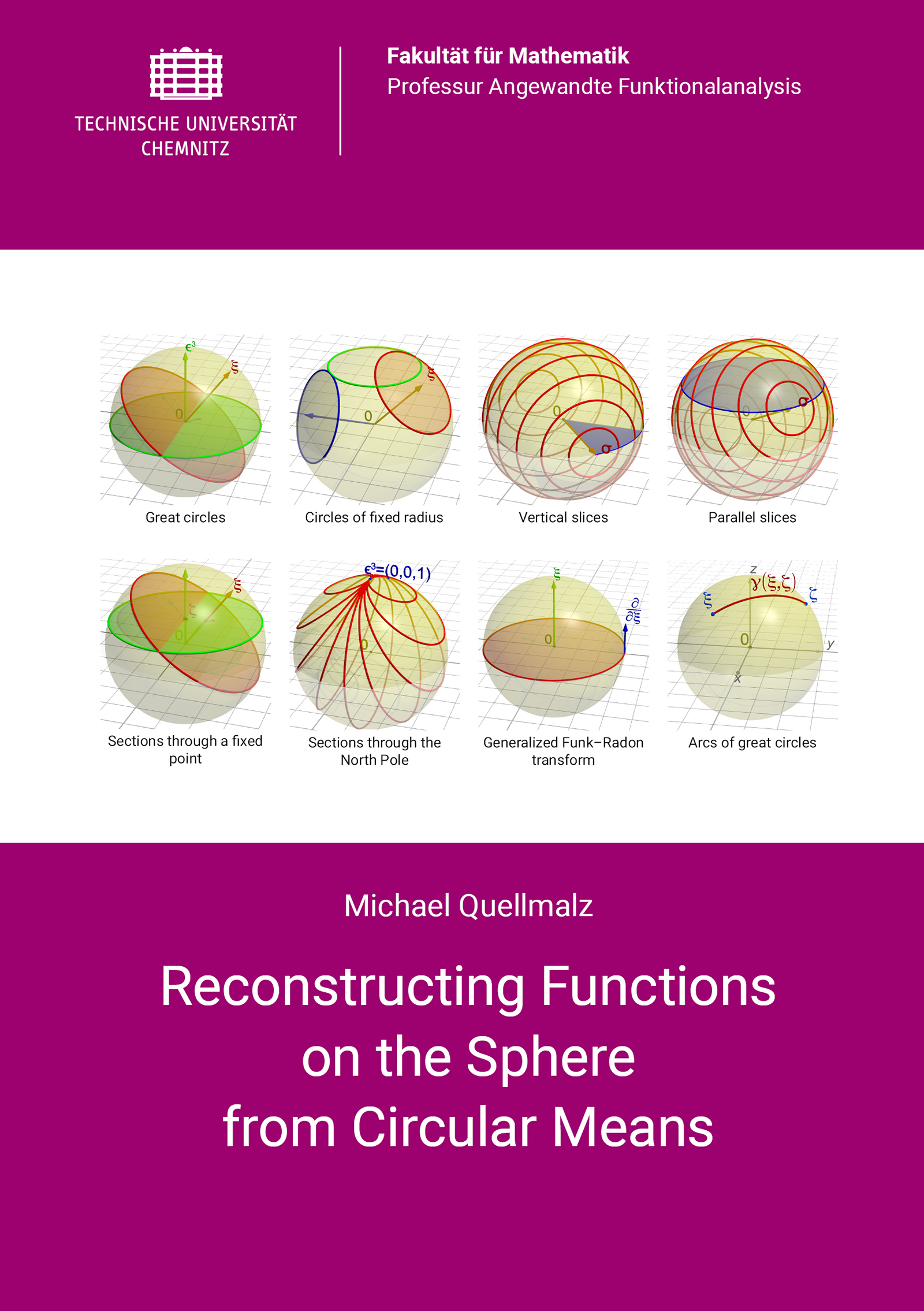
Dr. Michael Quellmalz is a Researcher in Applied Mathematics at the Technical University of Berlin (TU Berlin), affiliated with Faculty II - Mathematics and Natural Sciences and the Institute of Mathematics. His research focuses on inverse problems, tomography, optimal transport, and Fourier analysis with applications in medical imaging and computational geometry. He actively contributes to the SFB Tomography Across the Scales collaborative research center, advancing reconstruction techniques in diffraction tomography and motion detection. He teaches a variety of courses including Analysis II for Engineering, Harmonic Analysis I, and Numerical Mathematics, emphasizing both theoretical foundations and their practical implementations. His work has been recognized through awards such as the Universitätspreise 2020 and a Digital Fellowship for innovative educational contributions in adaptive feedback systems. Key publications include advancements in sliced optimal transport on spheres, motion detection algorithms, and Fourier-based reconstruction methods. Dr. Quellmalz's research group develops MATLAB toolboxes for applications like FourierODT and NFFT-Sinkhorn, reflecting his commitment to bridging mathematical theory with computational tools. His academic journey includes a PhD from TU Chemnitz (2019) and extensive participation in international conferences, workshops, and collaborative projects across Europe.
Elisa Davoli is a Professor of Multiscale Calculus of Variations at the Vienna University of Technology (TU Wien), leading the Research Group Multiscale Variational Calculus . She holds a PhD from SISSA (Trieste) and has earned prestigious awards including the Richard von Mises Prize (2020) and FWF START Prize (2020). Her research focuses on materials science, calculus of variations, and PDEs, with applications to elasticity, phase transitions, and image reconstruction. She teaches courses like Mathematics for Electrical Engineering and Gamma Convergence , and actively organizes international workshops on topics like Shape Optimization and Multiscale Modeling . Her work bridges mathematical analysis and material science, addressing challenges in metamaterials, homogenization, and nonlocal effects. Research Interests : Homogenization, magnetoelasticity, fracture mechanics, calculus of variations, nonlocal models. Key Projects : FWF-SFB grants, START Prize research on tunable materials, and international collaborations with institutions like UTIA (Prague). Awards : Richard von Mises Prize (GAMM, 2020), FWF START Prize (2020), Faculty Teaching Award (2018). Her publications span over 60 papers in journals like Archive for Rational Mechanics and Analysis and SIAM Journal on Mathematical Analysis , addressing topics from morphoelasticity to Cahn-Hilliard systems. She also supervises research groups and contributes to the SFB Taming Complexity in Partial Differential Systems initiative.