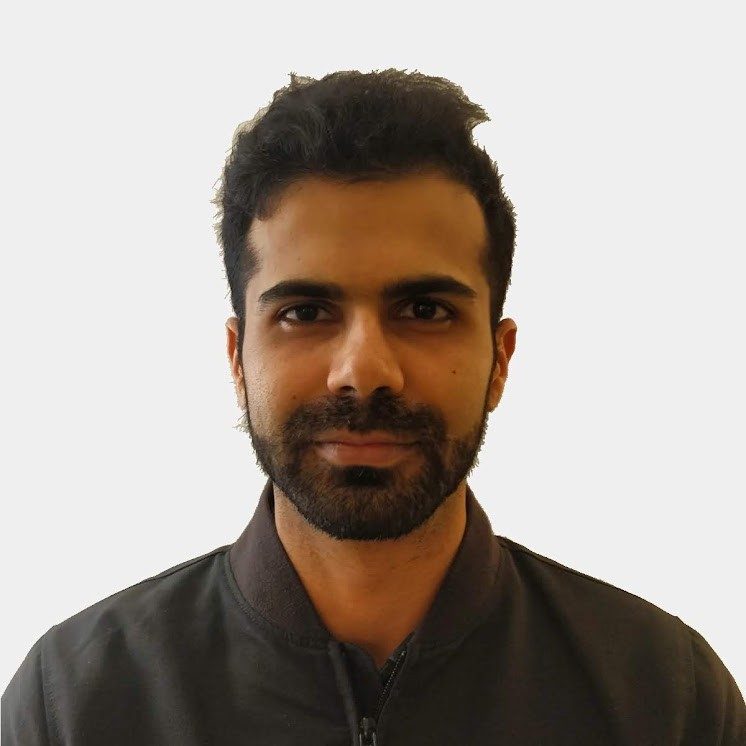
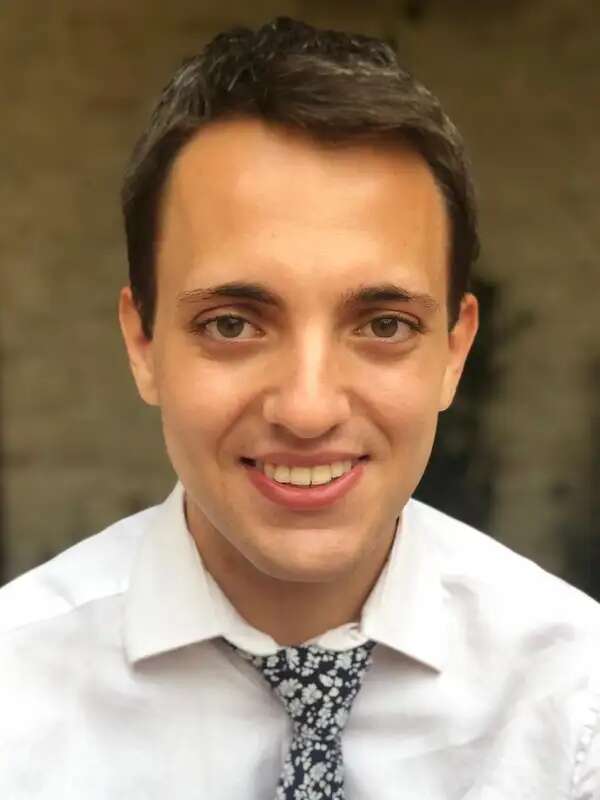
Ruben Verresen is an Assistant Professor of Molecular Engineering at the University of Chicago’s Pritzker School of Molecular Engineering. His research focuses on quantum-entangled states, topological phases of matter, quantum information theory, and their experimental realizations in engineered quantum systems. He collaborates with institutions like Harvard University, MIT, and Quantinuum to explore quantum technologies. Education: B.Sc. (2012): KU Leuven, Belgium M.Sc. (2013): Perimeter Institute for Theoretical Physics M.Sc. (2014): University of Cambridge PhD (2019): Max-Planck-Institute for the Physics of Complex Systems (Technical University of Dresden) Research interests include emergent phenomena in quantum devices, unifying concepts across physics disciplines, and tensor network methods. His work bridges theory and experiment, with notable contributions to topological order in quantum simulators and non-Abelian anyon detection. Awards include the Otto Hahn Medal (2021). Labs/Teams: Verresen Group at UChicago, collaborations with Harvard’s Lukin Lab and Quantinuum.
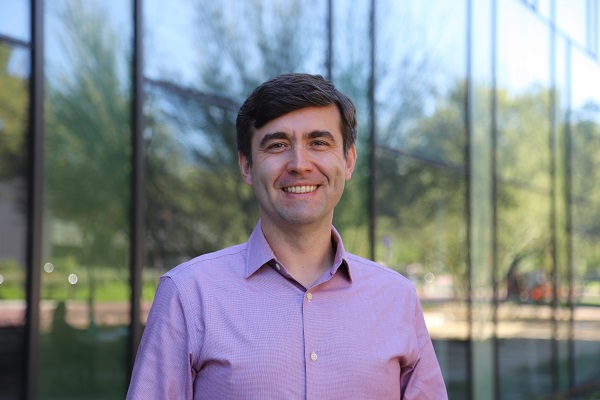
John Evans is an Associate Professor and Jack Rominger Faculty Fellow in the Department of Aerospace Engineering Sciences at the University of Colorado Boulder, affiliated with the Applied Mathematics program. He serves as Associate Chair for Undergraduate Curriculum and is part of the Aerospace Mechanics Research Center (AMREC). His research focuses on computational mechanics, particularly fluid dynamics, fluid-structure interaction, and turbulence modeling using high-order and structure-preserving methods. Evans holds a PhD (2011) and MS (2008) in Computational and Applied Mathematics from the University of Texas at Austin, and dual BS/MS degrees in Mathematics and Applied Mathematics from Rensselaer Polytechnic Institute (2006). Before joining CU Boulder, he was a postdoctoral fellow at the Institute for Computational Engineering and Sciences (ICES). His research interests include isogeometric analysis, immersed methods, and data-driven turbulence modeling. Notable contributions include development of divergence-conforming discretizations for incompressible flows, stabilized collocation methods, and invariant subgrid stress models. He leads the AMREC lab and collaborates on plasma-fueled propulsion systems and geometrically sensitive simulations. Key Awards: 2021: Rocky Mountain AIAA Educator of the Year 2021: Gallagher Young Investigator Medal 2019-2021: Clarivate Highly Cited Researcher Professional Activities: Editor of Engineering Computations, Senior AIAA Member, Simons Visiting Professor (2019) Evans' work bridges advanced numerical methods with real-world engineering challenges. His lab develops open-source tools like XIGA for multi-material problems and focuses on immersive simulation environments. Current projects explore turbulence closure models, plasma propulsion, and topology optimization with B-spline-based approaches.
Prof. Harry Hyungryul Baik is a Tenured Associate Professor at KAIST's Department of Mathematical Sciences since 2017. He holds a PhD from Cornell University (2014) and a B.S. from KAIST (2009), advised by William Thurston, John Hubbard, and Dylan Thurston. His research focuses on geometric topology, geometric group theory, and low-dimensional topology, with notable contributions to mapping class groups, Kleinian groups, and Teichmüller theory. Education: PhD in Mathematics (Cornell, 2014), B.S. in Mathematics (KAIST, 2009). Key research areas include asymptotic translation lengths, laminar groups, and circular orders of groups. He co-leads the KAIST-KIAS joint research group 2K-GATE as Director, emphasizing collaboration between topologists. Research highlights: Characterization of Fuchsian groups via laminations, unsmoothability of mapping class group actions on 1-manifolds, and exponential torsion growth in random 3-manifolds. His work bridges topology with dynamical systems and geometric group theory, often involving collaborations with institutions like KIAS and MPIM. Awards include the Sangsan Prize (2018), Young-KAST membership (2020–2023), and multiple grants from Samsung and POSCO. He advises 7 PhD students and has mentored 15+ alumni, many of whom hold postdoc positions globally. His lab actively hosts conferences like the KAIST Geometric Topology Fair. Labs/Teams: Director of 2K-GATE (KAIST-KIAS), core member of the KAIST Topology Research Group, collaborator with international networks including the Harvard-MIT-Princeton topology axis.
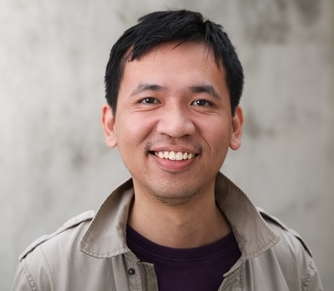
Paul Larson is a Professor of Mathematics at Miami University. His research focuses on set theory, topology, and model theory, with particular expertise in forcing axioms, descriptive set theory, and infinitary logic. He holds a Ph.D. in Mathematics from the University of California, Berkeley. His work bridges foundational mathematical logic with applications in topology and combinatorics. Key contributions include studies on canonical models under fragments of the Axiom of Choice, polar forcings, and cardinal characteristics. Larson has collaborated extensively with leading researchers such as Saharon Shelah and Jindřich Zapletal. His publications span prestigious journals like the Annals of Pure and Applied Logic and Transactions of the American Mathematical Society. Beyond research, he contributes to the academic community through editorial work and expository writings on historical developments in determinacy theory. Education: Ph.D., Mathematics, University of California, Berkeley Research interests emphasize foundational questions in set theory with applications to topology and model theory. His recent work explores advanced forcing techniques, square principles in Pmax extensions, and combinatorial properties of cardinal invariants. Publications reflect interdisciplinary engagement, including crystal structure prediction in high-pressure chemistry and operator theory in functional analysis. Despite an extensive publication record, no specific scientific awards are documented here. His advising and grant activities remain unspecified in the provided texts. Collaborations span international institutions, reflecting his role as a central figure in contemporary set theory research.
Dmitri N. Basov is the Higgins Professor of Physics at Columbia University, with a joint appointment as Professor of Physics at the University of California, San Diego. His research focuses on quantum materials, utilizing nano-optical techniques to investigate electronic phenomena and polaritonic systems. He leads the Basov Group at Columbia and has pioneered methods for imaging quantum materials at nanoscale resolutions. PhD in Physics, Lebedev Physics Institute (1991) Professor, Columbia University (2016–present) Professor, UC San Diego (2001–present) Postdoctoral Research, McMaster University (1992–1996) His work spans plasmonics , terahertz spectroscopy , and van der Waals heterostructures , with recent emphasis on polariton dynamics, superconductivity modulation, and moiré-driven electronic states. He employs cutting-edge tools like quantum scanning near-field optical microscopy (q-SNOM) and resonant inelastic X-ray scattering. Besides leading major grants such as the Gordon and Betty Moore Investigator award and Vannevar Bush Fellowship, Basov has received accolades like the National Academy of Sciences membership (2020), Ken Button Prize (2019), and Frank Isakson Prize (2012). His team explores novel quantum phases in 2D and topological materials.
Virginia Polytechnic Institute and State UniversityUnited States
Dr. Arpit Dua is an Assistant Professor in the Department of Physics at Virginia Tech. Previously, he held positions including a joint Simons-IQIM postdoc at Caltech under Xie Chen and a PhD at Yale University under Meng Cheng and Liang Jiang. His research focuses on theoretical quantum information systems, with emphasis on quantum error correction, topological order, and integrating machine learning principles into physics frameworks. Education: PhD in Physics from Yale University, Postdoctoral research at Caltech. Research Interests: Quantum error correction (developing novel codes using conventional and machine learning methods), thermalization in topological systems, self-correcting models, and applying physics-based insights to AI architecture design. His current projects explore fault-tolerant protocols, fracton orders, and Floquet codes. Publications reflect contributions to topological codes, subsystem symmetries, and fracton physics. His work bridges quantum information theory with condensed matter physics.
California Institute of Technology (Caltech)United States
Alexei Kitaev is the Ronald and Maxine Linde Professor of Theoretical Physics and Mathematics at the California Institute of Technology (Caltech). His research focuses on quantum computation, topological quantum phases, anyons, topological insulators and superconductors, and the black hole information paradox. He has pioneered the concept of topological quantum computation, where quantum information is protected through topological properties of many-body systems. His recent publications explore quantum error correction, scrambling dynamics, and holographic principles in SYK-like models, reflecting his interdisciplinary impact on quantum physics, computer science, and condensed matter. His work on the Sachdev-Ye-Kitaev model has advanced understanding of quantum chaos and gravitational phenomena. Kitaev has received numerous accolades, including the MacArthur Award (2008), Breakthrough Prize in Fundamental Physics (2012), Dirac Medal (2015), and Oliver Buckley Condensed Matter Prize (2017). He has taught advanced courses such as 'Quantum Computation' and 'Advanced Condensed-Matter Physics' at Caltech. Scientific Awards: MacArthur Award (2008) Breakthrough Prize in Fundamental Physics (2012) Dirac Medal (2015) Oliver Buckley Condensed Matter Prize (2017)
California Institute of Technology (Caltech)United States
Dr. Konstantin (Kostia) M. Zuev serves as Teaching Professor in the Computing + Mathematical Sciences Department at California Institute of Technology , where he has made significant contributions to network science and computational statistics since 2016. His dual PhDs in Mathematics (Moscow State University, 2008) and Civil Engineering (HKUST, 2009) underpin his interdisciplinary research spanning differential geometry, stochastic simulation, and network dynamics. Education PhD in Mathematics, Lomonosov Moscow State University (2008) PhD in Civil Engineering, Hong Kong University of Science & Technology (2009) His research focuses on network science , particularly course-prerequisite networks and complex financial systems , with recent work extending to network navigability in cosmological models and rare event simulation. Over his career, he has developed innovative Bayesian inference methods and geometric preferential attachment theories while maintaining active collaborations across mathematics, physics, and biomedical domains. Recent publications highlight network analysis in education ( 2023 ), hyperbolic graph theory ( 2024 ), and pandemic-informed cancer mortality studies ( 2023 ). His 15 most recent articles demonstrate methodological innovations across disciplines including statistics, physics, finance, and cosmology. Scientific recognition includes Humboldt Research Fellowship (2021) Carver Mead Seed Fund Grant (2023) ASCIT Teaching Award (2018, 2023) Northrop Grumman Teaching Excellence Prize (2019) As Graduate Option Representative for Information and Data Sciences at Caltech and faculty advisor for multiple student organizations including the Caltech Karate Club and Caltech Chess Club , he actively bridges academic rigor with community engagement through outreach initiatives like the virtual math education channel and university math circles for K-12 students.
Daniel Gottesman is the Brin Family Endowed Professor in Theoretical Computer Science at the University of Maryland, affiliated with the Department of Computer Science, Institute for Advanced Computer Studies (UMIACS), and the Joint Center for Quantum Information and Computer Science (QuICS). He holds a Ph.D. in Physics from Caltech (1997) and has held positions at institutions like the Perimeter Institute and Quantum Benchmark. His research focuses on quantum computing, quantum error correction, and fault-tolerant systems, with contributions to stabilizer codes and quantum teleportation-based gates. Education: Bachelor's in Physics, Harvard University (1992) Ph.D. in Physics, California Institute of Technology (1997) Research Interests: Quantum error correction and fault-tolerant architectures Quantum cryptography and secure communication protocols Quantum complexity theory and algorithm design Applications of stabilizer codes and topological quantum computing Scientific Awards: Fellow of the American Physical Society CIFAR Senior Fellow in Quantum Information Science Three U.S. Patents (e.g., quantum key distribution systems) Advising & Grants: Supervised over 30 students/postdocs and served on numerous thesis committees. Active in securing funding for quantum research through endowed professorships and industry partnerships (e.g., Quantum Benchmark). Labs/Teams: Member of QuICS and UMIACS, collaborating on quantum hardware-software integration and error correction challenges.
Meng Cheng is an Assistant Professor of Physics at Yale University, specializing in condensed matter theory. He holds a B.S. from Nanjing University (2008) and a Ph.D. in Condensed Matter Theory from the University of Maryland (2013). After a postdoctoral position at Microsoft Research Station Q (2013–2016), he joined Yale in 2017. His research focuses on quantum criticality, fractonic phases, and symmetric topological phases, with a particular emphasis on classification and characterization of exotic quantum matter. He has received prestigious awards including the NSF CAREER Award (2019) and the Alfred P. Sloan Fellowship (2019). Key research interests include topological superconductivity, global symmetry interactions, and applications in quantum information. His work bridges theoretical frameworks with experimental implications, exploring topics like Wilson loop operators, disorder operators, and entanglement entropy in gapless systems. He has contributed to advancements in understanding symmetry-enriched topological phases and their surface topological order. Publications span high-impact journals and cover topics such as fractionalization in electronic insulators, quantum Hall effects, and topological stabilizer models. His talks highlight interdisciplinary approaches, including seminars at the Perimeter Institute and Université de Montréal on fractonic topological phases and infinite-component Chern-Simons theories. Awards and grants underscore his contributions to advancing theoretical physics, with a focus on fostering innovation in quantum materials and computational methods. Teaching and mentorship activities further his commitment to education within the Yale Physics Department.
Jundong Li is an Assistant Professor at the University of Virginia with primary appointment in the Department of Electrical and Computer Engineering and secondary appointments in Computer Science and the School of Data Science. He is affiliated with the School of Engineering and Applied Science and conducts research at the intersection of machine learning, data mining, and artificial intelligence. Education: Ph.D. in Computer Science, Arizona State University, 2019 M.Sc. in Computer Science, University of Alberta, 2014 B.Eng. in Software Engineering, Zhejiang University, 2012 His research focuses on graph machine learning , trustworthy and fair AI , and large language models . He investigates how to make deep learning models more interpretable, robust, and equitable, especially in graph-structured data and NLP applications. His work combines causal inference, feature selection, and model explanation techniques to build reliable AI systems. His recent publications (2024–2022) reveal a strong trend toward large language models , with topics including in-context learning, knowledge editing, and collaborative reasoning. Simultaneously, he continues pioneering research on fairness and interpretability in graph neural networks , addressing structural bias, adversarial attacks, and node attribution. His work is highly interdisciplinary, spanning computer science, data science, and social impact. Scientific Awards: SIGKDD Rising Star Award (2024) PAKDD Best Paper Award (2024) NSF CAREER Award (2022) SIGKDD Best Research Paper Award (2022) JP Morgan Faculty Research Award (2021, 2022) Cisco Faculty Research Award (2021) Stanford/Elsevier Top 2% Scientist (2024) Jundong Li actively advises graduate students, as seen in his co-authored papers with researchers like Song Wang, Yushun Dong, and Binchi Zhang. His research is generously funded by the National Science Foundation (NSF) through multiple programs including CAREER, III, SaTC, SAI, and S&CC, as well as by the Department of Energy (DOE) , Office of Naval Research (ONR) , Jefferson Lab , and industry partners including JP Morgan, Cisco, Netflix, and Snap . He leads a dynamic research group focused on advancing the frontiers of graph learning and trustworthy AI, with projects on causal inference, model unlearning, and explainable systems. His lab contributes to both theoretical foundations and real-world applications in public health, transportation, and network security.
Marco Castronovo serves as an Assistant Professor in the Mathematics Department at Columbia University, with his office located in Mathematics Hall 614. His academic work bridges continuous and discrete mathematical structures through the lens of symplectic geometry and topology. His research focuses on Symplectic Topology , particularly exploring symplectic structures as frameworks for quantization of classical invariants. Key interests include: Developing open-string versions of Schubert calculus Investigating cluster structures in positroid varieties Constructing Landau-Ginzburg models for Grassmannians Studying Lagrangian cobordisms and exotic tori Analyzing connections between Dubrovin spectra and Fukaya algebras His recent publications reveal a consistent trajectory toward unifying symplectic geometry with combinatorial algebraic structures, particularly through Grassmannian varieties and their mirror symmetric counterparts. The work demonstrates increasing sophistication in connecting Fukaya categories with cluster algebraic frameworks, while maintaining strong ties to quantum topological invariants. As an academic mentor, Castronovo supervises undergraduate researchers including B. Basson (Barnard Summer Research Institute) and S. Kesavan (Columbia Summer Research Fellowship). He actively contributes to the mathematical community through refereeing and co-organizing the Columbia SGGTC Seminar, demonstrating commitment to both research dissemination and academic service. His computational work manifests through three significant open-source projects: Posetroids for exploring Zariski closure orders in Grassmannians, DubrovinDynamics for visualizing spectral evolution in truncated Dubrovin operators, and ClusterExplorer for conducting random walks on cluster structures of Grassmannians. These tools have become valuable resources for researchers working at the intersection of symplectic geometry and combinatorics.
David Perkinson is a Professor of Mathematics at Reed College, where he holds a position in the Department of Mathematics. His research focuses on combinatorics, algebraic geometry, and discrete mathematics, with a particular emphasis on sandpile models, graph theory, and matroid theory. He is the author of the textbook *Divisors and Sandpiles: An Introduction to Chip-Firing*, which explores the combinatorial theory of chip-firing on graphs. Perkinson has also developed software tools like the Sandpile Java App, which visualizes and analyzes the Abelian Sandpile Model. He organizes the Cascade Lectures in Combinatorics (CALICO), a series of conferences funded by the National Science Foundation, aimed at fostering collaboration among researchers in combinatorics. His work bridges discrete mathematics with algebraic geometry, emphasizing connections between graph theory and geometric structures. Perkinson teaches advanced courses in analysis and contributes to the academic community through his research on topics such as divisor theory on graphs, sandpile groups, and combinatorial game theory. His recent publications (2015–2024) address matroid theory, sandpile dynamics, and applications of algebraic methods to discrete systems.
Yuan Cao is an Assistant Professor of Electrical Engineering and Computer Science at the University of California, Berkeley, since July 2024. He completed his BSc in Applied Physics at the University of Science and Technology of China (2014), followed by an MS (2016) and PhD (2020) in Electrical Engineering at MIT. Before joining Berkeley, he was a Junior Fellow at Harvard University (2021–2024). His research focuses on the electrical properties of low-dimensional materials and their applications via nanotechnology, including MEMS. Notable achievements include pioneering work on twisted graphene superconductivity, recognized as a Nature’s 10 highlight (2018) and Physics Breakthrough of the Year . He has received awards such as the Sackler Prize in Physics (2020), McMillan Award (2021), and NSF CAREER Award (2025). His research integrates experimental physics, nanofabrication, and low-temperature transport to explore novel quantum phenomena in 2D materials. Recent breakthroughs include the MEGA2D platform, an on-chip MEMS system enabling precise manipulation of 2D materials. Collaborations with Prof. Nguyen secured a $1M DARPA NIMBUS contract, and his NSF CAREER award funds studies on reconfigurable graphene superlattices. Education: PhD, Electrical Engineering, MIT (2020) MS, Electrical Engineering, MIT (2016) BSc, Applied Physics, USTC (2014) Awards: NSF CAREER Award (2025) Sackler Prize in Physics (2020) McMillan Award (2021) TIME 100 Next (2019) Grants & Funding: $1M DARPA NIMBUS Program Contract (2023) $810K NSF CAREER Award (2025) Prof. Cao’s lab actively recruits motivated graduate students and postdocs with expertise in 2D materials, MEMS, nanofabrication, or low-temperature physics. The lab is part of UC Berkeley’s College of Engineering, fostering interdisciplinary research at the forefront of quantum and nanoscale systems.
Clay Córdova is an Associate Professor at the University of Chicago, associated with the Enrico Fermi Institute, James Franck Institute, Kadanoff Center, and Kavli Institute. His research focuses on theoretical physics, particularly quantum field theory, non-invertible symmetries, and their applications in particle and condensed matter physics. Córdova’s work explores topological phases, gauge theories, and string theory, with recent contributions to non-invertible symmetry classification and their role in phase transitions. His research interests include categorical symmetries, topological defects, and anomaly matching in quantum field theories. He has pioneered studies on soliton-particle degeneracies, anyon condensation mechanisms, and anomalies in non-invertible symmetry frameworks. Córdova’s work bridges high-energy physics with condensed matter systems, often employing advanced mathematical techniques from category theory and algebraic topology. His 2023 Sloan Research Fellowship highlights recognition of his contributions. Key research trends span non-invertible symmetries across dimensions, topological field theory applications, and interdisciplinary methods combining machine learning with lattice gauge theory. Current projects include exploring duality defects, gapped phase obstructions, and symmetry-enriched phases in (3+1)D systems.