Amanda Casarez serves as an Assistant Professor of Fashion Design within the College of Arts and Humanities at Lindenwood University, based at the J. Scheidegger Center For The Arts. She teaches a comprehensive curriculum spanning foundational to advanced fashion design courses across undergraduate and graduate levels, including Apparel Design, Textile Science, and Computer-Aided Design specializations. Her research focuses on the integration of digital technologies in traditional fashion workflows, with primary interests in 3D garment modeling, patternmaking innovation, and technical design for sustainable production. Key areas include textile applications, draping methodologies, and hybrid design approaches that bridge physical and digital fabrication techniques in contemporary fashion. No scientific awards or honors were documented in the available institutional records. While specific advising details and grant activities remain unreported in public university materials, her course load indicates active mentorship in senior collection development and technical design projects. Laboratory facilities or dedicated research teams were not referenced in the source documentation.
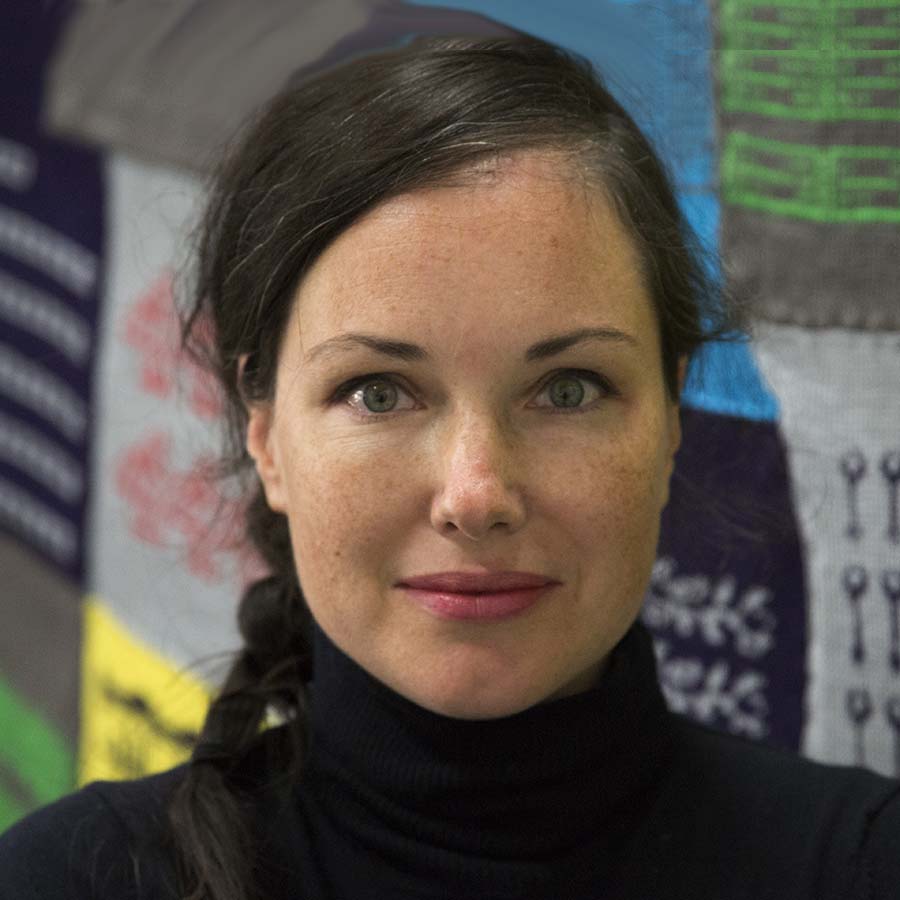
Cat Mazza is Professor of Art at the University of Massachusetts Boston since 2007, where her practice bridges textile traditions, digital technology, and critical labor studies through innovative visual art forms. Her educational background includes: MFA in Integrated Electronic Arts, Rensselaer Polytechnic Institute (2005) BFA in Studio Art, Carnegie Mellon University (1999) Mazza's research investigates how knitting and electronic media converge to expose hidden labor systems in technological production. Her work transforms textile craft into political commentary through algorithmic design and interactive installations, challenging distinctions between handmade and machine-made while highlighting gendered labor histories. This interdisciplinary approach positions craft as critical infrastructure for examining contemporary techno-capitalism. Her recent creative output demonstrates consistent evolution in electronic textile applications, moving from single-channel animations like "Knit for Defense" to complex sculptural installations that merge physical computing with traditional fiber techniques. These works establish textiles as active interfaces for engaging with labor politics, biotechnology, and resistance strategies in digital culture. Mazza's artistic contributions have been recognized through prestigious awards: Creative Capital Fellowship MacDowell Colony Fellowship Craft Research Fund Fellowship Now+There Public Art Accelerator Fellowship Rockefeller Foundation Fellowship As a professor at UMass Boston, Mazza mentors emerging artists while maintaining an active studio practice. Her early career at Eyebeam (1999-2002) established foundational collaborative methodologies that continue to inform her interdisciplinary approach, bridging art, technology development, and social critique within academic and public spheres. Mazza's work occupies significant space in major collections including the Smithsonian American Art Museum, with international exhibitions spanning the Victoria & Albert Museum, Museum of Arts and Design, and Triennale Design Museum, demonstrating sustained relevance across art, craft, and technology discourse.
Prof. Dr. Snezana Stanković is a Full Professor at the Department of Textile Engineering within the Faculty of Technology and Metallurgy, University of Belgrade . Appointed in 2022, her work focuses on textile comfort, sustainable materials, and functional clothing design. She teaches courses like "Clothing Construction" and "Thermal Comfort Optimization." Key Research Areas: Textile Engineering, Material Science, Sustainable Textiles Notable Collaborations: Milada Novaković, Dušan Popović, Goran Poparić Her recent publications emphasize eco-friendly cellulose textiles, UV protection, and hemp-based materials. She has mentored 11 students across Basic, Master's, and Doctoral studies, including Ana Mićković (2024) on UV protective hemp textiles and Stefana Milosavljević (2024) on fluid management in knits. Despite her 2000 paper on metal fibers in yarns, no explicit scientific awards are documented in the provided text.
Heidi Paavilainen is a Senior Lecturer at the Department of Design, Aalto University . Her work bridges design practice with academic research, focusing on everyday life, user engagement, and wellbeing. Academic Rank: Senior Lecturer University: Aalto University Department: Department of Design Research Interests include: User-Centered Design Sustainable Living Environments Emotional and Behavioral Aspects in Design Material Culture Studies Design Pedagogy Scientific Awards : Knight of the Order of the White Rose of Finland (for academic/artistic contributions)
Dr. Tomoko Aoyama is an Honorary Associate Professor at the School of Languages and Cultures , The University of Queensland , with a focus on Japanese literature, cultural studies, and translation. Her research bridges gender, humor, and food studies within modern and contemporary Japanese contexts. Education: PhD in Japanese Literature, The University of Queensland (1992). Research Themes include gender dynamics , humor in Japanese texts , food as cultural metaphor , and translation studies . She explores these through works like The Stripper Goddess of Japan (2023) and analyses of authors such as Itō Hiromi and Kanai Mieko. Publication Trends highlight her contributions to gender studies (e.g., LGBTQ+ themes in Yoshinaga Fumi's manga), food in literature (e.g., culinary metaphors in post-war narratives), and cultural hybridity (e.g., cross-border themes in Japanese-Australian collaborations).
Professor Hugh Cheape is a Course Leader at Sabhal Mòr Ostaig UHI , the National Centre for Gaelic Language and Culture. He lectures at both Sabhal Mòr Ostaig and Edinburgh University, drawing from a career as Principal Curator in the Department of Scotland and Europe at National Museums of Scotland. Academic Rank: Professor Teaching: MSc Cultar Dùthchasach agus Eachdraidh na Gàidhealtachd (Gaelic Cultural and Historical Studies) External Role: Lecturer, University of Edinburgh (Postgraduate Certificate in Scottish Culture and Heritage) Research Interests span ethnology , musicology , and material culture . His work focuses on Scottish agricultural history, vernacular architecture, piping traditions, tartans, and talismanic beliefs. He contributes to UN Sustainable Development Goals through cultural preservation initiatives. Key Themes: Cultural heritage, historical continuity, linguistic communities, maritime identity, and sustainable practices Recent Publications: Explore Hebridean plough types, maritime environmental campaigns, and island cultural heritage Scientific Awards: RSE Fellow (2023), recognizing contributions to Scottish cultural scholarship Collaborations include partnerships with the School of Scottish Studies and the University of Edinburgh. His work bridges academic research with public engagement through the Tobar an Dualchais / Kist o Riches digitization project.
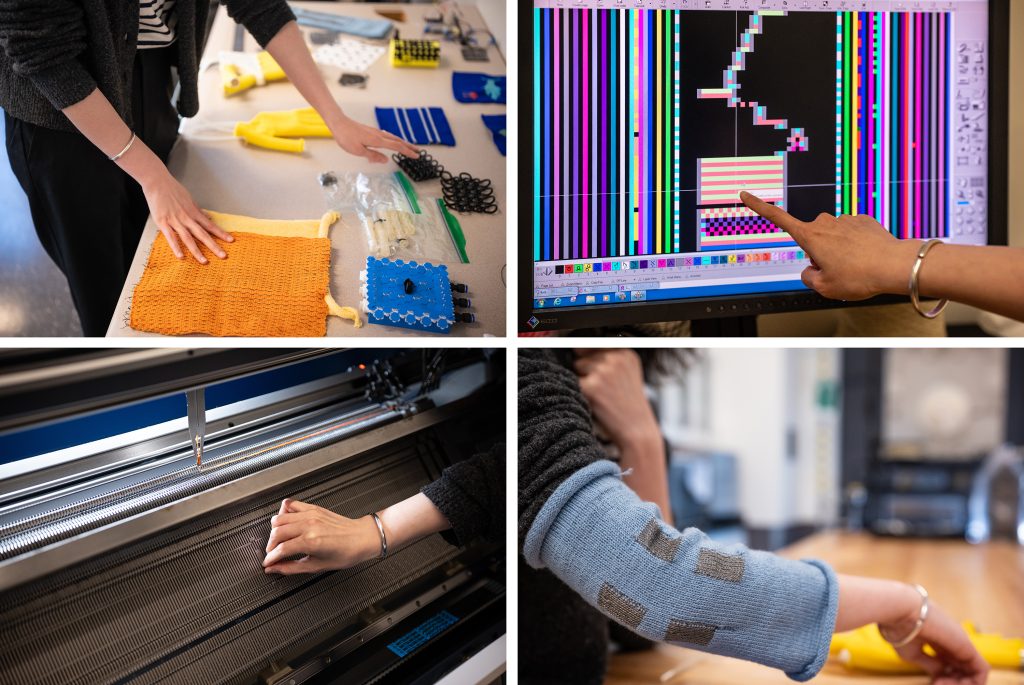
Yiyue Luo is an Assistant Professor at the University of Washington's College of Engineering, Department of Electrical and Computer Engineering (UW ECE). She leads the Wearable Intelligence Lab, focusing on integrating digital fabrication, human-robot interaction, and applied AI to develop smart textiles for physical task guidance.
Anne-Caroline Sieffert is a Lecturer in Romance Languages and Literatures at Binghamton University (SUNY system), where she teaches French language courses and specialized content courses. Originally from Strasbourg, France, she has taught at multiple institutions including Syracuse University, Brown University, Montclair State University, the College of Staten Island, Cornell University, and Ohio Wesleyan. Her educational background includes a BA and MA in History from the University of Strasbourg, an MA in Literature, Language and Linguistics from Syracuse University, and a PhD in French Studies from Brown University. Her research focuses on gender studies, the history of photography, mental health and neurodivergence, and the construction of racial categories in the 19th century. Sieffert's scholarly work centers on women and minorities in France from the mid-19th to mid-20th century, with particular emphasis on travel literature and the construction of gender through women-authored travel journals. Her dissertation, 'The Good Woman Abroad: Female Travel and French Citizenhood, 1860-1910,' examines how upper-class women traveling to the Maghreb and North America challenged traditional frameworks of femininity in the 19th century. Her recent publications and creative work show a consistent focus on how material culture, overconsumption, mass marketing, and capitalism transformed notions of gender and race during the long 19th century. Through her podcast 'The Transatlantic Notebook,' she explores the intersections of science in pop culture and the construction of race and gender in historical contexts. Graduate Student Contribution to Community Life Award, 2016 Nominated, The K Patricia Cross Future Leaders Award, 2014 Foundation Award for Service to the LGBTQ Community, Syracuse University, 2009 Beyond her formal teaching, Sieffert is passionate about mentoring students, creating inclusive classroom environments, and making education accessible. She has developed numerous syllabi with cost-conscious materials for students on financial aid. She is also an enthusiastic collector of Kodak cameras (over 60 spanning from the late 19th century to the 1980s), which informs her research on the intersection of popular culture, engineering ingenuity, and visual studies.
Miroslava Gašparová is a Lecturer at the Pedagogical Faculty of Matej Bel University , Banská Bystrica, Slovakia. She works in the Department of Early Childhood and Primary Education, focusing on curriculum integration, cultural heritage, and educational technology in primary education. Her contact details include office locations C 214 and A 107, with consulting hours by prior arrangement via email. Current project: Creation of educational materials for Slovak language teaching (2024-2026) Project: Enhancing teacher preparation through integrated curricula (2021) Project: Art interpretation in pre-primary education (2019-2021) Her research emphasizes: Integration of technical education with natural/social sciences Regional education content in early childhood curricula Digital technology applications in primary textbooks Interdisciplinary approaches to cultural heritage preservation Project-based learning methodologies for distance education Development of national identity through regional studies Recent publications show trends toward: Integrated regional and cultural content in primary textbooks Combining technical and environmental education Enhancing digital literacy through curriculum design Experiential learning models for early childhood Preservation of Slovak identity abroad through education Active life skills development from childhood Her professional work includes: Designing teacher training programs Curriculum development for primary education Regional content integration across subjects Collaborative educational material creation Distance education methodology research
Neil Reeves is a Professor of Secure Health Technologies at Lancaster University's Medical School. His work bridges digital health technologies and cybersecurity , focusing on diabetic foot ulcer prevention and gait improvement through smart medical devices. First proof-of-concept clinical trial on smart pressure-sensing insoles (Lancet Digital Health) Early clinical trial on vibrating insoles for balance improvement (Diabetes Care) EPSRC-funded Socksess project developing smart-sensing socks Co-developed FootSnap-AI app with Prof. Moi Hoon Yap Research spans AI-driven wearable technologies , medical device cybersecurity , and biomechanical interventions for chronic disease management. Recent publications focus on chronic wound segmentation , strain sensors , and plantar stress analysis . Scientific awards include the Oracle Innovator Accelerator Grant . He serves on international funding panels (EPSRC, NIH) and journal editorial boards (Gerontology, European Journal of Sport Science).
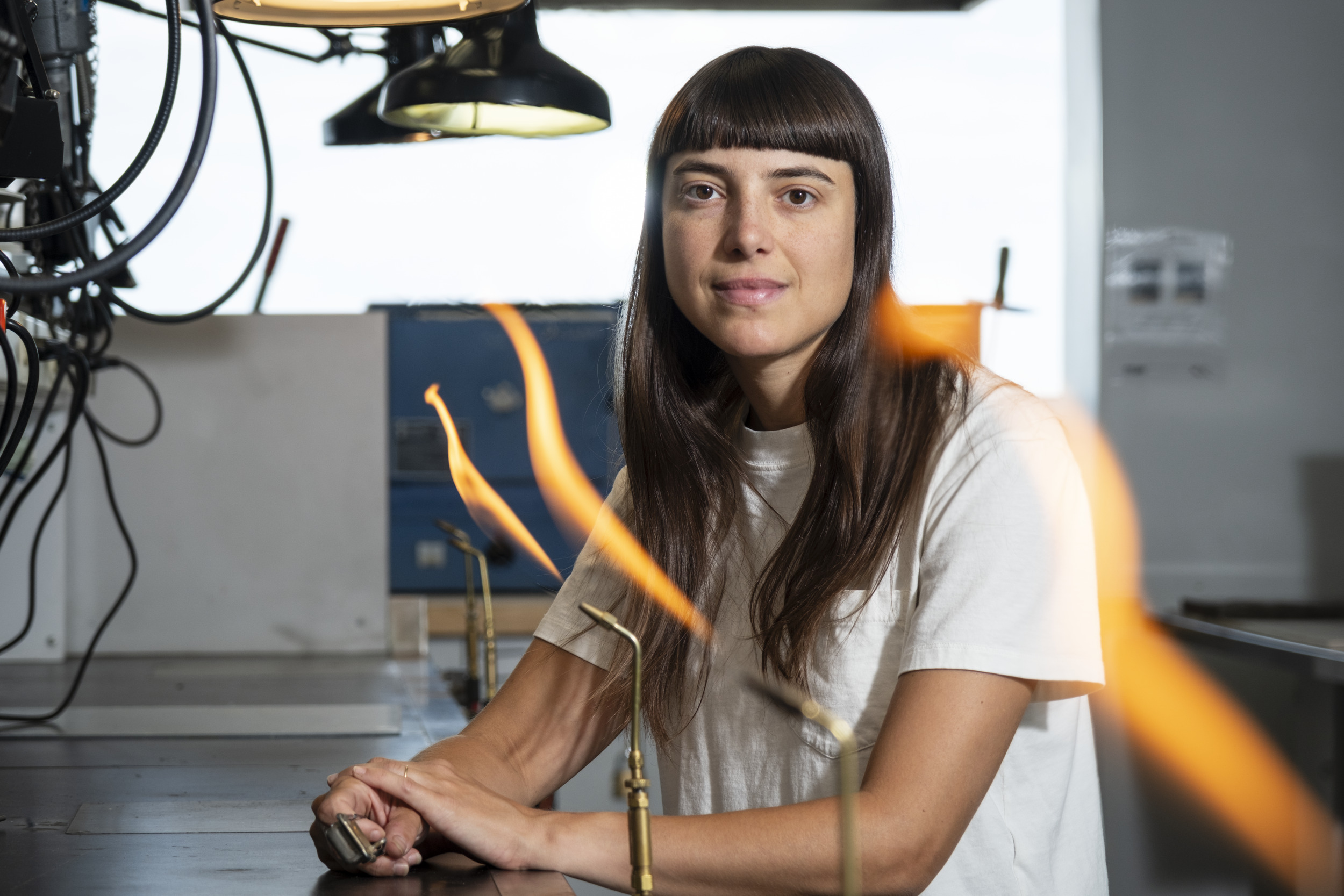
Mallory Weston is an Associate Professor in the Metals/Jewelry/CAD-CAM department at the Tyler School of Art and Architecture, Temple University. She combines traditional jewelry and metalsmithing with textile techniques and computer-aided design to create large-scale wearable art. A graduate of the Rhode Island School of Design (MFA, 2013) and The University of the Arts (BFA, 2009), she maintains an active studio practice as part of the JV Collective, a national art jewelry group. Education MFA, Rhode Island School of Design, 2013 BFA, The University of the Arts, 2009 Her research explores hybrid methodologies in craft, focusing on the intersection of analog processes and digital design. She is deeply involved in curatorial projects and international collaborations, bridging art jewelry with broader artistic platforms. Weston’s work has been featured in solo and group exhibitions globally, including at the Baltimore Jewelry Center, Sienna Patti Contemporary, and the RISD Museum. Her pieces are held in prestigious collections such as the Museum of Fine Arts (Boston), Dallas Museum of Art, and Design Museum den Bosch (Netherlands). Scientific Awards Art Jewelry Forum Young Artist Award (2022) Studio Rian de Jong Artist in Residence (2019) Open Studio Residency at Haystack Mountain School of Crafts (2017) MAD Artist Studios Residency (2016)
Henrik Widmark is a Senior Lecturer at the Department of Art History, Uppsala University, specializing in urban cultures, architectural history, and cultural heritage. His research explores the intersection of materiality, identity, and urban transformation. Affiliation : Department of Art History, Uppsala University Roles : Former research leader for The Good City, coordinator for the Forum for Research on Church Cultural Heritage Research Interests : Henrik focuses on urban identities shaped through architecture, subcultures, and historical narratives. His work spans topics like fascist symbolism in Rome, digital education frameworks, and the role of religious spaces in multicultural societies. Scientific Awards : None listed in the provided text.
Daniel Lee Ashbrook is an Associate Professor in the Department of Computer Science at the University of Copenhagen (DIKU). He specializes in Human-Centred Computing, focusing on tangible user interfaces, wearable technology, and computational fabrication. His work bridges hardware innovation with practical applications in interactive design. Research Themes : Embedded sensors, 3D-printed interactive systems, pneumatic computing, and accessible fabrication tools. Collaborations : Regularly works with researchers like Victor Savage and Hyeon-Jeong Kim on novel interface technologies. Recent publications highlight advancements in tactile feedback systems, multi-material fabrication, and sensor integration in everyday objects. His projects often combine physical and digital elements for intuitive user experiences. Key trends include democratizing hardware prototyping and enabling electronics-free interactivity. Awards : ISWC 2012 Best Papers Award. Contact : Email dan@di.ku.dk or call +45 53638312.
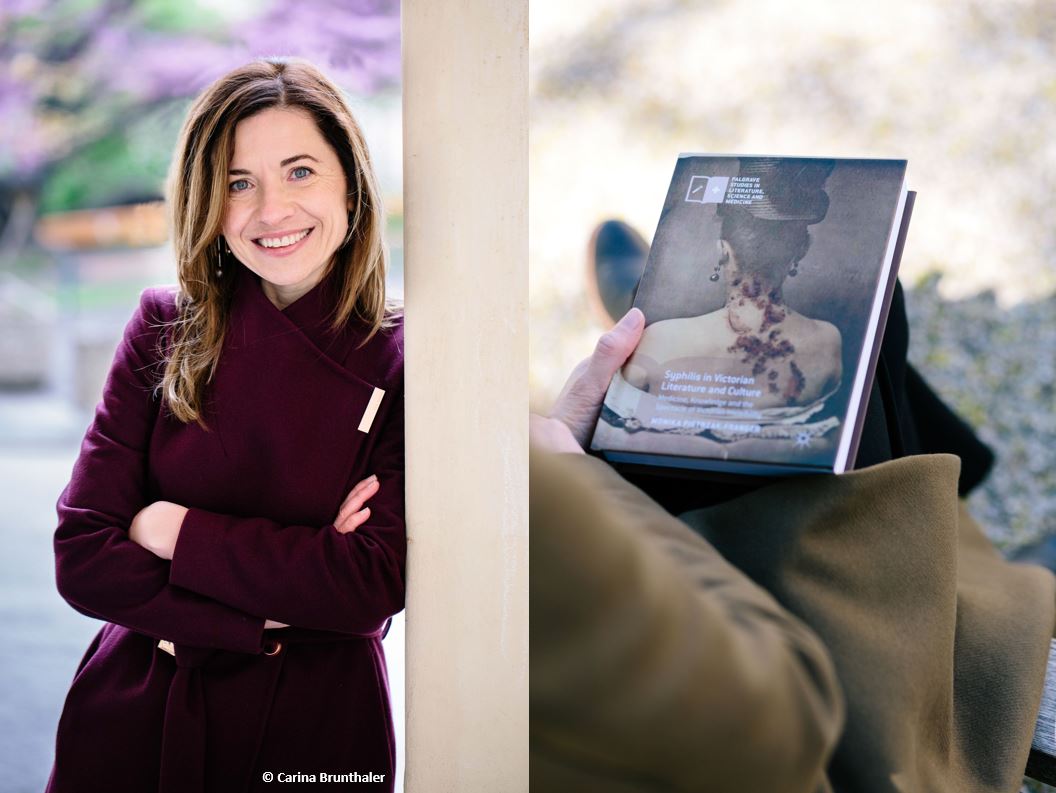
Univ.-Prof. Dr. Monika Pietrzak-Franger is a Full Professor for British Cultural and Literary Studies at the Department of English and American Studies, Faculty of Philological and Cultural Studies, University of Vienna. She serves as Head of Department and Deputy Head of Section "Knowledge, Literature and Media" at the Doctoral School of Philological and Cultural Studies. Her work bridges literary studies, cultural studies, and medical humanities with a particular focus on the socio-political dimensions of health, illness, and medical representation. Dr. Pietrzak-Franger's research spans multiple interconnected fields including Medical Humanities (particularly contagious diseases and their socio-political role and mediality), Adaptation Studies, Intermediality and Transmediality Studies, and Gender Studies. Her work examines how cultural narratives shape our understanding of health and illness, with special attention to visual representations, stigma, and the intersection of medicine with literature and the arts. She has made significant contributions to Victorian studies, particularly around representations of syphilis in the 19th century, which has informed her more recent work on pandemic representation. Her recent publications demonstrate a clear trajectory toward examining the cultural dimensions of the COVID-19 pandemic and its aftermath, particularly Long Covid. Through interdisciplinary approaches combining literary analysis, visual culture studies, and medical humanities, she explores how pandemics are narrated, visualized, and experienced across different media platforms and cultural contexts. Her work increasingly focuses on patient narratives, healthcare disparities, and the social dimensions of chronic illness. Among her notable achievements is the BritCult Award (2015) for her habilitation treatise "Spectres of Syphilis: Medicine, Knowledge and the Spectacle of Victorian (In)Visibility." She has also led significant projects including the Interuniversity Cluster "Post-COVID-19 Care: Medical Humanities and Health Economies at the Frontlines," the interdisciplinary lecture series and conference "COVID-19 beyond Borders: Rethinking Medical Humanities at the Frontlines," and "Post-COVID-19 Art Worlds: Viral Theatre, Precarity and Medical Humanities." Dr. Pietrzak-Franger supervises numerous doctoral and postdoctoral researchers and has established a vibrant research team focused on Medical Humanities. She has secured significant funding for her interdisciplinary projects and has been instrumental in developing the Medical Humanities field at the University of Vienna. Her "Viral Theatre Podcast" series represents innovative knowledge transfer that bridges academic research with public engagement. She leads the research team at the Medical Humanities initiative at the University of Vienna, which includes postdoctoral researchers, doctoral candidates, and administrative support staff. The team works at the intersection of literary studies, cultural studies, and medical humanities, with particular expertise in pandemic representation, chronic illness narratives, and the visual culture of health and disease. The group has organized numerous conferences, workshops, and public engagement initiatives including the "Threads of Life: Textiles in Medicine and the Arts" exhibition and conference.
Anna Kouhia is a University Lecturer at the University of Helsinki , Department of Education, specializing in craft education and sustainable material practices. She leads projects like DigiSTEAM: Digital learning in STEAM pedagogy and contributes to initiatives such as KoKä synergiaa (Collaborative Development of Home Economics and Craft Education Research). Her work bridges digital and material realms, focusing on consumer relationships with textiles, waste management, and pandemic-era educational adaptations. Fields of Research: Educational Sciences, Sustainable Fashion, Craft Pedagogy Projects: DigiSTEAM (Principal Investigator), Teacher education across Europe (Co-Investigator) Research Trends include analyzing textile repair as emotional sustainability ( 2024-2025 ), pandemic crafting communities ( 2022-2023 ), and multimaterial curriculum innovations. Her Google Scholar profile shows 49 research outputs, with recent emphasis on digital-material intersections and circular economies. Scientific Awards HY Alumni ry:n kannustusstipendi , 2008 Väitöskirjapalkinto , 2019 Kouhia collaborates on European educational mobility, evaluates projects like Kasvun tila (2024), and participates in academic workshops such as Teacher Education in international perspective (2025). Her teaching integrates STEAM frameworks and material literacy, impacting both undergraduate and doctoral programs.