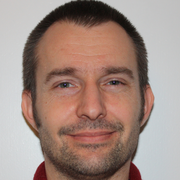
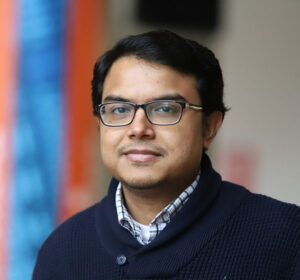
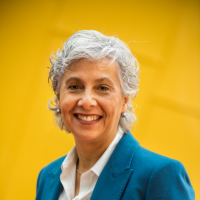
Magnus Liebherr is a Professor at the University of Duisburg-Essen , focusing on Technology Acceptance , Artificial Intelligence , and Sustainable Transportation . His work bridges Business Administration with Human-Computer Interaction , exploring how users adapt to emerging technologies like autonomous vehicles and AI systems. Key research areas include: Acceptance of AI applications in mobility Business model development for climate-neutral transportation Cognitive and psychological factors in technology interaction Digital media effects on adolescent well-being Trust calibration in automated systems His recent publications examine Large Language Model dependency , gamified language learning , and mental workload metrics for autonomous vehicles. While no formal awards are listed, his interdisciplinary work spans psychology , engineering , and business strategy .
Ruth Fong is a Teaching Professor at the Department of Computer Science, Princeton University , where she teaches foundational and advanced AI/ML courses (COS324, COS126) while leading the Looking Glass Lab in explainable AI research. She collaborates closely with the Visual AI Lab and Professor Olga Russakovsky . Education: PhD in Visual Geometry Group, University of Oxford (advised by Andrea Vedaldi , funded by Rhodes Trust and Open Philanthropy ) MSc in Neuroscience, University of Oxford (with Rafal Bogacz , Ben Willmore , and Nicol Harper ) AB in Computer Science, Harvard University (with David Cox and Walter Scheirer ) Research Focus: Pioneering Explainable AI and ML Fairness , with emphasis on post-hoc model understanding, interpretable-by-design architectures, and human-AI interaction frameworks. Her work spans computer vision, self-supervised learning, and neuroscience-inspired methodologies. Publication Trends: Recent papers (2023-2025) analyze interactive explanations , concept salience , and gender artifacts in vision datasets . Earlier work (2017-2020) established foundational techniques in extremal perturbations , backpropagation saliency , and neural network interpretability . Scientific Awards: Princeton Engineering Council Teaching Award (2025) Keller Center Summer Course Development Grant (2025) CHI Honorable Mention Paper Award (2023) Open Philanthropy AI Fellowship (2018) Rhodes Scholarship (2015) Advising: Directly mentored 10 Princeton undergraduates on IW/senior theses projects spanning generative AI , medical imaging fairness , and interactive visualization tools . Grants include Princeton SEAS and Open Philanthropy funding for the Looking Glass Lab. Lab & Team: Leads the Looking Glass Lab with 6 graduate/postgraduate members including Rawand Aziz , Matthew Barrett , and Ben Wachspress . Collaborates with faculty across Princeton and Oxford.
Fabian Fritz holds an M.Sc. degree and works at the Technical University of Munich (TUM) within the Chair of Aerodynamics and Fluid Mechanics . His research focuses on computational fluid dynamics (CFD) and numerical simulation of multiphase flows, particularly using Smoothed Particle Hydrodynamics (SPH) . He collaborates on projects like PBF-LB/M (additive manufacturing) and contributes to Lagrangian fluid mechanics benchmarking frameworks. Research Trends: His publications emphasize numerical methods (SPH, level-set, finite-volume), multiphase flow modeling , heat transfer , and thermoacoustic stability . Recent work includes hardware-agnostic code optimization and adaptive mesh refinement techniques. Education: Completed a master’s thesis on Diffusive-Interface Modeling of Multiphase Flows with Surface-Tension Effects , supervised by P.D. Dr.-Ing. habil. Stefan Adami.
Dr. Thomas Chen is an Assistant Professor in the Department of Medicine-Hospital Medicine at the University of Chicago. He serves as Co-Director of the Personalized Therapeutics Clinic, focusing on integrating pharmacogenomics into clinical practice. Dr. Chen's primary research interests include pharmacogenomics, medical education, and hospital medicine. He has particular expertise in the medication reconciliation process, prescribing practices, and quality improvements that decrease healthcare costs while improving patient outcomes. His work bridges the gap between genomic medicine and practical clinical applications in hospital settings. Dr. Chen has made significant contributions to the implementation of pharmacogenomics in inpatient care. His research demonstrates how pharmacogenomic information can be effectively integrated into routine hospital practice to improve patient care, with a focus on care team dynamics, applicability for minority populations, and outcomes of various medication regimens in hospitalized patients. His work shows a clear trend toward practical implementation of pharmacogenomics in real-world clinical settings, with publications spanning from diagnostic methods (2012) to current cutting-edge research on care team attributes predicting successful pharmacogenomic implementation (2025). Dr. Chen holds dual training in pharmacy and medicine, providing him with a unique perspective on medication management and pharmacogenomics. His research has been published in high-impact journals including Clinical and Translational Science, Pharmacogenetics and Genomics, and Journal of Personalized Medicine.
Prof. Dr. Raphael Sznitman serves as Director of the ARTORG Center for Biomedical Engineering Research and Head of the Artificial Intelligence in Medical Imaging group at the University of Bern, Switzerland, holding a Full Professor position in AI for Medical Imaging since 2015. Education: PhD in Computer Science, Johns Hopkins University (2011) MSc in Computer Science, Johns Hopkins University (2009) BSc in Cognitive Systems, University of British Columbia (2007) Research Interests: Sznitman's work centers on computational vision , probabilistic methods , and statistical learning applied to medical imaging challenges. His group develops AI algorithms for ophthalmic diagnostics, surgical robotics, and medical image analysis, with emphasis on OCT, surgical phase recognition, and domain adaptation techniques. Key application areas include retinal disease detection and cataract surgery automation. Publication Trends: His 2021-2025 publications reveal concentrated efforts in deep learning for medical imaging , particularly in ophthalmology (OCT analysis) and surgical video understanding. Emerging themes include LLM applications for clinical monitoring, unsupervised out-of-distribution detection for surgical safety, and physics-informed AI for multimodal medical data fusion. Research Leadership: As ARTORG Center Director, Sznitman oversees interdisciplinary research bridging computer science and clinical medicine. His group collaborates extensively with Bern University Hospital clinicians on translational projects, securing funding for AI-driven diagnostic tools and surgical assistance systems. Current initiatives focus on real-time intraoperative guidance and spaceflight ophthalmology applications. Laboratory: The Artificial Intelligence in Medical Imaging group operates within ARTORG's dedicated facilities, maintaining partnerships with surgical robotics labs and ophthalmology departments for clinical validation of AI systems. Their work integrates multimodal data streams including OCT, VR perimetry, and surgical video feeds.
Arthur Gervais is a Professor of Information Security at University College London's Department of Computer Science. His work focuses on blockchain systems, smart contract security, and decentralized finance (DeFi) risk analysis. He has published extensively on topics ranging from privacy technologies to systemic vulnerabilities in financial cryptography. Research Interests: Gervais investigates security challenges in blockchain ecosystems, including censorship mechanisms, zero-knowledge proofs, and DeFi liquidation risks. His interdisciplinary approach bridges computer science, cryptography, and financial systems. Publications Trends: Recent articles emphasize empirical studies of DeFi attacks, hybrid fuzzing for smart contract verification, and privacy trade-offs in blockchain mixers. His work spans conferences like ACM SIGMETRICS, IEEE Security & Privacy, and World Wide Web Conference.
Marcia C. Linn is the Evelyn Lois Corey Professor of Instructional Science in the Berkeley School of Education at the University of California, Berkeley. She serves as Chair of the Graduate Group in Science and Mathematics Education (SESAME) and has made significant contributions to the field of science education for over five decades. Dr. Linn is a member of the National Academy of Education and a Fellow of multiple prestigious organizations including the American Association for the Advancement of Science (AAAS), the American Psychological Association (APA), the Association for Psychological Science (APS), the American Educational Research Association (AERA), and the International Society of the Learning Sciences (ISLS). Dr. Linn earned her B.A. in Psychology and Statistics (1965), M.A. in Educational Psychology (1967), and Ph.D. in Educational Psychology (1970) from Stanford University, where she worked under Lee Cronbach. Her early career included working with Jean Piaget at the Institute Jean Jacques Rousseau in Geneva, Switzerland (1967-68), serving as a Fulbright Professor at the Weizmann Institute of Science in Israel (1983), and conducting research at University College in London. She has been a fellow at the Center for Advanced Study in Behavioral Sciences three times and a Writing Resident at the Rockefeller Foundation Bellagio Center twice. Dr. Linn's research focuses on how students learn science and how technology can be used to improve science education. She developed the Knowledge Integration framework, which has become widely used in science education. Her work explores the intersection of cognitive science and educational practice, with particular attention to how students develop understanding of complex scientific concepts. She has pioneered the use of technology in science education, developing the Web-based Inquiry Science Environment (WISE) and directing the NSF-funded Technology-Enhanced Learning in Science (TELS) center. Dr. Linn's recent publications demonstrate a clear trajectory toward integrating artificial intelligence with science education. Her work increasingly focuses on how AI can support knowledge integration, facilitate science learning opportunities, and promote equitable educational experiences. She examines how technology can help students develop deeper understandings of scientific concepts through inquiry-based learning while addressing issues of social justice in science education. Scientific Awards and Honors National Association for Research in Science Teaching Award for Lifelong Distinguished Contributions to Science Education American Educational Research Association Willystine Goodsell Award Council of Scientific Society Presidents first award for Excellence in Educational Research Fulbright Professor (1983) Apple Wheels for the Mind grant (1985) National Institute of Education grant (1983) Throughout her career, Dr. Linn has secured significant funding for educational research, including multiple National Science Foundation grants. She directed the NSF-funded Technology-Enhanced Learning in Science (TELS) center and has led numerous projects investigating the cognitive consequences of computer environments for learning. She has advised countless students and researchers in the field of science education, shaping the next generation of educational researchers and practitioners. Dr. Linn directs the Web-based Inquiry Science Environment (WISE) project and has been instrumental in developing technology-enhanced learning environments for science education. Her laboratory has been at the forefront of creating and testing innovative learning technologies that support students in developing deep understanding of scientific concepts through inquiry-based approaches.
Laurent Tapie is a Senior Lecturer at Paris Descartes University with a focus on Biomedical Engineering, Mechanical Engineering, and CAD/CAM . As Deputy Director of the URB2i research unit and manager of the PlatiNum platform , he coordinates the 3d4care.org consortium . His academic background includes a Doctorate in Mechanical Engineering from École Normale Supérieure de Cachan and authorization to direct research (HDR) from Université Paris 13. Research Interests: Mechanical Engineering, Biomedical Engineering, Medical Devices, CAD/CAM, Shaping of Biomaterials Theses Supervised: 3D evaluation of dento-prosthetic joints, impact of CAD/CAM on dental prosthesis integrity, and metrological evaluations of prostheses. Publications: His work spans dental CAD/CAM systems, surface integrity of prostheses, additive manufacturing, and 3D printing applications during the COVID-19 pandemic . Recent articles focus on data dispersion in CAD/CAM chains, tool-material influence on roughness, and numerical workflow standardization . Scientific Award: Prix du comité scientifique de la session recherche (2019). Projects: Currently leads initiatives like ProGéoMéca (Labex LaSIPS), Bio-Dents (CNRS Biomimicry), and additive process development for multi-material dental aligners .
Miguel Ángel Bernal Merino serves as a Part-Time Lecturer in the Department of Modern Philology, Translation and Interpretation at the University of Las Palmas de Gran Canaria. Concurrently, he acts as convener of the MA in Translation at the University of Roehampton in London, managing its Specialised Translation, Audiovisual Translation, and Intercultural Communication pathways since 2005. His academic profile bridges theoretical research and industry application in localization disciplines. PhD in The Localisation of Video Games, Imperial College London MSc in The Localisation of Multimedia Interactive Entertainment Software, Imperial College London Certificate in Software Localisation, University of Limerick CELTA, University of Cambridge MPhil in Lip-Synched Dubbing, Universidad de Alicante MA in Hispanic Literature, University of Rhode Island BA in English & Spanish Linguistics, Universidad de Alicante Bernal Merino's research pioneers the expansion of Translation Studies into interactive media domains. His work on video game localization examines interactivity, cultural adaptation, glocalisation, and playability, while his audiovisual translation research investigates creativity in lip-synched dubbing, subtitling, and audiodescription. He extends these frameworks into gaming-based language learning through haptic environments and multisensory reinforcement, exploring physiological aspects of multilingual cognition and polysemiotic neural networks. This multidisciplinary approach fundamentally challenges traditional boundaries in translation theory. His publication trajectory reveals evolving industry-academia integration, shifting from foundational game localization frameworks (2008-2015) toward user-centered research and educational applications (2018-2024). Recent work emphasizes measurable business impacts through quality localization, regional market adaptations, and crowd-sourced methodologies, demonstrating consistent influence on professional standards across gaming and translation sectors. Fellow of the Higher Education Academy Bernal Merino supervises doctoral research on mobile game localization, transmedia fan experiences, and historical game content translation while developing industry-academia pipelines through projects like AHRC's Media Across Borders. His funded initiatives—including Maximising ROI through Quality Game Localisation and Video Games for Language Learning—bridge theoretical innovation with commercial implementation, focusing on glocalisation strategies, interactivity metrics, and playability optimization. These collaborations connect European universities, gaming studios, and localization service providers. As chair of the IGDA Localization SIG and member of GIR Discourse, Communication and Society, he directs international forums for game localization discourse. His work with Routes into Languages promotes audiovisual media in language education, while REF-readiness collaborations enhance research excellence across European institutions through his professional network spanning industry conferences like GDC Summit and Game Global.
Francis Bach is a Professor and researcher at INRIA, leading the SIERRA project-team since 2011, which is part of the Computer Science Department at Ecole Normale Supérieure (ENS) within PSL Research University. His work bridges CNRS, ENS, and INRIA as a joint research effort. Elected to the French Academy of Sciences in 2020, he currently runs the ERC project SEQUOIA following his previous ERC project SIERRA (2009-2014). His research spans statistical machine learning with focus on optimization, sparse methods, kernel-based learning, neural networks, graphical models, and signal processing. Bach completed his Ph.D. in Computer Science at U.C. Berkeley under Professor Michael Jordan, followed by work at Ecole des Mines de Paris and the WILLOW project-team at INRIA/ENS/CNRS (2007-2010). His recent book "Learning Theory from First Principles" was published by MIT Press in December 2024. Bach's publication record shows consistent high-impact contributions across machine learning theory and applications, with recent work focusing on conformal prediction, diffusion models, optimization theory, and learning theory foundations. His research demonstrates strong connections between theoretical guarantees and practical algorithms, with applications spanning generative modeling, robust optimization, and statistical inference. Elected to French Academy of Sciences (2020) ERC project SIERRA (2009-2014) ERC project SEQUOIA (current) Author of "Learning Theory from First Principles" (MIT Press, 2024) Bach actively mentors numerous PhD students and postdocs, with many alumni now holding faculty positions at institutions like EPFL, Ecole Polytechnique, University of Washington, and University of Montreal. His teaching includes advanced courses on learning theory at ENS's Master's programs. He regularly presents tutorials at major conferences including COLT, NeurIPS, and ICML, demonstrating his leadership in the theoretical machine learning community.
Prof. Dr.-Ing. Ahmad Osman is a Professor at the Saarland University of Applied Sciences (htw saar), specializing in Test Technologies and Test Methods within the Faculty of Engineering. He also holds an Adjunct Professor position at Laval University in Quebec, Canada, in the Department of Electrical Engineering and Computer Science. His research focuses on Artificial Intelligence applications in Signal and Image Processing for Non-destructive Testing (NDT) , with extensive work on Deep Learning , 3D Ultrasound Tomography , and Sensor Data Fusion in industrial contexts. Engineering Artificial Intelligence Signal Processing Image Processing Non-destructive Testing Quality Control Augmented Reality Osman leads the AutomaTiQ research group and serves as Head of the Algorithms/Signal and Data Processing Department at Fraunhofer IZFP . His recent publications (2017–2022) emphasize Deep Learning for defect detection in CFRP , Terahertz Imaging for artwork diagnostics, and Acoustic Sensors for agricultural quality control. He has organized international conferences on Structural Health Monitoring and contributed to Springer books on NDT technologies. His projects include ComforTex-AI (2024) and development of 3D positioners for ultrasound measurements. Collaborations span institutions in Germany, Canada, Italy, and Brazil, with advisory roles in the German Society for NDT and technical committees for conferences in Montreal and Egypt.
Natasha Zhang Foutz is a Research Associate Professor of Commerce at the McIntire School of Commerce, University of Virginia . Her work bridges Artificial Intelligence , Marketing Analytics , and Consumer Behavior , with a focus on Digital Content and Location-Based Services . She teaches Marketing Analytics , Entertainment Marketing , and Marketing Models across undergraduate to PhD programs. Ph.D. in Marketing, Cornell University M.S. in Statistics & Marketing, Cornell University B.S. in Economics, Fudan University Her research investigates: AI-Powered Entertainment Marketing : Using machine learning to analyze consumer behavior in digital content. Privacy and Ethical Data Use : Studying consumer trade-offs between privacy and public good, especially during crises like the COVID-19 pandemic . Location Analytics : Leveraging mobile data for urban economics, real estate, and emergency response modeling (e.g., MobiRescue for disaster logistics). Prosocial Consumer Behavior : Exploring how social capital and diversity drive innovation and policy compliance. Recent publications highlight trends in Reinforcement Learning for crisis management, Privacy-Preserving AI , and Freemium Pricing Models in digital markets. Her awards include the 2025 UVA Outstanding Researcher Award and the 2018 Mallen Award for motion picture studies. Natasha serves as an Area Editor for multiple journals, emphasizing Data Science in marketing. She has advised numerous PhD students and collaborated on projects analyzing Big Data in consumer mobility and platform economics.
Endadul Hoque is an Assistant Professor in the Department of Electrical Engineering and Computer Science at Syracuse University (SU), leading the SYNE Lab. Previously, he held a similar position at Florida International University (FIU). He earned his Ph.D. in Computer Science from Purdue University in 2015, with postdoctoral research at Northeastern University. His research focuses on cybersecurity, particularly in automated vulnerability detection, network/system security, and IoT defense mechanisms. He draws on program analysis, formal verification, and fuzz testing. Key honors include the NSF CAREER Award (2024) and a Google Research Scholar Award (2022). His work has been published in top venues like ACM CCS, NDSS, and IEEE S&P. He actively seeks students for PhD/MSc positions in security, IoT, and program analysis. His grants include NSF funding for IoT policy enforcement and context-sensitive fuzzing. Education Ph.D., Computer Science, Purdue University, 2015 M.S., Computer Science, Marquette University, 2010 B.S., Computer Science and Engineering, Bangladesh University of Engineering and Technology, 2008 Research Interests Dr. Hoque’s work spans secure network systems, IoT security, vulnerability detection, and automated reasoning methods like SMT solving and symbolic execution. Recent innovations include VetIoT (runtime IoT defense validation) and LLM-driven security tools like iConPAL. He emphasizes practical defenses and user-centric security solutions, such as the SeQR enterprise Wi-Fi configurator. Awards NSF CAREER Award (2024) Google Research Scholar Award (2022) NDSS Distinguished Paper (2018) Grants & Service He leads NSF-funded projects on IoT policy enforcement and context-sensitive fuzzing. Served on program committees for S&P, SecDev, and DSN. Teaches courses on systems security and operating systems at SU and FIU. Lab/Team SYNE Lab at Syracuse University focuses on securing networked systems through automated analysis, runtime verification, and resilient protocols.
Una-May O'Reilly is a Principal Research Scientist at MIT's Computer Science and Artificial Intelligence Laboratory (CSAIL), leading the ALFA group. She holds a PhD in Computer Science from Carleton University (1995), with prior roles including a postdoctoral appointment at MIT's Artificial Intelligence Laboratory. Her research focuses on cybersecurity, adversarial AI, software security, and disinformation dynamics, applying evolutionary algorithms and machine learning to address arms races in cyber defense and societal challenges like climate change communication. Education: B.Sc., University of Calgary M.C.S., Carleton University Ph.D., Carleton University (1995) Research Interests: Adversarial machine learning for secure systems Coevolutionary algorithms in cybersecurity and healthcare Program comprehension via neuroscience and AI Climate disinformation mitigation on social media Large language model applications in code synthesis and threat hunting Key Projects: Adversarial Cyber Security : Modeling cyber attack-defense arms races GIGABEATS : AI-driven medical sensor data analysis for critical care MOOC Learner Project : Data science for online education insights Awards: EvoStar Award (2013) for contributions to evolutionary computation Fellow of ACM Sig-EVO Leadership & Service: Co-founder and Vice-Chair of ACM Sig-EVO Former Chair of GECCO (2005), major evolutionary computation conference Editorial roles in Evolutionary Computation and Genetic Programming and Evolvable Machines Labs & Groups: Leads the AnyScale Learning for All (ALFA) group at CSAIL, focusing on scalable AI for cybersecurity, healthcare, and education.
Stephen Bach is an Assistant Professor in the Computer Science Department at Brown University, where he leads the BATS (Bach's Awesome Team of Students) research group. His research focuses on improving how humans teach computers through programmatic weak supervision and methods for learning from fewer examples like zero-shot and few-shot learning. His primary research interests include weak supervision, data programming, probabilistic soft logic (PSL), statistical relational learning (SRL), information extraction, zero-shot learning, and few-shot learning. Bach's work often focuses on exploiting high-level, symbolic or semantically meaningful domain knowledge, with applications in information extraction, image understanding, scientific discovery, and data science. Bach's recent publications show a strong focus on language models, weak supervision techniques, and multimodal learning, particularly examining the capabilities and limitations of models like CLIP. His research has increasingly emphasized practical applications in low-resource settings and cross-lingual scenarios. Best Paper Award at NeurIPS Workshop on Socially Responsible Language Modelling Research (SoLaR) 2023 Larry S. Davis Doctoral Dissertation Award Selected for oral presentation at ICLR 2024 Best of VLDB 2018 paper selection Bach advises numerous Ph.D., Master's, and undergraduate students, many of whom have gone on to positions at leading tech companies, research institutions, and graduate programs. His research group has developed several influential frameworks including Snorkel (for weak supervision), PSL (Probabilistic Soft Logic), T0 (for zero-shot task generalization), ZSL-KG (for zero-shot learning with knowledge graphs), TAGLETS (for semi-supervised learning with auxiliary data), and WISER (for programmatic weak supervision in sequence tagging).