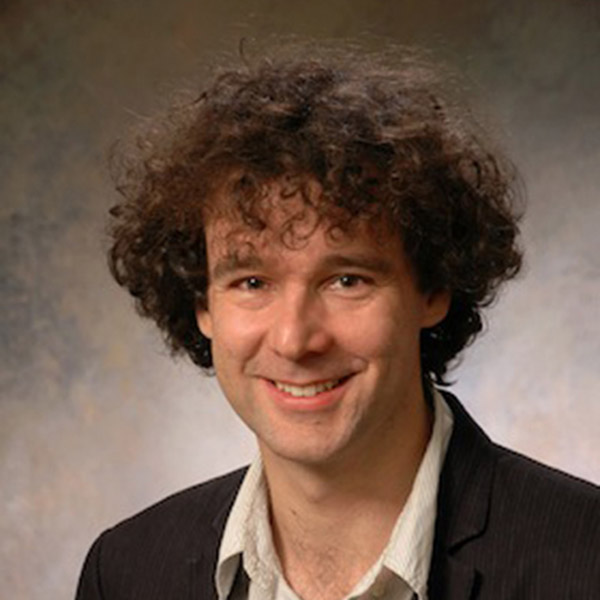
Risi Kondor is an Associate Professor in the Departments of Statistics and Computer Science at the University of Chicago. His research focuses on machine learning, group theory applications, and equivariant neural networks. He develops algorithms respecting geometric and physical symmetries, with contributions to graph learning, quantum mechanics modeling, and multiresolution matrix factorization. Key projects include the development of Covariant Compositional Networks (CCNs) for graph-structured data and N-body networks for molecular simulations. He has created software tools like GraphFlow, SnOB (FFT for symmetric groups), and Mondrian for high-performance computing. His work bridges algebraic methods (e.g., Fourier analysis on permutation groups) with machine learning, addressing challenges in multi-object tracking, computer vision, and materials science. Risi Kondor holds grants including a DARPA Young Faculty Award ($500K, 2016–2018) and NSF funding for non-commutative harmonic analysis in machine learning. His research emphasizes theoretical foundations and practical applications, advancing areas like equivariant architectures, multiscale analysis, and symmetry-aware machine learning systems.
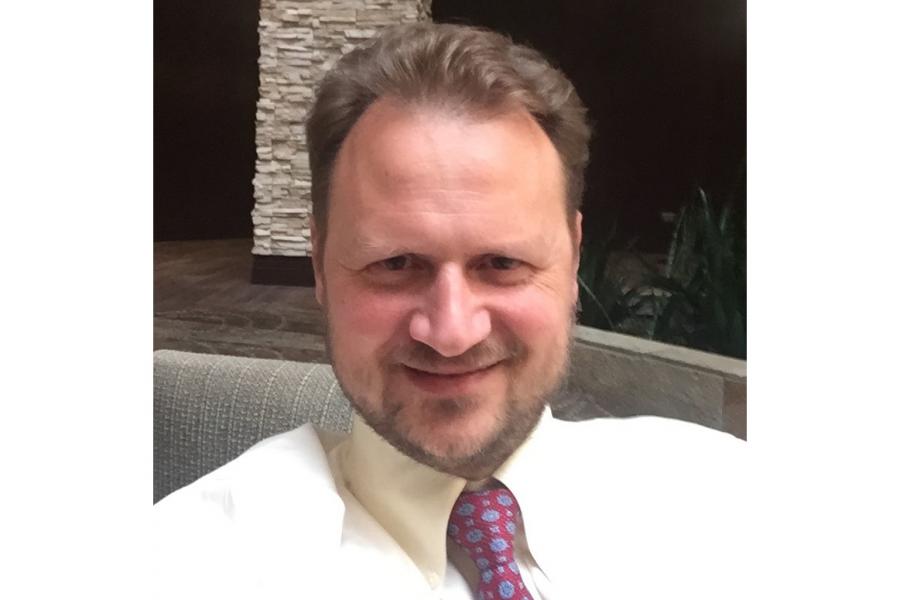
Dr. Vladimir Okhmatovski is a Full Professor in the Department of Electrical and Computer Engineering at the University of Manitoba, affiliated with the Price Faculty of Engineering. His research focuses on fast algorithms in electromagnetics, quantum computing, and high-performance computing. He holds a Ph.D. from the Moscow Power Engineering Institute and has held academic and industry roles globally. He has received prestigious awards including the 2017 Intel Outstanding Researcher Award. Education: Ph.D., Antennas and Microwave Circuits, Moscow Power Engineering Institute, 1997 M.S., Radiophysics and Electronics, Moscow Power Engineering Institute, 1996 Research Interests: Dr. Okhmatovski develops advanced computational methods for electromagnetics, including tensor train decompositions and quantum algorithms. His work addresses challenges in signal integrity, layered media analysis, and inverse scattering. He leads efforts in applying quantum computing to solve matrix equations and has pioneered fast direct solvers using H-matrices. Awards: 2017 Intel Outstanding Researcher Award 1996 Best Young Scientist Report (VI International Conference on Mathematical Methods in Electromagnetic Theory) 2007 Outstanding ACES Journal Paper Award Advising & Grants: He mentors students in climate change research through collaborations with the Centre for Earth Observation Science. His funded projects include quantum computing applications and Arctic sea ice remote sensing. He chairs technical committees for IEEE MTT-S and AP-S. Labs/Teams: His research group focuses on electromagnetic modeling, quantum algorithms, and layered media analysis. Collaborations include the Churchill Marine Observatory for Arctic studies.
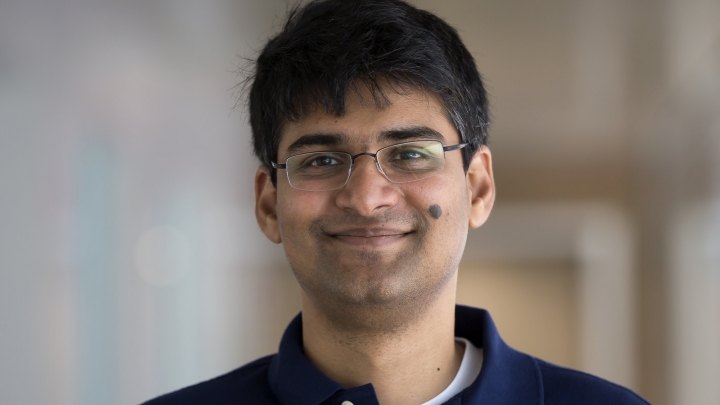
Joseph Landsberg is the Owen Professor and Professor in the Department of Mathematics at Texas A&M University , affiliated with the College of Arts & Sciences . His research focuses on Algebraic Geometry, Differential Geometry, and their applications to computational complexity, particularly matrix multiplication and tensor analysis. He has contributed to geometric complexity theory, secant varieties, and the study of symmetric tensors. Education: Ph.D., Mathematics, Duke University, 1990 Habilitation, Université de Toulouse, 1997 B.Sc. and M.Sc., Brown University, 1986 Research Interests: Landsberg explores the geometry of tensors, matrix multiplication algorithms, and complexity theory. His work bridges algebraic geometry, representation theory, and computational problems, with applications in quantum computing and cryptography. Recent studies include secant varieties, border rank analysis, and symmetry exploitation in tensor networks. Grants & Awards: AF: Small grants (2022, 2018) for complexity theory and matrix multiplication research Labs & Affiliations: Affiliated with the Institute for Applied Mathematics and Computational Science (IAMCS) at Texas A&M. His work intersects with interdisciplinary teams in computational mathematics and theoretical physics.
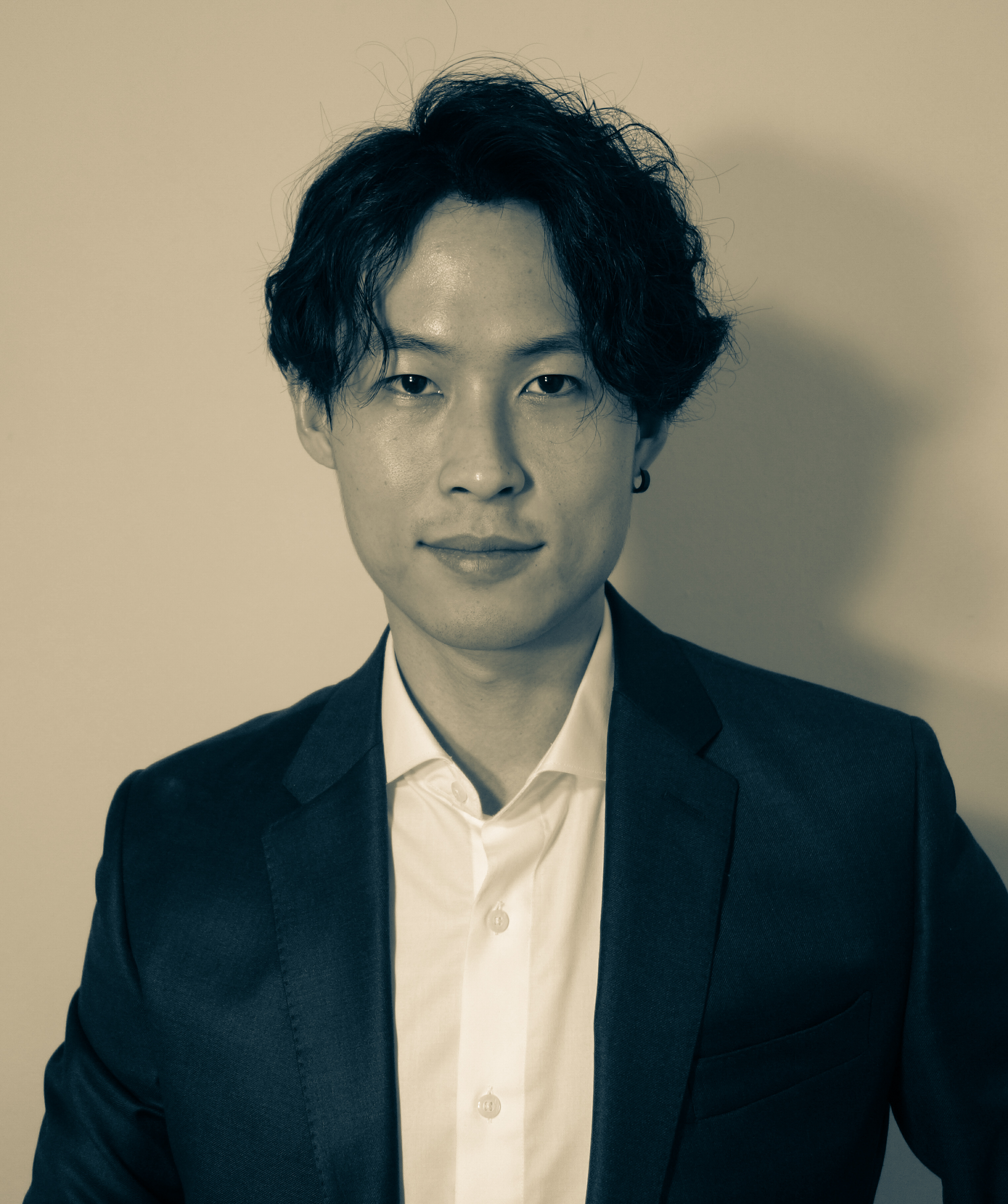
Vikram Gavini is a tenured professor at the University of Michigan's College of Engineering, holding joint appointments in the Departments of Mechanical Engineering and Materials Science and Engineering. He leads the Computational Materials Physics Group, focusing on quantum-mechanical simulations and multi-scale modeling of materials. Ph.D., Mechanical Engineering, Caltech (2007) M.S., Applied Mechanics, Caltech (2004) B.Tech., Mechanical Engineering, IIT Madras (2003) His research spans electronic structure calculations at macroscopic scales, quantum transport in materials, and high-performance computing (HPC) for density functional theory (DFT). Key areas include: Multi-scale modeling of materials defects Time-dependent DFT algorithms Tensor-structured numerical methods Exchange-correlation functional development Recent publications highlight advancements in: Quasicrystal stability analysis Machine learning for DFT functionals Exponential propagators for time integration GPU-accelerated DFT frameworks Scientific accolades include: 2023 ACM Gordon Bell Prize NSF CAREER Award (2011) Humboldt Research Fellowship (2012) AFOSR Young Investigator (2013) Gallagher Young Investigator Award (2015) Institute Silver Medal (2003) Allan Acosta Fellowship (2003) His group has produced influential open-source software like DFT-FE and trained numerous students now at institutions including Intel, LANL, and Stanford University.
Dr. Leron Borsten is a researcher at the University of Hertfordshire , affiliated with the School of Physics, Engineering and Computer Science and the Department of Physics, Astronomy and Mathematics. His work lies at the intersection of theoretical physics and mathematics, focusing on advanced structures in quantum field theory and gravity. Quantum Field Theory Quantum Gravity and Supergravity String Theory and M-Theory Higher Symmetries Homotopy Algebras Black Holes and Quantum Entanglement Quantum Measurement and Causality Causal Set Theory His recent publications emphasize homotopy algebras, gauge theories, and the double copy formalism. Studies on ambitwistor theories, AKSZ-Manin structures, and discrete symmetries advance the understanding of gravity as a gauge theory. His work also explores the interplay between quantum information and supergravity through topics like entanglement, causality, and Freudenthal dualities.
Petteri Kaski is an Associate Professor at the Department of Computer Science, School of Science, Aalto University , and a member of the Helsinki Institute for Information Technology (HIIT) . His research focuses on theoretical computer science, particularly in algorithm design, exact and parameterized algorithms, algebraic algorithms, and combinatorics. Doctoral Degree in Engineering and Technology, Helsinki University of Technology (2005) Licentiate Degree in Engineering and Technology, Helsinki University of Technology (2002) Master's Degree in Engineering and Technology, Helsinki University of Technology (2001) His recent work explores tensor scaling, Johnson-Lindenstrauss transforms, Hamiltonian cycles, and computational complexity, with contributions to polynomial-time algorithms, finite field computations, and combinatorial optimization. Notable awards include the Best Paper Award at ICALP 2017 , an ERC Starting Grant (2014) , and the Kirkman Medal (2007) . He has served on scientific committees for conferences like STACS 2025 and ICALP 2024 , and collaborated with institutions such as the IT University of Copenhagen and Universität Regensburg . Key Research Areas : Theoretical Computer Science, Algorithm Design, Exact Algorithms, Algebraic Computation, Graph Theory, Combinatorics
Sergey Samarin is a Senior Honorary Research Fellow at The University of Western Australia's School of Physics, Maths and Computing. His academic roles include teaching undergraduate courses on Solid State Physics and supervising postgraduate and honours students. He holds a Doctor Habil. Science from St. Petersburg State University, with thesis work on electron spectroscopy of surfaces. His research focuses on surface science, electron scattering dynamics, and quantum entanglement in electron pairs generated at solid surfaces. Key experimental techniques include spin-polarized two-electron spectroscopy and positron annihilation studies. Research interests span surface electronic structure, magnetic nanostructures, plasmon excitation, and spintronics. He has secured multiple ARC grants, including leadership roles in the ARC Centre of Excellence for Antimatter-Matter Studies ($7M). Notable achievements include first observations of radiative electron capture by surfaces (1992), plasmon-assisted inverse photoemission (1996), and spin-resolved (e,2e) experiments on ferromagnetic surfaces (1998). Current projects aim to explore electron entanglement via complete scattering experiments. Education: M.Sc. (1972), PhD (1976), Doctor Habil. (1995) - all from St. Petersburg State University Grants: Over $9M in ARC funding since 2001, including leadership roles in 6 major projects Supervision: Guided 17+ students through PhD, Master's, and undergraduate research projects Labs/Teams: CAMSP (Centre for Atomic, Molecular and Surface Physics) collaborator. Instrumentation expertise includes design of spin-polarized (e,2e) spectrometers and UHV systems. Languages: English, French, Russian (native).
Prof. Dr. Peter Sollich is a Professor of Theoretical Physics at Georg-August-Universität Göttingen, affiliated with the Institute for Theoretical Physics. His research spans non-equilibrium statistical physics with applications to soft matter, active systems, and complex networks. He maintains a small part-time appointment at King's College London. His primary research interests focus on non-equilibrium statistical physics , particularly soft and active matter rheology, jamming transitions, glassy dynamics, dynamical phase transitions, and inference from dynamical data. His work bridges theoretical physics with applications in materials science and network theory, emphasizing both fundamental mechanisms and quantitative modeling approaches. Analysis of his recent publications reveals strong thematic consistency in studying glassy dynamics and active matter systems , with increasing integration of machine learning techniques for network analysis. Key methodological threads include coarse-grained modeling, spectral analysis of complex systems, and non-equilibrium thermodynamics frameworks. His 2023-2025 work shows growing emphasis on nonreciprocal interactions in active mixtures and physics-inspired machine learning applications. Prof. Sollich actively supervises Bachelor's, Master's, and PhD students, welcoming thesis inquiries in theoretical physics. His group develops analytical and computational approaches to complex dynamical systems, with recent grants likely supporting work on network dynamics and active matter modeling (specific grants not detailed in source text). His research group operates within the Institute for Theoretical Physics at Göttingen, focusing on computational and analytical modeling of disordered systems. Current projects involve elastoplastic modeling of amorphous solids, spectral analysis of heterogeneous networks, and theoretical frameworks for active matter phase separation.
Hanbaek Lyu is an Assistant Professor in the Department of Mathematics at the University of Wisconsin-Madison, with an affiliation in the Department of Computer Science and membership in the Institute for Foundations of Data Science. His research spans discrete probability, matrix factorization, and machine learning, focusing on large discrete systems including interacting particle systems, networks, and structured random matrices. His educational background includes: Ph.D. in Mathematics, The Ohio State University (2018); Thesis: "Combinatorial and probabilistic aspects of coupled oscillators" (Advisor: David Sivakoff) B.S. in Mathematics, Seoul National University Lyu's research bridges theoretical probability and practical machine learning, with emphasis on optimization for dependent data and complex systems. His work develops foundational algorithms for matrix/tensor factorization while exploring synchronization phenomena in oscillator networks and phase transitions in particle systems. Recent publications highlight interpretable models for biological data and rigorous convergence guarantees for nonconvex optimization. Analysis of his 15 most recent publications reveals three dominant threads: (1) optimization theory for constrained nonconvex problems applied to dictionary learning, (2) interacting particle systems and random matrix theory with combinatorial aspects, and (3) interpretable latent models for network dynamics and genomics. His work consistently combines probabilistic methods with computational applications. Lyu leads two active NSF grants: DMS-2206296 (2022-2025): "Online Dictionary Learning for Dependent and Multimodal Data Samples: Convergence, Complexity, and Applications" DMS-2010035 (2020-2023): "Combinatorial and Probabilistic Approaches to Oscillator and Clock Synchronization" He currently mentors five doctoral students across Mathematics and Computer Science departments, organizes UW-Madison's probability seminar, and collaborates with over 30 researchers including Janko Gravner, Lionel Levine, and Wenpin Tang on interdisciplinary projects spanning genomics, network science, and statistical physics.
Prof. Dr. André Uschmajew is a full professor and holds the Chair of Mathematical Data Science at the Institute of Mathematics, Faculty of Mathematics, Natural Sciences, and Materials Engineering, University of Augsburg, Germany. He has held prominent research and academic positions at institutions including the Max Planck Institute for Mathematics in the Sciences (Leipzig), University of Bonn, and EPF Lausanne. 2022–present: Chair of Mathematical Data Science, University of Augsburg 2017–2022: Research Group Leader, Max Planck Institute MiS Leipzig 2014–2017: Bonn Junior Fellow Professorship, University of Bonn 2013: Ph.D. in Mathematics, TU Berlin His research centers on the theoretical and computational aspects of low-rank tensor and matrix approximations, with deep connections to Riemannian optimization, functional analysis, and high-dimensional scientific computing. He investigates the geometry of low-rank varieties, convergence of alternating algorithms, and applications in data science and dynamical systems. His work combines rigorous mathematical analysis with algorithmic innovation. The recent publications (2023–2025) reflect a strong focus on optimization methods for low-rank structures, dynamical low-rank approximation for PDEs like the Vlasov-Poisson equation, randomized SVD, Sinkhorn-type algorithms with overrelaxation, and Kronecker product operator approximation. Key themes include convergence analysis, algorithmic acceleration, and applications in scientific computing and signal processing. Although no specific awards are listed, his publication record in top-tier journals such as Numerische Mathematik , SIAM Journal on Optimization , and Foundations of Computational Mathematics indicates significant recognition in applied mathematics and numerical analysis. He advises students and researchers in mathematical data science and numerical analysis, though specific advisees are not named. He teaches courses such as Kernel Methods and Linear Algebra II. He has collaborated with leading researchers including Bart Vandereycken, Daniel Kressner, and Wolfgang Hackbusch. His work is supported through institutional affiliations and likely research grants, though specific grants are not listed. He is actively involved in the development of numerical methods for high-dimensional problems, particularly using tensor networks and manifold optimization. He is affiliated with research teams at the University of Augsburg and previously led a group at the Max Planck Institute MiS Leipzig, focusing on mathematical aspects of data science and tensor methods.
Chelsea Walton is a Professor in the Mathematics Department at Rice University. She received her B.S. from Michigan State University in 2005 and her Ph.D. from the University of Michigan in 2011. Her research is centered in Noncommutative Algebra, with particular focus on quantum symmetries of algebras and algebraic structures in categories. B.S. (2005) Michigan State University Ph.D. (2011) University of Michigan Professor Walton's research interests span multiple areas of algebra and category theory. She is particularly interested in noncommutative algebra, quantum symmetries of algebras, monoidal categories, Frobenius algebras, and Hopf algebras. Her work often bridges abstract algebraic structures with geometric and topological applications. Lately, her research has been centered on algebraic structures in categories, exploring how categorical frameworks can illuminate quantum symmetries. She is currently writing a three-volume book series on Algebraic Quantum Symmetry entitled "Symmetries of Algebras," with Volume 1 already published. Her extensive publication record demonstrates a consistent focus on developing the theoretical foundations of noncommutative algebra. The most recent articles reveal a deepening exploration of monoidal categories, Frobenius structures, and quantum symmetries, with increasing sophistication in the categorical frameworks employed. Her work shows strong connections between representation theory, quantum algebra, and topological quantum field theory, suggesting a unifying perspective on these seemingly disparate areas. Professor Walton has advised numerous students and maintains an active research group at Rice University. She has delivered several notable invited talks, including the NAM Claytor-Woodard Lecture at the 2021 Joint Mathematics Meetings titled "An Invitation to Noncommutative Algebra" and an MAA Invited Address at the same conference titled "Navigating Collaboration."
Joel Emer is Professor of the Practice in Electrical Engineering and Computer Science at MIT. His research focuses on computer architecture, VLSI design, hardware security, and AI acceleration. He has made significant contributions to performance analysis methodologies and hardware security techniques. Emer's recent work includes developing secure hardware for AI tasks, efficient acceleration methods for sparse tensor operations in large AI models, and novel cybersecurity protections at the hardware level. His research in computer architecture spans both theoretical frameworks and practical implementations, with emphasis on performance optimization and security vulnerabilities. His publications demonstrate consistent innovation in hardware design, with recent focus on AI accelerators, secure computation environments, and efficient processing of sparse data structures for machine learning applications.
Zhongyuan Lyu is a Research Fellow (Postdoctoral Research Scientist) at Columbia University's Data Science Institute, mentored by Professors Yuqi Gu and Kaizheng Wang. His research focuses on statistical methodology for latent structures in mixture models, graphical models, and tensor decompositions, with applications to heterogeneous data analysis. Prior to Columbia, he earned his PhD in Mathematics from the Hong Kong University of Science and Technology under Professor Dong Xia's supervision. His academic background includes advanced work in high-dimensional data analysis, latent variable modeling, and computational statistics. Research interests emphasize developing theoretically grounded algorithms for complex data types, particularly in network science and multilayer data frameworks. Recent publications highlight contributions to spectral clustering optimization, adaptive transfer learning frameworks, and tensor-based methodologies for higher-order networks. His work bridges statistical theory and practical applications, addressing computational limits and optimal estimation challenges in modern data science problems. No scientific awards or grants are explicitly mentioned in the provided data. His current position is full-time within the Data Science Institute's research team.
Aydın Buluç is a Senior Scientist at the Lawrence Berkeley National Lab (LBNL) in the Applied Mathematics and Computational Research Division and an Adjunct Professor in the Electrical Engineering and Computer Sciences (EECS) department at UC Berkeley. At LBNL, he leads the Performance and Algorithms group, and at UC Berkeley, he is part of the SLICE lab. He also serves as the Director of Sparsitute, a DOE Mathematical Multifaceted Integrated Capability Center (MMICC) focused on sparse computations. Dr. Buluç's research focuses on high-performance graph analysis, parallel sparse matrix computations, and communication-avoiding algorithms with applications in machine learning and computational genomics. His work bridges theoretical computer science with practical applications in scientific computing, particularly in bioinformatics and large-scale data analysis. He has made significant contributions to the development of parallel algorithms for sparse linear algebra operations, which form the foundation for many graph analytics frameworks. His recent publications demonstrate a strong trend toward optimizing sparse computations for modern hardware architectures, particularly GPUs and distributed systems. The research spans theoretical algorithm design, practical implementation challenges, and applications in computational biology. A notable pattern is the increasing focus on communication-avoiding techniques for distributed graph neural network training and large-scale genomic analysis. Dr. Buluç has been actively involved in numerous professional activities, serving on program committees for major conferences including EuroSys (2026), ALENEX (2019, 2026), SPAA (2025), and IPDPS (2013-2019, 2021-2022, 2025). He has also served on the SIAM George Pólya Prize for Mathematical Exposition Selection Committee (2025) and as Founding Associate Editor for ACM Transactions on Parallel Computing (2013-2020). He leads the PASSION Lab research group, which focuses on parallel algorithms and systems for irregular numerical workloads. The lab develops several important open-source software packages including Combinatorial BLAS, HipMCL, PASTIS, CAGNET, and BELLA. These tools address challenges in large-scale graph analysis, protein sequence alignment, and distributed machine learning.
Marek Kuś is a Full Professor at the Center for Theoretical Physics, Polish Academy of Sciences (PAS) in Warsaw, where he has held this position since 1995. He previously served as Full Professor at Cardinal Stefan Wyszyński University (2001-2012) and Director of the Center for Theoretical Physics, PAS (2003-2006). His international collaborations include visiting professorships in Germany, France, and the USA. Education: M.Sc. in Physics, Warsaw University (1979) Ph.D. in Physics, Warsaw University (1983) D.Sc. (Habilitation), Warsaw University (1988) Professor title conferred in 1995 His research spans quantum chaos, quantum information theory, and mathematical physics, with specialized interests in nonlinear phenomena, geometric methods, and quantum entanglement. Recent publications (2011-2015) focus on quantum correlations, entanglement detection frameworks, and symplectic geometry applications to quantum systems, reflecting sustained work in foundational quantum theory and complex systems. Scientific Awards and Leadership: Humboldt Fellowship (1987) President, Polish Society for Advancement of Arts and Sciences (2003-2005) Chairman, Scientific Council of National Center for Quantum Information (since 2008) Member, ERC Advanced Grants evaluation panel (2014) Editorial board member for International Journal of Quantum Information