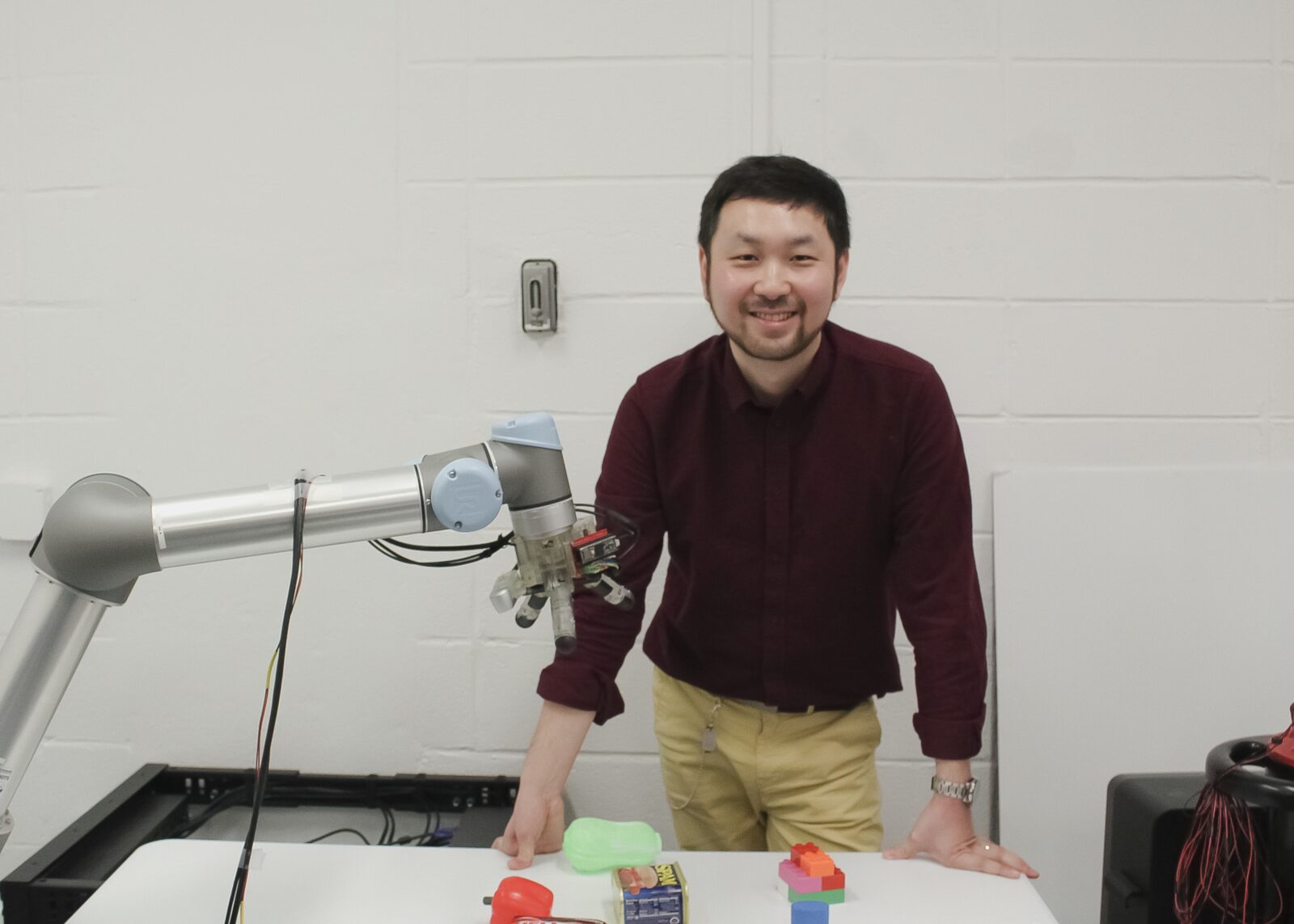
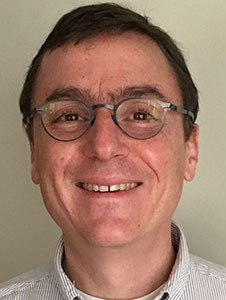
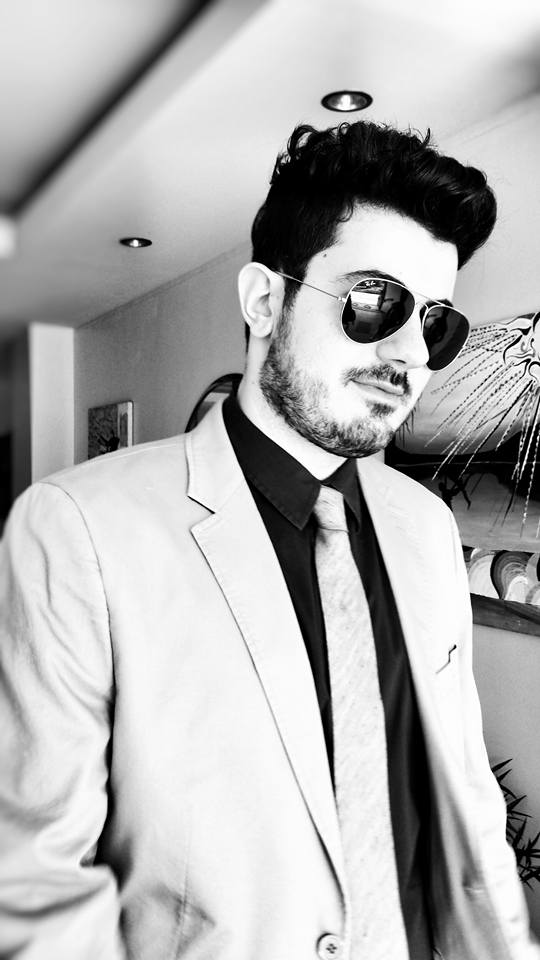
Professor Kaspar Althoefer is a Professor of Robotics Engineering at the School of Engineering and Materials Science , Queen Mary University of London. He leads the Centre for Advanced Robotics @ Queen Mary (ARQ) and serves as Programme Director for BEng/MEng Robotics Engineering. His research focuses on robot autonomy, soft robotics , and tactile sensing with applications in healthcare, nuclear engineering, and manufacturing. Research Highlights: Soft Robotics, Tactile Sensing, Haptic Perception, Minimally Invasive Surgery, Human-Robot Interaction Key Collaborations: St Thomas Hospital London, EU Horizon Europe, EPSRC, Innovate UK Accomplishments: £10M+ as Principal Investigator, 500+ peer-reviewed papers, 7 patent applications His work spans robot autonomy , soft robotics , and machine learning , particularly in modeling tool-environment interactions and developing tactile sensors for surgical and nuclear applications. Recent projects include intelligent endoscopic microsurgery robots and eversion robots for radiation mapping . Scientific Awards: Senior Member, IEEE He supervises a team of 6 PhD students and postdoctoral researchers, with completed projects in soft robotic gloves , pneumatic actuators , and eversion robot navigation .
Nabil Simaan is a Professor of Mechanical Engineering at Vanderbilt University with secondary appointments in Computer Science and Otolaryngology . He leads the Advanced Robotics and Mechanism Applications (ARMA) laboratory, focusing on surgical robotics, continuum robots, and intelligent human-robot interaction. Education : Ph.D., M.Sci., and B.S. in Mechanical Engineering from the Technion—Israel Institute of Technology . Postdoctoral Research at Johns Hopkins University NSF ERC-CISST (2003-2004). Research Interests : Medical robotics for minimally invasive procedures Kinematic modeling and optimization of parallel/continuum robots Telemanipulation and semi-autonomous control Flexible mechanisms and actuation redundancy Article Trends : His recent work emphasizes subretinal surgical robots, continuum manipulators for transurethral operations, and multi-scale dexterity through mathematical synthesis using screw theory and algebraic geometry. Scientific Awards : NSF Career Award (2009) for intelligent surgical robots IEEE Senior Member (2013) for contributions to robotics Advising & Grants : Advises PhD/MSc students in robotics and mechanism design. NIH-funded work on OCT-guided retinal surgery robots. NSF grants for continuum robot kinematics and redundancy control. Labs & Collaborations : Leads the ARMA Lab , bridging engineering and clinical medicine. Collaborates with Vanderbilt Institute for Surgery and Engineering (VISE) and industry partners like AURIS Surgical Robotics. Translational focus through Titan Medical Inc. partnerships.
Dr. Alexander Plopski is an Assistant Professor at the Institute of Visual Computing, Technische Universität Graz. His research focuses on advancing augmented reality (AR) technologies, human-computer interaction (HCI), and optical display systems. He holds a PhD, M.Sc., and BSc in relevant fields. His work emphasizes perceptual optimization in AR displays, eye tracking integration, and accessibility solutions for color vision deficiencies. Key research areas include gaze-contingent AR interfaces, light field manipulation for extended reality, and multimodal interaction techniques. Notable contributions include the development of the 'guitARhero' interactive AR guitar tutorial system and studies on focal distance effects in optical see-through displays. His publications span topics from AR display calibration to gesture recognition using radar sensing. He has explored applications in industrial training, medical AR, and robotic telemanipulation. His work often bridges theoretical perceptual studies with practical system implementations, aiming to enhance user experience and accessibility in AR/VR environments.
Thorsten A. Kern is Professor and Director of the Institute of Mechatronics in Mechanical Engineering at Hamburg University of Technology (TUHH). He joined TUHH in January 2019 after serving as R&D manager for interior components at Continental, leading a team of 300 engineers worldwide. From January 2023 to January 2025, he served as Dean of the Faculty of Mechanical Engineering, and is elected to serve as Vice President for Teaching and Learning from October 2025 to October 2028. Since 2022, he has been Vice President of the EuroHaptics Society. Dipl.-Ing. (2002), Darmstadt University of Technology Dr.-Ing. (2006), Darmstadt University of Technology Prof. Kern's research focuses on electromagnetic sensors and actuators, particularly their system integration in high-dynamic applications. His work spans human-machine interfaces, haptic devices, and the intersection of technology with arts. He has a strong interest in medical applications including robotic rehabilitation systems, wearable exoskeletons, and telemanipulation systems. His research also extends to maritime applications, including ship energy systems and ocean monitoring technologies. Prof. Kern's recent publications reveal a strong focus on haptic interfaces, rehabilitation robotics, and maritime energy systems. His work combines theoretical modeling with practical implementation, often involving interdisciplinary teams. There's a clear trajectory toward tele-rehabilitation systems with haptic feedback, maritime power systems optimization, and novel sensor development. His research demonstrates consistent integration of mechanical, electrical, and control engineering principles to solve complex real-world problems. Over 30 patent families with >120 patent applications worldwide Main editor of "Engineering Haptic Devices" (3rd edition) Vice President of EuroHaptics Society (since 2022) Prof. Kern shows a strong passion for entrepreneurship and mentors young people through the Impossible Founders network. He actively supports students in IP-oriented exploitation of research findings, leveraging his extensive patent experience. His research is supported by various projects in haptics, mechatronics, and rehabilitation engineering, with collaborations spanning academia and industry. Prof. Kern leads the Institute of Mechatronics in Mechanical Engineering (M-4) at TUHH, which houses specialized laboratories including the Haptics Lab, PHiLsLab (Power Hardware-in-the-Loop Laboratory), and Optics Lab (Goniometer Laboratory for Measuring Light Fields). His research team includes multiple research assistants and doctoral students working on electrical measuring systems, autonomous multi-sensor drifters, SMART Sensor Particles, and human-machine collaboration projects.
Péter Korondi is a Professor at the University of Debrecen in Hungary, affiliated with the Department of Electrical Engineering and Mechatronics . His work spans robotics, control theory, and industrial automation, with a focus on bio-inspired systems and human-robot interaction. Research Interests : Robotics, Mechatronics, Control Theory, Human-Robot Interaction, Industrial Automation, Sensor Fusion Recent Article Trends : Sliding mode control, friction compensation in micro-telemanipulation, path planning for mobile robots, smart industrial systems Collaborations : Co-authored works with Gabor Sziebig, Ferenc Tajti, Géza Szayer, and international researchers in IEEE Transactions , Sensors , and Acta Polytechnica Hungarica . Technological Focus : Development of rehabilitation devices, holonomic drive systems, and ethorobotics models inspired by animal behavior.
Jan B. van Erp is a Full Professor affiliated with the Digital Society Institute and Human Media Interaction, focusing on interdisciplinary research at the intersection of Human-Computer Interaction , Psychology , and Neuroergonomics . With over 145 research outputs and 22 academic activities, he explores topics like social presence , electrodermal activity , and telepresence systems . Key Research Areas: Human-AI collaboration frameworks Emotion and stress assessment methodologies Next-generation haptic interfaces Digital twin applications for human systems Recent publications analyze plant-based food perception (2025), bi-directional telemanipulation (2024), and cyber-physical humans (2024), reflecting his focus on immersive technologies and affective computing. His datasets include the HSPQ and EmojiGrid tools for social presence and emotion measurement. Scientific Awards: 2024 Honorable Mention Best Demo Award for electrotactile stimulation innovations
Prof. Massimo Mariani is a Professor and Head of Cardio-Thoracic Surgery at the University of Groningen, leading the Department of Cardio-Thoracic Surgery within the Faculty of Medical Sciences. He holds dual expertise in clinical practice and research, focusing on minimally invasive techniques, valve-sparing surgery, and aortic surgery innovations. His academic career spans prestigious institutions including Yale University, the University of Pisa, and TU Twente, with a PhD in Cardiovascular Physiopathology (1994). Education: Medical degree from the University of Pisa (1989, cum laude); specialized training at Yale-New Haven Hospital, the San Raffaele Institute in Milan, and the Thorax Center in Groningen. Board certifications include the European Board of Cardiovascular Surgery (1998) and the Netherlands Medical Specialist Registration Commission (2003). Research: Leads initiatives like the BiBo Project (pre-habilitation for cardiac surgery patients) and the PACE project (single-port LV lead delivery). Key interests include robotic surgery, surgical tool development, and heart failure management. Over 160 peer-reviewed publications and multiple awards highlight his contributions, including the 1993 De Gasperis-Donatelli Award and 1999 Outstanding Research Team Award. Grants & Industry: Holds grants from Abbott, Medtronic, and St. Jude Medical. Serves as a consultant for Artivion, Atricure, and CorCym, advancing medical device innovation. Teaching & Mentorship: Directed the School of Specialization in Cardio-Thoracic Surgery (2013-2014) and mentored students like C. Van De Wauwer (2014, lung transplantation research). Labs/Teams: Collaborates with TU Twente on telemanipulation platforms and mechanical valve design, emphasizing translational research between academia and industry.
L. Peternel is a Robotics researcher at Delft University of Technology's Faculty of Mechanical, Maritime and Materials Engineering, specializing in Human-Robot Interaction and Rehabilitation Robotics. With 56 research outputs including conference contributions, journal articles, and patents, Peternel leads cutting-edge work in impedance control, teleoperation, and collaborative robotics applications spanning medical rehabilitation, off-Earth habitat construction, and service robotics. Research focuses on developing advanced control frameworks enabling natural human-robot collaboration. Key areas include impedance-based teleoperation systems, human motor control-inspired co-manipulation strategies, and biomechanics-aware robotic physiotherapy. Recent work explores quadruped navigation, supermarket service robots with LLM interfaces, and off-Earth habitat construction systems that integrate computer vision with human-robot teamwork. Publications demonstrate strong emphasis on practical implementations with real-world impact across medical, industrial, and extraterrestrial environments. Article trends reveal consistent focus on physical human-robot interaction mechanisms, particularly impedance control methodologies and safety-critical applications. The research portfolio spans rehabilitation robotics (shoulder therapy systems), collaborative construction (off-Earth habitats), and service robotics (supermarket assistants), with increasing integration of AI and computer vision components in recent years. Best Paper Award at FICTA 2024 for Computer Vision- and Human-Robot Interaction-Supported Assembly Finalist Best Interactive Paper Award at Humanoids 2023 for robotic shoulder rehabilitation work Peternel leads the Rhizome project developing autonomous systems for off-Earth habitat construction and collaborates extensively across disciplines including biomechanics, computer science, and aerospace engineering. Media coverage including the Dutch press feature "Een robot als collega" highlights real-world impact of this research. Supervised work includes PhD candidates in robotics, with ongoing projects focusing on patient-centered rehabilitation systems and autonomous construction robotics for space applications.
Ignacio Avellino is a tenured Research Fellow (Chargé de Recherche) at CNRS, working in the Institute of Intelligent Systems and Robotics (ISIR) at Sorbonne-Université. His research focuses on Human-Computer Interaction (HCI) in healthcare, particularly surgical telementoring, remote collaboration (CSCW), and robotics. He holds a PhD from Paris-Saclay University (2017) under Michel Beaudouin-Lafon and conducted postdoctoral research at ISIR and UMBC. Education: PhD in HCI, Paris-Saclay University (2017) Postdoctoral Fellowships: ISIR (France) and UMBC (USA) Research Interests: His work bridges HCI with medical applications, emphasizing interaction design in surgical settings. Key areas include telementoring systems, telepresence tools for collaborative work, and robotic surgery interfaces. He explores challenges like gaze interpretation in hub-satellite collaboration and surgical video summarization for postoperative debriefing. Grants & Recognition: ISI Grant from IUIS (2020) Best Paper Honorable Mention at ACM CHI 2023 CHI Steering Committee member (Early Career Researcher) Advising & Grants: Supervises PhD/MSc students (e.g., Anastasiya Zakreuskaya, Nour Karoui) and manages grants like the IUIS-funded telementoring project. Collaborates on surgical cockpit systems to keep surgeons physically present during operations. Labs & Teams: Leads ISIR's healthcare systems group, focusing on surgical robotics and AR/VR applications. Active in collaborative projects like the Surgical Cockpit and Comanipulation for robotic tools.
Yildirim Hurmuzlu holds the dual distinguished professorships of Altshuler Distinguished Professor and University Distinguished Professor within the Department of Mechanical Engineering at Southern Methodist University. His primary affiliation is explicitly stated with his office located in Embrey 301C, confirming active faculty status in mechanical engineering research and instruction. His research interests focus on Robotics, Control Systems, and Dynamics and Vibrations, particularly examining rigid body collision mechanics, bipedal locomotion stability, and magnetic actuation for micro-scale robotics. Key specialties include impact dynamics in kinematic chains, nonlinear control of inverted pendulum systems, haptic interface design for medical applications, and aerospace robotics for space debris mitigation. This work bridges theoretical dynamics with practical implementations in robotic inspection systems and human digital twin technologies. Recent publications (2020-2025) reveal a strategic shift toward magnetic millirobotics for industrial inspection and modular assembly, while maintaining foundational work in impact dynamics. Aerospace applications now dominate new research strands, especially human digital twins for manufacturing quality assurance and tethered satellite control for space debris removal. Medical haptics remains a consistent theme with continued development of virtual palpation systems. Awards include: Altshuler Distinguished Professor University Distinguished Professor No student advising records or grant funding details were provided in the source material. His departmental affiliation confirms leadership in robotics and dynamics research without explicit mention of labs or teams, though his work implies substantial involvement in experimental robotic systems development through repeated references to design, control, and implementation.
Max Schäfer is a Researcher at the Institute of Medical Device Technology , Universität Stuttgart. His work focuses on medical robotics and haptic feedback systems for minimally invasive surgery, with a particular emphasis on cost-effective solutions and clinical workflow integration . PhD in Biomedical Engineering (Universität Stuttgart, 2024) Collaborates with international researchers Active at Hamlyn Symposium on Medical Robotics Research interests span surgical robotics , haptic user interfaces , and automated instrument handling . Publications demonstrate expertise in cable-driven mechanisms , soft robotics , and force measurement systems for telemanipulation. Key contributions include: 360° laparoscopic imaging systems Steerable flexible laparoscopes Granular jamming grippers for robotic scrub nurses Low-cost microscope modules Recent articles (2023-2025) highlight advancements in dynamic gripping force feedback , magnetic shape memory actuators , and pressure-modulated colonoscopy robots . Collaborators include Peter Pott, Sophie Weiland, and Jonas Hotz. No scientific awards or part-time status identified. Active in both theoretical modeling and prototype development for clinical applications.
Long Wang is an Assistant Professor in the Department of Mechanical Engineering at Stevens Institute of Technology, part of the Charles V. Schaefer, Jr. School of Engineering and Science. He holds a Ph.D. in Mechanical Engineering from Vanderbilt University (2018), an M.S. in Mechanical Engineering from Columbia University (2012), and a B.S. in Mechanical Engineering from Tsinghua University (2010). His research focuses on building robots and intelligent machines for challenging environments, with expertise in telemanipulation, kinematic modeling, continuum robots, and robotic hand designs. Dr. Wang leads the Advanced Robot Manipulators Laboratory, which investigates applications in minimally invasive surgery, search and rescue operations, and remotely assisted tasks. Key research areas include compliant manipulator designs, collaborative robotics, and human-in-the-loop teleoperation systems. His recent publications demonstrate a strong focus on continuum robots, underwater manipulation systems, and surgical robotics. Trends show innovative approaches to admittance control, modular designs for aerial and marine applications, and educational robotics initiatives. Courses taught include Robot Manipulators (ME 650), Introduction to Modern Control Engineering (ME 621), and Engineering Graphics (E 120).
Michael Gleicher is a Professor at the University of Wisconsin-Madison, holding primary affiliation in the Department of Mechanical Engineering and additional affiliation in the Department of Computer Sciences. His research focuses on Computer Graphics, Robotics, Data Visualization, and Human-Robot Interaction. He has contributed to projects such as Re-Cinematography for video stabilization and advanced telemanipulation systems. His work spans domains including motion editing, visualization techniques, and robotic control systems. Key themes include improving camera dynamics in casual videos, developing shared autonomy frameworks for teleoperation, and enhancing visual analytics for data exploration. Gleicher’s research integrates concepts from computer graphics, robotics, and human-computer interaction to create intuitive and effective systems. Recent articles highlight advancements in motion planning algorithms, collaborative robotics, and visual validation methods. He has explored topics such as end-effector trajectory tracking, parameter space analysis, and multimodal data integration for geospatial visualization. His work often emphasizes practical applications, such as improving robot teleoperation interfaces and enhancing user perception in data-driven tasks. Gleicher’s contributions include systems like RelaxedIK for robot motion synthesis and Boxer for classifier result comparison. His research has been published in top-tier venues, addressing challenges in both theoretical and applied domains of computer science and engineering.
Camilo Perez Quintero is a Research Fellow at the University of British Columbia's CARIS laboratory, specializing in Human-Robot Interaction systems. His current work includes developing augmented reality multimodal interfaces for aerospace manufacturing in collaboration with the German DLR and creating sidewalk navigation solutions for delivery robots through a Mitacs industry partnership. Education: Ph.D. in Computing Science, University of Alberta, Canada (2017) His research centers on communication mechanisms for human-robot collaboration, with expertise in augmented reality interfaces, haptic feedback systems, and gesture-based control. He excels at translating theoretical concepts into functional prototypes through multidisciplinary teamwork, focusing on mission-critical applications in manufacturing and urban environments where safety and intuitive interaction are paramount. Analysis of his 15 most recent publications (2017-2022) reveals consistent innovation in robot trajectory programming through multimodal interfaces, with significant contributions to safe human-robot collaboration in manufacturing via virtual barriers and pedestrian-aware navigation for sidewalk robots. His work bridges computer vision, robotics, and human-centered design, demonstrating particular strength in integrating tactile feedback with AR/VR systems for industrial applications. Grants and Programs: Mitacs Accelerate program developing HRI systems for sidewalk mobile robots with industrial partner German DLR collaboration on aerospace manufacturing interfaces He operates within UBC's CARIS laboratory, collaborating with mechanical engineering researchers and international partners to advance practical robotics solutions for real-world deployment in constrained environments.
Dr. Carlo Tiseo is an Assistant Professor in Engineering (Engineering and Design) at the School of Engineering and Informatics, University of Sussex, UK, where he has been faculty since October 2021. His research lies at the intersection of robotics, control systems, and computational neuroscience, with applications in medical and industrial domains. He previously held postdoctoral research positions at the University of Edinburgh and Nanyang Technological University. He earned his PhD in 2018 from Nanyang Technological University, Singapore, and both his Laurea (BSc) and Laurea Magistrale (MSc) in Biomedical Engineering from Università Campus Bio-Medico di Roma, Italy, in 2009 and 2012, respectively. He is a licensed professional engineer in Italy (since 2013). His research interests include: Human-robot interaction and collaboration Adaptive and bioinspired control systems Teleoperation and haptic feedback Legged and dexterous robotics Rehabilitation and assistive technologies Impedance and passive control frameworks His recent publications (2021–2024) reflect a strong focus on robust, safe, and dexterous robot control in uncertain environments. Key themes include fractal impedance control, dual-arm tele-cooperation, motion adaptation, and locomotion stability. His work combines theoretical control frameworks with practical implementation in medical and industrial robotics, emphasizing model-free and adaptive methods to enhance robustness. He has not received any named scientific awards or fellowships as per the provided information. Dr. Tiseo has been actively involved in teaching at the University of Sussex, delivering courses such as Mechanics of Mechanisms & Robots , Wearable Technologies , and Engineering Mechanics . He has collaborated with numerous researchers but no formal advisees are listed. He leads research in robot interaction control and is developing frameworks for safer, more adaptive robotic systems in unstructured environments. He is affiliated with research groups including TRL@Sussex and previously ECR@UoE and RRIS@NTU. His lab focuses on developing controllers for human-like robotic behavior, including projects on fractal impedance, locomotion planning, and multi-contact teleoperation.