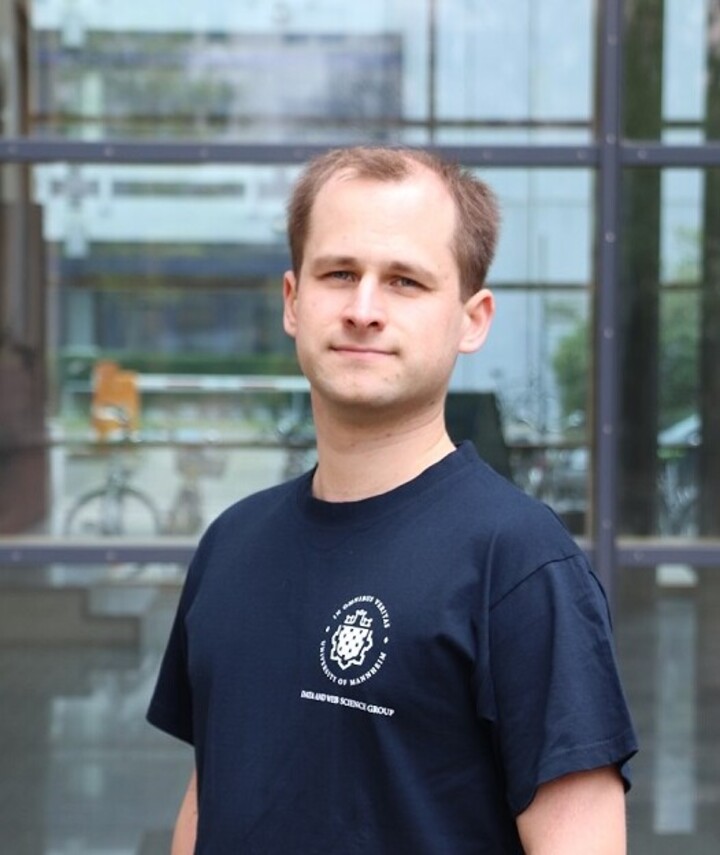
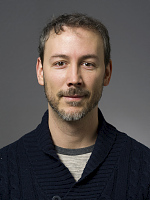
Dr. Sven Hertling is a Substitute Professor for Data Science at the University of Mannheim, affiliated with the Data and Web Science Group. His research focuses on Knowledge Graph Generation, Ontology Matching, and Knowledge Graph Fusion. He teaches courses such as Knowledge Graphs, Data Mining, and Database Technologies. Notable awards include the Best Demo at ESWC 2021 and Best Paper at the Knowledge Graphs and Semantic Web Conference (KGSWC) 2022. Education: PhD in Computer Science (implied by role). His research interests span ontology alignment, large language model integration, and scalable knowledge graph systems. Recent work includes frameworks like KGrEaT for knowledge graph evaluation and tools like MELT for ontology matching analysis. He has contributed to over 50 publications, with a focus on ontology alignment evaluation (OAEI) and semantic web technologies. Key projects include the Software Campus initiative's GUI search engine and DBkWik, integrating knowledge from thousands of Wikis. Grants: €100,000 from Software Campus for the SuGraBo project. Advising: Coordinates OAEI challenges and chairs ESWC 2023. He actively serves on program committees for ISWC, ESWC, and other conferences, emphasizing community engagement in semantic web research.
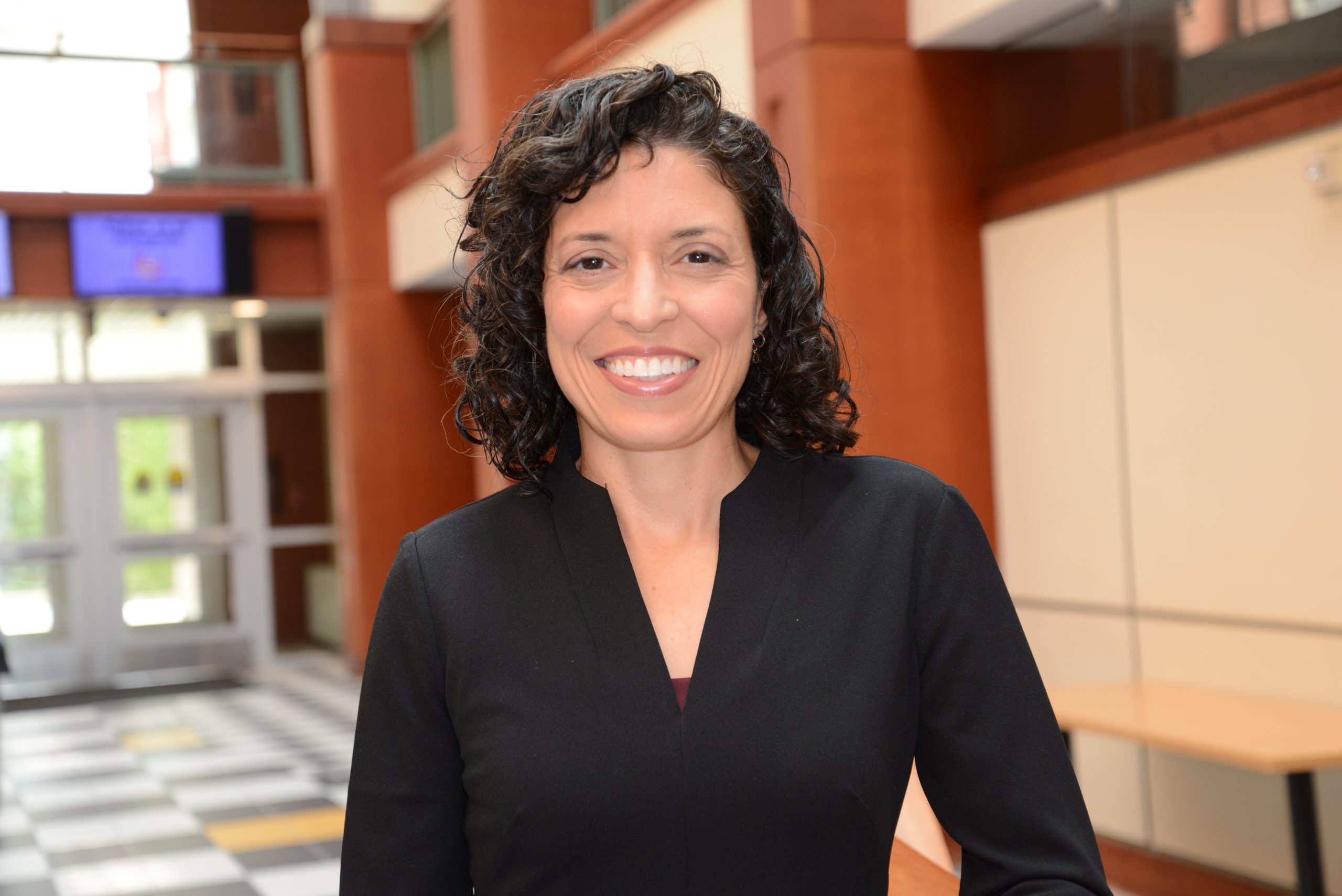
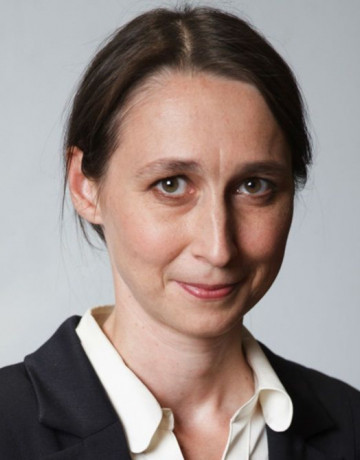
Tutita Casa is an Associate Professor of Elementary Mathematics Education in the Department of Curriculum and Instruction at the University of Connecticut's School of Education. Her work focuses on transforming mathematics education through mathematical discourse, particularly how writing and talk can empower students to engage with mathematics as mathematicians do rather than simply following step-by-step procedures. Dr. Casa's research expertise spans Mathematical Discourse (Writing and Talk), Mathematics Education, Elementary Education, Teacher Education, and Curriculum Studies. She challenges traditional mathematics instruction by developing frameworks like the Student Mathematician Discourse Model that support students' mathematical communication through writing. Her current work focuses on developing and researching written discourse approaches that use writing to leverage mathematics learning, addressing how elementary teachers can guide students to "write mathematically" rather than merely "write about math." Dr. Casa has directed significant research projects including an NSF-funded Elementary Mathematical Writing Task Force that produced recommendations about types and purposes for mathematical writing in elementary grades, and served as Co-Principal Investigator for Project M^2: Mentoring Young Mathematicians, which developed challenging geometry and measurement units for kindergarten through Grade 2 students. National Association for Gifted Children (NAGC) Curriculum Studies Award (2005-2012, 2017) "Connecting Class Talk with Individual Student Writing" recognized as favorite contribution by Teaching Children Mathematics' Editorial Board 2009 Gifted Child Quarterly Paper of the Year Award She has secured multiple major research grants including NSF projects focused on mathematical writing, teacher preparation, and challenging curriculum for elementary students. Dr. Casa has held significant leadership roles including Journal for Research in Mathematics Education Editorial Panel Chair (2023-2024) and National Council of Teachers of Mathematics Conference Program Committees. Her work continues to shape how educators implement mathematical discourse practices that develop students' reasoning and communication skills.
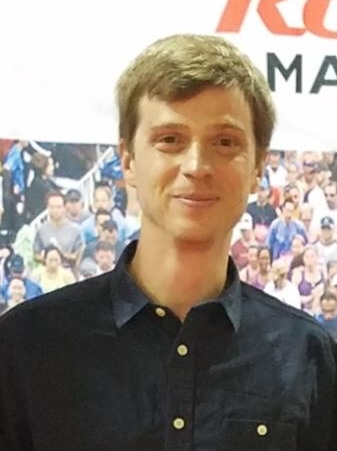
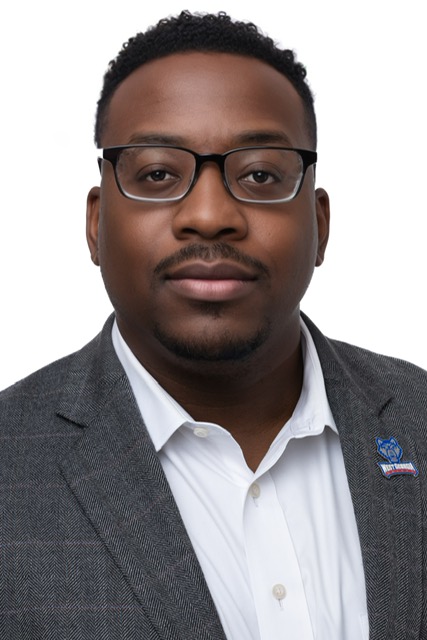
Anthony Becker is an Associate Professor in the English Department at Colorado State University, specializing in TEFL/TESL graduate education and undergraduate Linguistics. He coordinates workshops for the Programs for Learning Academic and Community English (PLACE) and teaches courses in second language assessment, research methods, and corpus linguistics. His research focuses on L2 assessment methodologies, corpus-based linguistic analysis, and English for specific academic purposes. Becker holds a Ph.D. and M.A. in Applied Linguistics from Northern Arizona University and Georgia State University, respectively, and a B.A. in Psychology from Millersville University. His teaching emphasizes inclusive pedagogy, with a commitment to diversity in race, gender, and academic background. Current research explores lexico-grammatical features in advanced L2 writing and phrasal complexity across linguistic backgrounds. He has published extensively on assessment frameworks, ESP curriculum design, and L2 vocabulary instruction in journals like Assessing Writing and International Journal of Corpus Linguistics . Becker coordinates the E601 TEFL/TESL research methods course, emphasizing hands-on classroom-based research in language education. His work integrates project-based learning strategies into ESP contexts, particularly for engineering students. He actively contributes to the CSU academic community through service and outreach initiatives.
Edoardo S. Biagioni is an Associate Professor at the University of Hawaii in the Department of Information and Computer Sciences , where he has been since 1997. His primary research focuses on decentralized networking , wireless security , and systems programming , with long-term projects including the Allnet project (since 2011) and earlier PODS micro-sensor networks (2000-2003). Current research since 2024 includes formal verification of file systems and correctness properties in systems programming Technical interests span protocol decomposition , language-based OS design , and congestion control Teaching emphasizes Java fluency , data structures , and algorithm complexity in courses like ICS 211 Prior roles included directing the Advanced Network Computing Laboratory (1997-2005) and contributions to the Fedora Core project. Students under his supervision have worked on projects ranging from network measurement to ATM transport protocols . His work bridges theoretical concerns like IP fragmentation theory with practical implementations in SML database systems and IPv6 transitions .
B. Kumaravadivelu serves as Professor in the Department of Linguistics and Language Development within San José State University's College of Humanities and the Arts, where he has significantly influenced language education through innovative pedagogical frameworks. His academic foundation includes a Doctor of Philosophy from Michigan State University (1986). Research focuses on transformative approaches to language instruction: Applied Linguistics Second Language Acquisition Postmethod Pedagogy Development Critical Classroom Discourse Teacher Education Models Leveraging Cultural-Linguistic Diversity Publication analysis (1992-2002) reveals pioneering work establishing 'macrostrategies' and the 'postmethod condition'—rejecting rigid teaching methodologies in favor of context-responsive frameworks. His scholarship consistently addresses classroom diversity utilization, peer evaluation systems, and communicative learning optimization, culminating in the seminal 2002 book 'Beyond Methods'. No scientific awards were documented in the source materials. Information regarding student mentorship, research funding, or laboratory affiliations was not provided in the available text.
Henriette W Langdon is a Professor in the Department of Communicative Disorders and Sciences at San José State University (SJSU), part of the College of Education. With over 40 years of experience, she specializes in working with bilingual children with speech and language disorders, emphasizing cultural and linguistic diversity in clinical practice. Her career includes full-time faculty service since 1997 and part-time roles prior to that. She holds licenses in Speech Pathology and credentials from the California State Department of Education. Education: She earned a B.S. in Chemistry, Pharmacy, and Biology from Universidad Nacional Autónoma de México (UNAM). Later, she obtained an Ed.M. in Foreign Languages from Tufts University and an Ed.D. in Special Education and Psycholinguistics from Boston University. Research Interests: Dr. Langdon’s work centers on bilingualism’s impact on speech-language development, assessment methodologies for non-English speakers, and effective collaboration with interpreters/translator in healthcare and education. She co-authored a revised edition of Working with Interpreters and Translators (2015), a seminal guide for professionals in speech-language pathology and audiology, and designed courses like Speech and Language Development in a Cross-Cultural Society and Providing Services in Spanish to Clients . Awards: Recognized as a Diversity Champion by ASHA (2009), she has also received multiple accolades including Fellowships from both ASHA (2001) and CSHA (1997), plus CSHA’s Diversity Award (1998) and Outstanding Service Award (2011). Her contributions emphasize equity in service provision for multilingual populations. Teaching & Grants: She has taught numerous courses including Student Teaching , Advanced Assessment , and Clinical Supervision . Courses like EDSP 268 were specifically designed for students under SJSU’s Horizonte, Arco Iris, and Cascades Diversity grants. Her clinical practice includes providing services in Spanish, French, and Polish. Labs/Teams: Collaborates with Terry Irvine Saenz on book revisions and co-authored works. Active in developing testing tools such as the SPELT-3 Spanish Edition and W-ABC Spanish Edition, which address cultural and linguistic assessment needs in multilingual contexts.
Dr. Hossein Nassaji is a Professor of Applied Linguistics in the Department of Linguistics at the University of Victoria, Canada. His research focuses on second language acquisition, corrective feedback, form-focused instruction, and sociocultural theories in language learning. He has authored or co-authored numerous books and articles in leading journals such as Applied Linguistics , Language Learning , and TESOL Quarterly . He currently serves as Co-Editor of Language Teaching Research and Editor of the Grammar Teaching Volume in the TESOL Encyclopedia of English Language Teaching . His research emphasizes the role of interactional feedback in instructed SLA, integrating experimental and qualitative methods. Key awards include the 2012 Humanities Award for Research Excellence and the Kenneth W. Mildenberger Prize. His editorial work includes special issues on form-focused interaction and current advances in instructed SLA, reflecting his commitment to advancing SLA pedagogy.
Raili Hilden is a full professor in language didactics (foreign languages) at the University of Helsinki's Department of Education, Faculty of Educational Sciences. Her core activities include research, teaching, and societal impact with a focus on language assessment, particularly in high-stakes testing contexts. She leads research projects like AASIS (Automatic assessment of spoken interaction in second language) and DigiTala, exploring automated assessment tools for speaking proficiency. She chairs the Finnish National Matriculation Examination Board's Swedish section and contributes to national curriculum development. Research Interests : Language assessment methodologies, teacher assessment literacy, educational equity in language education, and the integration of technology in language testing. Current projects emphasize automated scoring systems and multimodal assessment formats. Key Contributions : Directed national evaluations of language learning outcomes (2012-2014), developed grading criteria for Finnish national curricula, and pioneered computer-based language testing innovations. Her work bridges educational policy, technology, and pedagogical practice. Awards : Recipient of top honors including Vuoden kieltenopettaja 2003, Kulturfonden Språkpriset 2004, and The FIPLV International Award 2005. Active in international conferences and serves on boards like the Finnish Matriculation Examination Board. Grants/Projects : Multiple Academy of Finland grants (AASIS: 2023-2027; DigiTala: 2025-2026), DD-LANG (2022-2026) focusing on diagnostic language assessment innovations. Labs/Teams : Leads multidisciplinary teams combining linguistics, computer science, and educational research to advance automated assessment technologies. Collaborates with Scandinavian institutions on teacher assessment literacy initiatives.
Jeremy Barnes is an Assistant Professor in the IXA Group at the University of the Basque Country (UPV/EHU), part of the HiTZ Centre. He holds a PhD in Computational Linguistics and has extensive postdoctoral experience at the University of Oslo. His research focuses on cross-lingual methods, sentiment/emotion analysis, weak supervision, and under-resourced language resources. He has contributed to projects like NorDial and NorLM, developing tools like skweak. Barnes teaches courses in computational syntax, text mining, and NLP. Education: PhD (Pompeu Fabra University), M.A. and B.A. in Linguistics Key Projects: LUMINOUS (multimodal LLMs), SANT (Norwegian sentiment analysis) His work spans structured sentiment analysis, cross-lingual transfer learning, and dialectal feature identification. He has received awards for his book Sonic Ethnography (2021) and photography (2020). Barnes advises numerous Master's theses and collaborates internationally on NLP challenges.
Denilson Barbosa is a Professor of Computing Science at the University of Alberta's Faculty of Science. He holds a PhD and specializes in Natural Language Processing, Information Retrieval, and Machine Learning. His research focuses on knowledge extraction, entity recognition, and knowledge graph construction. Barbosa teaches courses like CMPUT361 (Information Retrieval) and CMPUT656 (Knowledge Graphs). He served as President of the Canadian Artificial Intelligence Association (CAIAC) from 2023 to 2024. His work includes developing tools like the NLP Workbench and contributing to open relation extraction, Wikipedia analysis, and low-resource language models. Education and Background: Barbosa's academic background aligns with his research interests in computational linguistics and AI applications. His teaching emphasizes practical skills in algorithms, data structures, and machine learning for text processing. Research Highlights: Barbosa's research spans semantic graphs, probabilistic language models, and defect prediction systems. He explores challenges in multilingual NLP, particularly for Indigenous and low-resource languages like Cree. His work often integrates machine learning with traditional IR methods to improve system efficiency and accuracy. Recent Contributions: Notable recent projects include improving Bengali/Hindi LLMs, evaluating QA systems via textual entailment, and developing Bayesian methods for crowdsourced truth discovery. His articles reflect his interdisciplinary approach, combining theory with real-world applications in education, software engineering, and social media analysis.
Pilvi Heinonen is a University Lecturer at the Department of Education, University of Helsinki, within the Faculty of Educational Sciences. She holds a Docent title in the Department of Languages. Her research focuses on educational interaction, particularly tactile communication in pedagogical contexts, discourse analysis in teaching, and multidisciplinary coherence in teacher education. She has participated in multiple research projects, including the Koskettava koulu (Touchable School) initiative exploring embodied interaction in education and the DICIA project studying digital customer interactions. Heinonen’s work emphasizes the role of physical touch and nonverbal communication in educational settings, examining how tactile actions contribute to classroom dynamics and student engagement. She has contributed to publications discussing differentiated instruction, pedagogical frameworks, and the integration of visual and metaphorical tools in teacher training. Her research also extends to sales negotiation discourse analysis and the application of qualitative methods in educational research. She has actively engaged in academic activities, organizing conferences like the Keskusteluntutkimuksen päivät 2020 , and presenting at international forums such as the International Conference on Conversation Analysis . Heinonen’s collaborative projects include studying the Finnish Centre of Excellence in Research on Intersubjectivity in Interaction, highlighting her commitment to interdisciplinary approaches in education.
Dr. Neil Kirk is a Reader in Cognitive and MIND Psychology and Senior Lecturer at Abertay University's Department of Sociological and Psychological Sciences, part of the Faculty of Social and Applied Sciences. He holds Chartered Psychologist status with the British Psychological Society (BPS). Before joining Abertay in 2016, he worked in research roles at the Medical Research Council and Scottish Government. Teaching: He teaches modules such as Evidence-Based Thinking, Psychology Mythbusters (Module Leader), Research Methods, and Advanced Social and Cognitive Psychology. He supervises Psychology Honours Project students. Research: Neil’s primary focus is bidialectalism’s cognitive mechanisms, exploring how speakers of Scottish English and Dundonian Scots exhibit bilingual-like effects. His work bridges linguistics and psychology, examining dialects’ role in social perception and language control. Notable studies include dialect switching costs and the cognitive effects of language mixing. Publications and Outreach: Over 22 peer-reviewed articles span 2012–2025, addressing topics like self-associated voice prioritization and language control in dialect speakers. His research has been featured in the Financial Times, BBC, and Aeon Magazine. He actively promotes science through festivals (Edinburgh Science Festival, Big Bang Science Festival) and authored articles for GIST magazine. Awards and Grants: Awards include the Leverhulme Trust PhD Studentship (2012–2015) and the Alexander D G Kydd Memorial Prize (2010). He has secured grants totaling £68,000+ for research projects. Labs and Teams: Collaborates on interdisciplinary projects, including studies on human-AI voice perception and cognitive effects of sports concussions. His work integrates behavioral experiments with sociolinguistic analysis.
Maria Falikman is a Teaching Professor of Psychology at HSE University in Moscow, Russia, and former Head of the School of Psychology there. She holds a Ph.D. and Dr. Habil from Lomonosov Moscow State University. Her research focuses on visual attention, cultural evolution, and digital transformations of the human mind, with contributions to cognitive psychology, psycholinguistics, and joint attention mechanisms. Falikman has authored the Psychology of Attention handbook and co-edited multiple Russian psychology readers. She has been a Visiting Scholar at Harvard University and the University of Groningen. Education: B.Sc., M.Sc., Ph.D., Lomonosov Moscow State University (Russia); Dr. Habil Her work bridges cognitive science and cultural-historical theory, exploring topics like meditation's effects on attention, predictive coding principles, and the mind-body problem. She has contributed to popular science via 30+ web lectures for Postnauka/Serious Science and appeared in documentaries on the human brain and cognitive robotics. Falikman is also a PEN International member and award-winning literary translator, having translated works of British and American authors and published poetry collections. Her recent research trends emphasize digital mediation's impact on cognition, cultural evolution, and interdisciplinary dialogues between psychology and neuroarchaeology. Key themes include gaze cueing mechanisms, attention allocation strategies, and the role of cultural tools in cognitive development. Awards: Russian National Psychological Award (2013, 2020); HSE Best Teacher Award (2019–2021) Falikman advises on autism interventions through joint attention studies and explores existential neuropsychology. She leads initiatives in neuroplasticity and acculturation mechanisms, integrating Vygotskian theory with modern digital contexts.
Morris Council III serves as an Associate Professor in the Department of Special Education within the College of Education at the University of West Georgia. His academic career centers on advancing equity and access for culturally and linguistically diverse (CLD) learners with high incidence disabilities through evidence-based research, transformative teaching, and community-engaged scholarship. His educational foundation includes a PhD in Special Education earned in 2016 from The Ohio State University, where his doctoral work established the framework for his ongoing research agenda focused on instructional interventions for diverse learners with disabilities. Dr. Council's research program critically examines how culturally responsive pedagogy intersects with evidence-based practices to improve academic outcomes, particularly in literacy and behavior domains. His work consistently addresses systemic barriers in urban educational settings through technology-enhanced interventions , social justice frameworks , and behavior-analytic approaches . Key themes include culturally relevant repeated reading , computer-assisted literacy instruction , and equity-focused special education law implementation , with particular attention to students at the intersection of disability, race, and language diversity. Analysis of his publication record reveals sustained focus on literacy development for CLD learners with disabilities, with recent scholarship (2024) pioneering the integration of science of reading principles with social justice imperatives. His work demonstrates consistent methodological rigor across urban elementary settings , technology-mediated interventions , and culturally sustaining pedagogies , while expanding into writing identity development and postsecondary transition for marginalized student populations. As an educator, Dr. Council teaches foundational and advanced courses including Special Education Law (SPED-7729), Dyslexia Methods (SPED-6500), Multiculturalism in Special Education (SPED-8704), and Research Seminar (SPED-8784). His teaching portfolio spans undergraduate practicum supervision (SPED-3750) through doctoral comprehensive examinations (SPED-8795), with documented instruction through Fall 2025 semesters across multiple modalities including online and hybrid formats. Though dedicated laboratory facilities aren't referenced in source materials, his collaborative research network spans multiple institutions including The Ohio State University and colleagues like Gardner III and Cartledge. His scholarly impact manifests through curriculum development for urban special education programs and ongoing mentorship of graduate students in research design and implementation within complex educational ecosystems.
Gim Hee Lee is an Associate Professor at the Department of Computer Science, National University of Singapore (NUS) School of Computing. He heads the Computer Vision and Robotic Perception (CVRP) Laboratory and holds affiliations with the NUS Graduate School for Integrative Sciences and Engineering (NGS) and the NUS Institute of Data Science (IDS). Previously, he was a researcher at Mitsubishi Electric Research Laboratories (MERL) in the USA and worked at DSO National Laboratories in Singapore. Education Dr.sc. in Computer Science from ETH Zurich M.Eng. in Mechanical Engineering from National University of Singapore B.Eng. in Mechanical Engineering (1st Class Honors) from National University of Singapore Research Interests Professor Lee's research focuses on Computer Vision , Robotic Perception , and Machine Learning , with specialization in dynamic 3D scene reconstruction, event camera applications, and cross-view geo-localization. His work bridges theoretical advances with real-world applications in autonomous systems and augmented reality, particularly through neural scene representations and geometric computer vision techniques. Scientific Awards Faculty Teaching Excellence Award (AY 2018/19 and AY 2017/18) CVPR 2014 Doctoral Consortium Travel Award Finalist for IROS 2012 Best Paper Award Finalist for IROS 2012 Best Video Award Advising and Service Professor Lee serves as Associate Editor for IJCV and has held Area Chair positions for major conferences including CVPR, ICCV, ECCV, and NeurIPS. He chaired Program Committees for 3DV 2022 and served as Demo Chair for CVPR 2023. His research on the Cross-View Matching Network (CVM-Net) demonstrated real-time ground-to-aerial geo-localization in moving vehicles, establishing a benchmark for subsequent research in this field. Laboratories He leads the Computer Vision and Robotic Perception (CVRP) Laboratory at NUS, which develops cutting-edge solutions for 3D scene understanding, event-based vision, and robotic navigation. The lab's work includes acquiring high-quality datasets for dynamic scene reconstruction and advancing neural representations for real-world applications.